The FIA World Endurance Championship stands as the top tier of modern endurance racing, where factory teams and private entrants compete across six- to 24-hour events. Its current shape reflects a long technical evolution, from LMP-era prototypes to the Hypercar formula and LMGT3. The series uses a distinct points system, including Le Mans, and its weekend format rewards consistency as much as outright pace. What changed to make this structure possible is less straightforward.
What Is the FIA World Endurance Championship?
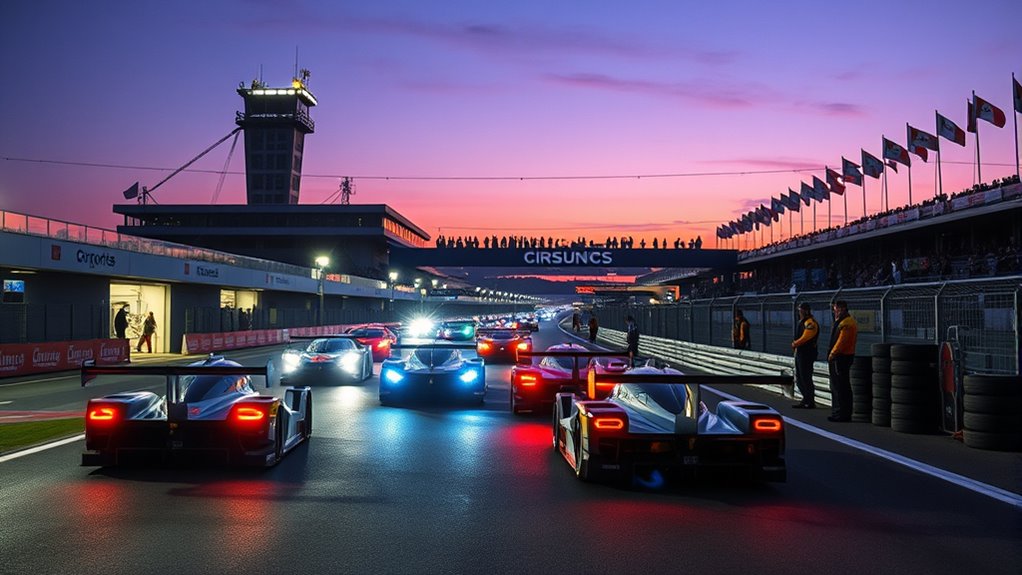
Established in 2012 by the FIA and the Automobile Club de l’Ouest (ACO), the FIA World Endurance Championship (WEC) is a global endurance racing series built around events lasting from six to 24 hours.
The FIA World Endurance Championship organizes multi-class competition, with the Hypercar class for purpose-built prototypes and LM GT3 scheduled to expand the grid in 2024. Its format rewards consistency, mechanical efficiency, and strategic execution across long-distance contests.
Hypercar and LM GT3 frame a multi-class test where consistency, efficiency, and strategy define endurance success.
Points are distributed on a sliding scale to the top ten finishers, with longer races carrying greater value and the 24 Hours of Le Mans awarding double points.
The championship also functions as a platform for manufacturers, with 14 expected in 2026, including Toyota, Ferrari, and BMW.
Regulation development emphasizes sustainability, hybrid technology, and broader technical relevance, aligning performance with reduced environmental impact.
For audiences seeking liberation through advanced competition, the WEC represents regulated speed, open contest, and durable innovation.
How WEC History Led to Hypercar
The FIA World Endurance Championship, which began in 2012 from the Intercontinental Le Mans Cup, gradually moved toward a new prototype formula as manufacturer interest in LMP1 declined and the series prioritized sustainability and hybrid technology.
This shift redefined top-level endurance at Le Mans and across each FIA WEC season. The LMP1 class, once the technical benchmark, became harder to sustain as costs rose and entries narrowed.
Regulators responded with the Hypercar concept, first introduced in 2021 through Le Mans Hypercar rules and later expanded to include LMDh. The result was a controlled balance between performance and affordability, designed to keep manufacturers engaged while preserving technical relevance.
In 2025, seven winners in eight Hypercar races signaled strong parity and competitive freedom. The new formula aligned endurance racing with practical engineering, reduced escalation, and broader participation.
Hypercar consequently emerged not as a break from WEC history, but as its calculated continuation.
How WEC Race Weekends Work
WEC race weekends usually begin with multiple free practice sessions, giving teams time to test setups and make adjustments before qualifying.
Qualifying is organized by class, with a 12-minute session leading to Hyperpole for the top ten competitors in each eligible category.
Race day then features endurance events ranging from six to 24 hours, with strategy shaped by driver stints, class regulations, and the points awarded for finishing position and race length.
Practice And Qualifying
Practice sessions give teams multiple opportunities to test setups, refine balance, and adapt cars to track conditions before qualifying begins. In FIA WEC, practice serves the practical needs of drivers and engineers seeking efficiency and control across the race weekend.
Qualifying is then split by class, with each 12-minute run setting grid positions under direct competition.
- Each class receives its own qualifying block.
- The fastest driver in each class scores championship points.
- The top ten advance to Hyperpole for pole position.
This structure keeps the championship open while rewarding precision in every race. The format is compact, measured, and technically demanding, giving entrants little margin for error and strong incentive to extract speed without losing balance.
Hyperpole And Race Day
After practice and qualifying, the weekend turns to Hyperpole and race execution, where the fastest entries in Hypercar and LMGT3 fight through 12-minute qualifying blocks and a 10-minute shootout for pole position, which carries an additional championship point. | Stage | Key detail |
| — | — |
|---|---|
| Qualifying | 12 minutes per class |
| Hyperpole | Top ten shootout |
| Pole | Extra point |
| Race day | 6-24 hours |
| Strategy | Stints, fuel, changes |
On race day, endurance demands disciplined driver rotations and efficient fuel use. Points scale with distance and finishing order, with the 24 Hours of Le Mans awarding double value. In the World Championship, Hyperpole can alter grid control, yet the main measure is sustained pace across changing conditions. Drivers must preserve tires, energy, and concentration while teams manage shifts with exact timing. The format rewards liberation through organized performance rather than raw speed alone.
WEC Hypercar and LMGT3 Classes
The Hypercar class is regulated through performance balancing, allowing LMH and LMDh entries to compete under comparable conditions while controlling manufacturer costs.
The LMGT3 category shifts the GT class structure toward FIA’s global GT3 platform, with customer teams and Pro-Am line-ups forming the core of its entry model.
Together, the two classes define a split between manufacturer-led prototype competition and private-team GT racing.
Hypercar Performance Balance
Within the WEC’s Hypercar category, performance balance regulations govern the relationship between power, weight, and aerodynamic efficiency to keep purpose-built prototypes from manufacturers such as Toyota, Ferrari, and Peugeot closely matched on track.
Hypercar World Endurance Manufacturers operate under FIA Endurance oversight, where performance balance supports competitive racing and rewards engineering discipline rather than unrestricted escalation.
- Power limits and minimum weights are adjusted to equalize pace.
- Aerodynamic parameters are monitored to preserve parity across designs.
- Advanced hybrid technologies remain central to efficiency and endurance.
This framework encourages customer-driven teams in the broader WEC ecosystem, while reducing cost barriers and sustaining technical diversity.
The result is a controlled arena in which speed, strategy, and reliability remain liberated from excessive advantage, yet tightly regulated for fairness and spectacle.
LMGT3 Team Structure
Emerging in 2024, the LMGT3 class will replace LMGTE and organize customer-driven entries around the FIA’s global GT3 technical platform, creating a structured grid for endurance racing teams operating under WEC regulations.
Compared with LMGTE Pro, the LMGT3 format shifts emphasis toward accessible competition, while still demanding disciplined preparation and technical compliance.
Teams such as Aston Martin and BMW are expected to enter multiple cars, pairing professional drivers with amateur partners in Pro-Am line-ups.
This structure preserves performance variation through controlled balance measures and car-specific adaptations, including digital display panels.
Entries will contest the FIA Endurance Trophy, as well as class awards, under rules designed to keep competition open, competitive, and mechanically credible across the season.
How WEC Points and Le Mans Scoring Work
WEC uses a tiered points system that rewards the top ten finishers on a sliding scale, with 25 points for victory and 1 point for tenth place, while classified entries outside the top ten receive half points. This structure governs the World championship across Hypercar and other classes, aligning drivers with teams through measurable points.
Standard races form the baseline, but 8- and 10-hour events carry roughly 1.5 times the normal value. Le Mans is the exception: the 24 Hours awards about double the points of a regular round, making endurance output decisive.
- Top ten scoring creates narrow gaps and tactical pressure.
- Extended Hours events magnify results without changing the scale.
- Le Mans points can reshape title tables quickly.
The 2026 Le Mans allocation reserves at least 15 LMP2 slots, despite no full-season role, showing the race’s separate standing within the World Endurance framework.
Why Manufacturers Keep Joining WEC
Beyond the scoring system, the World Endurance Championship continues to draw manufacturers because it functions as a high-profile development and marketing platform. It allows manufacturers to validate technological innovations under race conditions, then transfer proven systems to road-going vehicles.
The series also offers global visibility, with events across multiple continents that expose brands to diverse audiences and strengthen commercial positioning. In 2026, 14 manufacturers underline the category’s competitive depth, which increases unpredictability and the perceived value of entry.
Global events and 14 manufacturers in 2026 amplify visibility, competition, and the strategic value of entry.
Cost-capped regulations introduced in 2024 reduce spending barriers and make participation more viable, especially for programs seeking efficient resource allocation. The rules also prioritize sustainability and hybrid technologies, aligning motorsport activity with long-term engineering objectives.
Compared with the Le Mans Cup, the World Endurance Championship provides a broader platform, higher technical relevance, and stronger brand reach. For manufacturers, the championship remains a strategic arena where performance, efficiency, and visibility converge.
Frequently Asked Questions
What Is the History of Endurance Racing?
Endurance racing began in the early 20th century, emphasizing car development, race strategy, driver stamina, vehicle reliability, team dynamics, and fan engagement. The 1923 Le Mans 24 Hours popularized the discipline, driving technological progress.
What Are the Top 5 Endurance Races in the World?
Le Mans, like a 24-hour metronome, leads; Daytona, Spa, Bahrain, and Petit Le Mans follow. Their top-five status reflects team strategies, tire management, driver stamina, vehicle reliability, race regulations, and fan engagement.
Which Is Faster, WEC or F1?
F1 is faster. In a WEC technology comparison, F1 speed records, aerodynamic differences, tire performance analysis, and driver skill assessment favor outright pace, while endurance race strategies in WEC prioritize durability and consistency.
What Is the Oldest Endurance Car Race in the World?
The oldest endurance car race is the 24 Hours of Le Mans. Like 33 entrants in 1923 surviving a full day, its Le Mans legacy reflects endurance strategies, race regulations, driver stamina, technology evolution, team dynamics.
Conclusion
The FIA World Endurance Championship stands as a moving laboratory of speed, efficiency, and resilience. From its roots in long-distance racing to the silent pressure of modern Hypercars and LMGT3 machinery, each event traces a vivid line through night, rain, and changing light. Its points system, class structure, and global calendar shape a championship where endurance becomes both science and spectacle, drawing manufacturers toward a horizon of innovation, competition, and lasting visibility.