

Race tracks fall into a handful of distinct layouts, and each one changes how a race unfolds. Circuits, ovals, street courses, and rovals alter speed, braking, and passing opportunities through nothing more than their shape, length, and surface. A track’s banking, width, and corner sequence can swing race strategy more than most fans realize. Some layouts reward consistency lap after lap; others reward the driver willing to take a risk. The differences show up clearly once you compare racing line, tire wear, and risk profile side by side.
Quick Answer
Race tracks fall into four main layouts: ovals (closed loops with banked turns, common in NASCAR), road courses (permanent circuits with left and right turns), street circuits (temporary courses on public roads, like Monaco), and rovals (a hybrid that adds a road-course infield to an oval). Each layout changes cornering, braking, and passing strategy.
Key Takeaways
- Ovals dominate U.S. racing, but banking varies enormously — Indianapolis Motor Speedway is banked at just over 9 degrees while Talladega hits 33, so two “superspeedways” can drive completely differently.
- Road courses and street circuits demand heavier, more frequent braking than ovals, which favor sustained speed and drafting instead.
- Street circuits trade speed for spectacle: Monaco’s average race speed sits around 90–100 mph versus 230+ mph qualifying speeds at Indianapolis.
- Rovals (Charlotte, Indianapolis) combine oval straights with a road-course infield, testing both drafting skill and technical braking in one lap.
- Banking, length, and surface (asphalt, concrete, or dirt) are the biggest levers shaping cornering speed, tire wear, and passing opportunities.
What Are Circuits, Ovals, and Street Courses?
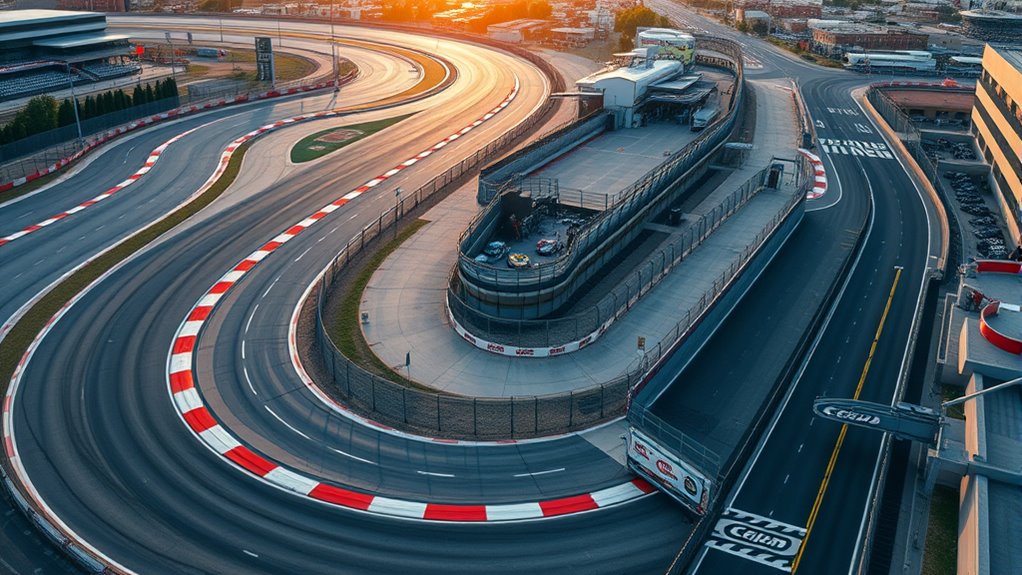
Race track design can be grouped into several distinct layouts, each shaping competition in different ways.
Circuits are permanent racing venues built for road racing, usually outside the United States, and they combine left and right turns across varied lengths and configurations.
Oval racing is largely an American phenomenon — most of the world’s motorsport, from Formula 1 to the World Rally Championship, is contested on road or street circuits instead.
Ovals dominate U.S. racing. According to the 2013 National Speedway Directory — still the most detailed public count available — 901 of the 1,262 oval tracks, drag strips, and road courses then active in the U.S. and Canada were ovals, and 683 of those ran on dirt. More recent editions of the directory point to a slow, steady decline in the overall track count as older short tracks close faster than new venues open, but ovals remain the backbone of American racing. Their geometry is defined by flat or banked turns and long straight sections, a format central to NASCAR competition.
Street courses are temporary circuits laid out on city streets, often uneven, with limited grip and tight boundaries; Monaco and Long Beach are prominent examples.
Combined road courses link an oval with an infield road course — often called a “roval” — creating hybrid layouts that support both oval and road racing.
Together, these forms organize racing into distinct spatial systems, each granting its own arena for speed, discipline, and strategy.
Dirt Tracks, Drag Strips, and Other Track Types
Circuits, ovals, and street courses cover most road and closed-loop racing, but they don’t capture everything raced on. Dirt ovals actually make up the majority of oval tracks in North America — of the roughly 901 ovals counted above, about 683 run on dirt rather than asphalt or concrete, hosting sprint cars, dirt late models, and weekly local racing rather than national touring series. Drag strips are a separate category entirely: straight-line quarter-mile (or eighth-mile) tracks built for standing-start acceleration runs rather than cornering, sanctioned mainly by the NHRA. Rally stages differ again, running point-to-point on closed public roads instead of looping back to a start/finish line, which is why rally drivers rely on a co-driver’s pace notes rather than a memorized racing line. Each format tests a different skill: a dirt racer reads a surface that changes lap to lap, while a drag racer’s whole race can be decided by reaction time off the line.
How Track Layout Changes Driving Style
Track layout directly alters cornering and braking demands, with road courses and rovals requiring sharper deceleration, tighter turn-in points, and more precise throttle application than high-banked ovals.
On ovals and superspeedways, drafting becomes a central control variable, shaping speed conservation and overtaking potential through sustained airflow management.
Line choice also shifts with geometry, as tri-ovals, short tracks, and banked turns each reward different entry angles, momentum retention, and passing strategies.
Cornering And Braking
Cornering and braking behavior changes markedly with track geometry. Oval circuits typically use banked turns that support higher corner speeds and reduced braking demand, while road courses require repeated, precise deceleration and throttle modulation through a mix of left- and right-hand corners.
On oval tracks, banking sustains cornering loads, letting drivers carry high speeds with minimal braking and steadier throttle management. Road courses, by contrast, demand disciplined braking markers, rotation control, and rapid reapplication of power.
Elevation changes further complicate road-course cornering, altering grip transfer and sightlines. Infield sections on dynamic layouts, especially rovals, force frequent shifts between oval and road-course driving, changing the driver’s rhythm from sustained speed to technical precision.
This geometry rewards adaptable technique and measured control.
Drafting And Line Choice
On oval circuits, drafting and line choice become central to race pace, with superspeedways such as Daytona and Talladega rewarding drivers who use the slipstream to cut aerodynamic drag and carry more speed on the straightaways.
On high-banked ovals, the preferred line may rise toward the outer groove to sustain cornering speeds, while flat venues demand the inside path for grip. Banking alters throttle application and braking points, reshaping oval-style racing into a calculation of momentum.
On road courses, line choice changes with elevation and turn geometry, requiring precise acceleration and braking.
Combined rovals demand both drafting on the straights and road-course handling in the infield, making race strategy a continuous trade-off between efficiency and control.
Oval Track Types by Length and Shape
Oval tracks are commonly categorized by length as short tracks under one mile, intermediate tracks from 1 to 2 miles, and superspeedways beyond 2 miles.
Their geometry also varies, ranging from symmetrical ovals to D-shaped layouts, tri-ovals, and paperclip forms.
These differences in length and shape directly influence speed, traffic density, and racing characteristics.
Short, Intermediate, and Superspeedways
Oval track classifications are typically divided by length into short tracks, intermediate tracks, and superspeedways, each producing distinct racing characteristics.
Short tracks, under one mile, such as Bristol and Martinsville, are often called bullrings; minimal banking concentrates cars into tight, technical racing.
Intermediate tracks span one to two miles, with 1.5-mile ovals like Charlotte and Kansas balancing speed and strategy.
Superspeedways exceed two miles, including Daytona and Talladega, where steep banking — up to 33 degrees at Talladega — supports high-speed racing, close pack racing, and drafting.
D-shaped ovals and tri-ovals introduce varied racing dynamics through geometry that preserves visibility and flow.
Across these forms, banking, length, and surface demand disciplined control while rewarding drivers with faster racing lines and sustained momentum.
Oval Shapes and Variants
Track length provides only part of the picture, since oval circuits also differ sharply in shape, banking, and symmetry. Short tracks, intermediate venues, and superspeedways each support a distinct rhythm, but shape matters just as much as size.
- Tri-ovals and D-shaped layouts improve sightlines and lengthen the frontstretch, often raising cornering speeds.
- Banking reshapes control: steeply banked turns at Bristol or Talladega reward carrying momentum, while flatter surfaces demand precision and restraint.
- Unique variants such as paperclip ovals and egg-shaped ovals — Darlington Raceway is a well-known 1.37-mile egg shape — compress distance and tighten turns.
Symmetrical designs use parallel straights and 180° turns; asymmetrical layouts create mixed demands within one circuit. Pocono Raceway is the sharpest example: its three turns are banked at 14, 8, and 6 degrees respectively, so a chassis setup that grips well in Turn 1 can understeer badly by Turn 3.
What Makes a Speedway or Superspeedway?
A speedway is generally defined as an oval circuit measuring at least one mile in length, while a superspeedway extends to two miles or more and is built to sustain even higher speeds.
Not every superspeedway shares the same banking, though. Daytona International Speedway is 2.5 miles with 31 degrees of banking in the turns, and Talladega Superspeedway is 2.66 miles with 33 degrees — the two combine length and steep banking to sustain pack racing and heavy drafting, where drivers reduce aerodynamic drag by running closely together. Indianapolis Motor Speedway is also 2.5 miles, but its four corners are banked at only about 9 degrees, 12 minutes — closer to a flat road-course corner than to Daytona’s high banks. That flatter geometry is why the Indianapolis 500 rewards precise, momentum-based driving rather than the three- and four-wide pack racing seen at Daytona and Talladega, even though IndyCar qualifying speeds at Indianapolis have topped 230 mph in recent years.
Note: Not all superspeedways drive alike. Banking, not just length, decides whether a track produces pack racing (Daytona, Talladega) or a more technical, momentum-based contest (Indianapolis). A track only needs to be at least two miles long to qualify as a superspeedway — the banking angle is a completely separate variable.
Long straightaways, wide turns, and expansive sightlines improve visibility for spectators at every superspeedway while preserving room for rapid, strategic movement. Whether a given superspeedway favors pack racing or precision ultimately comes down to that banking angle, not just the mile marker on the front stretch.
Road Courses and How They Work
Road courses are permanent racing circuits designed to force cars through both left- and right-hand turns, combining straightaways with a varied sequence of corners that demand precise braking, throttle control, and cornering technique.
These road courses reward driver skill because every lap asks for disciplined heavy braking, clean acceleration, and adaptation to elevation changes. Their layouts often include multiple configurations, giving organizers flexibility while preserving the circuit’s unique characteristics.
Unlike oval tracks, these layouts expose balance, grip, and timing in equal measure, offering a more varied, technical form of competition.
- Straight sections create a moment to reset before the next technical demand.
- Varied corner types test patience, courage, and precision.
- Watkins Glen and Sonoma show how permanent racing circuits shape memorable racing.
Street circuits differ because they are temporary city layouts, but road courses remain purpose-engineered environments.
That distinction matters, because permanence allows deeper tuning, sharper comparisons between cars, and a purer test of control under pressure.
Why Street Courses Are So Different
Street courses occupy a different category from permanent road circuits because they are built from city streets that are closed temporarily for racing, often over layouts of less than two miles.
These street courses function as temporary circuits, using existing pavement in urban settings rather than purpose-built acreage. Uneven surfaces, painted lines, and tight geometry produce limited grip, so driver errors are punished immediately by barriers and the absence of run-off.
Warning: Because street circuits reuse public roads, they typically have far less runoff than purpose-built tracks — concrete walls, curbs, and catch fencing sit close to the racing line. A mistake that would be a harmless spin on a road course can end a car’s race, or bring out a red flag, on a street circuit.
The result is a twisty layout with sharp corners, narrow margins, and constant precision demands. Prestigious examples such as Monaco and Macau show how prestige can coexist with compression, elevation changes, and unforgiving street furniture. At Monaco specifically, average race speeds sit in the 90–100 mph range — the slowest of any race on the calendar — because so much of the lap is taken in second and third gear.
Compared with permanent venues, street courses often lack the safety features built into modern purpose-built tracks, making risk management central to lap time.
Yet their confined format creates intense spectator proximity, since fans can stand meters from cars reaching triple-digit speeds on streets they might drive on themselves the next morning.
What Roval Layouts Add to Racing
Roval layouts merge oval speed with infield road-course complexity, creating circuits that test a wider range of driver skills than either format alone. They preserve oval racing momentum through high-speed turns while inserting infield road sections that demand controlled braking, line accuracy, and adaptive driver skill. The result is a format that rewards versatility — drivers who excel at pure speed don’t automatically excel on a roval, and vice versa.
- Drafting on the oval exposes timing and airflow control.
- Technical corners force precise braking and rotation.
- Mixed-format races expand racing strategies and overtaking chances.
At the Charlotte Roval, a 17-turn, roughly 2.3-mile road course built around the 1.5-mile oval, the start/finish area and pits streamline operations, yet the infield configuration completely reshapes rhythm and risk compared with a standard oval race. Indianapolis Motor Speedway’s own road course does something similar on a smaller scale, splicing part of the oval’s front stretch and Turn 1–2 into a 14-turn, 2.439-mile infield layout used for IndyCar’s Grand Prix of Indianapolis.
This combination rewards tactical patience, rapid shifts, and decisive execution. Roval layouts thus add unpredictability without abandoning speed, producing events where technical corners and open-track aggression coexist within a single, coherent lap.
How Fans and Drivers Compare Tracks
Fans and drivers often compare tracks by configuration because layout directly shapes speed, braking demand, and racecraft: oval circuits generally produce higher average speeds with fewer turns, while road courses require heavier braking, more gear changes, and tighter corner execution.
On oval tracks, especially in NASCAR, drafting and pack racing dominate at superspeedways like Daytona and Talladega, where airflow and positioning decide outcomes. Short tracks such as Bristol compress the field and reward aggressive contact, late braking, and rapid response.
Road courses, including Watkins Glen and Sonoma, add elevation changes, corner variety, and technical sections that expose precision deficits. Track configuration also affects fan experience: tri-ovals like Charlotte improve sightlines, while longer layouts highlight aerodynamics and sustained speed.
| Layout | Typical Length | What Decides Lap Time | Well-Known Examples |
|---|---|---|---|
| Oval | 0.25–2.66 mi | Banking angle, drafting, sustained speed | Bristol, Charlotte, Daytona, Talladega |
| Road Course | 2–4 mi | Repeated braking, elevation change, mixed-direction corners | Watkins Glen, Sonoma, Road America |
| Street Circuit | Under 2 mi | Low grip, tight corners, minimal runoff | Monaco, Long Beach, Macau |
| Roval | ~2.3–2.4 mi | Oval straights plus technical infield braking zones | Charlotte Roval, Indianapolis Road Course |
Across racing dynamics, drivers assess risk, tire wear, and passing opportunities differently, making each circuit a distinct test of control and strategy.
Frequently Asked Questions
What are the different types of race tracks?
The main categories are ovals, road courses, street circuits, and rovals, plus dirt ovals and drag strips as separate surface- or format-based types. Series choose based on the kind of racing they want: NASCAR and IndyCar run mostly ovals and road courses, Formula 1 mixes permanent circuits with street courses like Monaco, and drag racing and rally use entirely different straight-line or point-to-point formats.
What are the different types of oval track racing?
Oval racing is grouped by length and shape: short tracks under a mile (Bristol, Martinsville), intermediate tracks of roughly 1 to 2 miles (Charlotte, Kansas), and superspeedways over 2 miles (Daytona, Talladega, Indianapolis). Within those categories, shape varies too — tri-ovals, D-shaped ovals, quad-ovals, and unique layouts like Pocono’s triangle or Darlington’s egg shape all change how a car handles.
What are the different track types beyond circuits and ovals?
Beyond circuits, ovals, and street courses, racing also happens on dirt ovals, drag strips, and rally stages. Dirt ovals use a loose, shifting surface that changes lap to lap as conditions evolve. Drag strips are straight quarter-mile courses built purely for acceleration, not cornering. Rally stages run point-to-point on closed public roads rather than looping back to a start/finish line, so drivers rely on a co-driver’s pace notes instead of a memorized racing line.
Are all IndyCar tracks oval?
No. IndyCar’s schedule mixes all three main layouts: oval superspeedways like Indianapolis Motor Speedway (highlighted by the Indy 500), permanent road courses like Road America, and street circuits like the Grand Prix of Long Beach. That mix is intentional — it tests drafting and pack racing on ovals, braking and cornering on road courses, and precision in tight, low-grip street environments, all within one championship.
Conclusion
In conclusion, circuits, ovals, road courses, street courses, and roval layouts each impose distinct aerodynamic, mechanical, and strategic demands. Their geometry determines cornering load, braking frequency, tire degradation, and overtaking opportunity. The gap between formats can be dramatic: Monaco’s average race speed sits around 90–100 mph, while IndyCar’s Indianapolis 500 qualifying runs have topped 230 mph in recent years. That range, from the tightest street circuit to the fastest superspeedway lap, is what keeps motorsport’s competitive spectacle so varied from one weekend to the next.
Sources
- Indianapolis Motor Speedway — official track specifications, including oval length and layout
- INDYCAR — Indianapolis 500 event page — confirms IMS’s four corners are banked at 9 degrees, 12 minutes
- Talladega Superspeedway — official track specifications, including 33-degree turn banking
- Encyclopedia of Alabama — history of Talladega Superspeedway and its banking comparison with Daytona
- Charlotte Motor Speedway — official specifications for the 1.5-mile oval and Roval road-course configuration
- Bristol Motor Speedway — official specifications for the short-track oval
