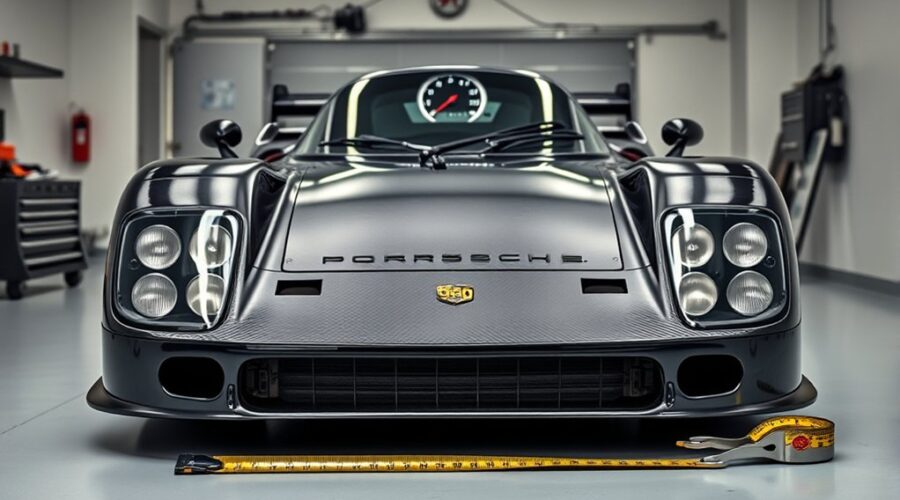
The Porsche 962 remains one of Group C’s defining endurance prototypes. Its twin-turbo flat-six ranged from 2.65 to 3.2 liters and produced roughly 680 to over 750 hp. At just 890 kg, it delivered exceptional speed and acceleration. The aluminum monocoque and ground-effect bodywork were central to its design. Its technical package was only part of the story, though, and the full picture becomes more interesting.
Key Takeaways
- The Porsche 962 used a rear mid-engine, aluminum monocoque chassis with extended wheelbase for IMSA GTP regulations.
- It was powered by twin-turbo flat-six engines from 2.65 to 3.2 liters, producing roughly 680 to 750+ horsepower.
- With about 890 kg curb weight, the 962 could reach around 220 mph and sprint from 0 to 60 mph in under 3 seconds.
- Ground-effect bodywork and race-proven endurance engineering gave it exceptional stability, downforce, and reliability.
- It debuted in 1984, won Le Mans in 1986 and 1987, and remains highly collectible with authentic cars fetching millions.
Porsche 962 Overview and Specs
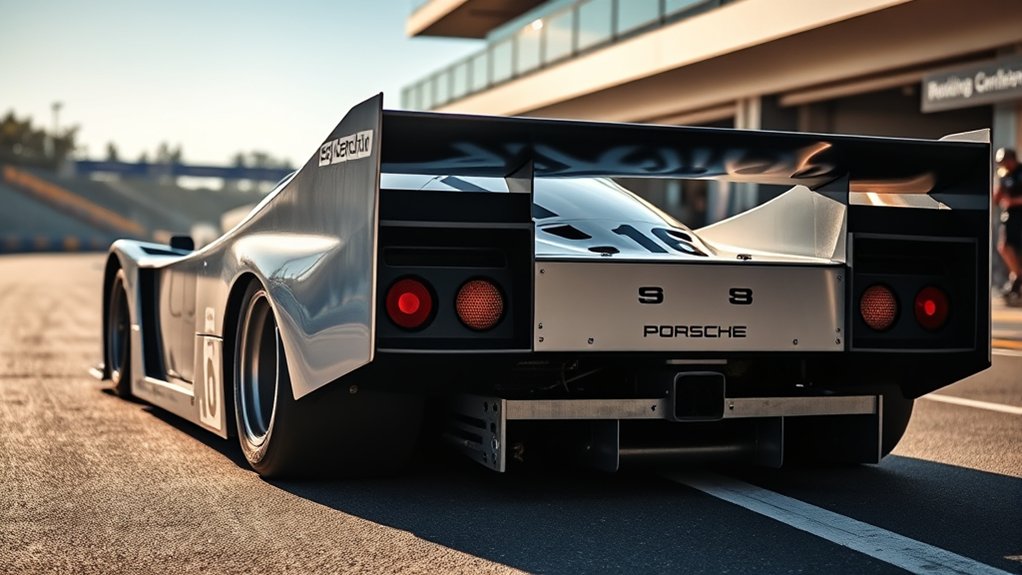
The Porsche 962 is powered by a turbocharged flat-six engine in multiple configurations, producing roughly 680 to over 750 hp depending on specification. The Porsche 962 powertrain supports a curb weight of 890 kg, yielding an estimated 775 ps per ton and sharp performance under race conditions. Its aluminum monocoque chassis improves rigidity and crash protection while reducing mass, a critical advantage in endurance racing. Acceleration from 0 to 60 mph occurs in under 3 seconds, reflecting rapid response and high traction. The top speed reaches about 220 mph, placing the car among the fastest endurance race cars ever built. These specifications show a machine designed for efficiency, durability, and speed rather than comfort. In period competition, the 962 served as a dominant platform at events such as the 24 Hours of Le Mans, where stability, reliability, and outright pace determined success.
Porsche 962 Engine and Power Output
Power for the Porsche 962 comes from a 2.65- to 3.2-liter twin-turbocharged flat-six engine, with output varying by specification. In Porsche 962 IMSA GTP form, the engine typically produces 680 to 720 horsepower, while Group C versions can exceed 750 horsepower in qualifying trim. This twin-turbocharged layout gives the car immediate response and strong flexibility across different circuit demands. The engine’s construction is widely regarded as exceptionally robust, supporting sustained loads in endurance racing without sacrificing consistency. Such strength allowed the Porsche 962 to remain competitive under restrictive rules and changing race conditions. The power output was not only high for its era, but also carefully managed to balance reliability with performance. This mechanical efficiency helped the 962 serve as a benchmark in sports car racing, where freedom of development often determined success.
Porsche 962 Performance and Top Speed
With its turbocharged flat-six producing roughly 680 hp in IMSA form and more than 750 hp in Group C trim, the Porsche 962 delivered exceptional straight-line performance and could reach a top speed of about 220 mph (354 km/h). Its powertrain gave the Porsche 962 one of the era’s most advanced performance profiles, combining brutal thrust with sustained endurance pace. In qualifying trim, acceleration capabilities were severe, with 0 to 60 mph achieved in under 3 seconds. The lightweight aluminum monocoque chassis and ground-effect aerodynamics supported stability at speed, allowing the car to remain composed while the driver pursued maximum freedom on track.
- Rapid launch, minimal delay
- High-speed stability, controlled aggression
- Relentless performance, liberated pace
At about 890 kg, the power-to-weight ratio approached 775 ps per ton, reinforcing the 962’s top speed and race-winning efficiency.
How the Porsche 962 Was Built
The Porsche 962 was developed in 1984 as a successor to the 956, with an extended wheelbase to satisfy IMSA GTP regulations and improve driver safety. Its pedal box was moved behind the front axle, a key IMSA safety change that altered the car’s packaging and crash structure. The chassis used an aluminum monocoque, providing the rigidity and protection needed for endurance racing.
IMSA Safety Changes
IMSA safety regulations prompted the Porsche 962’s development, requiring a longer wheelbase and a pedal box positioned behind the front axle. Under IMSA GTP regulations, the Porsche 962 integrated an aluminum monocoque chassis to raise safety, stiffness, and crashworthiness without sacrificing performance. Its rear mid-engine layout preserved balance, while ground-effect bodywork generated usable downforce for liberated control on fast circuits. Private teams later revised details to meet evolving safety demands and improve resilience in contact. The result was a machine shaped by regulation, yet still engineered for speed.
- Rigid structure
- Stable cornering
- Adaptive crashworthiness
Extended Wheelbase Design
Safety requirements did more than influence the Porsche 962’s structure; they also dictated its extended wheelbase layout. The Porsche 962 used an extended wheelbase design that moved the pedal box behind the front axle, improving driver safety and comfort under IMSA regulations. This geometry also refined weight distribution, giving the chassis calmer behavior in fast corners and on long circuits. The aluminum monocoque chassis added rigidity and protected the cockpit without excessive mass, supporting endurance use. Ground-effect packaging was central to aerodynamic efficiency, with the longer platform helping the body manage airflow and downforce more effectively at speed. Teams later adjusted bodywork and aero details to suit different tracks, preserving the car’s competitive edge while keeping the design focused on control, stability, and mechanical freedom.
Aluminum Monocoque Build
Built around an aluminum monocoque chassis, the Porsche 962 achieved a high ratio of rigidity to weight, giving endurance teams a structure that was both light and strong. This aluminum monocoque kept the Porsche 962 lightweight while preserving safety and performance under race stress. Ground-effect aerodynamics worked with the chassis to increase downforce, improving stability at speed and freeing cornering grip.
- Rigid shell, minimal mass
- Pedal box moved behind the front axle for safety
- Aerodynamics shaped for endurance pace
The result was a balanced platform for long-distance racing, where structural integrity and liberated handling mattered more than excess material. Its design answered safety rules without surrendering speed, allowing the 962 to remain competitive through efficiency, control, and mechanical discipline.
Porsche 962 Transmission and Drivetrain
The Porsche 962 used a rear mid-engine, rear-wheel-drive layout paired with a turbocharged flat-six drivetrain, a combination that supported strong traction and balance in endurance racing. The Porsche 962’s rear mid-engine layout placed mass centrally, while the rear-wheel-drive format transmitted power efficiently through endurance racing formats. Its transmission options included a 5-speed manual transmission and a dual-clutch semi-automatic transmission, both selected for rapid shifts and controlled output. The turbocharged flat-six delivered substantial force; the IMSA version used a 3.2-liter unit rated at roughly 680–720 hp. These drivetrain configurations gave engineers flexibility to tune response, drivability, and reliability. Compared with the 956, the 962’s reduced front overhang improved aerodynamic stability and helped keep the chassis composed at speed. Continuous development of the drivetrain allowed the car to remain effective across multiple endurance racing formats from 1984 to 1991, reinforcing its technical relevance and mechanical independence.
Porsche 962 Racing History and Major Wins
Arriving at the 1984 24 Hours of Daytona, the Porsche 962 opened its racing record with a victory that immediately established its competitiveness in endurance racing. In Porsche 962 racing history, that debut became the baseline for a campaign of major wins across top-tier sports car events. The model secured back-to-back overall victories at the 24 Hours of Le Mans in 1986 and 1987, then dominated the IMSA GT Championship from 1985 to 1988. Derek Bell and Al Holbert delivered decisive results, with Bell recording 21 victories between 1985 and 1987. Over 180 race wins followed, reflecting a machine built for disciplined speed and strategic freedom.
- Le Mans success validated its endurance authority.
- IMSA titles proved sustained competitive control.
- Privateer teams extended its reach into the early 1990s.
Privateer teams kept the Porsche 962 active in multiple formats, preserving its relevance and legacy in motorsport.
Porsche 962 Variants and Road Conversions
Among its most significant forms, the Porsche 962 appeared as both IMSA GTP and Group C variants, with the IMSA version using a 3.2-liter single-turbo engine rated at roughly 680–720 hp. The Porsche 962 platform was adapted to different regulations without losing pace or mechanical authority. Group C cars, built in roughly 54 examples as 962C models, used varied aerodynamic configurations to suit endurance circuits and fuel limits. Privateer efforts further extended the chassis: the Kremer Racing 962 CK6 added a carbon fiber tub for reduced mass and greater torsional stiffness. Beyond racing, road conversions translated the machine into street form. The Dauer 962 Le Mans became road-legal and later won Le Mans in 1994, confirming its racing pedigree. Other road conversions, including the Schuppan 962CR and DP62, retained the 962’s essential character while adding equipment for legality and use.
Porsche 962 Chassis Numbers and Famous Cars
Individual Porsche 962 chassis carried distinct histories that mapped the car’s development from factory prototype to privateer endurance weapon. Porsche 962 chassis number 001 opened the record in IMSA at the 1984 24 Hours of Daytona, establishing its racing legacy. Chassis 002 to 004 became Rothmans team cars, delivering repeated podium form and proving the platform’s speed under factory pressure. Chassis 006 remains in the Porsche museum, a fixed reference for historical significance and engineering discipline.
- #001: first IMSA entry, Daytona debut
- #006: preserved as a benchmark of design
- #011 to #016: Joest Racing cars that sustained the model after factory withdrawal
After Porsche stepped back, Joest Racing kept the 962 competitive in endurance events, showing how access and skill could preserve performance without factory control. The Dauer 962 Le Mans later used original racing chassis in road-legal form and won Le Mans in 1994, confirming the model’s adaptability and liberation from a single competition role.
Porsche 962 Value and Collectibility
Porsche 962 market value is primarily driven by provenance, race history, and original specification, with authentic competition cars often trading in the $1.5 million to $3 million range. Le Mans entries and victories materially increase desirability, placing race-proven chassis at the top of collector demand. Road-legal conversions and privateer examples usually command lower prices because they lack the same competitive pedigree.
Market Price Drivers
The market for the Porsche 962 is shaped primarily by provenance, race history, and condition, with authentic racing examples typically trading between $1.5 million and $3 million. For Porsche 962, market value rises when racing pedigree and documented provenance are intact; auction prices track that scarcity. Collectibles with verified race history often attract stronger bids, especially when linked to Le Mans entries or results. Privateer chassis and road-legal conversions generally sit lower, broadening access without changing the car’s core significance.
- Verified history can release higher value.
- Condition preservation supports freed ownership.
- Rare examples remain technically compelling collectibles.
Race Pedigree Impact
Race pedigree exerts the strongest influence on Porsche 962 collectibility, with over 100 race wins establishing the model as one of endurance racing’s most accomplished cars. Its racing pedigree includes the 24 Hours of Le Mans victories in 1986 and 1987, reinforcing value.
| Factor | Market effect |
|---|---|
| Racing pedigree | Premium pricing |
| Le Mans wins | Collector demand |
| Engineering innovations | Legacy status |
| Limited production numbers | Scarcity effect |
| Provenance | Auction strength |
Authentic Porsche 962 examples with documented competition history can reach $1.5 million to $3 million. As one of the successful endurance race cars, the 962 combines technical authority with rarity. Its engineering innovations and limited production numbers, just 91 units, sustain collectibility and elevate auction premiums among buyers seeking motorsport freedom.
Road-Legal Conversion Value
Road-legal conversions have added a distinct premium to 962 collectibility, with examples such as the Dauer 962 Le Mans often trading between $1.5 million and $3 million depending on provenance and competition history. For the Porsche 962, road-legal conversions transform a pure endurance prototype into an asset with elevated market value.
- rarity limits supply and intensifies demand
- racing pedigree sustains collector market credibility
- customization in cars like the Schuppan 962CR expands appeal
Authentic finishes at Le Mans reinforce desirability, while limited production keeps ownership exclusive. In this niche, the balance of performance, legality, and heritage offers a form of automotive liberation that remains measurable in price and unmistakable in significance.
Frequently Asked Questions
What Is Special About the Porsche 962?
The Porsche 962 stands out for Porsche Racing through Design Innovations, advanced Engine Technology, refined Aerodynamic Features, and Endurance Success; its Historical Significance and Legacy Impact define a dominant, liberated era in prototype motorsport.
What Is a Porsche 962 Worth Today?
A Porsche 962 today typically brings $1.5 million to $3 million; elite Porsche 962 auction results rise with racing history significance, collector market trends, and iconic design features, though maintenance costs and restoration challenges affect classic car investment.
What Is the Top Speed of the Porsche 962?
Top speed is about 220 mph. Porsche 962 Racing, Engine Specifications, Aerodynamic Features, Historical Significance, Design Innovations, Championship Wins, Driver Experience all reflect a machine engineered for liberation through relentless velocity and control.
What Were the Key Differences Between the Porsche 956 and 962?
The 956 and 962 contrasted sharply: Porsche racing shifted through design evolution, engineering advancements, longer wheelbase, altered aerodynamics features, and turbocharged engines. The 962 prioritized IMSA safety, while both retained Le Mans success and legacy impact.
Conclusion
The Porsche 962 remains one of endurance racing’s defining prototypes. Its most striking statistic is the combination of roughly 680 to 750+ hp in a car weighing only 890 kg, giving it a power-to-weight ratio near 775 ps per ton. That engineering balance helped produce a top speed of about 220 mph and sub-3-second acceleration to 60 mph. With its aluminum monocoque, ground-effect aerodynamics, and proven race record, the 962 remains highly significant.