
The F1 Sprint, introduced in 2021, adds a shorter race to selected Grand Prix weekends. It covers 100 kilometres and usually lasts about 30 minutes, with a separate qualifying process setting the grid. Points are awarded to the top eight finishers, and the result does not decide Sunday’s main-race starting order. That separation changes strategy, tyre use, and setup decisions in ways that are easy to miss at first.
Key Takeaways
- F1 Sprint debuted in 2021 to add excitement, replacing two practice sessions with a short competitive race weekend format.
- Sprint Qualifying uses three segments: SQ1, SQ2, and SQ3, with medium tyres required early and soft tyres in the final segment.
- The Sprint race covers about 100 kilometres, lasts roughly 30 minutes, and has no mandatory pit stops.
- Points are awarded to the top eight Sprint finishers, from 8 points for first to 1 point for eighth.
- Sprint results do not set the Grand Prix grid, which is decided by separate Saturday qualifying.
What Is the F1 Sprint?
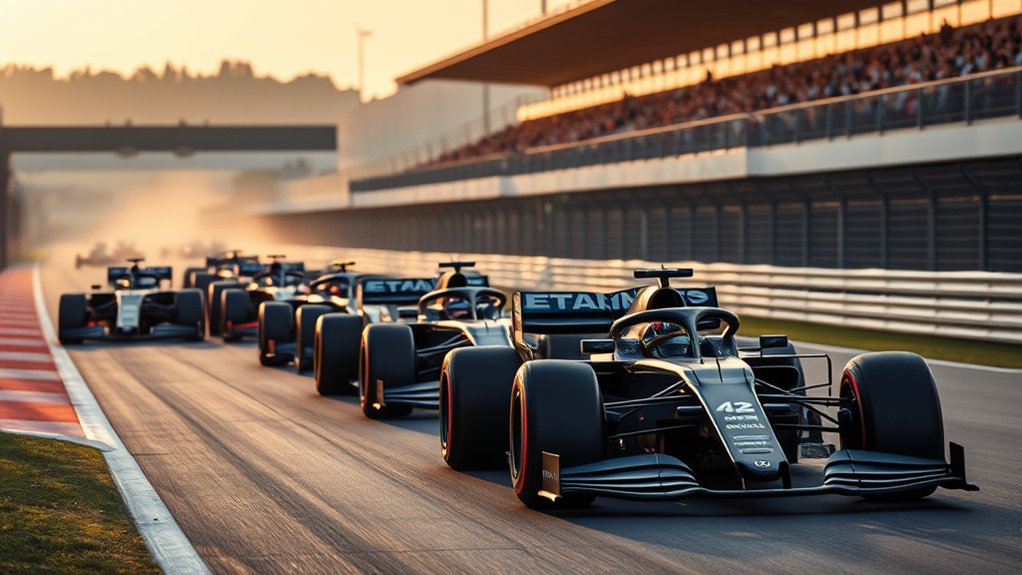
The F1 Sprint is a 100-kilometre race, or roughly one-third the distance of a standard Grand Prix, designed to last about 30 minutes and add a shorter, more condensed competitive element to the race weekend. Introduced in 2021, the Sprint was created to increase track action and broaden opportunities for competition across the weekend. Its format is deliberately compact: Sprint Qualifying on Friday sets the Sprint grid, and the race itself runs on Saturday. The main Grand Prix remains separate and is not reordered by the Sprint result. This structure reduces dependence on a single long contest and gives drivers more chances to challenge established hierarchy. Points awarded in the Sprint extend from eighth place to first, with 8 points for the winner and 1 point for eighth. The format serves an audience seeking more racing, fewer gaps, and a tighter, more immediate form of motorsport contest.
How the F1 Sprint Weekend Works
Across a three-day weekend, the F1 Sprint format replaces two conventional practice sessions with Sprint Qualifying on Friday, which sets the grid for Saturday’s 100-kilometre Sprint race.
The structure compresses track time while preserving competitive value for teams and drivers seeking advantage.
| Session | Function |
|---|---|
| Friday | Sprint Qualifying decides the Sprint grid |
| Saturday | Sprint race covers about one-third of a Grand Prix |
| Duration | Roughly 30 minutes, with no mandatory pit stops |
| Scoring | Points on offer go to the top eight finishers |
| Grand Prix | A separate qualifying session sets that grid |
Sprint Qualifying uses SQ1, SQ2, and SQ3, with the fastest 10 reaching the final phase. Medium tyres are used in SQ1 and SQ2, then soft tyres in SQ3. The Sprint format awards championship points, but the finishing order does not determine the Grand Prix start. That grid is fixed later on Saturday, through separate qualifying.
F1 Sprint Qualifying Explained
F1 Sprint Qualifying takes place on Friday and is divided into SQ1, SQ2, and SQ3, with progressively shorter sessions that narrow the field. Medium tyres are required in SQ1 and SQ2, while soft tyres are mandatory in SQ3, and the slowest six drivers are eliminated before the final segment. The outcome sets the starting order for Saturday’s Sprint race, not Sunday’s Grand Prix, increasing the weight of execution and strategy.
Sprint Qualifying Format
Sprint qualifying is divided into three timed segments—SQ1 lasting 12 minutes, SQ2 lasting 10 minutes, and SQ3 lasting 8 minutes—with the slowest drivers eliminated after each phase. In this Sprint qualifying format, all 20 drivers enter SQ1 on medium tyres, using qualifying runs to secure track position. SQ2 continues the same tyre rule, while the top 10 progress to SQ3. The final segment uses soft tyres and decides the Sprint Pole winner for the Saturday Sprint race. The session replaces one practice period, compressing preparation and increasing strategic pressure on teams. Held on Friday, it establishes the competitive order for the weekend and reduces margin for error. The structure rewards precision, setup efficiency, and disciplined execution across every lap.
Tyres And Elimination Rules
In Sprint Qualifying, the tyre rule is fixed by segment: medium tyres are required in SQ1 and SQ2, while soft tyres are used in SQ3 for maximum pace. This mandated sequence limits tyre changes and standardizes strategy, giving every driver the same starting constraint. SQ1 lasts 12 minutes and SQ2 10 minutes, with seven-minute intervals between sessions for preparation. After each of these first two stages, the six slowest drivers are eliminated, reducing the field to 10 for SQ3. The final 8-minute segment decides the leading grid positions on the faster soft compound. A false start, if a driver moves before the starter’s gun, can bring disqualification from the session.
How F1 Sprint Points Are Awarded
F1 Sprint points are awarded to the top eight finishers, beginning with 8 points for first place and decreasing by one point per position to 1 point for eighth. The scale is designed to reward consistent performance across the short race and to add competitive value to the weekend. These points count toward both the Drivers’ and Constructors’ Championships, giving the Sprint direct championship impact.
Points For Top Eight
Points are awarded only to the top eight finishers in an F1 Sprint, with the winner receiving 8 points and each subsequent position earning one fewer point, down to 1 point for eighth place. This short format assigns points for performance in a compressed race, giving teams and drivers a direct incentive to compete at the top. The result affects both the Drivers’ and Constructors’ Championship standings, so every position inside the points is materially relevant. By limiting scoring to eight places, the system keeps the competition tight and efficient, while preserving a clear reward structure. In practice, the Sprint becomes a concentrated test of pace, execution, and control, where results translate immediately into championship value and strengthen the event’s competitive logic.
Sprint Points Scale
The Sprint points scale is straightforward: only the top eight finishers score, with first place awarded 8 points and each position thereafter receiving one point fewer, down to 1 point for eighth. In F1 Sprint, this points distribution supports sprint races by adding measurable reward for pace and execution.
| Position | Points |
|---|---|
| 1st | 8 |
| 2nd | 7 |
| 3rd | 6 |
The full scale continues to 4th with 5, 5th with 4, 6th with 3, 7th with 2, and 8th with 1. These points enter the Drivers’ Championship, increasing competitive value without altering the Grand Prix grid, which remains set by separate qualifying. The format was built to reward consistent performance and intensify weekend stakes.
Championship Impact Explained
Sprint Sprint points are awarded to the top eight finishers, with 8 points for first place and 1 point for eighth, and those totals feed directly into both the Drivers’ and Constructors’ Championship standings. This structure gives each Sprint race measurable championship value, not merely spectacle. Because points are limited and distributed only to the leading eight, teams must treat every lap as strategically significant. The format rewards consistent performance across the season, since repeated gains can alter title trajectories. For drivers, each finish can influence the Drivers’ table; for teams, the same result affects the Constructors’ balance. The system thus increases competitive pressure, sharpens tactical decisions, and adds stakes to shorter races. In effect, the Sprint converts brief competition into direct championship leverage.
How the Sprint Affects Sunday’s Grand Prix
Although the Sprint adds competitive intensity and extra championship points, it does not determine the starting grid for Sunday’s Grand Prix; that grid is set by a separate qualifying session held on Saturday. On sprint weekends, the Sprint functions as an independent race, leaving teams free to protect Grand Prix strategies while still contesting a points-paying event. The finishing order changes the record of the weekend, not the grid for the main race. As a result, engineers can collect data from a high-pressure session and adjust setups before Sunday. This can refine tire management, pace balance, and operational decisions without locking teams into a specific grid position. The format also increases track time and on-track action, giving drivers and teams more information before the Grand Prix. For audiences seeking open competition, the Sprint expands the racing program while preserving the distinct structure of the Sunday contest.
Why Formula 1 Introduced the Sprint
Introduced in 2021, the F1 Sprint was designed to add more competitive action across the weekend and give fans meaningful racing on more than one day. Its purpose was structural: a Sprint weekend compresses the schedule, replaces two practice sessions with Sprint Qualifying, and creates a short race that can alter the competitive order before Sunday. The format raises stakes without removing the Grand Prix’s central role.
| Element | Purpose | Effect |
|---|---|---|
| Sprint weekend | More racing days | Greater engagement |
| short race | About 100km | ~30 minutes, no pit stops |
| points | Top eight score | Championship impact |
Which Tracks Suit the Sprint Format Best
Sprint races are best suited to circuits with overtaking-friendly layouts, where long straights and heavy braking zones create repeated position-change opportunities. Short, fast laps such as those at the Red Bull Ring or Monza compress the field and sustain race intensity. Limited practice impact also favors these tracks, since the Sprint format rewards immediate adaptation and reduces the advantage of extensive setup refinement.
Overtaking-Friendly Layouts
Circuits with high overtaking potential are generally the best fit for the F1 Sprint format, as the shortened 100km distance rewards tracks that encourage immediate race action. On such a track, overtaking becomes a primary performance factor, and the short distance keeps the contest highly competitive. Layouts with wide corners, long straights, and effective DRS zones support repeated passing attempts, giving drivers room to attack without excessive risk. Silverstone and Interlagos illustrate this profile, combining flow with clear opportunities for position changes. For the Sprint, the objective is not simply speed, but dynamic racing that frees drivers to use aggressive strategy from the start. This design increases action, maximizes overtakes, and makes the format more engaging than a conventional race weekend.
Short, Fast Laps
Tracks with short, fast laps are generally the best fit for the F1 Sprint format because the 100km distance rewards immediate pace, aggressive positioning, and sustained attack without pit-stop strategy.
- Silverstone: high-speed flow, strong overtaking potential
- Interlagos: varied corners, rapid position changes
- Red Bull Ring: short lap, decisive acceleration zones
- Tight corners: compress gaps and invite attack
- Long straights: enable slipstream-based overtaking
These tracks suit the Sprint because their layout preserves pressure from start to finish. Short laps reduce recovery time, while fast sections amplify commitment and expose weaknesses quickly. Circuits with sharp turns and acceleration zones generate the most competitive racing, allowing drivers to act freely and decisively. The result is a compact, high-energy format that favors track characteristics over strategic delay.
Limited Practice Impact
Limited practice sessions place greater emphasis on immediate setup accuracy, since the condensed three-day format leaves teams fewer chances to gather data and refine performance. Under limited practice, engineers must make rapid decisions on aerodynamics, tyre management, and balance before competitive running begins. Circuits with clear overtaking zones and varied corners suit this structure best, because the limited practice penalty is offset by race-day action. Silverstone and Interlagos are strong examples, as their layouts encourage aggressive passes and sustained pressure. Mandatory pit stops can further reshape strategy, but they do not compensate for unsuitable layouts. Tracks lacking speed variation or passing space reduce competitiveness, much like a narrow track and field corridor restricts movement. The sprint format, consequently, rewards liberated, fluid circuits where decisive racing remains possible.
How Teams Prepare for a Sprint Weekend
Teams prepare for a Sprint weekend by maximizing car setup performance within a compressed schedule, with limited practice time forcing rapid decisions on balance, aero settings, and tire use. Sprint Qualifying reshapes the timetable, so engineers refine strategies quickly, using data to protect speed and tire management under pressure.
- Rapid setup correlation between simulator and track
- Short-run testing for balance and degradation
- Sprint Qualifying execution with medium tires
- Race planning centered on overtaking windows
- Review of prior Sprint results for optimization
This format rewards disciplined analysis rather than caution. Teams evaluate wind, track evolution, and fuel loads to identify efficient compromises that enhance pace in both qualifying and the 100km race. With no mandatory pit stops in the Sprint itself, teams prioritize clean launches, track position, and controlled aggression. The objective is clear: extract maximum points through sharp preparation, precise adjustments, and race strategies that convert limited track time into competitive advantage.
Common F1 Sprint Rules and Tyre Requirements
Sprint weekends use a tightly defined tyre format in Sprint Qualifying: medium tyres are required in SQ1 and SQ2, while soft tyres are mandatory in SQ3 to determine the Sprint grid. This structure limits strategic drift and keeps qualifying performance transparent. The Sprint itself then follows standard race-control discipline, with drivers confined to designated lanes, each 1.22 meters wide, to preserve equitable track access. For very short launches, starting blocks remain mandatory up to 400 meters, reducing variation at the start. Weather also matters: record-setting conditions allow a maximum tailwind of +2.0 m/s, since wind can alter pace and reliability of comparisons. The format also carries sporting value through points, awarded to the top eight finishers, from 8 for first to 1 for eighth. That allocation directly influences Drivers’ and Constructors’ standings, linking each Sprint to championship freedom through measurable performance.
Key F1 Sprint Facts to Know
Covering 100 km, the F1 Sprint is a short race format designed to run for roughly 30 minutes without mandatory pit stops, making it about one-third the distance of a standard Grand Prix. It is structured to increase competitive intensity while preserving strategic freedom. Sprint weekends use Friday Sprint qualifying, Saturday Sprint, and Sunday Grand Prix sessions.
- Top eight finishers score points.
- First place earns 8 points; eighth earns 1.
- Sprint Qualifying has SQ1, SQ2, and SQ3.
- Medium tyres are required in SQ1 and SQ2.
- Sprint results do not set the Grand Prix grid.
The format separates the Sprint from the main event, so the Sunday starting order comes from a distinct qualifying session held on Saturday. This arrangement lets teams pursue performance in two different competitive layers without one result controlling the other.
Related Reading
Frequently Asked Questions
What Is the History of the Sprint Race?
The sprint race originated in ancient Greece’s stadion, then evolved through Olympic notable sprint events. Modern sprint race origins include standardized sprint race formats, improved athlete training, and metric distances shaping faster, more equitable competition worldwide.
What Are the Four Techniques of Sprint Races?
The four sprint techniques are acceleration, maximal velocity, speed endurance, and proper technique; they form a blazing system of race strategies, athlete conditioning, and sprinting equipment use, delivering almost unstoppable efficiency and precision.
What Is the 75% Rule in F1?
The 75% rule grants full points only when an F1 race covers at least 75% of scheduled distance; otherwise half points apply, shaping sprint race strategy, qualifying format, points system, and driver impact.
What Is the History of F1 Sprint Races?
F1 sprint races began in 2021 as trial sprint race formats, reshaping qualifying strategies and driver impact while increasing fan engagement. The system evolved through several revisions, each seeking more competition and broader spectacle.
Conclusion
In conclusion, the F1 Sprint remains a compact test of speed, strategy, and adaptability. Its coincidence of shorter distance and higher pressure often produces unusually competitive running, while its independent points system can subtly shift both championship narratives and weekend preparation. For teams and drivers alike, the format rewards precision more than patience. As a result, the Sprint has become a technical exercise in controlled risk, where small details can shape a decisive Saturday outcome.