πŸ”§ Expert automotive guides trusted by 250,000+ Canadian drivers every month
Car Tech & Gadgets

Twin-scroll Turbo Explained: How It Works and What Drivers Should Know

twin scroll turbocharger functionality explained

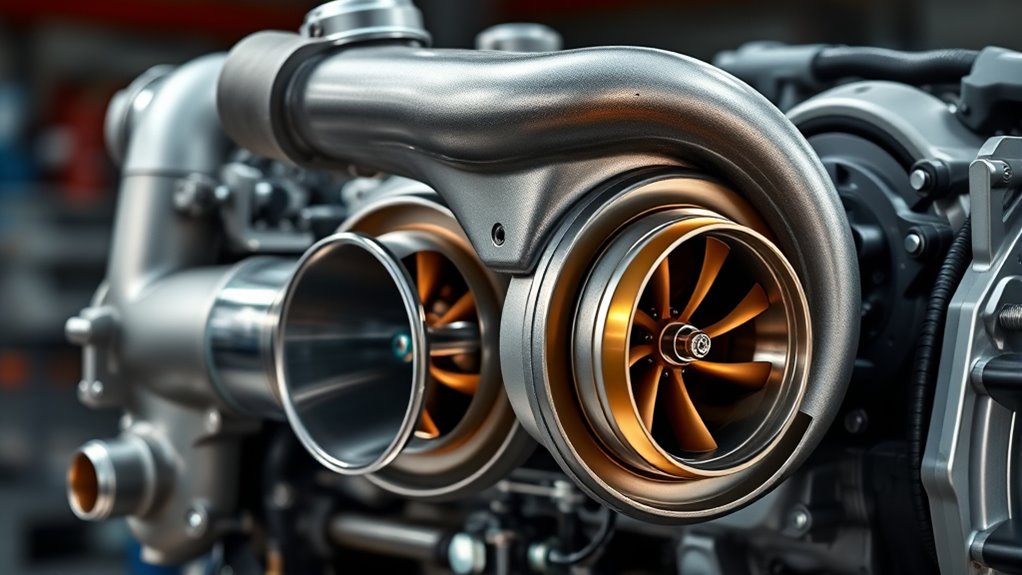
A twin-scroll turbocharger uses one turbine housing divided into two passages, separating exhaust pulses from paired cylinders. That split reduces interference, improves turbine efficiency, and helps boost build earlier in the rev range. The result is faster spool, stronger low-end torque, and better drivability than a comparable single-scroll setup. Yet the layout adds complexity and cost, which raises a practical question for drivers weighing performance against simplicity.

What Is a Twin-Scroll Turbo?

enhanced torque reduced turbo lag

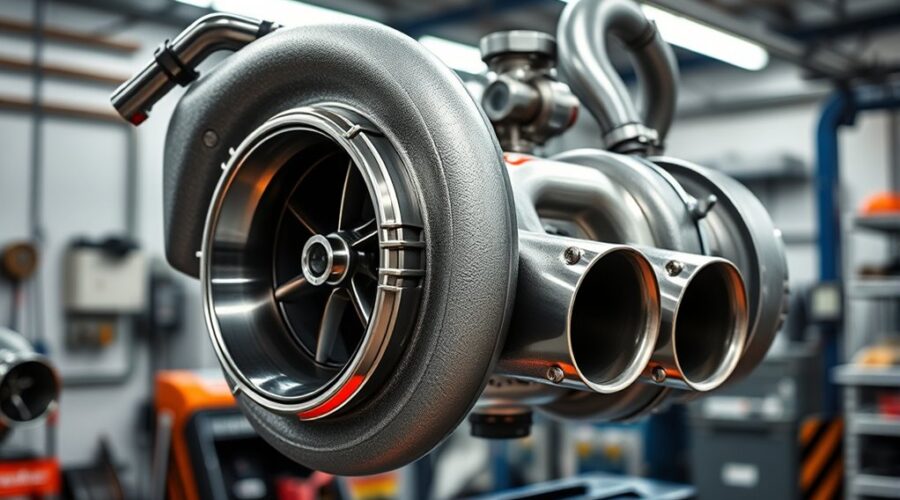
A twin-scroll turbocharger uses a single turbine housing divided into two separate exhaust passages, or scrolls, to route exhaust pulses from specific cylinder pairs with minimal interference.

This architecture gives the twin-scroll turbocharger two exhaust channels that preserve pulse energy, improving turbine response and limiting turbo lag. By separating exhaust pulses instead of blending them prematurely, the design supports stronger low-end torque and more immediate boost delivery, conditions that matter to drivers seeking performance enhancement without unnecessary delay.

Two exhaust channels preserve pulse energy, sharpening turbine response, reducing lag, and delivering more immediate low-end boost.

In practice, the configuration can raise output by as much as 20% and add substantial midrange torque relative to single-scroll systems. It also promotes engine efficiency by using exhaust energy more effectively, which can improve fuel economy by up to 8% and lower exhaust temperatures.

The result is a technically refined solution, especially suited to 1.5- to 2.5-liter engines where responsive power delivery is valued over compromise and mechanical inertia.

How a Twin-Scroll Turbo Works

How a twin-scroll turbo works becomes clear in the way its turbine housing is divided into two isolated exhaust passages that route gases from paired cylinders to separate scrolls.

In a twin-scroll turbocharger, each scroll receives exhaust gases from cylinders timed to minimize overlap, so pressure pulses arrive with greater energy and less interference. That controlled exhaust flow improves turbine efficiency because the wheel is driven by cleaner pulse sequencing rather than mixed, weakened flow.

The result is quicker spool-up, less turbo lag, and stronger response when the driver demands power. By preserving pulse energy, the system can increase low-end torque and support more immediate acceleration without added mechanical burden.

The same arrangement can also improve volumetric efficiency by helping the engine breathe more effectively, which raises overall engine performance. Its advantage lies in organizing energy already present in the exhaust, not in making the hardware more complex.

Why Twin-Scroll Turbos Spool Faster

Twin-scroll turbos spool faster because their divided turbine housing keeps exhaust pulses from different cylinder pairs isolated, reducing pulse interference and preserving more turbine inlet energy.

In twin-scroll turbochargers, each scroll channels exhaust pulses through separate passages, so pressure waves arrive with greater coherence at the turbine. This improves exhaust flow dynamics, raising shaft acceleration and shortening spool times without requiring higher engine load.

The result is quicker boost response at lower RPMs, where a conventional single-scroll unit may still be waiting for usable energy. Real-world testing shows reduced lag by roughly half a second and peak boost levels reached about 400 RPM sooner.

For drivers seeking liberation from delay, the effect is immediate: throttle input produces stronger early response, making acceleration feel more direct and controlled.

Because the turbine sees more efficient pulse energy, the system builds boost earlier, helping the engine deliver responsive performance before the rev range climbs.

Twin-Scroll Turbo Benefits

Beyond the faster spool characteristics, twin-scroll turbochargers offer measurable gains in low-end torque and boost response, improving acceleration and drivability from a standstill. In twin scroll technology, exhaust pulses from different cylinders are separated, reducing turbo lag and helping the turbocharged engine’s airflow stay organized. The result is a denser, cooler charge, improved scavenging, and freer combustion. Engineers report up to 8% engine efficiency gains across the rev range, with lower fuel consumption and reduced exhaust gas temperature. Midrange torque increase can reach 50.7 lb-ft, enough to improve performance in daily driving and passing maneuvers.

Benefit Effect
low-end torque stronger launch
boost response faster acceleration
engine efficiency up to 8% gain
fuel consumption reduced use
torque increase midrange pull

Such behavior supports liberated driving, where throttle input translates into immediate, controlled output rather than delay.

Twin-Scroll Turbo Drawbacks

Twin-scroll turbochargers impose greater manufacturing and packaging complexity than single-scroll units, which raises cost and can complicate installation.

Their added mechanical and airflow coordination requirements also increase maintenance sensitivity and restrict compatibility with certain engine layouts.

At higher engine loads and speeds, these systems may lose some efficiency, limiting peak power potential in demanding operating conditions.

Higher Cost And Complexity

Higher manufacturing cost is a key drawback of twin-scroll turbochargers, because their dual-scroll housings, specialized exhaust manifolds, and tighter engineering tolerances require more sophisticated production and calibration.

This higher cost reflects added complexity in twin-scroll turbochargers, where dual scrolls must be matched to the exhaust manifold and engine architecture with precision.

Installation is consequently more demanding, and maintenance can be less straightforward than with simpler systems.

The design also works best with even cylinder counts, which narrows its application in some engines.

These factors raise the vehicle price point, placing a premium on performance that not every driver may choose.

For consumers seeking technical advantage without unnecessary constraint, the tradeoff is clear: more capability, but at increased expense and procedural burden.

Limited High-RPM Efficiency

At elevated engine speeds, the twin-scroll layout often loses much of the advantage that makes it effective at lower RPMs, since its geometry is tuned primarily to improve exhaust pulse separation, spool response, and low-end torque rather than peak airflow.

In a twin-scroll turbocharger, the turbine housing and divided exhaust flow promote quick response, yet at high RPM the same restriction can limit efficiency and blunt performance gains. As engine RPMs rise, turbocharged engines may see little improvement over single-scroll systems, because maximizing exhaust flow becomes the dominant requirement.

The design can also be harder to package in high-revving applications, especially with larger displacements. For drivers seeking liberation through sustained top-end power, this tradeoff means the system excels in responsiveness, but not always in high RPM breathing.

Twin-Scroll vs. Single-Scroll Turbos

Compared with single-scroll units, twin-scroll turbos separate exhaust flow into two distinct channels, reducing pulse interference and improving turbine efficiency. This architecture gives the twin-scroll a clear advantage in low RPM operation, where turbo lag in single-scroll systems often delays boost response.

By organizing exhaust flow and preserving pressure energy, the twin-scroll delivers quicker spool, stronger power delivery, and more consistent performance. In testing, it can raise engine efficiency by up to 8 percent and, in favorable conditions, improve output by as much as 20 percent.

Twin-scroll turbos organize exhaust flow for quicker spool, stronger delivery, and up to 8 percent better efficiency.

Single-scroll turbos remain simpler and may be adequate where high-RPM flow dominates, but their shared path can blur exhaust pulses and weaken responsiveness.

For drivers seeking liberated acceleration and immediate control, twin-scroll designs provide a more precise, efficient path to boost, while single-scroll layouts trade response for simplicity. Choice depends on the required powerband, not on hype or habit.

What Engines Work Best With Twin-Scroll?

Twin-scroll turbochargers are most effective in four-cylinder and six-cylinder engines, where paired exhaust pulses can be separated cleanly to reduce interference and improve turbine efficiency.

In a four-cylinder engine, the firing order can be arranged to preserve pulse energy, supporting smoother exhaust flow and faster boost delivery. In six-cylinder engines, similar pulse separation helps limit turbo lag while strengthening low-end torque, which is valuable where responsiveness matters.

These systems perform best in displacement ranges of roughly 1.5 to 2.5 liters, where compact airflow management translates directly into performance. Engineers can further optimize the design by matching cylinder pairings to the firing order, reducing pumping losses and improving turbine drive.

Twin-Scroll Turbo in Real Cars

Among production cars, twin-scroll turbocharging has moved from a niche engineering solution to a widely adopted performance and efficiency tool. On a turbocharged car, twin-scroll turbochargers separate exhaust flow pulses so pulse energy arrives cleaner at the turbine, helping torque build earlier at low engine speeds while sustaining performance higher in the range. The Mazda RX-7 Mk2 first used the layout in 1989, proving it on Wankel engines. Mitsubishi later applied it to the Lancer Evolution, while Renault, GM, and BMW broadened use across compact and premium models.

Model Effect
RX-7 Mk2 Early response
Lancer Evolution Stronger torque
Saab 9-3 Aero Broader use
BMW engines Better efficiency

This architecture guides fresh air through a more responsive system, reducing lag and supporting driver control. The result is a technical path to liberated acceleration without sacrificing efficiency.

Is a Twin-Scroll Turbo Worth It?

The practical value of twin-scroll turbocharging comes down to measurable gains in response, efficiency, and midrange output. For twin-scroll turbochargers, the case is strongest when turbo lag matters and low-end torque is a priority.

By separating exhaust pulses, the system spools faster, trimming lag by about half a second and improving acceleration from a standstill. In documented applications, engine efficiency can rise by up to 8%, while fuel consumption may fall roughly 5%, a meaningful advantage for performance enthusiasts who also track operating cost.

Midrange horsepower and torque gains of up to 20% further strengthen the argument, especially in daily driving where usable output matters more than peak figures.

The main drawback is installation cost, since the hardware and tuning are more complex than a single-scroll setup. Even so, the upgraded driving experience often justifies the investment for drivers seeking restrained but tangible freedom from compromise.

Frequently Asked Questions

Can You Explain How a Twin-Scroll Turbo Works?

A twin-scroll turbo separates exhaust flow into two channels, preserving pulse energy for better boost efficiency and engine responsiveness. This improves power delivery, reduces turbo lag, aids heat management, and supports fuel economy, despite greater design complexity in performance tuning.

What Are the Downsides of Twin-Scroll Turbos?

Downsides include cost implications, installing challenges, maintenance issues, engine compatibility limits, tuning requirements, heat management complexity, performance limits at high load, potential noise levels, and only partial turbo lag reduction.

Can You Explain How a Twin-Turbo Works?

Two turbochargers, not one burden: a twin-turbo uses one small unit for low-rpm spool time and one larger unit for high-rpm boost pressure, improving turbocharger efficiency, exhaust flow, power delivery, and engine performance, despite installation complexity, maintenance requirements, fuel economy.

What Are the Benefits of a Twin-Scroll Turbo?

A twin-scroll turbo improves power delivery, shortens spool time, sharpens engine responsiveness, cuts turbo lag, and raises boost pressure stability. It yields performance gains, better fuel efficiency, improved heat management, and refined sound characteristics.

Conclusion

In practice, the theory behind twin-scroll turbos holds up: separating exhaust pulses reduces backpressure and improves turbine efficiency, which explains the faster spool and stronger low-end torque. That advantage is most pronounced in properly paired four- and six-cylinder engines. The tradeoff is real, however, as added hardware complexity and cost can offset the gain for some buyers. For drivers prioritizing responsiveness, the twin-scroll design is often justified.

Vance Ashford

Vance brings extensive knowledge in tire specifications, auto accessories, and parts reviews, helping you find the right gear for your vehicle’s safety and performance.

Leave a Comment

Your email address will not be published. Required fields are marked *