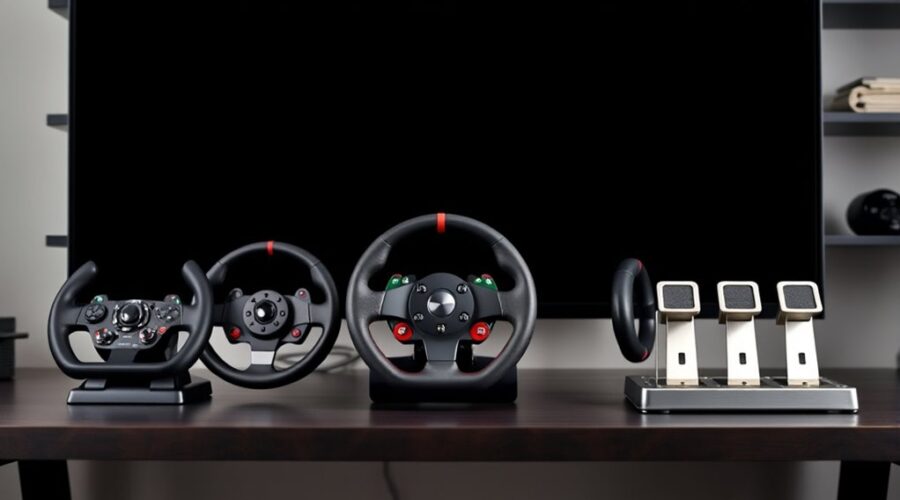
Choosing a racing wheel starts with budget, because entry models begin near $99.95 while high-end direct drive systems can exceed $1,000. Force feedback quality is the next filter, since stronger and more precise feedback improves control and realism. Platform compatibility must also be checked for PC, PlayStation, or Xbox support. Button layout, pedal quality, and adjustability matter as well, and the final choice often depends on how the wheel fits a specific driving setup.
How to Choose a Racing Wheel
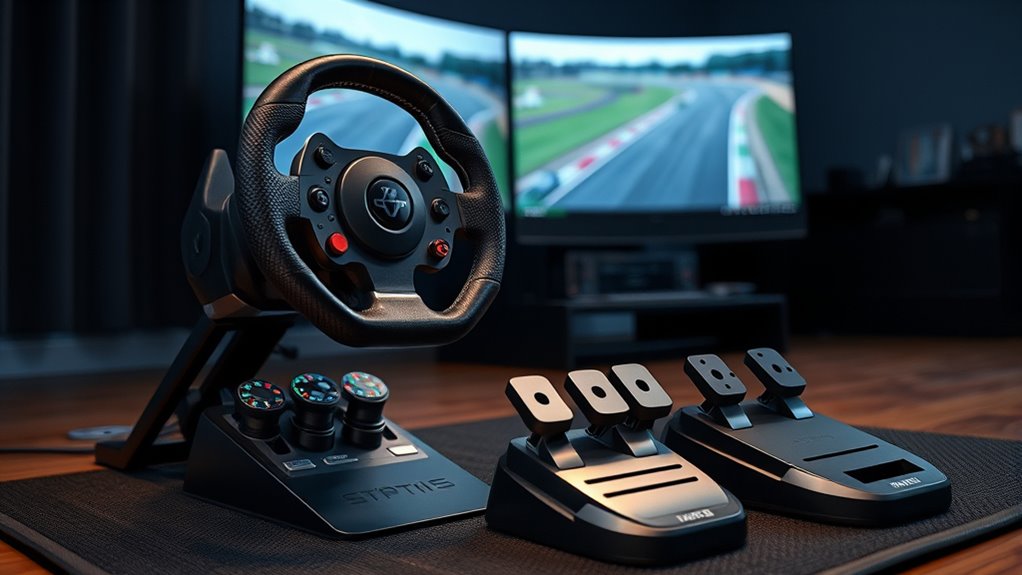
Choosing a racing wheel begins with a clear assessment of budget, platform compatibility, and intended use. Entry-level wheel options such as the Thrustmaster T128 can suit a sim drive setup, while premium models reach far higher prices.
Choosing a racing wheel starts with budget, platform compatibility, and the driving experience you want.
Compatibility with console or PC must be verified before purchase, since some racing wheels remain system specific. The drive system also matters: direct drive units deliver stronger feedback and finer precision, while gear-driven designs can still meet casual needs.
Essential controls include adjustable rotation, accessible button layouts, and a pedal set that supports consistent input. Build quality influences durability and response, especially under repeated use.
Ergonomics affect control, with comfortable grips reducing fatigue during extended sessions. A well chosen wheel should align mechanical performance with the user’s preferred level of immersion, allowing more precise driving without unnecessary compromise.
Set Your Racing Wheel Budget
A racing wheel budget should be organized into clear tiers, from entry-level models near $99.95 to premium systems that can exceed $1,000.
The full system cost must also include pedals, shifters, and other sold-separately accessories that materially increase the total investment.
Price-to-performance and future upgrade costs should be weighed together, since mid-range wheels often provide stronger value than lower-cost models that require additional spending over time.
Budget Tiers
Budget tiers should be set before comparing racing wheels, since price often determines the available force feedback, build quality, and accessory ecosystem. | Tier | Example and value |
| — | — |
|---|---|
| Entry | T128 at $99.95 gives value for money. |
| Mid-range | T248 at $399.99 balances performance and cost. |
| Premium | G Pro at $1,000 suits demanding sim racing wheels. |
| Add-ons | Pedal sets consideration can raise costs by $100–$500. |
| Upgrades | Custom accessories expand control, but elevate the price point. |
For an entry-level direct drive path, budget tiers should remain realistic. A mid-range investment usually reveals stronger feedback without excess. High-end choices serve users seeking precision and endurance. In all cases, budget tiers should include pedal sets consideration and custom accessories so the final setup stays coherent and freedom from hidden limits remains intact.
Total System Cost
Total system cost should be defined before any racing wheel comparison, because the base price is only one part of the investment. A rational budget should include the wheel, pedal sets, and any customization options that expand control or comfort.
Entry level systems such as the Thrustmaster T128 begin near $99.95, while mid-range racing wheels like the Thrustmaster T248 approach $399.99. The MOZA R5 Bundle offers an affordable entry point at about $379.98 for direct drive access. At the opposite end, the Logitech G Pro Racing Wheel can reach roughly $1,000, shifting the performance and price equation sharply.
- A desk-mounted cockpit
- Separate pedals on the floor
- Optional shifter, rim, or mount
Liberation comes from planning total system cost before purchase.
Pick the Right Force Feedback
Force feedback is one of the most important factors in a racing wheel, since it reproduces road texture, tire slip, curb strikes, and load changes that make sim racing feel physically believable.
Effective force feedback should be evaluated by FFB strength, signal detail, and how naturally the wheel returns information. Direct Drive units generally deliver the highest realism, because their motor is mounted directly to the shaft, reducing latency and preserving subtle cues.
Gear-driven systems are cheaper, but they usually sacrifice smoothness and resolution. Hybrid force feedback designs can offer a practical middle path, combining gear and belt elements for balanced control.
For most users, torque ratings in the 10–15 Nm range provide enough authority without overwhelming effort. Advanced FFB features, including low-frequency effects, can further improve road feel and the immersive experience by separating surface vibration from steering load.
The objective is not maximum force alone, but clear, detailed, and usable feedback.
Match Your Racing Wheel to Your Platform
Racing wheel selection should begin with platform verification, since PC, PlayStation, and Xbox systems impose different compatibility requirements.
Native compatibility checks are essential, as some wheelbases provide direct support for a single platform while others offer broader or cross-platform functionality.
Button mapping, software support, and force feedback behavior should also be evaluated to guarantee the wheelbase operates correctly within the intended racing environment.
PC, PlayStation, Xbox
Choosing a racing wheel begins with verifying platform compatibility, since many models are built for specific ecosystems rather than universal use. For PC, PlayStation, or Xbox, the chosen sim racing wheel should match the target system before any racing game purchase.
Logitech G920 suits Xbox and PC, while G29 serves PlayStation and PC; Thrustmaster T128 offers console-specific variants.
- A wheel locked to one platform can reduce friction in setup.
- Fanatec models often provide cross-platform compatibility, supporting freer movement between ecosystems.
- Logitech G Pro direct drive wheels improve force feedback quality, especially when liberation from weak detail matters.
Cross-platform compatibility matters for users who switch between PC and consoles. Console compatibility, software support, and update access also shape long-term usability.
MOZA software simplifies customization, while strong wheel ecosystem support keeps control precise, responsive, and adaptable.
Native Compatibility Checks
Native compatibility should be verified before purchase, because a wheel must explicitly support the intended platform—PC, PlayStation, or Xbox—to prevent connection and feature mismatches.
| Check | Result |
|---|---|
| specifications | Confirm native compatibility and console-specific features |
| cross-platform support | Identify whether racing wheels need specific hubs |
| software updates | Gauge future support and customer support |
Many racing wheels advertise broad cross-platform support, yet Fanatec-style ecosystems may still depend on specific hubs. Models such as Logitech G Pro or G923 reduce connectivity issues, while MOZA R5 targets PC by design. The Thrustmaster T128 illustrates platform variants for PS4/PS5 or Xbox. Evaluating specifications clarifies which platform receives full force feedback, button mapping, and firmware stability. Ongoing software updates and customer support matter because liberated choice depends on durable, transferable access, not accidental compatibility.
Compare Buttons, Pedals, and Extras
Button layout, pedal quality, and optional extras all shape how well a racing wheel performs in practice. Buyers should compare wheel-mounted buttons for quantity, placement, and ergonomic reach; a strong layout improves tactile feedback and preserves focus during rapid inputs. Models such as the Thrustmaster T128 show how paddle shifters can raise responsiveness in shifts, supporting precise control.
- A compact cluster of buttons near the rim
- A firm pedal set with adjustable brake tension
- Handbrakes or button boxes extending functionality
Pedals matter as much as the rim itself. Separate sets, including Logitech G Pro pedals, can deliver a more immersive experience and customizable resistance.
Accessories deserve equal attention because they expand functionality in rally and drift simulations. In technical terms, the best package is the one whose buttons, pedals, and extras work together cleanly, allowing disciplined, liberated driving without wasted motion or confusion.
Choose the Best Racing Wheel for You
How should the ideal racing wheel be selected? The answer is to choose the best racing wheel for you by matching performance targets to budget, compatibility, and control demands.
Choose the best racing wheel by matching your performance goals to budget, compatibility, and control needs.
Entry-level units such as the Thrustmaster T128 offer an accessible starting point around $99.95, while premium models like the Logitech G Pro Racing Wheel may exceed $1,000.
System support for PC, PlayStation, or Xbox, plus game-specific compatibility, must be verified before purchase.
Force feedback quality is a primary differentiator; direct drive systems, including the Simagic Alpha Evo, deliver cleaner, stronger response than gear-driven designs, improving precision and an immersive experience.
Build quality should also be examined, since premium materials usually provide greater durability than lighter budget constructions.
Additional features, especially customizable buttons and paddle shifters, expand control and responsiveness, allowing users to refine their setup without constraint.
Frequently Asked Questions
What’s Better, G920 or G29?
G29 is generally better, especially for PlayStation users. G920 features comparison favors Xbox, but G29 build quality, racing games compatibility, force feedback performance, pedal set quality, console compatibility, user reviews, setup ease, long term durability slightly win.
What Is the Most Realistic Racing Wheel?
The Logitech G Pro Racing Wheel is considered the most realistic, with direct-drive force feedback, strong build quality, and broad game support. Pedal sensitivity, wheel diameter, compatibility issues, price range, user reviews, and setup tips matter.
Is Thrustmaster or Logitech Better?
Logitech is generally better for performance and durability, while Thrustmaster is better for price and compatibility. Thrustmaster features and feedback suit entry users; Logitech software, design, support, and performance favor serious sim racers.
Is It Worth It to Buy a Racing Wheel?
Yes—11 Nm force feedback can justify the purchase, if budget considerations, compatibility factors, gaming setup, pedal quality, game selection, setup space, and maintenance tips align; user reviews and brand reputation usually determine liberation from controller limitations.
Conclusion
To sum up, selecting a racing wheel is a measured calibration of cost, force feedback, platform compatibility, and control layout. A well-matched wheel functions like a precise instrument, translating every corner and curb into usable information rather than noise. Direct drive systems offer the clearest signal, while ergonomic design and platform support determine long-term comfort and utility. The best choice is not the most expensive, but the one that aligns performance, immersion, and driving goals with disciplined efficiency.