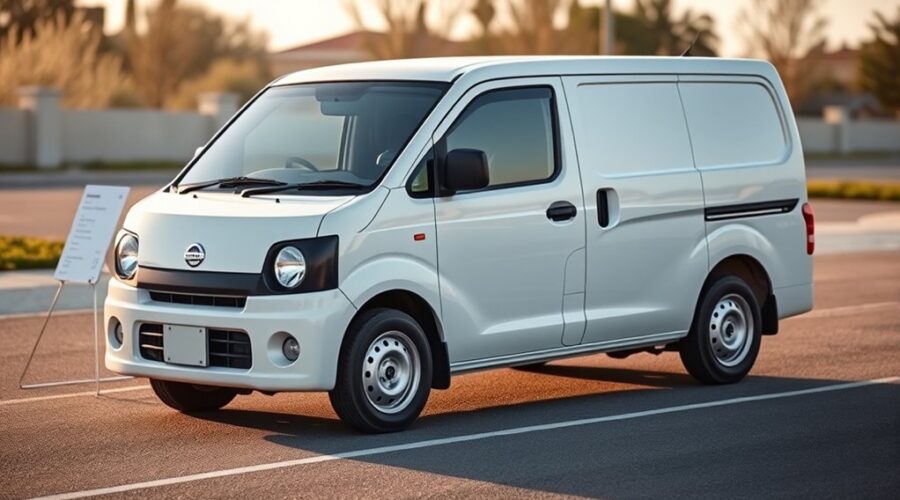
The Nissan S-Cargo, built from 1989 to 1991, stands out as a compact retro van with practical proportions and modest mechanicals. It uses a 1.5-liter E15S four-cylinder engine rated at 73 PS and 116 Nm, matched to a 3-speed automatic. With a length of 3,480 mm, a width of 1,595 mm, and a 300 kg payload, its layout raises a few questions about how it actually performs in use.
What Is the Nissan S-Cargo?
The Nissan S-Cargo was a compact, retro-styled van produced from 1989 to 1991 as part of Nissan’s Pike Factory project, a series of niche vehicles designed around distinctive, nostalgic aesthetics.
The Nissan S-Cargo combined “Small Cargo” and “escargot” in its name, reflecting a snail-inspired identity rather than conventional commercial-vehicle logic. Built in limited numbers, it occupied an unusual position between utility transport and collectible design object.
Its compact footprint, modest mass, and functional cabin made it suitable for constrained urban use, while its unusual form signaled a refusal of standardized automotive conformity.
Mechanically, it used a 1.5-liter E15 inline-four, producing 73 PS and 116 Nm through a 3-speed automatic transmission.
Approximately 10,685 units were made, reinforcing its rarity. This scarcity, along with its cult following, has sustained enthusiast interest and collector demand, especially among those drawn to vehicles that break away from mass-market uniformity.
Nissan S-Cargo Design Features
Building on its limited-production status and collectible appeal, the Nissan S-Cargo’s design is defined by an intentionally unconventional form that blends retro cues with practical utility. Its rounded body references the Citroën 2CV, giving the Cargo Van a whimsical profile while preserving clear functional intent.
The cabin continues that theme with a single-spoke steering wheel and a table-like instrument panel centered by a large speedometer, both reinforcing its minimalist, liberated character. Optional oval portal windows in the side panels add visual distinction and improve side visibility. An electric canvas sunroof further opens the interior to light and air, strengthening the vehicle’s open, user-focused atmosphere.
Large exterior panels also serve as effective billboard surfaces, making the design suitable for mobile advertising. Overall, the S-Cargo presents a compact commercial form whose styling prioritizes individuality, visibility, and practical expression.
Nissan S-Cargo Dimensions and Cargo Space
Measuring 3,480 mm in length, 1,595 mm in width, and 1,860 mm in height, the Nissan S-Cargo occupies a compact footprint while still offering useful internal volume for commercial tasks.
Its 2,260 mm wheelbase supports balanced handling and improves maneuverability in dense urban streets, where space and freedom of movement matter.
The Cargo area is engineered for practical utility, with a maximum load capacity of 300 kg, or about 660 pounds, giving it credible capability for deliveries and light transport.
A luggage room height of 1,230 mm provides generous headroom, helping accommodate boxes, parcels, and irregularly shaped goods with less restriction.
This layout makes the S-Cargo a disciplined, efficient hauler rather than a purely decorative compact vehicle.
Despite its modest exterior dimensions, the interior packaging prioritizes usable Cargo volume, allowing owners to move materials with relative independence in constrained environments, without sacrificing structural simplicity or everyday accessibility.
Nissan S-Cargo Engine and Transmission
Powered by a 1.5-liter E15S four-cylinder engine, the Nissan S-Cargo develops approximately 73 PS (54 kW) at 5,600 rpm and 116 Nm of torque at 3,200 rpm, figures that suit its role as a compact urban delivery vehicle.
In Nissan S-Cargo engine and transmission terms, output is routed through a 3-speed automatic transmission with a console-mounted shift lever, a layout chosen for straightforward operation in stop-and-go service. The calibration emphasizes usable low- and mid-range response rather than outright speed, supporting light commercial tasks with minimal driver effort.
Practicality remains central to the drivetrain package, as the vehicle is engineered to carry up to 300 kg overall, including 200 kg in the cargo area. This mechanical configuration reflects a utilitarian approach: simple, accessible, and efficient for independent movement through crowded streets.
The result is a modest but functional powertrain suited to delivery work and everyday city mobility.
Nissan S-Cargo Road Performance
The Nissan S-Cargo’s 1.5-liter E15 engine and 3-speed automatic deliver modest but sufficient response for city driving, with the vehicle’s light curb weight helping low-speed maneuverability and stop-and-go use.
On the highway, its approximately 75 mph top speed and limited power output indicate clear performance constraints, making it better suited to short commutes and local delivery work than sustained high-speed travel.
Its front strut and independent rear trailing arm suspension provide a compliant urban ride, while handling remains oriented toward stability and load carrying rather than sharp cornering.
City Driving Feel
With a 1.5-liter E15 engine producing 73 PS at 5,600 rpm and a curb weight of roughly 970 kg, the Nissan S-Cargo is well suited to city use, delivering enough output for urban deliveries without feeling cumbersome. Its city driving feel is defined by light mass, compact dimensions, and a calm steering wheel response that supports precise lane placement in traffic. The 3-speed automatic reduces workload in stop-and-go conditions, allowing the driver to focus on movement and space. | Attribute | Effect |
| — | — |
|---|---|
| 3-speed automatic | Smooth low-speed control |
| 3,480 mm length | Easier parking |
| 1,860 mm height | Better visibility |
| Tall cabin | Comfortable driving posture |
This setup favors effortless urban motion, enabling practical independence within dense streets.
Highway Performance Limits
Its 1.5-liter four-cylinder engine, rated at roughly 70 horsepower, gives the Nissan S-Cargo enough capability for basic road use but leaves little reserve for sustained highway acceleration.
The 3-speed automatic favors simplicity over speed, so merging and passing require advance planning. With a top speed near 75 mph, its highway performance limits are evident against contemporary traffic, where reserve power matters for safe, independent travel.
The carbureted fuel system can also reduce efficiency at elevated speeds, adding operating cost during longer runs.
Right-hand drive packaging may further complicate highway use outside Japan, especially where overtaking visibility is critical.
Even with its unmistakable snail-like styling, the S-Cargo remains a utility-focused compact van whose road performance is defined by restraint rather than freedom from effort.
Suspension And Handling
Although the Nissan S-Cargo was never intended to be a high-speed machine, its suspension layout supports predictable everyday road behavior. The front suspension uses struts, helping maintain composure over uneven urban pavement, while the independent trailing arm rear suspension improves cargo stability and ride control.
Together, the suspension tuning promotes accessible mobility and measured response, especially at lower speeds.
- Front strut suspension for steady city comfort
- Independent trailing arm rear suspension for load handling
- 970 kg curb weight and 3-speed automatic for easy maneuvering
With its 1.5 L E15 engine producing 73 PS at 5,600 rpm, the S-Cargo pairs modest power with a chassis that favors control over aggression.
That balance makes its road manners practical, efficient, and free from unnecessary complexity.
Nissan S-Cargo Production and Legacy
The Nissan S-Cargo was built from 1989 to 1991 in limited numbers, with total output estimated between 10,685 and 12,000 units, making it a relatively scarce model.
As a Pike Factory product, it shared Nissan’s retro-design program with vehicles such as the Pao and BE-1, while its rounded form referenced the Citroën 2CV Fourgonnette.
Despite Japan-only sales, the model developed an international cult following and is now regarded as a collectible example of late-1980s retro automotive design.
Limited-Run Production
Introduced at the 1989 Tokyo Motor Show and offered initially only through reservation at Nissan Cherry Stores in Japan, the Nissan S-Cargo was built as a deliberately limited-volume model within Nissan’s Pike Factory program. Its limited-run production totaled 10,685 units between 1989 and 1991, reflecting a controlled manufacturing strategy rather than mass-market scale.
- Pike Factory origin
- 10,685-unit total output
- Reservation-only launch in Japan
The program prioritized distinctive retro styling and a whimsical profile influenced by the Citroën 2CV, while maintaining practical utility.
Production restraint preserved design exclusivity and reduced commercial exposure to conventional market pressures. This constrained output also positioned the model as a clear example of Nissan’s experimental small-series engineering, where individuality and technical simplicity were allowed to operate outside standard volume targets, offering a freer form of automotive expression.
Cult Status Legacy
Built from 1989 to 1991 in an output of approximately 10,685 units, the Nissan S-Cargo has developed a durable cult following rooted in its unusual retro-inspired form and deliberately limited production.
As a Pike Factory model, it translated Citroën 2CV-era utility cues into a compact van body with practical load space and expressive panel geometry.
That combination of function and playfulness has secured a cult status legacy in collector markets, where it appears in retro showcases and niche enthusiast circles.
Its broad side panels also supported mobile branding use, adding commercial relevance beyond novelty.
Despite its eccentric silhouette, the S-Cargo remains technically notable for how scarcity, design coherence, and visual freedom sustained its reputation as a liberated alternative to conventional light commercial vehicles.
Frequently Asked Questions
How Many Nissan S Cargos Were Made?
Production Numbers indicate 10,685 Nissan S-Cargo units were made from 1989 to 1991, though some estimates reach 12,000. The figure reflects a rare, Japan-only Pike Factory commercial vehicle with limited reservation-based distribution.
Is the Nissan S-Cargo Reliable?
Reliable? Only moderately. The Nissan S-Cargo rates 6/10, with electrical faults and parts shortages reducing dependability. Maintenance Tips: inspect wiring, tires, and carburetion regularly. In urban service, enthusiasts may still find liberated utility.
What Is the Top Speed of a Nissan S-Cargo?
The Nissan S-Cargo reaches an estimated top speed of 75 mph, or 121 km/h. Performance Overview data shows modest output, prioritizing urban utility over highway pace, with a 1.5-liter engine and 3-speed automatic.
What Are Common Nissan Cargo Van Problems?
Common Nissan Cargo van problems include electrical faults, scarce replacement parts, weak highway performance, folding mirrors, and limited fuel range; these issues reduce Cargo Versatility and complicate maintenance, especially for owners seeking reliable, practical mobility.
Conclusion
In the small courier of the late 1980s, the Nissan S-Cargo stood like a mechanical snail, carrying modest loads with deliberate purpose. Its 1.5-liter E15S engine, 3-speed automatic, and compact chassis formed a system optimized less for haste than for nimble urban passage. Though production ended in 1991, its unusual shape and light construction preserve it as a technical curiosity: a reminder that utility can wear an unconventional silhouette without losing function.