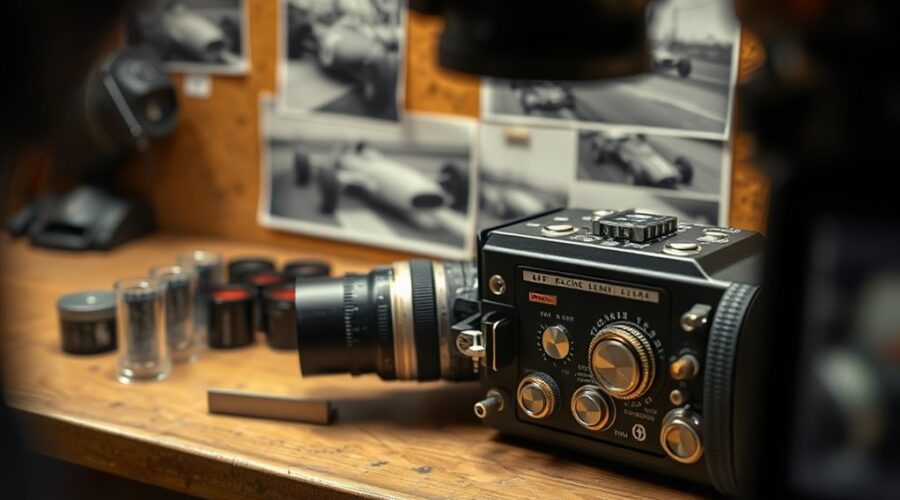
Racing cinematography has moved from early street-side curiosities to highly engineered productions built around speed, risk, and precision. Its history begins with silent-era footage and grows through camera rigs, optical tricks, and later digital tools that changed how motion could be seen and felt. The technical problem has always been the same: how to make velocity legible on screen. The answer has rarely been simple, and the next examples show why.
What Is Racing Cinematography?

Racing cinematography refers to the specialized filming methods developed to depict motorsport with clarity, speed, and intensity. In racing, motor racing, and auto racing films, cinematography is engineered to translate velocity into legible motion.
Tracking shots, aerial views, and on-car cameras create immersive angles that free the viewer from distance and simulate direct contact with the circuit. High frame rates permit slow-motion analysis of overtakes, crashes, and decisive turns, revealing details otherwise lost in real time.
Production practice depends on cooperation with professional drivers and stunt coordinators, whose rehearsed maneuvers protect crews while preserving authenticity. Modern digital effects and CGI extend this craft beyond physical limits, allowing filmmakers to construct hazards, crowds, and environments that real roads cannot provide.
The result is a technical language of speed, one that presents racing as both spectacle and disciplined mechanical action.
How Racing Film Began
Racing film began with early nonfiction-inspired motion pictures that recorded motorsport as a modern spectacle, with *Kid Auto Races at Venice* (1914) often cited as the first known example.
As the form developed, historic tracks and organized competition became central subjects, moving racing from brief actuality footage into structured screen narrative.
Milestones such as *The Crowd Roars* and later *Grand Prix* established the genre’s technical and dramatic foundations, linking speed, machinery, and cinematic innovation.
Early Race Film Roots
| Year | Title | Technical note |
|---|---|---|
| 1914 | *Kid Auto Races at Venice* | Improvised camera engagement |
| 1932 | *The Crowd Roars* | Speedway danger narrative |
| 1966 | *Grand Prix* | 70mm immersive racing |
Later works, including Formula One documentaries and John Frankenheimer’s *Grand Prix*, refined realism through actual motion, compressed editing, and high-speed image capture. This lineage shows cinema learning to record liberated velocity without surrendering analytical control.
Historic Tracks On Screen
Long before racing cinema perfected motion on film, the sport’s own venues supplied its visual grammar. In 1894, the Paris-Rouen contest exposed the first competitive motor race, while Aspendale, Melbourne, introduced the first purpose-built circuit in January 1906: a gravel oval just under a mile long.
That same year, Le Mans hosted the French Grand Prix, the inaugural use of the term Grand Prix, giving organized speed a public template. Historic racing films later borrowed these track forms, treating straights, curves, and crowds as cinematic architecture.
The Indianapolis 500, begun in 1911, reinforced this pattern across F1 World memory and broader motorsport culture. Classic racing films, including Grand Prix (1966), translated these sites into liberated motion through technical camera placement and high-speed realism.
First Motorsport Movie Milestones
| Milestone | Significance |
|---|---|
| 1914 | Comic origin |
| 1932 | Dramatic escalation |
| 1966 | Technical breakthrough |
| 1972 | Documentary intimacy |
*Grand Prix* (1966) advanced the racing movie with 70mm imagery and international scope. *Le Mans* (1971) favored actual track footage and minimal dialogue. *Weekend of a Champion* (1972), at the Monaco Grand Prix, presented Jackie Stewart’s world with precision. These films also opened screen space for liberated, complex identities, including the first Black presence in racing narratives.
Early Racing Movies and Screen Milestones
Early screen race footage established the basic cinematic grammar of motion, spectacle, and competition, with *Kid Auto Races at Venice* (1914) serving as an early milestone in motorsport film history.
Later works such as *The Crowd Roars* and *Grand Prix* expanded the form through technical staging, narrative conflict, and advanced cinematography.
Early Screen Race Footage
Cinema’s first major encounters with racing emerged in silent and early sound-era films that treated speed as both spectacle and narrative device. *Kid Auto Races at Venice* (1914) is widely regarded as the earliest known racing film, using a children’s automobile race as the backdrop for Charlie Chaplin’s Little Tramp and establishing an enduring link between motorsport imagery and screen comedy.
One early car race image already suggested collective motion, mechanical risk, and public freedom. Later, *The Crowd Roars* (1932) framed the driver as worker and rebel, while *Grand Prix* expanded the form through dynamic camera rigs and cross-cut drama.
*Le Mans* deepened realism with live 24-hour footage, limited dialogue, and disciplined editing, proving racing cinema could document speed without surrendering its emotional charge.
First Motorsport Film Milestones
Among the earliest motorsport screen works, *Kid Auto Races at Venice* (1914) established a foundational model by placing Charlie Chaplin’s Little Tramp against the organized spectacle of a children’s auto race, combining comedy with emerging cinematic technique.
*The Crowd Roars* (1932) advanced the form by centering a speedway driver’s professional and emotional life, linking competition to brotherhood, labor, and physical danger.
These milestones marked the first known shift from novelty footage to structured narrative.
Later works such as *Grand Prix* exploited 70mm film and mobile cameras to render Formula One speed with technical precision, while *Le Mans* used actual race footage and sparse dialogue to intensify realism.
Together, these films trace a lineage in which motorsport cinema became a disciplined, modern language of motion and liberation.
Key Techniques for Filming Speed
Filmmakers have long relied on specialized techniques to translate racing speed into convincing screen motion, with high-speed cameras capturing action at 120 frames per second or more to reduce blur and preserve detail in fast-moving sequences.
In the race tradition, a camera car often carries operators alongside high-speed racing machines, while careful safety management keeps crews protected during demanding setups. Low-speed filming helps prevent overheating in engines, enabling sustained movement without mechanical strain.
- Drones supply aerial perspectives, broadening visual freedom and revealing track geometry.
- Hydraulic rigs and motion simulators reproduce vibration, jolts, and steering force with controlled precision.
- Specialized frame rates preserve wheel rotation, tire deformation, and bodywork reflections.
- Technical discipline balances realism, performance, and operational safety.
Historically, these methods expanded what racing cinema could show, making velocity legible without sacrificing control.
How Filmmakers Capture Real Racing Action
Capturing real racing action on film has always depended on a careful balance between spectacle and mechanical restraint. Historically, crews filmed each car at reduced speed to limit overheating, then shaped motion through special effects and editing. Real racing footage was often inserted, granting authenticity without surrendering safety. Collaboration with professional stunt drivers and racing schools enabled precise maneuvers, letting machines be pushed while drivers retained control. Dynamic camera angles, mounted low or beside the track, transformed movement into a study of force and freedom.
| Method | Purpose |
|---|---|
| Low-speed filming | Protects engines |
| Real racing footage | Builds authenticity |
| Special effects | Simulates velocity |
| Dynamic camera angles | Intensifies emotion |
Sound design reinforced the illusion, converting mechanical noise into narrative pressure. In this history, liberation emerged not from reckless speed, but from disciplined craft that allowed audiences to witness racing action safely, vividly, and with technical truth.
Best Racing Movies to Watch
- Choose Le Mans for realism
- Choose Rush for tactical drama
- Choose Ford v Ferrari for innovation
- Choose Senna for historical truth
Frequently Asked Questions
What Was the First Race Film?
The first race film was Kid Auto Races at Venice (1914). In silent cinema, it employed early film techniques to parody racing genres, carrying historical significance through Chaplin’s debut and socially liberatory comic observation.
Did Brad Pitt Actually Drive in the F1 Movie?
Yes—like a torch crossing a dark circuit, Pitt reportedly drove many scenes himself. Historical records of F1 film production note Pitt’s driving skills, yet stunt driver involvement and technical controls preserved racing authenticity and safety.
What Is Considered the Best Racing Movie of All Time?
Many consider Grand Prix the best racing movie of all time, because its Iconic races, Legendary drivers, advanced Film techniques, and enduring Cultural impact forged a technical standard that still liberates audiences through speed and spectacle.
What Are Some Interesting Facts About Race Cars?
Race cars are lightning on wheels. Engine innovations raised speed, famous racetracks tested endurance, racing legends shaped strategy, and safety advancements—rear-view mirrors, helmets, stronger chassis—turned risk into disciplined progress, freeing drivers from earlier mechanical limits.
Conclusion
Racing cinematography has progressed from early spectacle to a disciplined craft, shaped by documentary roots, technical innovation, and precise storytelling. From primitive street scenes to mounted rigs, drones, and high-speed cameras, each era has refined how velocity is recorded and interpreted. The genre remains a finely tuned engine of image and sound, where history, engineering, and emotion converge. In that balance, racing films continue to reflect motorsport itself: a contest of control, risk, and human ambition.