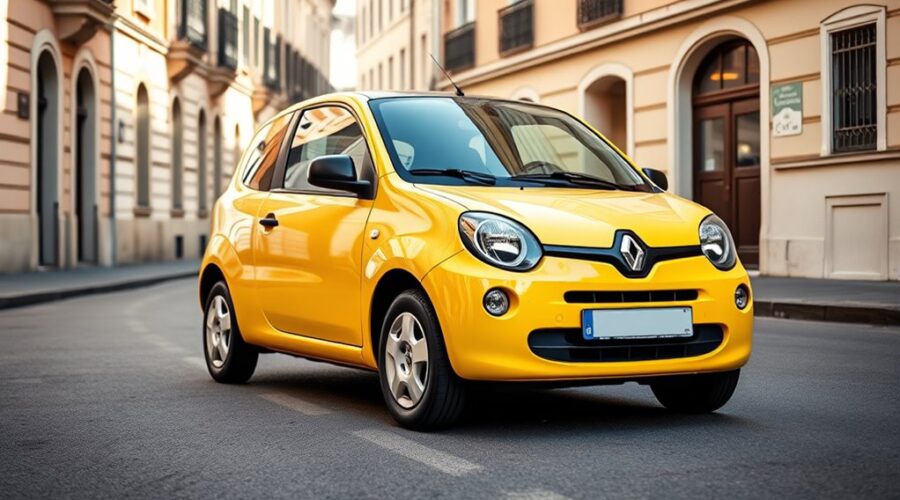
The Renault Twingo E-Tech Electric pairs a 60 kW (82 hp) electric motor with 175 Nm of torque, giving brisk city performance and a 0 to 50 km/h time of around 3.9 seconds. Its 27.5 kWh LFP battery is rated for up to 263 km on the WLTP cycle, while its 3,789 mm length and 2,493 mm wheelbase keep it compact. Yet the real question is how these figures translate into daily use, cabin space, and value.
Quick Answer
The Renault Twingo E-Tech Electric is a fully electric city car with a 27.5 kWh LFP battery, 263 km WLTP range, and a 60 kW (82 hp) motor. It’s sold in Evolution (from €19,490) and Techno (from €21,090) trims, built in Slovenia, and is already on sale across most of Europe, with UK deliveries expected in early 2027.
Key Takeaways
- 27.5 kWh LFP battery delivers up to 263 km (163 miles) WLTP range from a 60 kW (82 hp), 175 Nm motor.
- Standard charging is 6.6 kW AC; an optional Advanced Charge pack adds 11 kW AC and 50 kW DC fast charging.
- Just two trims: Evolution (from €19,490) and Techno (from €21,090), both before incentives.
- Up to 24 driver-assistance systems, including hands-free parking — a first for this car segment.
- Backed by a 3-year/100,000-mile vehicle warranty and an 8-year/100,000-mile battery warranty.
Renault Twingo E-Tech Electric Key Specs
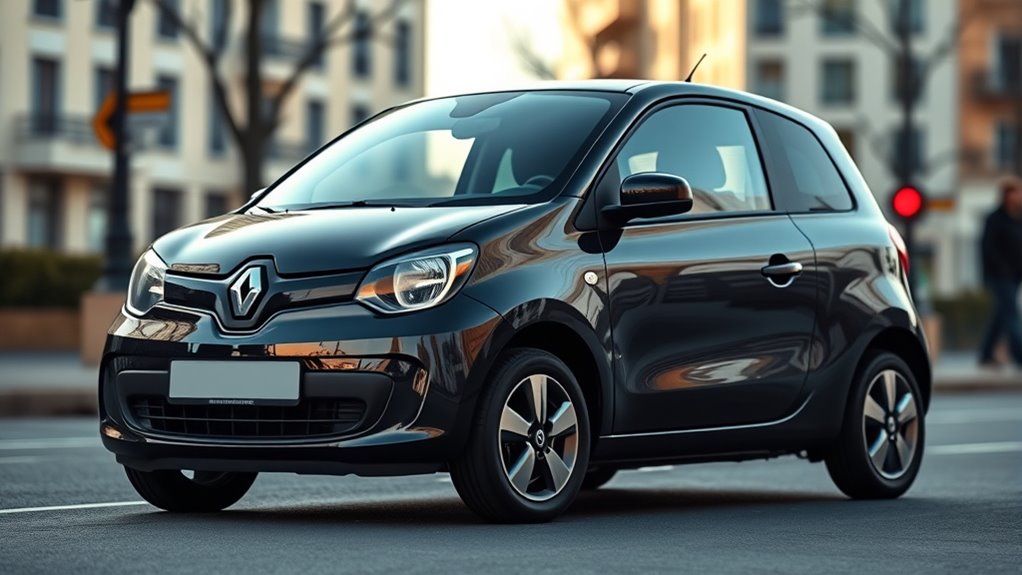
The Renault Twingo E-Tech Electric pairs a 60 kW (82 hp) electric powertrain with 175 Nm of immediate torque, enabling brisk response in urban driving.
Renault quotes 0 to 100 km/h in 12.1 seconds and 0 to 50 km/h in around 3.9 seconds, while a 130 km/h top speed is enough for a European motorway without straining the car’s efficiency-focused setup.
Its compact body measures 3,789 mm in length and 1,720 mm in width, with a kerb weight of 1,200 kg, supporting agile maneuverability in dense traffic and tight parking spaces.
Range reaches up to 263 km on the WLTP cycle, a figure aligned with daily commuting demands; independent testers report a realistic 180–240 km in mixed real-world driving depending on weather and speed.
Inside, every version gets a 7-inch digital driver display and 10-inch touchscreen; the entry-level Evolution runs Renault’s standard multimedia system with wired and wireless Android Auto and Apple CarPlay, while the range-topping Techno adds OpenR Link with Google built-in, extending access to Google Maps, Google Assistant, and the “Reno” avatar.
Together, these key specs position the Twingo E-Tech Electric as a compact electric hatchback oriented toward practical urban freedom rather than outright range or speed.
Twingo E-Tech Powertrain
Powertrain details underline how the Twingo E-Tech turns its compact dimensions into usable everyday performance.
The Twingo E-Tech uses a 60 kW, 82 hp electric motor delivering 175 Nm of instant torque to the front wheels, a configuration that supports brisk, low-speed response in dense traffic. Renault’s own figures put 0 to 50 km/h at 3.85 seconds, helping drivers move with confidence through stop-start city environments, even if the 0-100 km/h sprint (12.1 seconds) is unhurried by EV standards.
A 60 kW electric motor and 175 Nm of instant torque give the Twingo E-Tech a genuine burst of low-speed confidence, even though its 12.1-second 0-100 km/h time keeps it firmly in city-car territory.
The motor is paired with a 27.5 kWh usable (29.0 kWh gross) LFP battery, packaged for efficient energy use in a small footprint. Top speed is limited to 130 km/h, sufficient for expressway sections without compromising the car’s efficiency-oriented character.
For smoother urban deceleration, the Techno trim adds a one-pedal driving mode that increases regenerative braking under lift-off, easing stop-start driving without a separate brake-pedal input.
In the Twingo E-Tech, the electric drivetrain favors accessible mobility, technical simplicity, and a sense of freedom in everyday travel over outright pace.
Range, Charging, and Performance
The Twingo E-Tech Electric uses a 27.5 kWh LFP battery to deliver up to 263 km on the combined WLTP cycle (roughly 10.5 kWh/100 km), balancing urban efficiency with everyday usability.
Charging is where trim level matters most: the base Evolution ships with a 6.6 kW AC onboard charger only, while an optional Advanced Charge package brings both an 11 kW bidirectional AC charger and DC fast charging up to 50 kW.
Note: Don’t assume every Twingo E-Tech can DC fast-charge. Ex-works, the Evolution trim is limited to 6.6 kW AC. The 11 kW AC / 50 kW DC “Advanced Charge” package is a low-cost option worth checking for on the specific car you’re buying, especially if you don’t have off-street parking.
Driving Range
With its 27.5 kWh usable battery, the Twingo E-Tech Electric delivers up to 263 km (163 miles) of WLTP range, aligning it well with short- and medium-distance urban use.
WLTP figures are a lab benchmark rather than a guarantee: independent reviewers who drove the car on international launch routes reported real-world consumption of roughly 4.8–5.0 miles per kWh, putting realistic range closer to 180–240 km (110–150 miles) depending on temperature, speed, and driving style. Renault notes that a typical European city driver covers around 35 km a day, well within the car’s everyday capability.
- 27.5 kWh usable battery (LFP): compact, efficient, urban-focused
- WLTP range: 263 km combined
- Real-world range: roughly 180–240 km depending on conditions
- Regenerative braking: one-pedal driving mode on Techno trim for smoother energy recovery
In practical terms, the platform prioritizes efficiency over long-haul endurance, making it a technically balanced choice for liberating city travel rather than motorway touring.
Charging And Performance
On a standard 6.6 kW AC home wallbox, the Evolution trim charges from 10–100% in around 4 hours 15 minutes. Adding the optional 11 kW AC charger cuts that to roughly 2 hours 35 minutes — useful for destination chargers at supermarkets or gyms.
For drivers who occasionally need a quicker top-up, the optional Advanced Charge package also unlocks DC fast charging at up to 50 kW, recovering 10–80% of the battery in about 30 minutes. The same package enables Vehicle-to-Load (V2L) for powering external devices, and Vehicle-to-Grid (V2G) in supported markets.
Acceleration stays city-focused: 0–50 km/h in 3.85 seconds feels sprightly around town, while the unhurried 12.1-second 0–100 km/h time and 130 km/h top speed are the trade-off Renault made to keep the price and weight down.
Dimensions and Kerb Weight
The current, fourth-generation Twingo E-Tech Electric measures 3,789 mm in length, 1,720 mm in width, and 1,491 mm in height, with a 2,493 mm wheelbase and 143 mm of ground clearance — noticeably larger than the petrol-engined Twingos that came before it, partly to meet modern crash-safety requirements.
Its hatchback body supports genuine four-adult practicality, with two independently sliding rear seats as standard across both trims.
Kerb weight for the electric model is 1,200 kg, a figure that reflects the battery pack and drivetrain hardware while remaining light by current EV standards.
Exterior Dimensions: Then and Now
It helps to separate the new electric car from its predecessors, since “Renault Twingo” has referred to three quite different designs since 1992. The rear-engined, rear-wheel-drive third-generation Twingo (2014–2024) measured roughly 3,595–3,615 mm long depending on facelift year, on a similar 2,492 mm wheelbase, and was discontinued in summer 2024 when the fully electric E-Tech model was announced as its successor.
The new Twingo E-Tech Electric switches to a conventional front-motor, front-wheel-drive layout shared with the Renault 5 and Renault 4 E-Tech on the AmpR Small platform, and grows to 3,789 mm long — about 17–19 cm longer than the outgoing petrol car — largely to accommodate the battery pack and updated safety structure.
- Short overhangs and an 9.8-metre turning circle aid manoeuvrability
- 1,720 mm width keeps gap navigation easy in narrow streets
- 1,491 mm height maximizes usable interior volume
- Sized to fit standard parking bays despite the size increase
This exterior geometry reflects an efficiency-focused design language, balancing city agility with the extra space today’s safety and battery packaging demand.
Kerb Weight
Kerb weight has crept up across the Twingo’s history, largely tracking added safety equipment, technology, and — most recently — battery hardware.
The original 1992 Twingo was famously light, commonly cited at around 750–800 kg for base versions. The rear-engined third-generation petrol Twingo (2014–2024) typically weighed in the region of 950–1,050 kg depending on engine and trim.
The new, fully electric Twingo E-Tech carries a kerb weight of 1,200 kg — heavier than its petrol predecessors, as expected for any EV, but still light for a battery-electric car of any size thanks to its compact 27.5 kWh pack and use of lighter LFP cell chemistry.
Even with this increase, the Twingo remains easy to place in traffic, benefiting from a low mass profile relative to rival EVs that enhances responsiveness and manoeuvrability in congested streets.
Cabin Space and Everyday Use
Inside, the Renault Twingo E-Tech is engineered around compact efficiency, yet it comfortably accommodates four adults with enough practicality for daily urban use. Unlike the outgoing rear-engined Twingo III, the new electric model uses a front-motor, front-wheel-drive layout — the compact motor and single-speed reduction gear under the bonnet free up cabin length that would otherwise be lost to a conventional engine bay, supporting the car’s long 2,493 mm wheelbase and flexible seating arrangement.
- Two independent sliding rear seats move 170 mm fore-and-aft, trading legroom for cargo space or back again.
- Boot capacity is 360 litres with the rear seats slid forward, dropping to 260 litres slid back, and expanding past 1,000 litres with the seats folded flat.
- A further 50 litres of underfloor storage, plus around 19 litres spread across the cabin (glovebox, door bins, console), adds everyday practicality.
- A tight 9.8-metre turning circle simplifies parking and narrow-space access.
For drivers seeking liberation from bulky vehicles, the Twingo offers a technically efficient interior package. It prioritizes usable space, adaptability, and city-friendly movement without demanding excess road space.
Safety Features and Driver Assistance
The Renault Twingo E-Tech incorporates up to 24 advanced driver-assistance systems, varying by trim, to support safer, more controlled driving in both urban and highway conditions.
Its safety features include an occupant safe exit alert, which warns when opening a door could expose occupants to approaching traffic or cyclists, reducing avoidable incidents in dense environments.
For low-speed urban use, hands-free parking assistance — described by Renault as a first for this car segment — helps guide the vehicle into tight spaces with less stress and greater precision.
On open roads, the Techno trim’s adaptive cruise control with Stop & Go and lane-keeping/emergency lane-keeping assist contribute to stable spacing and lane discipline, while traffic-sign recognition, blind-spot warning, rear cross-traffic alert, rear automatic emergency braking, and a driver-fatigue monitoring camera are available depending on trim.
Occupant protection is further strengthened by six airbags and Renault’s “Fireman Access” system, designed to give emergency responders rapid access for battery cooling in the rare event of a fire.
Note: As of testing, the Twingo E-Tech Electric had not yet been crash-tested by Euro NCAP, so no star rating exists for it yet. For reference, the previous, rear-engined Twingo III scored four stars when it was tested in 2014.
E-Tech Design and Infotainment
Building on its safety-focused driver-assistance suite, the Twingo E-Tech’s cabin centers on twin 7-inch and 10-inch digital displays fitted to every version.
The entry-level Evolution trim runs Renault’s standard connected multimedia system with wired and wireless Android Auto and Apple CarPlay, manual climate control, and 16-inch wheels. Stepping up to Techno adds OpenR Link with Google built-in — including Google Maps with real-time charging-station availability, Google Assistant, and access to over 100 apps via the Play Store — plus the “Reno” avatar, which can now handle basic requests using ChatGPT integration, automatic climate control, one-pedal driving, adaptive cruise control, and a folding front-passenger seatback for carrying long items.
- Standard 6.6 kW AC charging works at home, at work, or at public points.
- An optional Advanced Charge pack adds 11 kW AC and 50 kW DC fast charging, recovering up to 80% in around 30 minutes.
- A six-speaker Arkamys sound system on Techno trim was tuned with input from composer Jean-Michel Jarre, right down to the start-up chime.
- Four launch colours are offered: Absolute Red, Absolute Green, Mango Yellow, and Starry Black.
Together, these systems create a compact EV architecture tuned for city use, where straightforward home charging and connected infotainment reduce day-to-day friction.
Trims, R Pass, and Options
The Twingo E-Tech Electric is offered in just two trims: the value-oriented Evolution, aimed at everyday efficiency with sliding rear seats and driver-assistance basics as standard, and the more richly equipped Techno, which adds OpenR Link, adaptive cruise control, automatic climate control, one-pedal driving, and a digital rear-view camera.
Ahead of launch, Renault ran the Twingo R Pass scheme, priced at €100, giving early registrants priority access to order and take delivery of the car ahead of the general public, along with a 1/43-scale model of the Twingo and an exclusive key cover. The pass was made available progressively across Germany, Belgium, Spain, France, Italy, the Netherlands, and the UK from October 2025. R Pass holders in those first six European markets were able to order the Techno trim from 16 December 2025, with general public ordering for Techno opening on 8 January 2026 and the entry Evolution trim following in spring 2026.
Pro Tip: If you mostly drive locally but occasionally want a quicker top-up on a longer trip, check whether the Advanced Charge package (roughly €500) is fitted or available to add — it’s the difference between being limited to slow 6.6 kW AC charging and being able to use public 50 kW DC fast chargers.
Specification freedom extends to exterior colour palettes and interior finishes, enabling a more individualized cabin and body presentation without compromising the car’s compact logic. Every version comes with two independently sliding rear seats as standard, along with the twin 7-inch and 10-inch digital displays.
Price, Rivals, and Positioning
Renault has confirmed pricing for the Twingo E-Tech Electric: the Evolution trim starts at €19,490, and the Techno trim at €21,090, both before government incentives. Ordering is already open across most of continental Europe, with the car on sale and being delivered since spring 2026.
In the UK, Renault is targeting a starting price under £20,000 for the entry trim, though right-hand-drive deliveries are expected to begin in early 2027, making Britain one of the later markets to receive the car.
Its price places it directly against a new generation of affordable small EVs: the Citroën ë-C3, Fiat Grande Panda Electric and Fiat 500e, Hyundai Inster, BYD Dolphin Surf, Leapmotor T03, and Dacia Spring — a much more current and competitive field than the discontinued city EVs of a few years ago.
- Confirmed sub-€20,000 entry price supports accessible electric mobility
- Rivals are current, actively-sold city EVs rather than discontinued models
- 360-litre boot beats the Hyundai Inster’s 351 litres and rivals the Fiat Grande Panda Electric’s 361 litres
- Backed by a 3-year/100,000-mile vehicle warranty and an 8-year/100,000-mile battery warranty
Frequently Asked Questions
What Is Special About the Twingo?
The new Twingo E-Tech Electric stands out for its compact, urban-optimized form, genuine electric efficiency, and up to 24 driver-assistance systems, including hands-free parking — a first for this car segment. Its immediate torque and one-pedal driving mode (Techno trim) create agile, low-stress city driving, and it undercuts most rivals on price while beating several of them on boot space.
What Are the Common Problems With the Renault Twingo?
This depends heavily on which “Twingo” you mean. The long-running petrol-engined generations (1992–2024) were sometimes reported to develop minor electrical faults in locking and windows, clutch and gearbox wear, infotainment glitches, and rust on older bodies — concerns generally manageable with attentive maintenance. The all-new electric Twingo E-Tech only launched in 2025/2026, so there isn’t yet a track record of common faults; its LFP battery chemistry is generally regarded by the industry as tough and cost-effective, and shares its motor and platform with the already-established Renault 5 E-Tech.
Does the Renault Twingo Have a Timing Belt or Chain?
The new Renault Twingo E-Tech Electric has no combustion engine at all, so it has neither a timing belt nor a timing chain — power goes through a single-speed reduction gear instead. The older, petrol-engined Twingo generations (1992–2024) typically used a timing chain rather than a belt, which usually lasted the engine’s life with only periodic inspection needed.
How Many Miles Can a Renault Twingo Last?
Petrol-engined Twingos could commonly reach 100,000 to 200,000 miles with diligent servicing, corrosion control, and sensible driving habits. For the new electric Twingo E-Tech, longevity is really a question of battery health rather than engine wear: Renault backs the traction battery with an 8-year/100,000-mile warranty, and LFP battery chemistry is widely regarded as one of the more durable EV battery types, tolerating frequent full charges without notable degradation.
Conclusion
Overall, the Renault Twingo E-Tech Electric presents itself as a genuinely capable urban electric hatchback, pairing a 60 kW motor, 27.5 kWh battery, and a 263 km WLTP range with easygoing city manners and a starting price from €19,490. Its brisk low-speed response, sliding four-seat cabin, and a 360-litre boot make it well suited to daily commuting and tight streets, while an 8-year battery warranty adds peace of mind. It isn’t quick, and its standard 6.6 kW charging is modest unless you add the Advanced Charge pack — but as an unpretentious, keenly-priced city companion up against the Citroën ë-C3, Hyundai Inster, and BYD Dolphin Surf, it occupies a genuinely competitive middle ground.
Sources
- Renault official media release — pricing, battery, motor, and R Pass details
- Renault UK warranty terms — vehicle and traction-battery warranty coverage
- Renault Twingo E-Tech overview, Wikipedia — dimensions, platform, and production details
- Renault Twingo E-Tech review, Carwow — charging times, boot capacity, and Euro NCAP status
- Renault Twingo E-Tech review, Electrifying — real-world range and rival comparisons