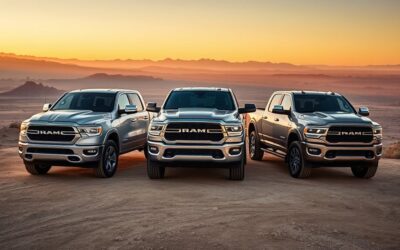
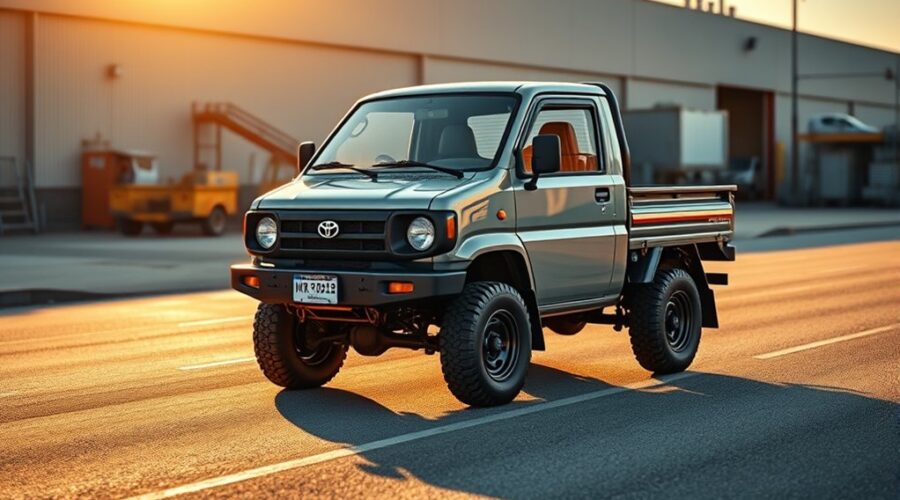
The Toyota Mini Truck aims to balance city-friendly size with useful capability. Its compact footprint, roughly 200 inches long and 70 inches wide, supports easy maneuvering, while the available hybrid powertrain and 226-236 horsepower output suggest efficiency without major compromise. Towing is rated near 3,500 pounds, and payload ranges from 1,500 to 2,000 pounds. Those numbers only tell part of the story, though, especially once the trim and performance details come into view.
Toyota Mini Truck: What It Is and Who It’s For
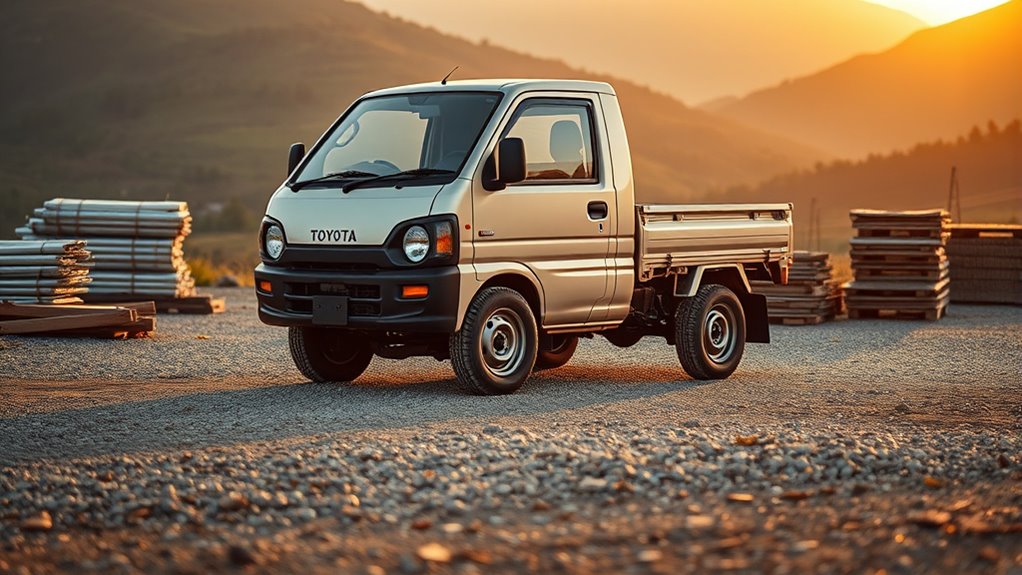
Toyota’s mini truck concept, including the anticipated Stout, is aimed at urban buyers who want pickup utility in a smaller, more efficient package.
The Toyota Mini Truck is positioned as a compact pickup with an expected starting price near $30,000, a level intended to broaden access. Built on TNGA-based unibody architecture, it favors city maneuverability, ride compliance, and packaging efficiency while retaining conventional truck proportions.
Positioned as a compact pickup near $30,000, it blends city maneuverability with practical truck utility.
Its cabin is expected to deliver a crossover-like environment for four to five occupants, with modern interfaces and smart storage suited to practical use. Target users include young urban families, DIY enthusiasts, and small business operators seeking flexibility without excess bulk.
Hybrid options are expected to support fuel efficiency and lower operating costs, while the platform should still allow light towing and hauling.
In technical terms, the vehicle is designed to provide utility with reduced footprint, enabling more autonomous urban mobility.
Toyota Mini Truck Powertrain and Hybrid Specs
Powertrain specifications are expected to be a major part of the Toyota Mini Truck’s appeal, with the 2026 Toyota Stout projected to use hybrid systems tuned for urban efficiency and light-duty capability. Toyota is anticipated to offer front-wheel drive and all-wheel drive versions, balancing performance, fuel economy, and everyday control. The core powertrain may generate 226-236 horsepower, while a plug-in hybrid variant could exceed 300 horsepower for stronger acceleration and more flexible use.
| Setup | Output | Use Case |
|---|---|---|
| Hybrid FWD | 226-236 hp | Efficient commuting |
| Hybrid AWD | 226-236 hp | Light hauling |
| Plug-in hybrid | 300+ hp | Higher performance |
The unibody platform, derived from the RAV4 architecture, should support lower maintenance needs and reduced fuel costs over time. Realistic towing capacity is expected to reach about 3,500 pounds, aligning the Toyota mini truck with practical work and travel demands.
Toyota Mini Truck Dimensions and Bed Sizes
Toyota mini truck dimensions are typically engineered for compact body measurements that support maneuverability in urban settings and fit within garage-friendly constraints.
Bed length options vary by model, with configurations such as 5-foot and 6-foot beds providing different cargo capacities for work and recreational use.
Cab layout and cargo space are balanced to preserve passenger room while maintaining practical hauling utility.
Compact Body Measurements
Sized for urban use, the Stout is expected to carry compact body measurements that balance pickup practicality with easy maneuverability, with an overall length projected at about 200 inches and a width near 70 inches.
These dimensions place the model within the compact pickup range, supporting garage-friendly storage and confident navigation through dense streets. Its unibody architecture should further improve maneuverability, simplify parking, and preserve a clean pickup appearance without unnecessary bulk.
The bed lengths are anticipated to span roughly 5 to 6 feet, providing sufficient utility for cargo, tools, and outdoor gear. Practical bed features such as tie-down points and outlets should strengthen everyday use.
The result is a restrained, functional layout designed to maximize freedom of movement in constrained environments.
Bed Length Options
Bed length options further define the mini truck’s utility, with the Tacoma-style layout commonly offering approximately 5-foot and 6-foot cargo boxes to suit different hauling demands.
In the Toyota mini truck, the 5-foot bed measures about 60.5 inches, while the 6-foot version reaches roughly 73.7 inches, expanding the cargo area for tools, supplies, or recreational gear.
Both configurations use durable materials to resist abrasion and weathering during repeated use. Integrated tie-down points improve load control and practical versatility.
The shorter bed supports greater maneuverability in tight urban streets, while the longer bed favors larger payloads without sacrificing compact proportions.
These bed length options give the Tacoma a flexible, work-ready character, balancing utility, access, and freedom of movement for users who need efficient transport solutions.
Cab And Cargo Space
A compact footprint defines the Toyota mini truck’s cab and cargo space, with the upcoming Stout engineered for urban maneuverability while preserving practical hauling capacity. Its compact dimensions favor tight streets, narrow parking gaps, and efficient city use without surrendering utility.
The cab is expected to provide interior space for four to five passengers, with smart storage solutions arranged to support daily work and personal transport. Cargo capability is reinforced by anticipated five-foot and six-foot bed options, allowing the truck to adapt to tools, equipment, or recreational gear.
A unibody layout should improve structural efficiency and cargo volume, while tie-down points and bed outlets add functional control. The result is a liberated, task-ready package that balances cabin comfort, cargo access, and everyday flexibility.
Toyota Mini Truck Towing and Payload Limits
Toyota mini truck towing and payload limits vary by model, with the Stout projected at about 3,500 pounds of towing capacity, the Tacoma at 6,500 pounds, and the Tundra at up to 9,500 pounds.
Payload ratings are similarly differentiated, with the Tacoma reaching up to 1,705 pounds to support hauling demands in mixed-use conditions.
These figures define the practical range for hauling and trailering, especially for buyers comparing light-duty utility against higher-capacity truck configurations.
Towing Capacity Limits
Towing and payload limits on Toyota mini trucks vary by model and configuration, with the Tacoma reaching up to 6,500 pounds of towing capacity and as much as 1,705 pounds of payload capacity for cargo in the bed.
This towing capacity positions the Tacoma for broad utility, while the Hilux can be specified for roughly 3,500 kg, or 7,700 lbs, in select trims.
The 2026 Toyota Stout is projected near 3,500 pounds, indicating a lighter-duty focus.
Trailer Backup Guide support is included across models to improve control during hitching and maneuvering.
These figures reflect engineered capability rather than excess, giving operators measured freedom to haul equipment, materials, or trailers with confidence, provided configuration, equipment, and conditions remain within the manufacturer’s rated limits.
Payload Rating Details
Payload ratings define how much weight a Toyota mini truck can safely carry in the cab and bed, and they vary considerably by model and configuration.
For Tacoma, payload ratings can reach 1,705 pounds of cargo, while the anticipated Toyota Stout is projected near 1,500 to 2,000 pounds. These figures support practical utility without compromising control.
Hybrid powertrain tuning in newer models improves torque delivery and efficiency, which helps preserve usable capacity alongside towing capacity.
Bed layouts with multiple tie-down points keep cargo organized and secure, reinforcing confidence in daily work and independent movement.
- Tacoma: higher load flexibility
- Toyota Stout: urban-focused payload
- Hybrid powertrain: efficient force
- Cargo secured: greater freedom
Hauling And Trailering
When hauling duties call for measured capability, Toyota’s truck lineup offers clear distinctions in towing and payload limits.
The Stout is expected to deliver about 3,500 pounds of towing capacity, positioning it for light trailers and compact utility work. Its anticipated hybrid powertrain should support efficient urban operation without sacrificing practical hauling function.
The Tacoma extends the range substantially, with up to 6,500 pounds of towing capacity and a payload capacity of 1,705 pounds, making it the stronger choice for heavier cargo and broader trailering demands.
Across the lineup, Trailer Backup Guide technology improves control when reversing with a trailer. Available four-wheel drive adds traction on uneven routes, while performance front seats help maintain secure support during long-duty transport and recreational use.
Toyota Mini Truck On-Road and Off-Road Performance
The Toyota Mini Truck’s on-road and off-road performance is expected to center on an efficient hybrid powertrain producing roughly 226 to 236 horsepower, balancing responsive acceleration with improved fuel economy. This hybrid technology should support smooth power delivery in urban commuting, where front-wheel drive may favor efficiency and all-wheel drive can add traction in rain, snow, or loose surfaces.
Regenerative braking is likely to improve control at low speeds, while the projected 3,500-pound towing capacity broadens utility for light hauling.
- Confident city movement can feel liberating.
- AWD may strengthen control on rough terrain.
- Calm low-speed response supports precise handling.
- Light towing adds practical freedom outdoors.
Its unibody structure will probably enhance maneuverability and ride comfort, though it may constrain heavy off-road capabilities compared with body-on-frame trucks.
Toyota Mini Truck Interior and Tech Features
Inside the Toyota Mini Truck, a crossover-like cabin is expected to prioritize comfort and practicality, with supportive seating for four to five occupants and smart storage solutions that improve everyday usability.
The interior layout appears engineered for efficient packaging, giving passengers usable space without sacrificing cargo flexibility. Material choices and seat contours are likely tuned for long-distance comfort, while higher trims may add automatic climate control, heated seats, and ventilated seats for finer cabin regulation.
Tech features should center on a large touchscreen, wireless connectivity, multiple USB-C ports, and wireless charging, creating a streamlined interface for drivers who want fewer constraints.
Safety features are projected to include the Toyota Safety Sense suite as standard, supporting collision avoidance, lane assistance, and broader driver awareness.
Toyota Mini Truck Pricing, Trims, and Configurations
Pricing and configuration strategy for the 2026 Toyota Stout is expected to position the compact pickup as an accessible entry in Toyota’s truck lineup, with an estimated starting price near $30,000.
That pricing would place it below the Tacoma, which begins at $32,545, while preserving a practical range of trims and configurations for urban use.
Street-oriented and off-road packages are anticipated, allowing buyers to select a setup aligned with daily mobility or more capable light-trail duty.
Front-wheel drive and all-wheel drive versions are projected, adding flexibility without complicating the core package.
Upper trims may integrate advanced technology such as wireless charging and multiple USB-C ports, supporting connected, liberated movement.
- Lower entry pricing may widen access.
- Distinct trims can match individual purpose.
- AWD configurations may expand terrain freedom.
- Advanced technology can reduce daily friction.
Toyota Mini Truck Pros and Trade-Offs
Although compact enough to suit dense city use, the Toyota mini truck’s expected strengths come with clear trade-offs that define its role in the market. The hybrid powertrain should yield about 226-236 horsepower, supporting efficient urban driving while preserving useful front-end response. A unibody layout and smaller dimensions improve parking, visibility, and maneuverability, yet they also limit ruggedness compared with a traditional body-on-frame pickup truck. Safety equipment is expected to be standard, reducing buyer burden and improving confidence for new owners.
| Advantage | Trade-off | Effect |
|---|---|---|
| Hybrid powertrain | Higher complexity | Better efficiency |
| Compact dimensions | Reduced cargo volume | Easier city use |
| Standard safety | Less off-road focus | Lower ownership stress |
With a projected 3,500-pound towing rating and a starting price near $30,000, it offers accessible utility for young families and small businesses. The compromise is clear: it favors liberation from fuel and parking constraints over heavy-duty capability.
Frequently Asked Questions
Are There Any Rumors About a New Toyota Small Truck?
Yes, rumors point to future models like a compact Toyota Stout with design updates, hybrid options, off road capabilities, and pricing trends near $30,000, driven by market demand for efficient, versatile small trucks.
How Many Miles to the Gallon Does a Japanese Mini Truck Get?
A Japanese mini truck typically gets 30–40 MPG, depending on fuel efficiency, engine types, and driving conditions. Maintenance tips improve results; owner reviews and comparison charts often confirm these figures across models.
Which Mini Truck Is the Fastest?
The Toyota Tacoma appears fastest, its turbocharged hybrid powertrain standing like a lightning bolt among mini truck performance benchmarks. Speed comparisons favor it; engine specifications, aftermarket modifications, racing potential, and driving experiences all support that assessment.
How Fast Can a 660CC Kei Truck Go?
A 660cc kei truck typically reaches about 62 mph, or 100 km/h, under Japanese speed limitations. Its kei truck performance depends on engine specifications, light weight, driving experience, weight capacity, and available tuning options.
Conclusion
In conclusion, the Toyota Mini Truck presents itself as the automotive equivalent of a highly organized apartment: compact at roughly 200 inches long, efficient, and surprisingly capable. Its 226-236 horsepower powertrain, hybrid availability, 3,500-pound towing rating, and 1,500-2,000-pound payload suggest genuine utility, provided expectations remain appropriately miniature. It is aimed at drivers who want practicality without bulk, and who appreciate that a truck can be useful, economical, and just slightly amused by its own existence.