
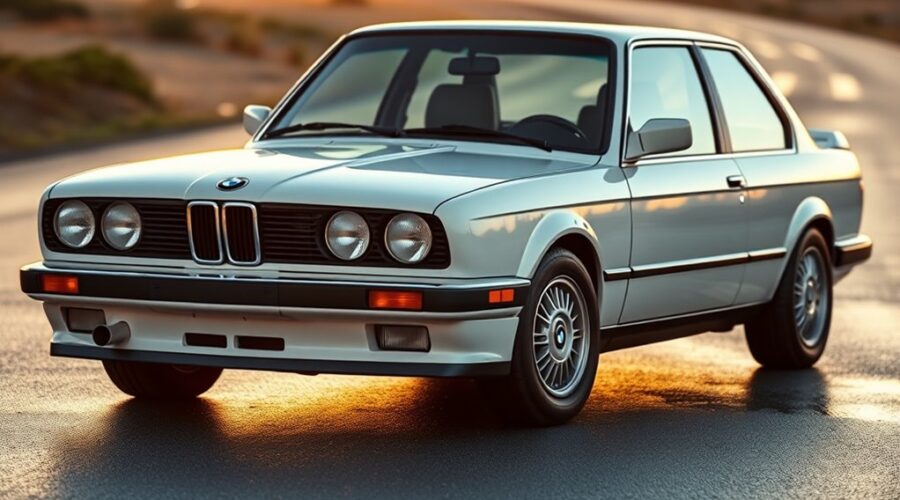
The BMW E30, built from 1982 to 1994, remains a benchmark for compact rear-wheel-drive design. Its range spans the 1.8L M10 four-cylinder to the M20 six-cylinder, with outputs from 90 to 235 hp. Dimensions stay neatly balanced at 4,370 mm long and 2,460 mm between the wheels. Yet the most notable details are not only in the numbers, but in how the model changed across body styles, drivetrains, and special versions.
BMW E30 Overview
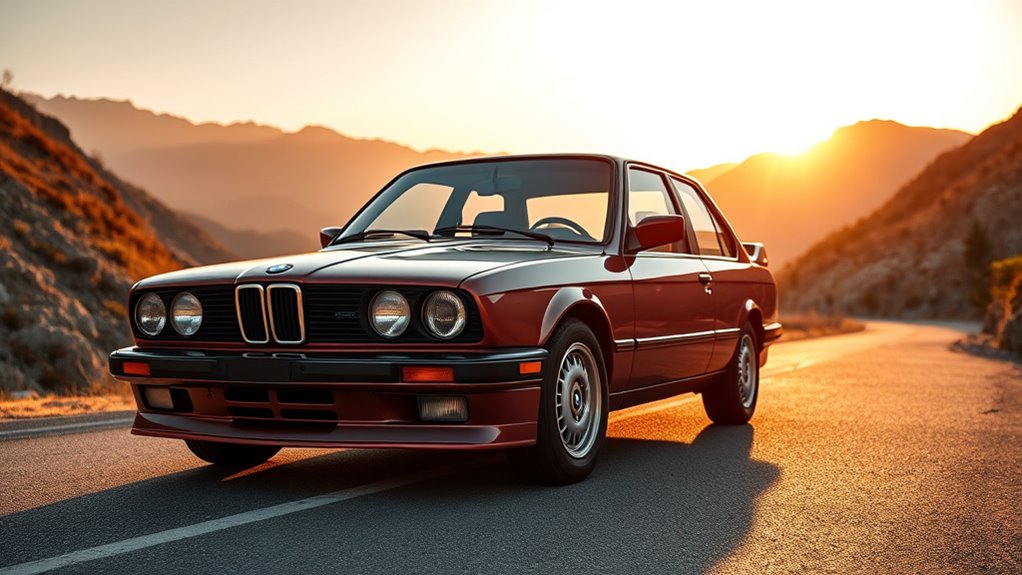
The BMW E30 was produced from 1982 to 1994 and established itself as one of the brand’s most successful compact models, with more than 2.4 million units sold across coupe, sedan, convertible, and touring body styles.
It presented a balanced BMW formula: rear-wheel drive, manual or automatic transmission choices, and compact dimensions that supported agile road manners. Its wheelbase measured 256.2 cm, overall length 436 cm, and curb weight 1165 kg, reinforcing a light, purposeful stance.
The range included four-cylinder and six-cylinder variants, while the M3 arrived in 1986 as the defining performance model, linking the E30 name to motorsport credibility. An all-wheel-drive 325ix followed in 1988, broadening the lineup’s capability.
The range included four- and six-cylinder variants, with the M3 and 325ix expanding its performance and capability.
Across the range, the E30 combined restrained size, clear engineering, and performance potential, giving drivers a car that favored control, independence, and direct engagement over excess.
BMW E30 Engine Options
Engine choices gave the BMW E30 much of its character, ranging from the 1.8-liter M10 four-cylinder with 90 PS to the M20 six-cylinder units available in 2.0-liter to 2.5-liter form, producing roughly 121 bhp to 168 bhp depending on the model.
Within the BMW 3 Series range, the E30 engine lineup also included the 318is, whose updated four-cylinder delivered 111 hp and sharpened everyday response.
Diesel buyers could choose the 2,443 cc M21 in the 324d, while the turbocharged 324td added stronger midrange pull from 1987.
The M3 Evolution used the S14 unit, with outputs from 192 hp to 235 hp, reinforcing the model’s motorsport identity.
Transmission options were broad, with four manual and two automatic choices, and the 325iX introduced all-wheel-drive for added traction.
Together, these engines defined a flexible, freedom-oriented balance of efficiency, refinement, and performance across the E30 range.
BMW E30 Performance by Model
Across the BMW E30 range, performance varied sharply by model, allowing the chassis to serve everyone from economy-minded drivers to enthusiasts.
The 318i sat at the entry point, using a 1.8L M10 engine for 90 PS and modest acceleration.
The 325e prioritized fuel efficiency, pairing a 2.7L straight-six with strong low-end torque and 121 hp for calmer, economical driving.
Introduced in 1985, the 325i brought the M20 engine to 168 bhp, giving the line a more assertive balance of performance and daily usability.
The all-wheel-drive 325iX used the same M20 engine but added traction and stability for mixed conditions, broadening its appeal across model year updates.
At the top, the E30 M3 used the S14 engine, producing 192 to 235 hp and delivering sharp agility, motorsport pedigree, and freedom for drivers seeking the most focused response.
BMW E30 Body Styles and Dimensions
In addition to its wide performance range, the BMW E30 was offered in several body styles that broadened its appeal and practical use. The E30 body lineup included a 2-door coupe, 4-door sedan, convertible, and, from 1987, a 5-door station wagon.
All variants shared a 2,460 mm wheelbase, giving each model a consistent stance and balanced proportions. Its dimensions were compact by modern standards, measuring about 4,370 mm in length, 1,690 mm in width, and 1,360 mm in height, supporting an agile, uncluttered profile.
All variants shared a 2,460 mm wheelbase, with compact dimensions and balanced, agile proportions.
- 2-door coupe: lighter and more compact in feel
- 4-door sedan: added practicality with similar proportions
- 5-door station wagon: expanded cargo-focused versatility
- Wheelbase: identical across the range for predictable packaging
- M3 variant: flared fenders and a wider stance
The M3 variant stood apart with flared fenders and a wider track, creating a more assertive look while preserving the E30’s disciplined shape.
BMW E30 Transmission and Drivetrain
BMW E30 transmission and drivetrain choices were broad enough to suit both everyday use and performance-focused driving, with four manual and two automatic configurations offered across the range. The E30 kept rear-wheel-drive as standard, preserving a balanced, driver-centered feel, while the 325iX added all-wheel drive in 1988 for broader traction. Manual transmission choices included 4-speed and 5-speed units; automatics were typically 3-speed, later 4-speed. Six-cylinder versions, including the 325i, commonly used a 5-speed manual to sharpen acceleration and response. The M3 paired its S14 engine with a close-ratio 5-speed manual, emphasizing performance and control.
| Model | Drivetrain | Transmission |
|---|---|---|
| Base E30 | Rear-wheel-drive | 4-speed manual |
| Mid-range E30 | Rear-wheel-drive | 5-speed manual |
| 325i | Rear-wheel-drive | 5-speed manual |
| 325iX | All-wheel drive | Automatic/manual |
| M3 | Rear-wheel-drive | Close-ratio 5-speed manual |
BMW E30 Suspension and Brakes
A hallmark of the E30 chassis is its suspension and brake layout, which combines a front MacPherson strut setup with a rear semi-trailing arm design to preserve cabin space while delivering sharp, composed handling.
This E30 suspension gives the car a controlled ride and responsive turn-in, reinforcing its liberated, driver-focused character. All models use disc brakes on the front wheels, with early cars fitted with solid discs and later versions gaining vented discs for stronger heat management.
Rear brakes are usually solid discs, though some four-cylinder variants used drums. In 1986, an anti-lock braking system was added, increasing stability during hard stops and variable road conditions.
- Front MacPherson struts support precise steering.
- Rear semi-trailing arms balance comfort and agility.
- Vented discs improve repeated braking performance.
- ABS adds confidence under braking.
- The package helped define the E30 as a driver’s car.
BMW E30 M3 and Special Editions
Building on the E30 chassis’s balanced suspension and braking hardware, the M3 version sharpened the formula into a homologation special. The E30 M3 used the S14 engine, with horsepower ranging from 192 to 235 depending on variant, giving the compact coupe notable performance and a 0-60 mph time of about 6.5 seconds.
Its purposeful bodywork and chassis tuning served racing aims while remaining usable on public roads. Among the special editions, the Sport Evolution stood out with 235 hp, lightweight components, and a production run of only 600 units.
Other limited models, such as the Cecotto and Ravaglia editions, added horsepower and unique styling details tied to motorsport identities. Outside the M3 line, the Australian-only 323i JPS edition showed how special editions could combine Recaro sports seats, a limited-slip differential, and a restricted 70-unit build.
Together, these versions illustrate how the E30 platform was turned toward freedom through speed.
BMW E30 Production Timeline
BMW E30 production began in October 1982, with the first cars reaching buyers in November, establishing the model as the longest-lived generation of the 3 Series.
Early output centered on 2-door and 4-door saloon versions, while the Touring variant was added in 1987 to broaden the range.
Regular 2-door production ended in April 1991, and the final E30s were Touring models built in 1994 and sold as 1995 model year cars.
Early Development Milestones
Development of the E30 began in July 1976 under chief designer Claus Luthe, with the project’s final design approved in 1978 and the design freeze completed in 1979. The E30 development emphasized aerodynamic refinement, balanced proportions, and a freer, more modern saloon layout.
- 1976: development launched
- 1978: design approval
- 1979: freeze completed
- CAD and crash testing guided validation
- 1982: production and release began
The launch film recorded the design process in detail, showing how engineering discipline shaped the M30-era platform. Series production started in October 1982, and the model reached the market in November with updated suspension and interior design relative to the E21.
Body styles expanded through the production phase, including the Touring, which appeared later and broadened practical use.
Production Run Endpoints
Series production of the BMW E30 began in October 1982 and continued until 1994, giving it the longest production run of any 3 Series generation.
The E30 reached key endpoints in stages: the two-door saloon left series production on April 30, 1991, followed by the four-door saloon ending in February 1992.
Final output came from the Touring variant, built in 1994 and sold as a 1995 model year.
This extended production run reflected sustained demand across markets and supported the model’s global presence.
Assembly took place in Munich, Regensburg, and Rosslyn, South Africa, reinforcing broad reach and manufacturing flexibility.
The timeline shows how the E30 remained relevant long after its 1970s development phase, maintaining a clear presence through the early 1990s.
Frequently Asked Questions
What Are the Performance Specs of the BMW E30?
The BMW E30’s performance specs vary by engine variants, with 105–235 bhp, rear-wheel-drive balance, strong weight distribution, and precise suspension setup. Its racing heritage supports lively driving experience, while E30 tuning options and performance upgrades expand capability.
Which E30 Engine Is Best?
The best E30 engine often appears to be the M20 six-cylinder, by coincidence matching many drivers’ hopes: strong reliability ratings, broad tuning potential, acceptable fuel efficiency, balanced weight distribution, and an engaging driving experience.
Why Is the BMW E30 so Special?
It is special for its classic design, balanced driving experience, cultural impact, strong aftermarket support, enduring community enthusiasm, proven racing heritage, and timeless appeal, which together make it a remarkably liberated, engaging classic.
Which Year Was the Best for the BMW E30 M3?
1988 is often judged best: race-bred yet refined, raw yet balanced. Its E30 racing history, M3 design evolution, Classic car culture, E30 restoration tips, BMW E30 modifications, M3 vs. competitors, Iconic E30 features remain decisive.
Conclusion
To sum up, the BMW E30 combines compact dimensions, varied engine choices, and balanced rear-wheel-drive dynamics into a package that remains highly regarded. Its range from efficient four-cylinder models to the high-performance M3 gave it broad appeal across drivers and markets. With multiple body styles, capable suspension, and durable engineering, the E30 stands as a benchmark of 1980s BMW design, a well-tuned machine that continues to cast a long shadow over the classic-car world.