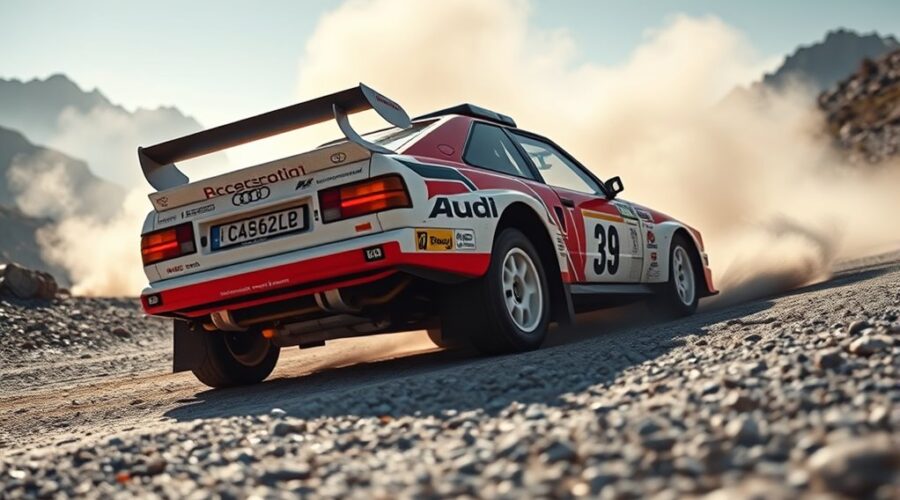
The Audi Quattro changed rally engineering when it arrived in 1981. Its turbocharged inline-five produced serious output, while the lightweight body and shortened wheelbase improved traction and response. The car’s claimed 0–100 km/h time of 3.1 seconds and 1,090 kg curb weight suggest a machine built for speed and control. Its championship record hints at a deeper technical story that still invites scrutiny.
Audi Quattro Overview
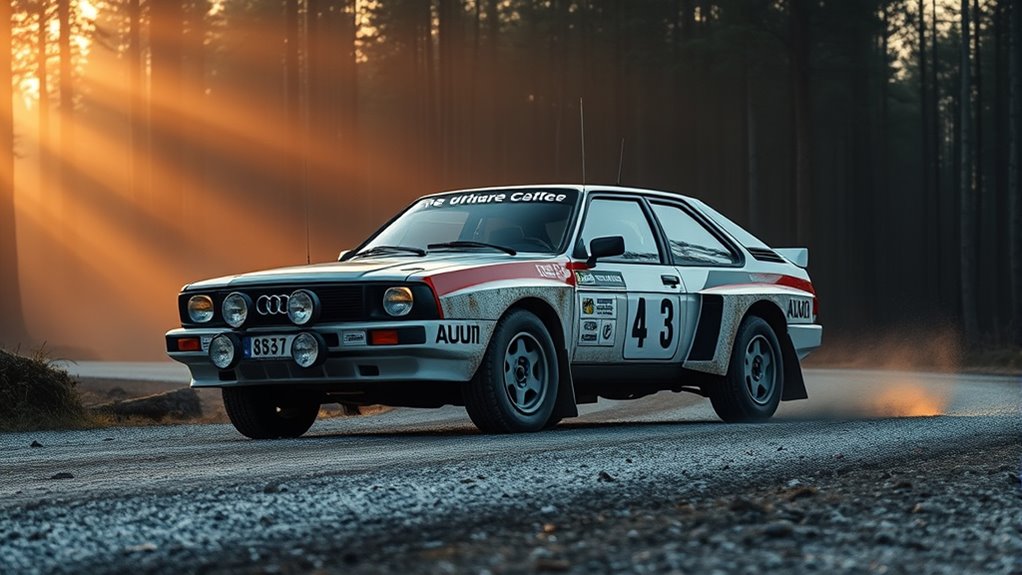
Introduced in 1981, the Audi Quattro was the first rally car to reliably use all-wheel drive, and it quickly changed the direction of the sport. The Audi Quattro, often called the Ur-Quattro, was produced from 1980 to 1991, with 11,452 units built.
Its 2.1L inline-5 turbo engine gave the car a clear power advantage, starting at 200 PS and rising to 220 PS by 1989. Performance figures were strong for the era: curb weight ranged from 1,290 to 1,350 kg, and 0 to 100 km/h took 7.1 seconds.
In Group B, the Quattro converted technical specifications into championships, giving Audi a dominant presence in rally competition. Its dimensions and mechanical layout reflected a practical but forceful design philosophy.
The result was a rally car that combined traction, power, and performance in a form that expanded what drivers could expect from competition machinery.
Why Audi Built the Sport Quattro
Audi developed the Sport Quattro to satisfy Group B homologation rules, requiring a limited production run of 200 units.
The model also targeted weight reduction and a shorter wheelbase, addressing the original Quattro’s size and agility limits.
These changes were intended to improve handling, stability, and overall rally performance.
Homologation Requirements
To satisfy FIA Group B homologation rules, the Sport Quattro was built as a limited-production road car, with Audi required to produce 200 units to qualify its competition version.
The Sport Quattro S1 followed in 1984, adding 20 examples to meet revised homologation requirements. This strategy let the Audi Quattro evolve into a production car that could support racing development without surrendering technical intent.
The shorter wheelbase, cut by 32 cm, improved agility and preserved advanced engineering in service of competition. Although the platform was road-legal, its purpose was clear: enable higher power output, demonstrate compliance, and keep Audi in Group B.
The result was a controlled bridge between public roads and liberated racing performance, with homologation serving as the mechanism that legitimized the machine.
Weight Reduction Goals
Built to correct the original Quattro’s weight penalty, the Sport Quattro used aluminum, kevlar, sheet steel, and plastic body panels to cut curb weight to 1,090 kg (2,403 lbs). This weight reduction paired lightweight materials with a shortened 32 cm wheelbase and a lattice-tube shell, preserving structural integrity while improving maneuverability and agility.
| Element | Effect |
|---|---|
| Aluminum | Lower mass |
| Kevlar | Higher strength-to-weight |
| Plastic panels | Reduced curb weight |
| Rear radiator | Balanced weight distribution |
Advanced engineering also moved the radiator rearward and trimmed ancillary components, refining the powertrain package around a lean chassis. The result was a Sport Quattro built for liberation through less mass, cleaner response, and sharper control. These choices supported performance without excess, making the platform more direct and efficient.
Rally Performance Gains
With the weight reduced to 1,090 kg, the Sport Quattro’s compact package was aimed directly at Group B performance requirements. Audi shortened the dimensions to improve agility, then paired the chassis with extensive lightweight materials such as kevlar and aluminum.
The 2.1L inline-5 powertrain delivered 470 factory horsepower, with some rally specifications estimated above 500, giving the Sport Quattro S1 explosive acceleration and stronger stage speed. A 0-100 km/h time of 3.1 seconds placed it among the era’s quickest cars.
The power-shift gearbox further sharpened performance by reducing interruption during gear changes. In rally use, the result was clearer handling, faster direction changes, and greater freedom on loose terrain.
These gains explain why Audi built the Sport Quattro: to dominate Group B through compact dimensions, efficiency, and power.
Sport Quattro S1 Design Changes
The Sport Quattro S1 underwent extensive structural revision, most importantly a wheelbase shortened by 32 cm to sharpen agility and handling. The Sport Quattro S1 paired design modifications with lightweight materials, including kevlar and aluminum, producing a reduced curb weight of 1,090 kg and a more responsive chassis. A rear-mounted radiator improved weight distribution, while the lattice-tube structure added stiffness without excess mass. Large overhangs and a massive rear wing increased aerodynamic downforce, helping stabilize the car at speed and under braking. Some examples also used an early dual-clutch automatic gearbox, reflecting advanced control architecture for its era.
| Element | Effect |
|---|---|
| Shortened wheelbase | Faster directional change |
| Rear wing and overhangs | More aerodynamic downforce |
| Structure | Benefit |
| Lattice-tube frame | Lower mass, higher rigidity |
These engineering choices gave the S1 a freer, more precise character on loose surfaces.
Turbo Five-Cylinder Powertrain
Audi’s turbocharged 2.1-liter inline-five served as the Quattro’s core powerplant, rated at 470 horsepower with estimates placing actual output above 500 horsepower. This turbocharged inline-5 engine formed a brutally effective powertrain, pairing high boost pressure with a 79.3 mm bore, 86.4 mm stroke, and 7.5:1 compression ratio.
Audi also used a dual-clutch automatic gearbox, an advanced choice that anticipated later DSG systems and helped keep boost delivery controlled under load. The result was immediate force and measurable performance capabilities, including 0 to 100 km/h in 3.1 seconds.
Lightweight construction, with aluminum used in key areas, kept curb weight near 1,090 kg, improving the power-to-weight ratio and sharpening response on the rally stage. In technical terms, the package translated engine output into usable traction, allowing the Quattro to convert mechanical energy into forward motion with unusual efficiency and freedom from hesitation.
Performance, Weight, and Dimensions
Power and packaging define the Audi Sport Quattro S1’s stage performance: its 2.1-liter inline-five is estimated at 500 horsepower and enables 0 to 100 km/h acceleration in 3.1 seconds.
The Sport Quattro S1 uses a 1L inline-5 engine layout? No, the turbocharged five-cylinder package is paired with a curb weight of 1,090 kg, giving a strong power-to-weight ratio that sharpens performance on loose surfaces.
Its shortened dimensions matter as much as output: overall length is 4,240 mm, while the 2,224 mm wheelbase improves agility and directional response.
- Top speed reaches about 220 kph.
- Ventilated 295 mm discs with four-piston calipers strengthen braking systems.
- Compact dimensions support fast shifts and control.
This combination of acceleration, top speed, and chassis packaging made the Sport Quattro S1 a highly effective rally machine.
Rally Wins and Lasting Legacy
The Audi Sport Quattro S1 recorded key results from its debut, including a second place at the 1985 1000 Lakes Rally and a San Remo Rally victory for Walter Röhrl.
Its competitive record also included Pikes Peak success with Michele Mouton and Röhrl, while drivers such as Hannu Mikkola and Stig Blomqvist helped establish Audi’s Group B dominance.
Although withdrawn in 1986, the S1’s event wins and extreme performance secured a lasting motorsport legacy.
Key Rally Victories
With its turbocharged power and advanced quattro drivetrain, the Audi Sport Quattro S1 quickly established a formidable rally record. In Group B, the Sport Quattro S1 delivered rally victories that reshaped the world championship landscape. It finished second on debut at the 1000 Lakes Rally, then won the San Remo Rally with Walter Röhrl, confirming it as a powerful rally car.
- Pikes Peak: record run in 1987, 10:47.85
- Michèle Mouton: rally class win in 1984, overall win in 1985
- 23 world championship event wins: 1984 to 1986
At Pikes Peak, Walter Röhrl set an unmatched benchmark for years. Despite a short career, the S1 became a reference point for performance, control, and mechanical freedom, leaving a lasting technical legacy in motorsport and engineering.
Iconic Drivers
Among the most influential drivers to campaign the Audi Sport Quattro S1, Walter Röhrl, Michèle Mouton, Hannu Mikkola, and Stig Blomqvist each demonstrated how Audi’s quattro system could be converted into results at the highest level.
Walter Röhrl delivered rally victories at San Remo and a Pikes Peak record in 1987.
Michèle Mouton, the first woman to win a world championship rally, secured victories in the Audi Sport Quattro, including Pikes Peak in 1985.
Hannu Mikkola helped Audi earn championship titles in 1982 and 1983 through consistent speed in Group B.
Stig Blomqvist added further wins across long- and short-wheelbase cars.
Together, these drivers converted engineering advantage into 23 world championship event wins, underscoring the Audi Sport Quattro’s competitive reach.
Enduring Motorsport Legacy
Audi’s Sport Quattro S1 translated its technical advantages into marquee results, including Walter Röhrl’s 1985 San Remo Rally victory and the 1987 Pikes Peak International Hill Climb record of 10 minutes, 47.85 seconds.
The Audi Quattro line, and especially the Sport Quattro S1, defined Group B speed through advanced engineering and uncompromising performance. Driven by Hannu Mikkola, Michele Mouton, and Stig Blomqvist, the rally car supported Audi’s dominance before withdrawal in 1986 ended the category’s most extreme era.
- Powerful rally car benchmarks
- Pikes Peak supremacy
- Enduring legacy in motorsport
As a powerful rally car, it remains a reference point for traction, turbo response, and control.
Its legacy persists in later rally and road-car engineering, where liberation from convention still matters.
Frequently Asked Questions
How Fast Was the Audi Quattro Rally?
It reached 0–100 km/h in 7.1 seconds and exceeded 220 km/h. In rally history, turbo technology, all wheel drive, driver legends, race strategy, suspension design, engine specs, weight distribution, competition impact, fan culture shaped liberation.
Which Audi Rally Car Is Considered the Best?
The Audi Sport Quattro S1 is generally considered best, for Quattro legacy, Rally innovations, Performance benchmarks, Driver experiences, Engineering feats, Historic races, Team dynamics, Fan culture, Technology evolution, and Competitive edge in liberation-minded motorsport analysis.
What Are the Key Features of the Audi Sport Quattro?
A wolf in sheet metal, the Audi Sport Quattro featured Quattro technology innovations, turbocharged engine performance, all wheel drive advantages, lightweight construction benefits, aerodynamic design features, iconic rally legacy, driver control enhancements, suspension tuning details, historic rally victories, competitive edge strategies.
How Many Audi Quattro Rallys Were Made?
11,452 Audi Quattro production numbers were made. Rally car history shows Group B era driver achievements, Audi engineering innovations, and motorsport regulations impact shaped the Quattro evolution timeline, rally car design, iconic rally victories, legacy in motorsports.
Conclusion
To summarize, the Audi Quattro combined a turbocharged five-cylinder powertrain, reduced wheelbase, and lightweight construction to create a highly effective rally platform. Its most striking statistic is the car’s 23 world championship wins between 1984 and 1986, a figure that underscores its competitive impact far beyond its modest 1,090 kg curb weight. With up to 470 horsepower and 0 to 100 km/h in 3.1 seconds, the Quattro established a lasting benchmark in rally engineering.