

1980s cars moved from sharp, wedge-shaped styling toward smoother, more aerodynamic bodies while adding turbocharging, fuel injection, digital displays and new safety systems. This guide covers the main design trends, the iconic models and the technology that made the decade a bridge to modern cars.
Quick Answer
1980s car design was defined by angular styling, wedge profiles, improving aerodynamics, pop-up headlights, digital instrumentation, turbocharging, and increasingly integrated safety technology. Cars such as the Corvette C4, Nissan 300ZX, Toyota Supra, Porsche 959, Ferrari F40, and Ford Taurus show how the decade moved from crisp-edged shapes toward smoother, more technical designs.
What Defined 1980s Car Design?
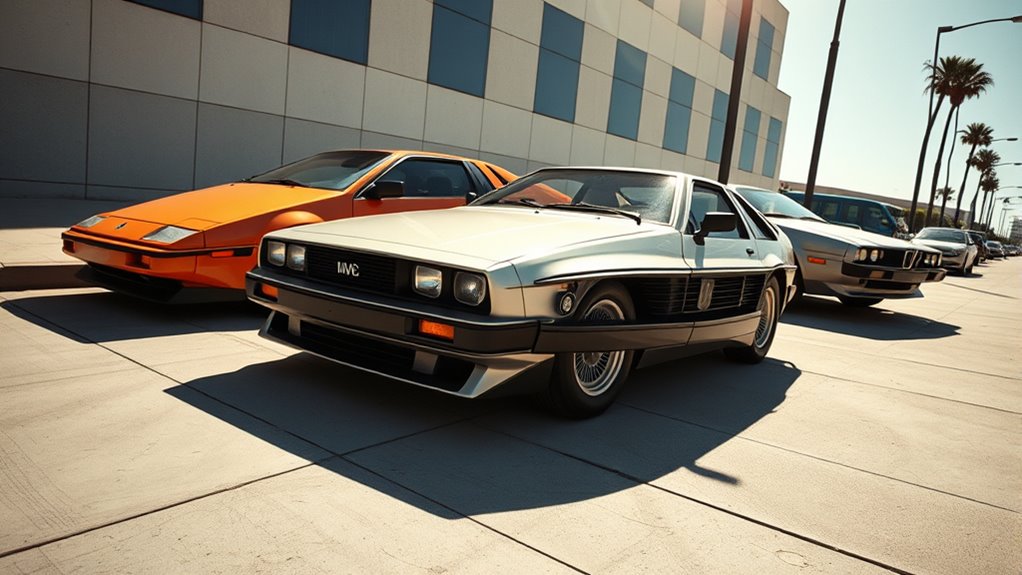
1980s car design was defined by a transition from crisp, geometric shapes to smoother and more aerodynamic forms. That shift affected sports cars, family sedans, luxury models, and even minivans.
At the start of the decade, straight lines, flat surfaces, black trim, pop-up headlights, and wedge-like silhouettes still looked futuristic. Cars such as the DeLorean DMC-12, Lamborghini Countach, Toyota AE86, and early Nissan 300ZX made that angular language easy to recognize.
As fuel economy and high-speed stability became more important, designers paid closer attention to airflow. Flush glass, integrated bumpers, sloping noses, smoother transitions between panels, and reduced frontal drag became more common. The 1986 model-year Ford Taurus became a clear example of this transition, breaking from the upright, boxy look of many earlier family sedans with a smoother, more integrated silhouette.
Inside, electronics became part of the styling story. Digital instrument clusters, trip computers, electronic climate controls, and increasingly complex audio systems made dashboards look more technical. The Chevrolet Corvette C4 became one of the decade’s clearest examples of a sports car cockpit built around electronic information.
Safety also became more visible. Mercedes-Benz had introduced electronic ABS before the decade, then brought a driver airbag to the W126 S-Class in 1981 and a front-passenger airbag in 1988. Those Mercedes-Benz safety milestones show how electronic restraint and braking systems were moving into production cars during the 1980s.
1980s Car Design and Aerodynamics
Aerodynamics became a practical design tool in the 1980s, not just a racing concern. Lower drag could support fuel economy, top speed, wind-noise reduction, and stability, so designers increasingly shaped the whole body around airflow.
The change was gradual. Many cars kept sharp shoulder lines and squared-off cabins while adopting smoother noses, flush-mounted glass, molded bumpers, underbody work, and carefully managed spoilers. This is why late-1980s cars often look like a bridge between the hard-edged 1970s and the more rounded 1990s.
The Toyota Supra provides a useful example. Toyota’s 1986 launch material described the new Supra’s flush surfaces and aerodynamic exterior and reported a drag coefficient of 0.32. The same release also detailed the car’s inline-six engines and four-wheel double-wishbone suspension, showing how body design and chassis engineering were being developed together.
At the extreme end, the Porsche 959 demonstrated how far the idea could go. Porsche lists a drag coefficient of 0.31, an aerodynamically optimized composite body, electronically controlled variable all-wheel drive, tire-pressure monitoring, and sequential twin turbocharging. Its 317 km/h top speed made it one of the decade’s defining technology showcases.
Iconic 1980s Cars That Defined the Decade
The most influential 1980s cars did not all chase the same goal. Some made performance more exciting, others changed family packaging, and several made new technology visible to ordinary drivers.
- Chevrolet Corvette C4: Its low nose, crisp body, hatchback profile, and electronic instrument cluster gave the American sports car a distinctly technical identity.
- Ford Mustang: The Fox-body Mustang kept affordable rear-wheel-drive performance alive through the decade, with the GT helping restore V8 excitement to the nameplate.
- Dodge Caravan: The Caravan arrived in 1984 and helped establish the modern minivan as a practical alternative to wagons and full-size vans.
- DeLorean DMC-12: Stainless-steel bodywork and gullwing doors made it visually unforgettable, while its film role turned it into a lasting pop-culture symbol.
- Ford Taurus: Its smooth, integrated shape showed how mainstream family cars could move away from upright, boxy styling.
Together, these cars show why the decade matters. The 1980s were not simply about exotic posters or high horsepower; they changed expectations for packaging, aerodynamics, cabin technology, and everyday usability.
Japanese 1980s Cars That Changed the Game
Japanese automakers became especially influential in the 1980s because they combined efficient packaging, distinctive engineering, reliability, and serious performance. Cars such as the Toyota Supra, Nissan 300ZX, Mazda RX-7, Honda CR-X, and Toyota Celica gave buyers very different paths to an engaging car.
The trend was broader than horsepower. Manufacturers experimented with turbocharging, rotary engines, front-wheel drive, electronically controlled systems, independent suspension layouts, and increasingly aerodynamic bodies.
That variety helped Japanese cars move from being seen mainly as economical transportation to becoming benchmarks in several enthusiast categories.
Turbocharged Performance Icons
Turbocharging became one of the decade’s strongest performance themes because it allowed manufacturers to extract more power from relatively compact engines. Japanese brands used it in sports coupes, grand tourers, and rally-influenced models.
- The 1983 Nissan 300ZX Z31 introduced a turbocharged VG30ET V6; Nissan describes it as Japan’s first mass-produced turbocharged V6.
- The 1986 Toyota Supra offered turbocharged inline-six engines, giving the A70 a strong blend of grand-touring refinement and performance.
- The second-generation Mazda RX-7 kept rotary power at the center of its identity. Mazda’s history records the FC-generation RX-7 with a 185-horsepower 13B rotary engine.
The Honda CR-X showed another side of the decade. Light weight, compact dimensions, and front-wheel-drive packaging could make a car feel lively without relying on large displacement or extreme output.
Sharp Edge Styling
Sharp-edge styling gave many Japanese cars a technical, purposeful look. Low noses, straight character lines, pop-up headlights, and clean greenhouse shapes made even modest cars appear modern and performance-focused.
| Model | Styling cue | Significance |
|---|---|---|
| Toyota AE86 | Boxy, clean profile | Simple, driver-focused proportions |
| Nissan 300ZX Z31 | Low, angular nose | Aerodynamic grand-touring presence |
| Mazda RX-7 FC | Low wedge with pop-up lights | Sports-car shape with rotary identity |
The styling was not purely decorative. Lower noses, flush details, and more integrated surfaces often worked with aerodynamic development, while wider tires and more sophisticated suspension systems gave designers a stronger performance stance to work around.
Legacy Of The Supra
The A70 Toyota Supra arrived in 1986 as a distinct model and became one of the decade’s most recognizable Japanese grand tourers. It paired rear-wheel drive and inline-six power with an aerodynamic body and a chassis designed for higher-speed stability.
Toyota’s original 1986 Supra launch release rated the 3.0 GT Turbo’s 7M-GTEU engine at 230 PS and specified four-wheel double-wishbone suspension. It also listed a 0.32 drag coefficient for the new body.
Those details matter because they separate the 1980s A70 from later Supras. The famous 276-hp figure is associated with later Japanese-market performance conventions and engines, not the Supra that Toyota launched in February 1986.
The A70’s lasting importance comes from its blend of comfort, speed, engineering depth, and tuning potential. Later Supra generations expanded the nameplate’s pop-culture reputation, but the 1980s car established a clear independent identity.
How 1980s Cars Balanced Power and Tech
Performance cars in the 1980s increasingly relied on electronics as well as engine size. Turbocharging, electronic fuel injection, engine-control computers, digital instruments, and electronically managed systems changed both how cars made power and how drivers interacted with them.
Electronic fuel injection spread because it could meter fuel more precisely than a conventional carburetor across changing temperatures, loads, and engine speeds. That supported cleaner emissions, easier starting, and more consistent drivability while giving engineers finer control over performance.
Turbocharging also became more sophisticated. Early turbo cars were often known for noticeable lag, but developments in intercooling, engine management, and sequential turbo systems improved response. The Porsche 959 is a strong example because its sequential twin-turbo setup was designed to deliver boost more progressively across the rev range.
Digital dashboards made this technological shift visible. Instead of hiding electronics under the hood, cars such as the Corvette C4 put speed, engine information, fuel data, and warnings directly in illuminated electronic displays.
At the same time, ABS and airbags showed that electronics were not only about speed. They were becoming part of how a car managed braking and occupant protection, setting expectations that would expand rapidly in the 1990s.
1980s Luxury Cars and Supercar Trends
Luxury and supercars in the 1980s moved toward two related ideas: more technology inside and more engineering drama outside. Premium sedans added electronic convenience and safety features, while exotic cars used advanced materials, turbocharging, aerodynamics, and extreme styling to establish new performance benchmarks.
Mercedes-Benz and BMW refined the European luxury-sedan formula, while Acura entered the U.S. market in 1986 and Lexus followed in 1989. That new Japanese competition broadened expectations for build quality, reliability, equipment, and refinement.
At the same time, cars such as the Lamborghini Countach, Porsche 959, Ferrari Testarossa, and Ferrari F40 turned supercars into rolling demonstrations of both design and engineering.
Luxury Brand Evolution
Luxury cars in the 1980s became less dependent on size alone. Buyers increasingly expected precise road manners, sophisticated climate and audio systems, power accessories, better safety equipment, and cabins designed around long-distance comfort.
The Mercedes-Benz W126 S-Class is one of the clearest examples because it paired restrained styling with important safety technology. BMW’s E30 3 Series, including the M3, helped define a smaller, more driver-focused form of European prestige.
Japanese luxury brands then changed the competitive picture. Acura opened in the United States in 1986 with the Legend and Integra, while Lexus launched the LS 400 and ES 250 in 1989. Their arrival showed that premium buyers were willing to consider new brands if quality, engineering, and service matched the promise.
Supercar Design Advances
Supercars pushed 1980s design toward lighter materials, more deliberate aerodynamics, and increasingly complex powertrains. The decade produced both hard-edged visual icons and engineering-led shapes built around stability and cooling.
The Porsche 959 used composite body panels, electronically controlled all-wheel drive, sequential turbocharging, adjustable suspension systems, and tire-pressure monitoring. Ferrari took a more stripped, competition-inspired approach with the F40. Ferrari’s official history lists the 1987 F40 at 478 hp and 324 km/h.
The Lamborghini Countach represented the theatrical side of the era. Its low wedge, dramatic doors, vents, and widening bodywork made it a visual shorthand for the exotic-car boom even as newer supercars became more aerodynamically integrated.
Performance And Prestige
By the end of the 1980s, prestige increasingly came from technical capability as well as leather, size, or price. A flagship car could signal status through electronics, aerodynamic development, sophisticated suspension, or race-derived engineering.
- Porsche 959: combined 450 PS, advanced all-wheel drive, active chassis systems, and a 317 km/h top speed.
- Ferrari F40: used a twin-turbo V8, lightweight construction, and aggressive aerodynamics to reach 324 km/h.
- Japanese sports cars: models such as the Supra, 300ZX, and RX-7 brought increasingly advanced performance to a broader audience.
This is one reason the decade remains so influential. It made technology itself part of a car’s identity, whether the car was a luxury sedan, a practical family vehicle, or an exotic poster car.
Why 1980s Car Design Still Matters
1980s car design still matters because it captured a visible transition between mechanical simplicity and electronic sophistication. Cars from the decade often retained direct controls and relatively simple layouts while introducing technologies that later became normal.
The era also produced a wide range of memorable silhouettes. A Countach, DMC-12, AE86, C4 Corvette, 300ZX, RX-7, or boxy Mercedes sedan can often be identified quickly because designers were willing to give models strong individual shapes.
Pop-up headlights, digital dashboards, two-tone paint, geometric wheel designs, black body trim, and wedge profiles now function as visual shorthand for the decade. Modern retro-inspired cars sometimes borrow these cues because they communicate character immediately.
More important, the period proved that efficiency and performance did not have to be opposites. Aerodynamic bodies, fuel injection, turbocharging, lighter materials, and better packaging all helped designers extract more from the same basic vehicle footprint.
How 1980s Cars Shaped Modern Design
Modern cars did not copy the 1980s directly, but many current design priorities grew rapidly during that decade. Aerodynamic integration, electronic engine control, digital driver information, turbocharging, and electronically assisted safety all became more important.
- Aerodynamics became part of mainstream styling. Cars such as the Taurus and Supra showed that smooth surfaces, flush details, and carefully managed airflow could define a car’s whole shape.
- Electronics moved into the driver’s view. Digital clusters and trip computers introduced the idea that a dashboard could present processed vehicle data rather than only mechanical gauge readings.
- Safety became more electronically assisted. ABS and airbags helped establish a path toward the much broader network of sensors and control systems used in later vehicles.
- Turbocharging became a repeatable performance strategy. The decade’s sports cars demonstrated that forced induction could deliver serious power without simply increasing engine displacement.
- New body styles changed family transport. The Dodge Caravan showed that packaging could be as influential as styling, creating a lower, more carlike alternative to a full-size van.
The strongest legacy of the 1980s is therefore not one shape or one model. It is the shift toward cars designed as integrated systems, where bodywork, airflow, electronics, safety, packaging, and performance increasingly influenced one another.
Keep reading with our guides to 1970s cars and 1990s cars, or dig into the BMW E30 specs for a closer look at one of the decade’s classic European cars.
Frequently Asked Questions
What defined 1980s car design?
1980s car design was defined by angular styling, wedge shapes, improving aerodynamics, pop-up headlights, integrated bumpers, digital displays, and growing use of electronics. The decade also saw smoother, more wind-tunnel-influenced bodies appear, so its design language ranged from crisp early-1980s geometry to more rounded late-1980s forms.
Why were many 1980s cars so angular?
Many 1980s cars were angular because crisp lines and wedge-like forms matched the era’s idea of modern, technical styling. As aerodynamic development became more influential, those hard edges were increasingly blended with sloped noses, flush glass, integrated bumpers, and smoother transitions between panels.
Did the Subaru WRX exist in the 1980s?
No. Subaru says the first Impreza WRX was introduced in Japan in 1992, so it should not be listed as an example of an original 1980s performance car. Its turbocharged all-wheel-drive formula fits the spirit of later Japanese performance cars, but it belongs to the 1990s.
Which 1980s car technologies became common later?
Electronic fuel injection, turbocharging, ABS, airbags, engine-control computers, trip computers, and digital driver displays all became far more common after the 1980s. The decade did not invent all of them, but it was an important period when many moved from specialist or luxury applications toward broader production use.
Conclusion
The 1980s changed car design by joining bold styling with better aerodynamics, emerging electronics, turbocharged performance, and more advanced safety systems. Its best cars were not memorable only because they looked distinctive; they helped establish the integrated approach to body design, technology, and performance that still shapes modern vehicles.
Sources
- Subaru Corporation: first Impreza WRX introduction in Japan in 1992.
- Mercedes-Benz Group: ABS and airbag production milestones.
- Porsche Newsroom: Porsche 959 aerodynamics, powertrain, all-wheel drive, materials, and top speed.
- Stellantis: 1984 Dodge Caravan introduction.
- Nissan Motor Corporation: Z31 300ZX introduction and turbocharged V6 history.
- Mazda Motor Corporation: second-generation RX-7 history and engine output.
- Toyota Motor Corporation: 1986 Supra specifications, aerodynamics, engine output, and suspension.
- Ferrari: 1987 F40 power and top speed.




[…] more classic-car context, see our guides to 1980s cars and the classic Mini Cooper, and our manual transmission explainer for how the E30’s […]
[…] the decade with its neighbours in our guides to 1980s cars and 1990s cars, or see how a small-car icon was built in the classic Mini Cooper […]
[…] More Group B and rally reading: the Audi Quattro rally car specs, the Lancia Delta and our guide to 1980s cars. […]