Old automatic cars began with General Motors’ Hydra-Matic, the first mass-produced automatic transmission, offered on the 1940 model year Oldsmobile and Cadillac. It shifted four forward gears through a fluid coupling and hydraulic controls, and by the late 1950s most new American cars had an automatic. This guide explains how early automatics worked, which designs popularized them and what to check before buying one.
Quick Answer
Old automatic cars date from the Hydra-Matic of the 1940 model year, a four-speed unit with a fluid coupling. Torque-converter automatics followed with the Buick Dynaflow (1948) and the Chevrolet Powerglide (1950), and automatics became the norm in American cars during the 1950s. Early units can lack a Park position, so use the parking brake.
What Makes an Old Car Automatic?
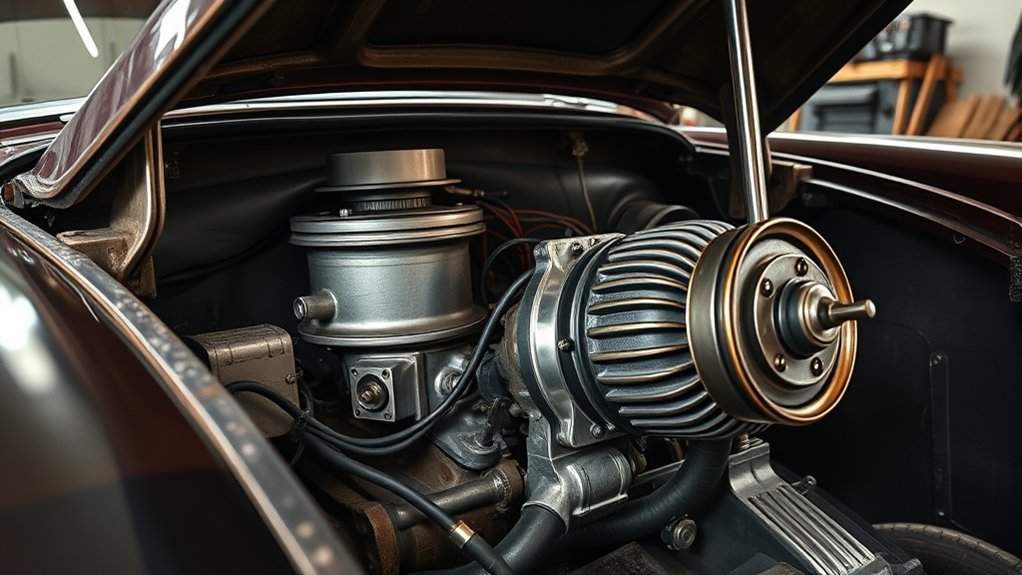
An automatic transmission changes gear ratios without a clutch pedal or a driver-operated shifter pattern. In old automatic cars, hydraulic pressure, planetary gearsets, clutches and bands do the work that a driver does in a manual car.
Earlier attempts existed in the 1920s, including a patent by Alfred Horner Munro that used compressed air, but they lacked power and never reached production. The breakthrough for everyday cars came with GM’s Hydra-Matic.
How the Hydra-Matic Changed Driving
GM announced the Hydra-Matic in 1939 for the 1940 model year, and it first appeared on the Oldsmobile Series 60 and the Cadillac Sixty Special. It used three hydraulically controlled planetary gearsets to give four forward speeds plus reverse.
It did not use a torque converter. The Hydra-Matic connected the engine to the gearbox with a fluid coupling, which let the engine idle at a stop but did not multiply torque.
- Shifts were chosen by hydraulic controls that sensed throttle position and road speed.
- There was no clutch pedal, which reduced effort in stop-and-go traffic.
- The original unit had no Park position. Park arrived with the Controlled Coupling Hydra-Matic in 1956.
Torque Converters and Other Early Automatics
A torque converter uses an impeller, a turbine and a stator to transfer and multiply torque through fluid. It gave automatics smoother starts than a plain fluid coupling.
The Buick Dynaflow, for the 1948 model year, was the first torque-converter automatic. The Packard Ultramatic followed in mid-1949 and the Chevrolet Powerglide arrived for 1950.
| Transmission | Introduced | Key feature |
|---|---|---|
| GM Hydra-Matic | 1940 model year | Four speeds, fluid coupling, no Park at first |
| Buick Dynaflow | 1948 model year | First torque-converter automatic |
| Packard Ultramatic | 1949 | Torque-converter automatic |
| Chevrolet Powerglide | 1950 model year | Two-speed torque-converter automatic |
The Powerglide is also the transmission offered in the original 1953 Chevrolet Corvette, which had no manual option. It is a good example of an automatic fitted to a sports car.
How an Old Automatic Transmission Works
Most old automatics share the same basic parts, even though the details differ by brand and year.
- Fluid coupling or torque converter: links the engine to the gearbox without a clutch pedal.
- Planetary gearsets: provide the different gear ratios.
- Bands and clutches: hold or release parts of the gearsets to select a ratio.
- Hydraulic control system: uses fluid pressure, throttle position and road speed to decide when to shift.
Why Automatics Replaced Manual Shifting
Automatics won buyers over because they were easier to drive, especially in traffic and on long trips. They also opened driving to people who did not want to learn clutch control.
Adoption rose quickly after World War II, and by the late 1950s automatics were fitted to the large majority of new American cars. Several makers also experimented with push-button shift controls in the 1950s and 1960s, most famously Chrysler.
For how the other side of this story works, see our guide to how a manual transmission works.
Buying and Restoring Old Automatic Cars
Old automatic cars are popular with collectors, especially 1950s to 1970s models. Check these points before you buy:
- Fluid: look for a clean level and no burnt smell. Use the fluid type in the factory manual, because early units are fussy.
- Shift quality: slipping, harsh engagement or long delays point to worn clutches, bands or hydraulics.
- Leaks: check seals, the pan gasket and cooler lines.
- Parts support: rare transmissions can be hard to rebuild, so check for specialists and club support.
- Park position: if the car has none, always use the parking brake and chock the wheels on a slope.
Later automatics are easier to service. Our guide to the BMW E39 automatic transmission shows what a modern-era unit looks like, and the automatic transmission motorcycles post covers the two-wheeled side.
Frequently Asked Questions
What was the first mass-produced automatic transmission?
General Motors’ Hydra-Matic, introduced in 1939 for the 1940 model year, first on the Oldsmobile Series 60 and the Cadillac Sixty Special. It gave four forward speeds using a fluid coupling and three planetary gearsets.
Did the Hydra-Matic have a torque converter?
No. The Hydra-Matic used a fluid coupling. The Buick Dynaflow, for the 1948 model year, was the first torque-converter automatic, followed by the Packard Ultramatic in 1949 and the Chevrolet Powerglide for 1950.
Did early automatic cars have a Park position?
Not at first. The original Hydra-Matic had no Park position, which was added with the Controlled Coupling Hydra-Matic in 1956. Some other early automatics also lacked Park, so use the parking brake and check the owner’s manual on a pre-1956 car.
Are old automatic transmissions reliable?
A well-maintained one can be durable, but age matters more than the badge. Leaks, burnt fluid, worn clutches and bands, and hard-to-find parts are the usual issues, so inspect the transmission and its service history before buying.
When did automatics become the norm in American cars?
During the 1950s. Adoption rose quickly after the war, and by the late 1950s automatics were fitted to the large majority of new American cars, while manuals became the exception.
Conclusion
Old automatic cars started with the Hydra-Matic in 1940 and gained smoother torque-converter designs from 1948. By the late 1950s they were the default in American cars. If you are shopping for one, inspect the fluid, shifting and parts support, and confirm whether the car has a Park position.
Sources
- Wikipedia — Automatic transmission: Hydra-Matic introduction, fluid coupling design, Dynaflow, Ultramatic and Powerglide dates, and the 1956 Park position.