
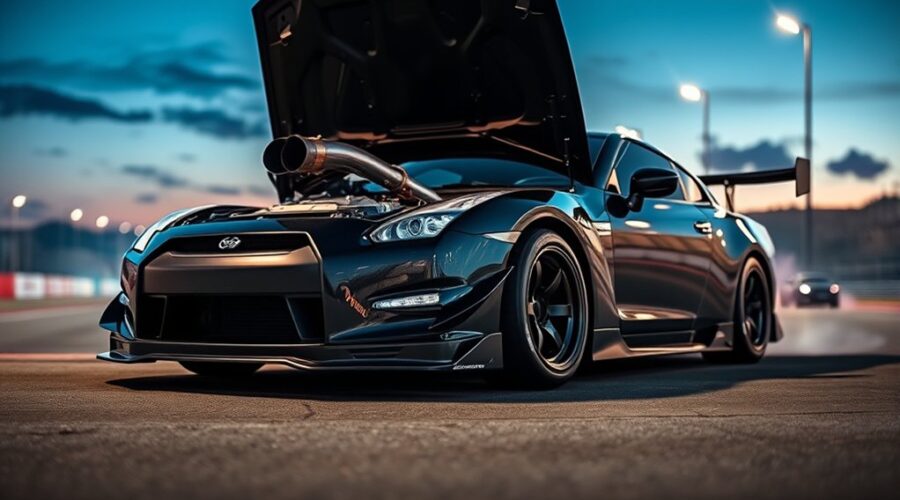
The Nissan 350Z stands out as a rear-wheel-drive drift platform with a V6 powertrain rated from 287 hp to more than 400 hp in turbocharged builds. Its near 50:50 balance, limited-slip differential, and compact 169.5-inch length support predictable handling. Curb weight stays near 3,200 to 3,400 lbs. The technical package is only part of the story, though, because several chassis and trim details shape how it performs on track.
Key Takeaways
- The Nissan 350Z is a rear-wheel-drive drift platform with near 50:50 weight balance and a limited-slip differential.
- Common VQ35DE/VQ35HR engines make 287–306 horsepower, while turbocharged builds can exceed 400 horsepower.
- Drift-focused setups use 6-speed manuals, launch control, no-lift shift, and angle kits for about 74 degrees of steering lock.
- Suspension includes double-wishbone front and multi-link rear layouts, plus coilovers and forged wheels for sharper handling.
- Dimensions are about 169.5 inches long, 72.6 inches wide, 50.8 inches high, with a 100.4-inch wheelbase and 3,200–3,400-pound curb weight.
Nissan Drift Car Overview
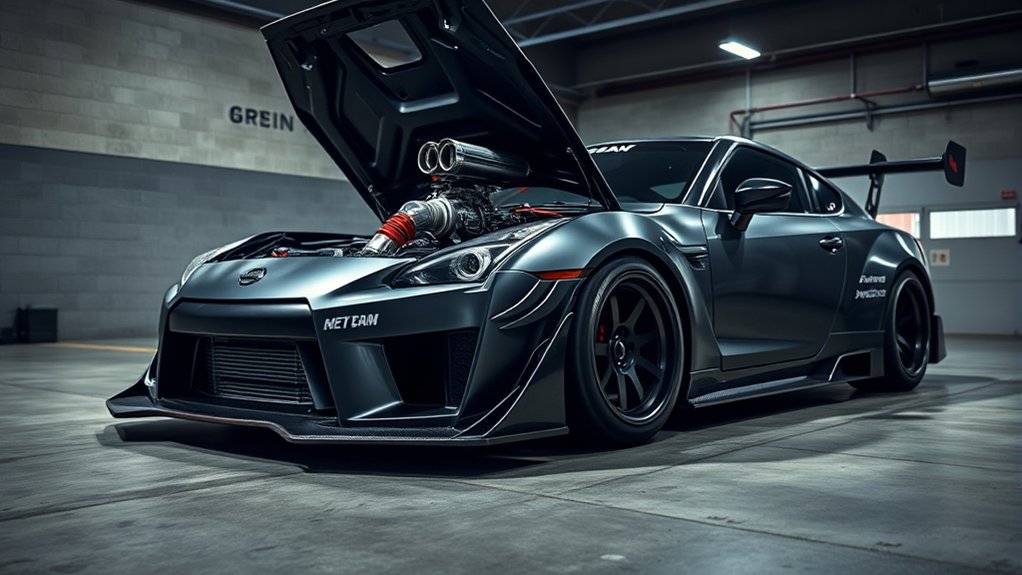
The Nissan 350Z is widely regarded as a capable drift platform due to its rear-wheel-drive layout, naturally aspirated V6 powertrain, and near 50:50 weight distribution.
That chassis balance gives drivers a controllable breakaway threshold, supporting precise modulation through corners. As a drift car, the 350Z benefits from a limited-slip differential, which helps maintain rear-wheel traction while allowing sustained oversteer.
Its steering geometry also responds well to aftermarket angle kits, with some setups increasing lock to approximately 74 degrees for greater drift control.
Chris Forsberg has demonstrated the model’s competitive potential, reinforcing its reputation among builders seeking liberation from understeer and predictable handling limits.
Beyond the basic platform, the 350Z is supported by a deep aftermarket ecosystem, simplifying suspension, steering, and chassis tuning.
This combination of balance, adaptability, and parts availability makes it a practical foundation for drivers pursuing committed sideways performance.
Nissan Drift Powertrain and Output
Nissan drift setups commonly pair rear-wheel drive layouts with VQ35DE or VQ35HR engines, producing roughly 287 to 306 horsepower before tuning adjustments.
For higher-output builds, turbocharged variants such as the VQ38DETT exceed 400 horsepower, while cooling system capacity and airflow management become critical under sustained drift loads.
Transmission selection typically centers on manual gearboxes matched to limited-slip differentials, with lightweight aluminum alloy components helping preserve the power-to-weight ratio.
Engine Output
Powertrain specifications point toward an output of roughly 400 horsepower and 350 lb-ft of torque for the Silvia, a calibration intended to preserve both track-capable performance and everyday drivability.
This engine output supports rapid acceleration, consistent drift initiation, and stable modulation through the power band. Aluminum-alloy block and heads reduce mass, sharpening throttle response and helping the chassis remain agile under load.
- 400 horsepower for decisive rear-wheel drive momentum
- 350 lb-ft for controlled oversteer and traction management
- Manual or automatic selection with Cruise Control compatibility for road use
The result is a liberated, mechanically focused setup: precise, accessible, and engineered to let the driver exploit power without sacrificing control or practicality.
Turbo And Cooling
Turbocharged drift setups commonly rely on engines such as the VQ38DETT, where forced induction helps sustain outputs near 400 horsepower and 350 lb-ft of torque with immediate throttle response.
In this configuration, turbocharged engines are paired with custom turbo manifolds to optimize placement, airflow, and exhaust efficiency, supporting clean power delivery through the rev range.
Optical turbo speed sensors can monitor turbine operation at speeds approaching 240,000 rpm, allowing precise calibration under load.
Effective cooling systems are equally important; water-cooled intercoolers stabilize charge temperatures, while robust thermal management reduces heat soak during extended drifting sessions.
Together, these components preserve reliability, maintain consistent output, and enable the controlled, liberated oversteer that defines high-performance Nissan drift powertrains under sustained stress.
Transmission Options
Available transmission choices for the new Nissan Silvia are expected to include both a 6-speed manual and a 9-speed automatic, giving the platform flexibility for street driving and drift-focused use.
These transmission options are engineered to manage an estimated 400 horsepower with controlled, liberated response. The 6-speed manual should appeal to drivers seeking direct command, while the 9-speed automatic can deliver rapid shifts and consistent acceleration.
No-lift shift capability supports uninterrupted power flow, and launch control helps reduce wheel spin at takeoff.
- Seamless gear changes under load
- Improved traction through mechanical limited-slip differential
- Stable acceleration for controlled drifting
Transmission, LSD, and Launch Features
The new Nissan Silvia is expected to offer both a 6-speed manual and a 9-speed automatic, giving drivers a choice between direct control and quicker, more automated shifting.
A mechanical limited-slip differential is included to improve traction and maintain predictable torque transfer during drift initiation and sustained angle.
Launch control, together with no-lift shift functionality, is intended to reduce wheel spin and preserve power delivery for consistent acceleration and cleaner gear changes.
Manual Vs Automatic
For the new Nissan Silvia, transmission choice is expected to split cleanly between a 6-speed manual and a 9-speed automatic, allowing the platform to serve both traditional drift drivers and those prioritizing convenience or consistency.
The manual keeps direct control at the steering wheel, letting the driver manage clutch engagement, throttle modulation, and rear end attitude with precision.
The automatic should deliver repeatable shifts and lower workload, which may suit newcomers seeking accessible track use and liberation from constant input.
- manual: highest involvement, fastest response to driver intent
- automatic: smoother operation, consistent acceleration, easier learning curve
- both: paired with launch control for controlled starts and reduced wheel spin
Limited-Slip Differential
Although transmission choice shapes driver control, the limited-slip differential is what allows Nissan drift platforms to put that control to the pavement with usable rear-wheel traction.
In the Silvia, mechanical LSD components engage as wheel slip rises, helping stabilize corner entry and preserve line authority.
The 350Z’s viscous and clutch-type options similarly improve power transfer during high-speed maneuvers, supporting sustained angle and cleaner throttle modulation.
Proper LSD tuning can sharpen steering response and expand drift angle, giving the chassis a freer, more precise breakaway.
This hardware is distinct from launch control systems, which manage takeoff wheel spin; please go, email address are not drivetrain features and do not affect differential behavior.
Launch Control Features
Launch control enhances the Nissan model’s off-the-line performance by managing wheel spin during hard acceleration, allowing the drivetrain to deploy power more effectively from a standstill.
The available system works with a mechanical LSD and suspension tuning to support stable launches, sharper response, and cleaner weight transfer for drivers refining driving techniques and performance tuning.
- 6-speed manual: direct control for precise engagement and throttle modulation.
- 9-speed automatic: calibrated for rapid shifts and efficient power delivery.
- No-lift shift: preserves boost and momentum between gears during competitive drifting.
Together, these launch features improve traction, reduce interruption under load, and help the chassis remain composed when the driver demands freedom through acceleration, controlled slide initiation, and repeatable track performance.
Drift Suspension, Wheels, and Brakes
The drift-focused chassis uses a double-wishbone front and multi-link rear suspension, re-tuned for sharper response and greater control at the limit, with larger dampers and BC Racing race-spec coilover dampers that allow precise stiffness adjustment. These drift tuning methods support wheel alignment strategies aimed at predictable slip angles and stable maneuver behavior. Brake performance upgrades are centered on Akebono® Performance Brakes, with 14-inch front rotors and 4-piston calipers delivering repeatable deceleration.
| Component | Specification | Effect |
|---|---|---|
| Front suspension | Double-wishbone | Accurate turn-in |
| Rear suspension | Multi-link | Composed power delivery |
| Wheels | RAYS® forged-alloy | Reduced unsprung mass |
The lightweight RAYS® forged-alloy wheels, inspired by the 300ZX Z31, preserve modern aesthetics while improving response. A mechanical limited-slip differential remains standard, distributing torque to both rear wheels for cleaner exits and stronger traction. Together, these systems create a chassis tuned for controlled freedom, where precision and drift authority coexist.
Nissan Drift Dimensions and Weight
Measured against drift requirements, the Nissan 350Z Z33 presents a compact rear-wheel-drive chassis with a length of about 169.5 inches, a width of 72.6 inches, and a height of 50.8 inches, creating a low, broad stance that supports stability at angle.
Its 100.4-inch wheelbase helps balance rotation and cornering response, while the 3,200 to 3,400 lb curb-weight range keeps the platform substantial yet manageable. A 50:50 distribution further aids predictable maneuvers, letting the rear end break free without destabilizing the chassis.
In a drift car setup, these proportions support precise suspension tuning and targeted weight reduction, giving drivers a freer, more responsive machine.
- Wide track and low roofline improve planted behavior.
- Wheelbase length supports smooth initiation and recovery.
- Balanced mass encourages controlled, repeatable slides.
These dimensions make the Z33 a practical foundation for aggressive lateral driving and technical course work.
Interior, Safety, and Driver Tech
Beyond chassis proportions and weight balance, the Nissan Drift Specs package extends into the cabin, where a driver-oriented cockpit pairs a horizontal instrument panel with a 9-inch center touch-screen for straightforward access to vehicle functions.
The layout supports interior aesthetics through clean geometry and a purposeful, uncluttered presentation. Deep bucket seats use anti-slip material and padded knee bolsters to stabilize the body during lateral load, improving driver comfort without compromising support.
A GT-R-inspired steering wheel sharpens tactile feedback and steering precision, helping the driver remain connected to the vehicle’s responses. Safety enhancements include Intelligent Cruise Control, Automatic Emergency Braking with Pedestrian Detection, and Blind Spot Warning, each designed to reduce exposure to common hazards.
Genuine Nissan Accessories also allow functional personalization, letting owners adapt the cabin’s appearance and utility while preserving its technical focus.
Pricing and Trim Options
Pricing for the new Nissan Silvia is anticipated to remain below $35,000, a figure that would place it within reach of entry-level drifters and budget-conscious enthusiasts. This pricing strategy suggests a deliberate balance between accessibility and performance, while keeping the model competitive against established rivals.
Positioned between the Nissan Z and GT-R, it would occupy a strategic middle ground in market competition, offering more focus than a grand tourer but less cost than a halo car.
- Lightweight trim choices may emphasize reduced mass and sharper response.
- RWD configuration should remain standard to support controlled oversteer.
- A manual transmission option would preserve driver involvement and freedom.
Historical precedent indicates multiple trims, similar to the 350Z’s Base, Enthusiast, Performance, and Track variants.
That template points to diversified offerings for different drift priorities. Input from professional drifters is expected to shape configuration decisions, ensuring the Silvia remains affordable, technically capable, and aligned with the demands of liberated rear-drive driving.
Frequently Asked Questions
What Is Nissan’s Most Powerful Engine?
Nissan’s most powerful engine is the VR38DETT 3.8-liter twin-turbo V6. It dominates engine comparisons through turbo advantages, advanced cooling, and substantial tuning potential, delivering up to 600 horsepower stock and far more modified.
What Is the Ideal Horsepower for a Drift Car?
Ideal drift car horsepower typically falls between 300 and 600, with about 400 offering balanced control. Effective drift car modifications, tire selection strategies, and suspension tuning tips optimize momentum, grip, and liberating, precise handling.
Which Nissan Is Best for Drifting?
The Nissan Silvia S15 is often best for drifting, thanks to favorable weight distribution, light chassis, and tuning depth. It supports advanced drift techniques, sensible tire selection, and responsive control for liberated, precise slides.
How Fast Does the Nissan GT-R Go From 0 to 60 Mph?
About 2.9 seconds, like a catapult released. The GT-R’s launch control benefits, traction control settings, and weight distribution effects help deliver this brutal sprint, while all-wheel drive and dual-clutch shifting maximize grip and acceleration.
Conclusion
Overall, the Nissan 350Z’s drift appeal is defined by its balanced engineering rather than extreme output alone. A notable statistic is its near 50:50 weight distribution, which helps explain why the chassis remains predictable at the limit. Combined with rear-wheel drive, V6 power ranging from 287 to over 400 horsepower in turbocharged builds, and a curb weight of roughly 3,200 to 3,400 lbs, it delivers controllable, responsive drift performance.