
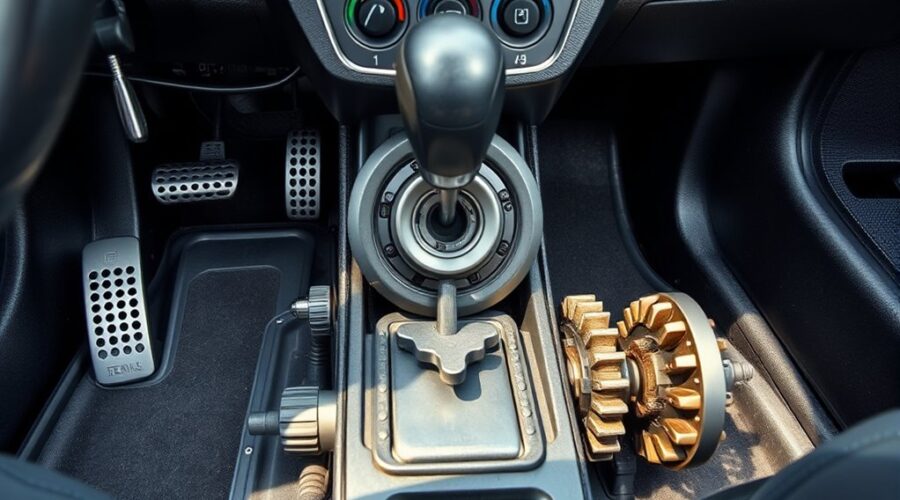
This guide explains how a manual transmission works: the clutch briefly disconnects the engine, the shift lever moves a synchronizer sleeve, and the chosen gear locks to the output shaft. It also covers shifting technique, manual vs. automatic, and basic maintenance.
Quick Answer
A manual transmission lets you choose gear ratios with a shift lever while a clutch temporarily disconnects engine torque during each change. In most synchronized passenger cars, the gears stay meshed; synchronizers match speeds before a collar locks the chosen gear to the output shaft. Smooth clutch timing and the correct fluid are key to clean shifts.
What Is a Manual Transmission?
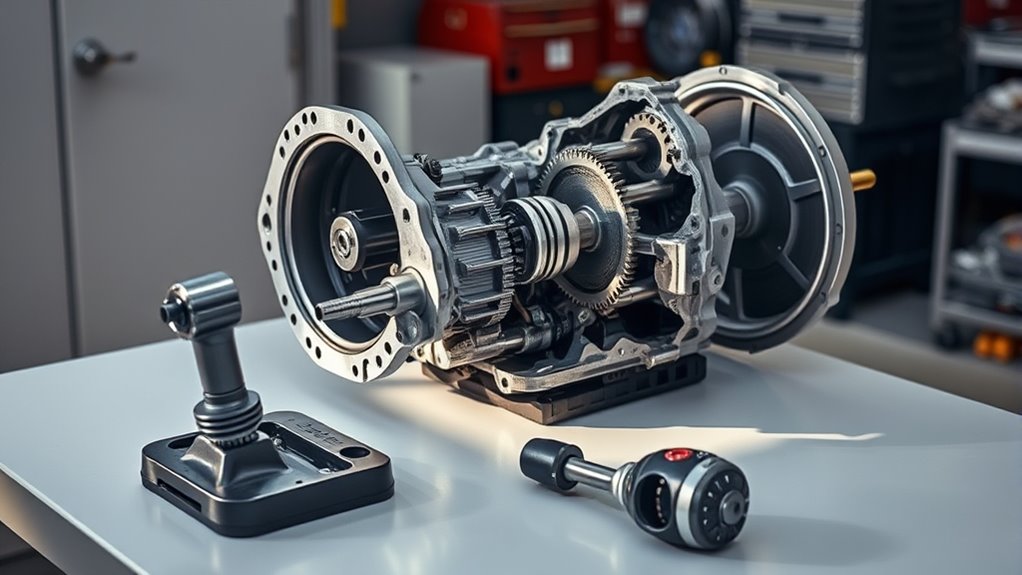
A manual transmission is a gearbox in which you select the gear ratio yourself, normally with a clutch pedal and an H-pattern shift lever. The clutch connects or disconnects the engine from the transmission, while the selected ratio determines the balance between wheel torque and road speed.
Passenger-car manuals commonly have five or six forward gears plus reverse, although the number varies by vehicle. Lower gears provide greater torque multiplication for moving away and accelerating. Higher gears reduce engine speed for a given road speed and are better suited to cruising.
Unlike a traditional automatic transmission, the gearbox does not normally choose the next ratio for you. That gives the driver direct control over when to upshift, downshift, hold a gear, or use engine braking.
The mechanism is relatively straightforward, but that does not mean every manual has the same maintenance needs. Fluid type, clutch design, gear ratios, synchronizer materials, and service intervals are all vehicle-specific.
How a Manual Transmission Works
A manual transmission transfers torque when the clutch is engaged and a gear is selected. During a shift, pressing the clutch interrupts engine torque, the shift mechanism selects another ratio, synchronizers equalize the relevant speeds, and releasing the clutch reconnects the engine to the drivetrain.
In a typical constant-mesh passenger-car gearbox, the input shaft receives torque from the clutch and drives a countershaft. Gear pairs remain meshed, but the gears on the output side are not all locked to the shaft at once. Selecting a gear locks the appropriate gear to the output shaft through a synchronizer hub and sleeve.
| State | Effect |
|---|---|
| Clutch depressed | Engine torque to the gearbox is interrupted |
| Neutral selected | No forward ratio is locked to transmit drive |
| Gear engaged | Selected gear is locked to the output path |
| Sync rings active | Rotational speeds are matched before engagement |
| Clutch released | Engine torque can flow through the selected ratio |
Neutral does not necessarily mean that every internal part stops rotating. The input shaft, countershaft, and free-spinning gears may still turn, but no forward gear is locked into a complete torque path to the wheels.
The synchronizer is especially important. As described in SAE research on manual-transmission synchronization, the shift mechanism and synchronizer work together to equalize speeds and allow a smooth ratio change.
Manual Transmission Parts You Should Know
The main manual-transmission parts are the input shaft, countershaft, output shaft, gearsets, synchronizers, shift forks, and selector mechanism. The clutch assembly sits between the engine and gearbox and controls when engine torque reaches the transmission.
These parts do different jobs, but every shift depends on their timing. The clutch removes most engine load from the gearbox, the selector moves the correct synchronizer, and the selected gear becomes locked to the shaft that sends torque toward the wheels.
Input, Counter, Output Shafts
The three main shafts establish the gearbox’s power path. The input shaft receives engine torque through the clutch, the countershaft carries the mating gears that create different ratios, and the output shaft transfers the selected ratio to the rest of the driveline.
| Shaft | Function | Position in Power Flow |
|---|---|---|
| Input shaft | Receives torque through the clutch | Engine side |
| Countershaft | Carries mating gears that create ratios | Gearset |
| Output shaft | Sends selected torque to the driveline | Driveline side |
Exact layouts differ between rear-wheel-drive gearboxes and front-wheel-drive transaxles, but the same principle applies: gears provide different speed and torque relationships between the engine and driven wheels.
Clutch, Flywheel, Pressure Plate
The clutch, flywheel, and pressure plate form the mechanical connection between the engine and transmission. With the clutch engaged, the pressure plate clamps the clutch disc against the flywheel so engine torque can reach the transmission input shaft.
The flywheel is attached to the engine crankshaft. The clutch disc sits between the flywheel and pressure plate and is splined to the transmission input shaft.
Pressing the clutch pedal operates the release mechanism and reduces the clamping force on the disc. The engine can then continue running while the transmission changes ratios or the vehicle remains stationary.
As the pedal comes back up, the disc progressively grips the flywheel. That controlled slip at the bite point is what allows a smooth launch from rest rather than an abrupt connection between a spinning engine and stationary drivetrain.
Shifter, Forks, Synchronizers
The shifter tells the transmission which ratio you want. Selector rails and shift forks translate that lever movement inside the gearbox, moving a synchronizer sleeve toward the chosen gear until it can lock that gear to the shaft.
A synchronizer works like a small friction coupling. Before the sleeve’s dog teeth engage, the synchronizer ring contacts a cone on the target gear and reduces the speed difference between the rotating parts.
Once their speeds are close enough, the sleeve can engage without the harsh tooth-to-tooth contact associated with an unsynchronized gearbox. Worn synchronizers, an incompletely released clutch, or incorrect transmission fluid can therefore make a shift feel resistant or cause grinding.
Why a Manual Transmission Uses a Clutch Pedal
In a conventional manual car, the clutch pedal temporarily separates engine torque from the transmission. This allows you to start from rest, stop without stalling, and change ratios while reducing load on the synchronizers and gear-engagement components.
The clutch is not simply an on/off switch. During a standing start, it must pass through a short slip phase so the stationary drivetrain can accelerate gradually to match the running engine.
Engine And Gear Separation
Pressing the clutch pedal releases the clutch disc from its firmly clamped state between the flywheel and pressure plate. That interrupts the normal torque path and allows the transmission input side to change speed independently enough for another ratio to be selected.
| Component | Function | Result |
|---|---|---|
| Clutch pedal | Operates the clutch release system | Torque path can be interrupted |
| Flywheel and disc | Transfer torque when clamped together | Engine can drive input shaft |
| Pressure plate | Applies or releases clamping force | Engagement can be controlled |
The rotating parts do not necessarily stop instantly when you press the pedal. They can continue spinning from inertia, which is one reason synchronizers are still needed during normal shifts.
Smooth Gear Changes
Smooth shifts depend on reducing torque through the gearbox while the synchronizer brings the next gear and shaft to compatible speeds. Fully pressing the clutch, moving the lever without force, and reconnecting the clutch progressively all reduce driveline shock.
On an upshift, engine speed normally needs to fall before the clutch is fully re-engaged because the higher gear requires fewer engine revolutions for the same road speed. On a downshift, engine speed must rise instead.
This is why clutch timing matters as much as lever movement. Releasing the pedal too quickly with a large RPM mismatch can produce a noticeable lurch even if the gear itself engaged correctly.
Preventing Engine Stall
The clutch prevents a stall by disconnecting the engine before road speed becomes too low for the selected gear. At a stop, pressing the clutch lets the engine continue idling even though the wheels are stationary.
When moving away, gradually releasing the pedal through the bite point lets the clutch transfer increasing torque to the drivetrain. Too little engine torque or an excessively quick clutch release can pull engine speed down far enough to stall.
Do not use clutch slip to hold a vehicle stationary on a hill. Use the brake or parking brake instead, because prolonged slipping converts engine power into heat and accelerates clutch wear.
How to Shift a Manual Transmission Smoothly
To shift a manual transmission smoothly, remove acceleration load, press the clutch fully, select an appropriate gear, and release the clutch progressively as engine speed approaches what the new ratio requires. The correct shift point depends on the vehicle, load, road speed, and driving conditions rather than one universal RPM.
Upshifting
An upshift moves to a taller ratio so the engine turns more slowly for the same road speed. Smoothness comes from letting engine speed fall naturally while the clutch is disengaged rather than rushing the lever or abruptly releasing the pedal.
- Ease off the accelerator.
- Press the clutch pedal fully.
- Move the lever into the appropriate higher gear without forcing it.
- Begin releasing the clutch smoothly.
- Blend in throttle as the clutch finishes engaging.
There is no reliable universal instruction such as “always shift at 2,500 to 3,000 RPM.” Follow the vehicle manufacturer’s guidance and choose a gear that keeps the engine operating smoothly under the current load.
Downshifting and Rev-Matching
A downshift selects a lower ratio, so the engine must rotate faster at the same road speed. Rev-matching uses a brief throttle input while the clutch is disengaged to bring engine speed closer to the speed the lower gear will require.
Warning: Never select a lower gear that would force the engine beyond its safe RPM range. A severe downshift mismatch can damage the engine or drivetrain and may upset vehicle stability.
- Slow the vehicle as needed with the brakes.
- Press the clutch fully.
- Select an appropriate lower gear.
- Raise engine speed enough to reduce the RPM difference.
- Release the clutch smoothly.
Do not assume every manual car has the same rules about skipping gears. Some vehicles allow or even command skip-shifts under certain conditions, while others warn against them. The vehicle owner’s manual is the authority for permitted shift patterns and downshift limits.
Stopping and Hill Starts
When stopping, use the brakes while remaining in an appropriate gear, then press the clutch before engine speed falls low enough to stall. Once stopped, select neutral when appropriate and keep the vehicle secured with the brake.
For a hill start, use the parking brake or service brake to prevent rollback while you find the clutch bite point and add enough throttle to move away. Official GOV.UK driving-test guidance specifically expects a driver starting on a gradient to move away safely without rollback or excessive engine speed.
Manual vs. Automatic Transmission
The main difference between manual and automatic transmissions is who chooses and engages the gear ratio. A manual requires the driver to operate the clutch and shifter, while an automatic system carries out most or all ratio changes without a conventional clutch pedal.
“Automatic” covers several designs, so not every automatic uses the same hardware. Conventional planetary automatics commonly use torque converters, while dual-clutch transmissions and continuously variable transmissions operate differently.
| Feature | Manual | Automatic |
|---|---|---|
| Gear selection | Driver selects ratios | Control system selects most or all ratios |
| Clutch pedal | Normally present | Normally absent |
| Driver workload | Higher in traffic and during frequent shifts | Lower during normal driving |
| Fuel economy | Historically had an advantage | Modern designs can match or exceed manuals |
| Driver involvement | Direct control over ratio choice and clutch engagement | Most shifting is automated |
A manual gives the driver direct control of ratio selection; an automatic handles most or all shift decisions for the driver.
The old assumption that a manual always saves fuel is no longer reliable. The EPA’s 2025 Automotive Trends Report says modern automatic transmissions are generally more efficient and notes that manuals have represented less than 1% of new U.S. vehicle production since model year 2021.
The same report explains that automatic transmissions added gears faster and improved their efficiency over time. For a real buying comparison, therefore, use the fuel-economy figures for the exact engine and transmission combination rather than assuming one transmission type will always win.
Common Types of Manual Transmissions
Manual gearboxes are not all built or operated the same way. The synchronized H-pattern transmission is the familiar passenger-car design, while non-synchronized, sequential, automated-manual, and dual-clutch systems use different methods to select or engage ratios.
- Synchronized manual transmission: Uses synchronizer rings and sliding sleeves to match speeds before a forward gear engages. This is the common passenger-car layout.
- Constant-mesh transmission: Gear pairs remain meshed while collars or dog clutches select which ratio transfers torque. Most modern synchronized manuals use constant-mesh principles.
- Non-synchronized manual: Lacks conventional synchronizers, so the driver may need double-clutching and careful speed matching. These are more associated with older vehicles and some heavy-duty applications.
- Sequential manual transmission: Allows selection of the next higher or lower ratio in sequence rather than moving freely through an H-pattern. Sequential systems are common in motorcycles and competition vehicles.
- Automated manual transmission: Uses manual-style gearbox architecture but actuators operate the clutch and gear selection instead of the driver doing both directly.
- Dual-clutch transmission: Uses separate clutch paths for alternating gearsets and automated controls. It can provide manual-style ratio selection, but it is not a conventional three-pedal manual transmission.
Manual Transmission History and Evolution
Manual transmissions evolved from crude sliding-gear mechanisms into synchronized constant-mesh gearboxes that require far less skill to shift cleanly. Major milestones include early multi-speed Panhard designs, Cadillac’s introduction of synchromesh, and the spread of five- and six-speed passenger-car gearboxes.
The Henry Ford documents Panhard & Levassor automobile production in 1891, the period associated with the influential early Panhard layout and its multi-speed sliding-gear transmission.
Cadillac transformed everyday shifting decades later. General Motors records that its fully synchronized “Synchro-Mesh Silent-Shift” transmission debuted in 1929, using bronze cones to match gear speeds and reducing the need for double-clutching.
| Era | Development | Effect |
|---|---|---|
| 1891 | Influential Panhard multi-speed sliding-gear layout | Helped establish early manual-transmission architecture |
| 1928–1929 | Cadillac Synchro-Mesh unveiled and introduced | Made shifts easier and reduced gear clash |
| 1930s | Synchronized designs spread through passenger cars | Less dependence on double-clutching |
| Late 20th century | Five-speed manuals became common | More ratio choice for acceleration and cruising |
| 1989 | BMW 850i presented with a six-speed manual option | Six-speed capability reached a flagship performance coupe |
BMW says the 850i was presented at the 1989 Frankfurt International Motor Show and could send its V12 power through a specially developed six-speed manual or a four-speed automatic.
Manual availability has since fallen sharply in the U.S. market. EPA data show manuals dropped from almost 35% of new-vehicle production in model year 1980 to below 1% from model year 2021 onward.
Manual Driving Techniques That Help
Good manual driving is mainly about matching engine speed, road speed, and clutch engagement. Rev-matching can smooth downshifts, double-clutching is useful with non-synchronized gearboxes, and careful hill starts prevent rollback without overheating the clutch.
Rev-matching means briefly raising engine speed during a downshift so the engine is closer to the RPM required by the lower gear. When the speeds are well matched, releasing the clutch causes less driveline shock.
Double-clutching separates a shift into two clutch operations with a neutral phase between them. It is mainly useful on older or non-synchronized transmissions because the neutral phase lets the driver alter input-shaft speed before engaging the next ratio.
Hill starts are easier when the brake or parking brake holds the car while you establish the clutch bite point. This is preferable to balancing the car on a slipping clutch, which creates unnecessary heat.
Gear ratios explain why the car behaves differently in each gear. Lower gears provide greater torque multiplication for starting and climbing. Higher gears reduce engine speed for cruising.
Do not treat gear skipping as a universal technique. Whether a particular upshift or downshift is appropriate depends on road speed, engine speed, transmission design, and the instructions provided for that vehicle.
Why Does a Manual Transmission Grind or Feel Hard to Shift?
Grinding or difficult engagement means the parts involved in the shift are not reaching the conditions needed for clean engagement. Common causes include incomplete clutch release, synchronizer wear, incorrect or low fluid, linkage problems, or trying to select a gear too quickly.
| Symptom | Possible Cause | What to Check |
|---|---|---|
| Several gears are hard to select with the engine running | Clutch may not be fully releasing | Clutch hydraulics, cable/linkage, pedal travel, or clutch assembly |
| One particular gear regularly grinds | Synchronizer wear is possible | Shift quality in that gear and transmission condition |
| Engine RPM rises without matching acceleration | Clutch slip | Clutch disc, pressure plate, contamination, or adjustment |
| Shift quality changed after fluid service | Wrong fluid specification or level is possible | Exact manufacturer fluid specification and fill procedure |
Do not force a reluctant shifter. If grinding persists with the clutch fully depressed, a gear repeatedly jumps out, or the transmission develops a new mechanical noise, have the clutch and gearbox inspected before continued driving causes additional wear.
Manual Transmission Maintenance Basics
Manual-transmission maintenance is mainly about using the exact specified lubricant, following the manufacturer’s service schedule, watching for leaks, and correcting clutch or shifting problems early. A single universal fluid-change interval does not apply to every gearbox.
Driving technique also affects service life. Excessive clutch slip creates heat, forcing the shifter can damage engagement parts, and using an unsuitable gear for road speed increases stress throughout the drivetrain.
Fluid Change Intervals
Manual-transmission fluid intervals vary substantially by vehicle, so the owner’s manual should determine both the service interval and fluid specification. The original blanket rule of changing gear oil every 30,000 to 60,000 miles does not apply reliably across modern vehicles.
For example, the official 2026 Mazda3 maintenance schedule specifies manual-transmission oil replacement every 100,000 km (62,500 miles) or five years. Other transmissions use different schedules, showing why model-specific information matters.
The lubricant itself is just as important as the interval. Some manual transmissions use conventional gear oil, while others require specialized manual-transmission fluid or even an automatic-transmission-fluid specification.
Do not substitute a different viscosity or API GL category simply because it appears “stronger.” Synchronizer materials and friction characteristics differ between gearboxes, so use only a fluid meeting the manufacturer’s stated specification.
Clutch Wear Signs
A worn clutch often shows itself when engine speed rises but vehicle acceleration does not increase proportionally. That slip occurs because the clutch can no longer hold engine torque securely between the flywheel and pressure plate.
A burning smell after repeated slipping can indicate excessive clutch heat. A change in the engagement point or difficulty transferring power smoothly also deserves inspection.
Pedal problems should not automatically be blamed on the clutch disc. A soft or spongy pedal can result from a hydraulic fault, air in the system, or another release-system problem.
Grinding can also have several causes. If the clutch does not release completely, the input side remains driven and shifts become difficult. If only one gear consistently grinds, a worn synchronizer may be more likely.
Extending Transmission Life
A manual transmission lasts best when the clutch releases correctly, the gearbox contains the specified lubricant at the correct level, and shifts are made without forcing the mechanism. Good habits reduce heat, shock loads, and unnecessary wear.
- Use the exact transmission-fluid specification listed for the vehicle.
- Follow the manufacturer’s inspection and replacement schedule.
- Repair fluid leaks rather than repeatedly topping up a low gearbox.
- Avoid resting your foot on the clutch pedal while driving.
- Do not hold the vehicle on a hill by slipping the clutch.
- Match downshifts to road speed and avoid engine over-revving.
- Do not force the shifter through resistance or grinding.
- Come to a complete stop before selecting reverse when the vehicle manufacturer requires it.
Related guides: how old automatic cars changed gearbox design, the BMW E39 automatic transmission, and the BMW E30 specs for a classic manual-gearbox car.
Frequently Asked Questions
Can You Explain How a Manual Transmission Works?
A manual transmission sends engine torque through the clutch to an input shaft, then through gears to the output shaft. Pressing the clutch interrupts that torque so you can select another ratio. Synchronizers use friction to match speeds before the selected gear is locked to the shaft, then releasing the clutch restores power flow.
What Does Gear 1, 2, 3, 4, 5 Mean?
Gear 1, 2, 3, 4, and 5 are different ratios, not fixed speeds. First is a low gear with strong torque multiplication for starting; each higher gear generally reduces engine speed for a given road speed. The exact ratios and usable speeds depend on the vehicle.
What Is the Hardest Part of Driving a Manual?
For most beginners, the hardest part is coordinating the clutch’s bite point with enough throttle to move away without stalling or jerking. Hill starts add the challenge of preventing rollback. Practice in a safe area until the pedal movement becomes consistent, then work on smoother upshifts and downshifts.
How Do You Drive a Manual Transmission as a Beginner?
Start with the parking brake set, select neutral, press the clutch, and start the engine. Select first gear, release the clutch gradually to the bite point while adding gentle throttle, then release it fully once moving. To stop, brake first and press the clutch before the engine would stall. Practice away from traffic.
Can You Skip Gears in a Manual Transmission?
Sometimes, but not as a universal rule. Some manuals permit or even force an upshift skip under specific conditions, while other owner manuals warn against skipping gears, especially on downshifts. Follow your vehicle’s shift instructions, and never select a lower gear that would over-rev the engine.
Are Manual Transmissions More Fuel-Efficient Than Automatics?
Not necessarily. Manuals had an efficiency advantage historically, but modern automatics often equal or exceed them. EPA data show automatics became more efficient on average than comparable manuals beginning with model year 2016, so fuel economy should be compared by exact vehicle and powertrain rather than transmission type alone.
Conclusion
A manual transmission is a coordinated system rather than simply a clutch pedal and gear lever. The clutch controls torque transfer, synchronizers prepare the next ratio for engagement, and the gears provide the torque and speed relationships the vehicle needs.
Smooth shifting comes from correct clutch timing and sensible gear selection, while long-term reliability depends on the exact fluid specification, the manufacturer’s maintenance schedule, and early attention to grinding, slipping, leaks, or other changes in operation.
Sources
- SAE International: Manual-transmission synchronizer operation and ratio-change principles.
- General Motors / Cadillac: Cadillac Synchro-Mesh history and its 1929 introduction.
- BMW Group: 1989 BMW 850i introduction and six-speed manual gearbox.
- U.S. Environmental Protection Agency: Modern transmission efficiency and U.S. manual-transmission production trends.
- Mazda USA: 2026 Mazda3 manual-transmission oil replacement schedule.
- GOV.UK / Driver and Vehicle Standards Agency: Safe moving-off and hill-start expectations.
- The Henry Ford: Archival record of Panhard & Levassor automobile production in 1891.




[…] A model year alone does not tell you the gearbox. A 528i from the late 1990s could carry more than one of these, so check the car itself. Manual cars used Getrag or ZF five- and six-speed boxes. For those, see our manual transmission guide. […]
[…] For how the other side of this story works, see our guide to how a manual transmission works. […]
[…] Manual Transmission Explained: How It Works and How to Drive […]