
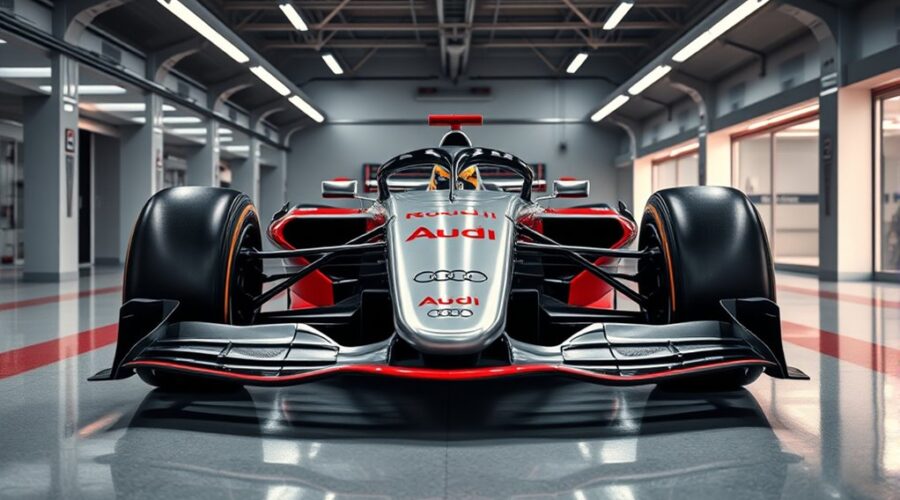
Audi’s return to Formula 1 with the R26 signals a major shift in the sport’s technical landscape. The car combines a new hybrid power unit, synthetic fuel, and advanced aerodynamics under the 2026 rules. Built in Hinwil, it connects modern engineering with the brand’s racing history. The key question is whether Audi’s approach can translate heritage and innovation into immediate competitiveness.
What Is the Audi F1 Car?
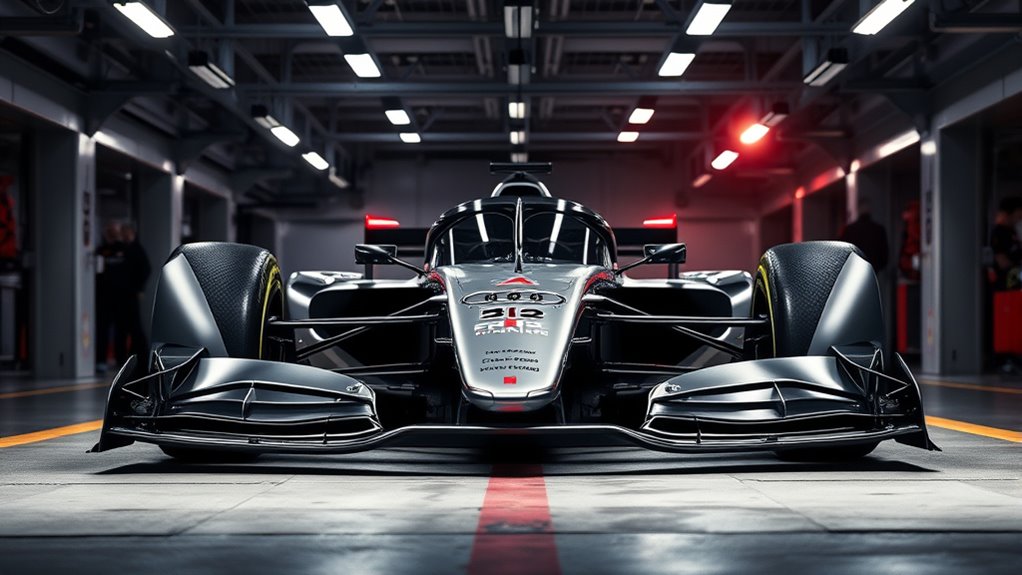
The Audi R26 is Audi’s planned Formula 1 car for the 2026 season, marking the brand’s return to Grand Prix racing after its last involvement in the 1930s.
Built at Audi’s Hinwil F1 factory, the R26 is a purpose-designed machine combining chassis development with an in-house power unit program across Hinwil, Neuburg an der Donau, and Bicester. Its hybrid system pairs a combustion engine with an electric motor, targeting near-equal power delivery and improved control.
The car also reflects the 2026 regulations through sustainability measures, including advanced aerodynamics and use of synthetic fuels. Audi’s engineering approach emphasizes technical autonomy, with each major component developed internally to align performance, efficiency, and accountability.
The livery uses titanium silver, Audi Lava Red, and gloss black carbon fiber, signaling a modern identity.
Fundamentally, the R26 represents Audi’s entry into Formula 1 as a technologically integrated, hybrid, and sustainability-focused contender.
Why Audi Entered Formula 1 in 2026
Audi entered Formula 1 in 2026 to capitalize on a sweeping regulatory reset that prioritizes sustainability and advanced hybrid technology.
The new 2026 regulatory standards create a rare opening for the Audi F1 team to enter as a power unit manufacturer, rather than as a passive entrant. The rules demand hybrid powertrains with an almost equal split between electric and combustion output, aligning with Audi’s engineering strengths and its ambition to develop a fully in-house power unit and chassis.
This environment rewards technical autonomy, efficiency, and performance, giving Audi a platform to shape its own competitive future. The strategic partnership with Sauber Motorsport adds operational stability and established infrastructure, reducing barriers to immediate relevance.
Audi’s first car, the R26, is intended to merge more than 1,000 hp from both energy sources, reflecting a deliberate response to a generational shift in Formula 1 technology and a bid for liberated, high-performance participation.
Audi’s Road to Formula 1
Rooted in Auto Union’s Grand Prix successes from 1935 to 1939, Audi’s path back to Formula 1 reflects a long-delayed return to formula racing. The project is structured around audi’s Formula debut in 2026, with the brand treating the racing series as a platform for technical autonomy and competitive relevance.
| Milestone | Significance | Location |
|---|---|---|
| Auto Union era | Early Grand Prix pedigree | Germany |
| Sauber acquisition | Operational foundation | Switzerland |
| 2026 entry | Return to F1 | Europe |
Audi’s strategy centers on an in-house power unit and a chassis program shaped by new regulations. The hybrid concept pairs electric deployment with a combustion engine in a near 50/50 balance, aligning performance with sustainability mandates. Multiple facilities in Switzerland, Germany, and England support this effort, combining established expertise with fresh development capacity. The result is a measured, liberation-oriented pursuit of control: fewer dependencies, more design freedom, and a clear intent to compete on Audi’s terms.
Meet the Audi R26 Concept
Arriving as Audi’s first Formula 1® race car, the R26 Concept is built for the 2026 season and the sport’s new regulations, which place greater emphasis on sustainability and electrification.
The Audi R26 Concept presents a clear technical statement: a hybrid powertrain with a near-even split between combustion and electric output, targeting more than 1,000 hp in combined form.
Its architecture is shaped by advanced aerodynamics, with state-of-the-art materials selected to support efficiency, stability, and speed under extreme track demands.
Audi also signals a broader strategic shift by integrating synthetic fuels and low-carbon technologies into a competitive racing platform.
Visually, the car’s titanium silver, Audi Lava Red, and gloss black carbon fiber livery reinforces a modern identity without excess.
The result is not merely a concept, but a disciplined preview of how performance and sustainability can coexist in Formula 1, with precision guiding every surface and system.
How the Audi F1 Power Unit Works
At the heart of Audi’s 2026 Formula 1 entry is a hybrid power unit designed to balance combustion and electrical output almost evenly, with the combined system targeting more than 1,000 hp.
The Audi F1 power unit uses a hybrid design that pairs a turbocharged combustion engine with a powerful electric motor, creating a more efficient route to performance.
Energy recovery systems capture power during braking, then redeploy it for acceleration, reducing wasted energy and extending strategic freedom on track.
Development is centered in Neuburg an der Donau, with integrated engineering support from Hinwil, so engine and chassis decisions remain tightly aligned.
This factory structure gives Audi direct control over internal combustion, electrical deployment, and packaging choices.
The result is a power unit built not only for speed, but also for sustainability, reflecting Formula 1’s shift toward electrification.
In this framework, efficiency becomes a competitive tool rather than a constraint.
What Changes in the 2026 F1 Regulations?
The 2026 Formula 1 regulations will reshape both powertrains and car design, creating a package that is far more electrified, efficient, and technically demanding.
Under the 2026 regulations, power units will move to a near 50/50 split between combustion and electric drive, replacing the current heavy dependence on internal combustion. This shift should increase the strategic role of energy deployment and recovery, while also rewarding engineering precision.
Sustainable fuels will become mandatory, aligning performance with lower-carbon development.
At the same time, active aerodynamics will allow real-time wing adjustments, helping cars adapt to different phases of a lap and improving racecraft.
The chassis will also become smaller and more efficient, reducing drag and improving handling.
Together, these changes are designed to expand innovation, open technical freedom, and intensify competition across the grid.
Where Audi Builds Its F1 Car
Audi’s Formula 1 program is split between two main engineering hubs: the F1 factory in Hinwil, Switzerland, where the car is developed and race operations are managed, and Audi Formula Racing GmbH in Neuburg an der Donau, Germany, where the power unit is built.
This division gives Audi a structured engineering base, with Hinwil acting as the car’s operational and aerodynamic centre and Neuburg focusing on propulsion.
Audi Formula Racing links the two sites through close coordination, allowing design decisions and mechanical systems to be integrated with precision.
For the 2026 season, the Audi R26 will be the brand’s first Formula 1 race car under the new regulations, and its development reflects this cross-border model.
A further Technology Centre in the UK strengthens support capacity and broadens technical input.
Together, these facilities form a disciplined network designed to advance performance while keeping the program agile and technically coherent.
Audi F1 Fuel, Technology, and Sustainability
With the 2026 regulations, Audi’s Formula 1 powertrain is being developed around a hybrid concept that places electric and combustion components in near-equal balance, reflecting the sport’s push toward greater efficiency.
This F1 power unit is built to advance sustainability without surrendering speed, using a hybrid system designed for rigorous competition and lower environmental impact.
Synthetic fuels are central to the concept, supporting reduced CO₂ output while preserving the energy density required for racing.
Audi also targets more than 1,000 hp from the combined package, showing that cleaner technology can still deliver forceful performance.
Advanced energy recovery systems will capture and redeploy energy under braking and through other recovery channels, improving overall efficiency.
Active aerodynamics further refine fuel use by managing drag and load.
In this framework, Formula 1 becomes a demanding proving ground for electrified innovation, where performance and responsibility are treated as compatible, not opposed.
Key Facts About the Audi Revolut F1 Team
The Audi Revolut F1 Team is set to enter Formula 1 in 2026, representing Audi’s return to the championship after nearly nine decades.
Its operation is anchored across Hinwil, Neuburg an der Donau, and Bicester, while Nico Hülkenberg and Gabriel Bortoleto are confirmed as the inaugural driver pairing.
The R26 will be built to the 2026 rules with a hybrid powertrain that targets an almost even split between electric and combustion power.
Team Origins And Entry
Entering Formula 1 in 2026, the Audi F1 Team will operate as a full factory outfit, with in-house chassis and power unit development centered on the R26 concept. Its team origins trace to the October 2022 Sauber partnership, a calculated entry that strengthened Audi’s competitive position and widened technical autonomy. The Audi F1 Team name, with Revolut as title sponsor, signals a modern, technology-led identity. Driver selection also reflects continuity, with Bortoleto joining Nico Hülkenberg after prior Sauber exposure.
| Element | Detail | Significance |
|---|---|---|
| entry | 2026 debut | official arrival |
| factory team | full works structure | direct control |
| team origins | Sauber link | strategic base |
| Bortoleto | confirmed driver | experience |
| Audi F1 Team | official name | clear branding |
Operations span Hinwil, Neuburg, and Bicester.
Factory, Drivers, And Powertrain
Audi Revolut F1 Team splits its core operations between Hinwil, Switzerland, where the chassis program is developed, and Neuburg an der Donau, Germany, where Audi Formula Racing GmbH oversees powertrain design and testing.
The factory in Hinwil serves as the team’s race-car base, while the upgraded Neuburg site is tailored for power unit development, simulation, and bench validation.
Nico Hülkenberg and Gabriel Bortoleto are the confirmed drivers, pairing seasoned technical feedback with emerging pace.
Audi’s 2026 R26 will enter under new regulations centered on sustainability and electrification. Its hybrid powertrain targets more than 1,000 hp, with nearly equal contributions from combustion and electric systems.
This structure reflects a disciplined, modern program, where Audi aligns engineering autonomy with competitive ambition and the pursuit of freer, cleaner performance.
Frequently Asked Questions
What Are Some Interesting Facts About Audi’s History?
Audi’s history includes Auto Union’s 1936 championship, the quattro’s rally revolution, and a century of Audi innovations. Its Motorsport legacy reflects Engineering excellence, Racing partnerships, and Brand evolution, culminating in planned Formula 1 entry.
What Are 10 Interesting Facts About Formula 1?
Formula 1, a thrilling dance of speed, features hybrid power, rapid innovation, Race strategies, Driver rivalries, Team dynamics, Circuit designs, Fan engagement, global manufacturers, cost caps, sustainability, active aerodynamics, and 2026’s near-even power split.
What Is the History of Audi in Formula 1?
Audi’s Formula 1 history began with Auto Union’s 1930s dominance, then paused for decades. Its Audi F1 debut in 2026 revives Audi race strategy, Audi engine performance, Audi team dynamics, and Audi championship aspirations.
What Technologies Are Used in Formula 1 Cars?
About 50% of an F1 car’s output comes from hybrid powertrains. Formula 1 uses aerodynamic innovations, tire management, telemetry systems, and safety features, all engineered for precision, speed, efficiency, and liberated performance.
Conclusion
Audi’s F1 return with the R26 concept signals a deliberate fusion of heritage and modern engineering. Drawing on Auto Union’s racing legacy, the project aligns with 2026 regulations, emphasizing hybrid performance, synthetic fuel, and efficiency. Built in Hinwil and designed for the next era of grand prix competition, the car reflects both ambition and restraint. In effect, Audi is attempting to turn a historic lap into a future-facing strategy, as if drafting tomorrow’s playbook today.