
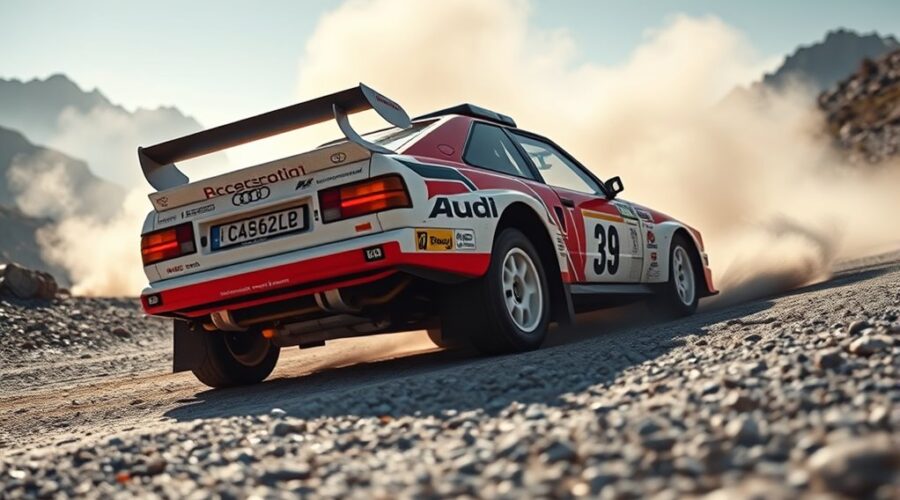
Audi Quattro rally car specs depend on the version: the 1985 Sport quattro S1 produced 350 kW (476 PS), weighed 1,090 kg and reached 100 km/h in 3.1 seconds, while the road-going Sport quattro made 306 hp. This guide covers each version, plus dimensions, rally wins and legacy.
Quick Answer
Audi’s quattro rally program combined permanent four-wheel drive with a turbocharged five-cylinder engine. The 1985 Sport quattro S1 produced 350 kW (476 PS), weighed 1,090 kg, and could reach 100 km/h in 3.1 seconds with its medium gearing. Audi won four WRC titles during the quattro era.
Audi Quattro Rally Car Specs Overview
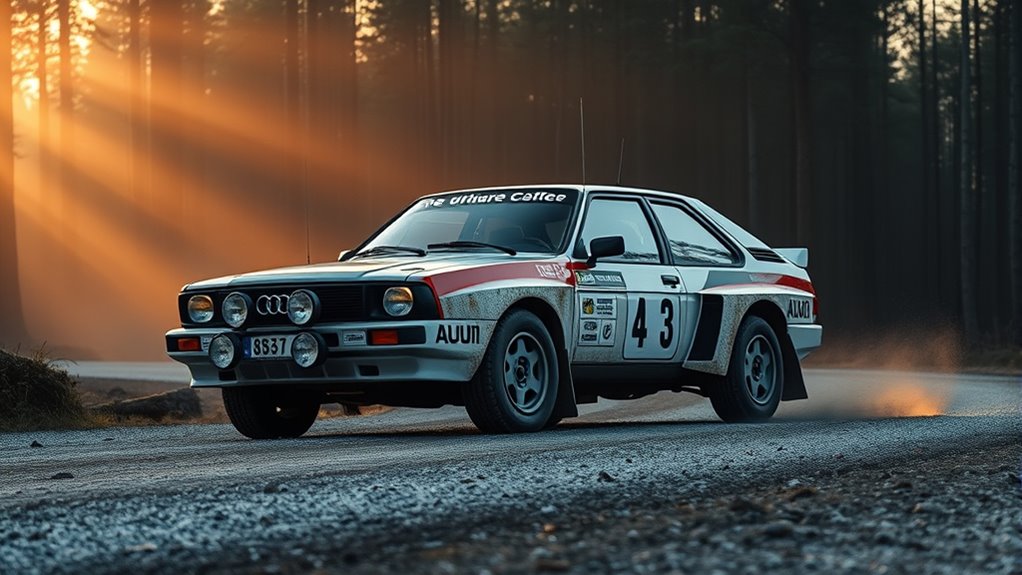
The Audi quattro was both a road car and the foundation of a major rally program. Audi introduced the production quattro at the 1980 Geneva Motor Show, then entered international rallying with the four-wheel-drive car in 1981.
According to Audi’s rally history, Hannu Mikkola and Arne Hertz gave the quattro its first World Championship rally victory in Sweden in February 1981. Michèle Mouton and Fabrizia Pons then won San Remo later that year.
The road-going original quattro remained in production from 1980 to 1991, with 11,452 examples built. Early cars used a turbocharged five-cylinder producing 147 kW (200 PS), while later road versions eventually reached 220 PS.
The rally story developed much faster. Audi won the manufacturers’ World Rally Championship in 1982. Hannu Mikkola secured the drivers’ title in 1983, and Audi won both the manufacturers’ and drivers’ championships in 1984, with Stig Blomqvist taking the drivers’ crown.
As rival Group B cars became lighter and more specialized, Audi needed a more agile version of its front-engine quattro concept. That pressure led to the short-wheelbase Sport quattro and, ultimately, the spectacular S1 E2.
Why Audi Built the Sport Quattro
Audi built the Sport quattro to make its rally platform shorter, lighter, and more competitive under Group B regulations. The original quattro had excellent traction, but its relatively long front-engine layout became harder to exploit against increasingly compact purpose-built rivals.
The solution kept Audi’s basic formula intact: a longitudinal front engine, turbocharged five-cylinder power, and permanent four-wheel drive. However, the wheelbase was shortened substantially and the engine received a four-valve cylinder head.
Homologation Requirements
Group B required manufacturers to base their competition cars on a homologated production model. Audi therefore created the road-going Sport quattro as a limited series rather than redesigning only the works rally cars.
Audi states that the Sport quattro production series totaled 214 vehicles. Its 2.1-liter five-cylinder produced 225 kW (306 hp) at 6,700 rpm and 350 Nm of torque at 3,700 rpm.
The Sport quattro’s competition identity is recorded in the FIA Historic Database under homologation number B-264. The FIA record lists four-wheel drive, five cylinders, and a homologation date of May 2, 1984, followed by numerous approved evolution extensions.
The important distinction is that the road Sport quattro, the 1984 rally Sport quattro, and the later S1 E2 were related stages of development. They were not one unchanged car carrying different names.
Weight Reduction Goals
Audi also wanted to reduce the size and mass that worked against the original long-wheelbase car on tight stages. The Sport quattro therefore used a much shorter wheelbase and lightweight materials, including aluminum and composite body components.
The competition development went further. The S1 used sheet steel, lightweight panels, aluminum and Kevlar-related composite construction, while major components were repositioned to improve mass distribution.
| Element | Effect |
|---|---|
| Aluminum | Reduced component mass |
| Kevlar and composite panels | Lower body weight with useful strength |
| Shorter wheelbase | Quicker directional response |
| Rear-mounted cooling components | Improved distribution of mass |
The short wheelbase was especially important because Audi retained its front-engine architecture while major competitors increasingly moved toward purpose-built mid-engine layouts.
Rally Performance Gains
The shorter package improved the Sport quattro’s ability to change direction, but power also rose sharply. Audi’s 1984 rally Sport quattro initially produced around 400 hp, while later versions moved well beyond that figure.
By 1985, the Sport quattro S1 E2 had become a far more aggressive machine. Audi officially quoted 350 kW (476 PS), a competition weight of 1,090 kg, and 0–100 km/h acceleration of 3.1 seconds with the medium transmission ratio.
That combination gave drivers strong traction out of slow corners and enormous acceleration between them. It did not eliminate the inherent packaging challenge of a front-mounted engine, but it made the quattro concept considerably more competitive against increasingly specialized Group B machinery.
Sport Quattro S1 E2 Design Changes
The 1985 S1 E2 was visually and technically more extreme than the earlier Sport quattro. Large front and rear aerodynamic surfaces, revised cooling arrangements, weight reduction, and a compact chassis were all intended to improve stability and response at competition speeds.
The oversized wings and spoilers were functional rather than decorative. They generated additional aerodynamic load during fast stages, helping the car remain more stable as power and speed increased.
| Element | Effect |
|---|---|
| Shortened wheelbase | Faster directional changes |
| Large front and rear aero | Greater high-speed aerodynamic stability |
| Lattice-tube reinforcement | Added rigidity around the competition structure |
| Relocated components | Better distribution of mass |
Audi also experimented with transmission technology. At the 1985 RAC Rally, Walter Röhrl used a pneumatically actuated dual-clutch transmission. Audi describes it as an early predecessor of the company’s later S tronic dual-clutch technology.
Turbo Five-Cylinder Powertrain
The turbocharged inline-five was central to the Audi Quattro rally car’s identity. In the S1, Audi combined high boost with a 20-valve cylinder head and permanent quattro all-wheel drive to produce exceptional acceleration for the period.
Audi’s official quattro technical history gives the 1985 Sport quattro S1 an output of 350 kW (476 PS). It also confirms the 1,090 kg weight and 3.1-second 0–100 km/h figure.
The power figure needs context because competition specifications changed. Period accounts often describe outputs above Audi’s official rating, while the heavily modified 1987 Pikes Peak car was substantially more powerful than the WRC-era S1.
Power alone was not the key advantage. Permanent four-wheel drive let the car distribute that output across four driven wheels, giving it exceptional traction on surfaces where a high-powered two-wheel-drive car could struggle to apply its power.
The experimental dual-clutch arrangement also showed how aggressively Audi was pursuing uninterrupted acceleration. Rather than being a normal production automatic, it was a competition development designed to reduce interruption during shifts.
Performance, Weight, and Dimensions
The Sport quattro S1’s numbers show how far Audi had moved from the original road-going quattro. The S1 paired 476 PS with a 1,090 kg competition weight, while its short chassis made the car much more compact than the original rally platform.
Official Audi data also shows that specification depended on gearing and competition use. Audi Japan lists the 1985 Sport quattro S1 at 4,240 mm long, 1,860 mm wide, 1,344 mm high, and 1,090 kg, with a stated top-speed range of 180–240 km/h.
| Version | Key Figure | Role |
|---|---|---|
| Original road quattro | 200 PS initially | Production foundation for quattro technology |
| Road Sport quattro | 306 hp; 214 built | Group B homologation special |
| 1985 Sport quattro S1 | 476 PS; 1,090 kg; 0–100 km/h in 3.1 seconds | Final major WRC evolution |
| 1987 Pikes Peak S1 E2 | 598 hp; 590 Nm | Special hill-climb development |
The FIA homologation form lists the short Sport quattro platform with a 2,204 mm wheelbase. That short footprint explains much of the car’s distinctive shape and gave Audi a more agile base without abandoning its front-engine design.
Rally Wins and Lasting Legacy
The Audi quattro’s legacy comes from the entire rally program, not from the S1 alone. Audi won two manufacturers’ WRC titles and two drivers’ titles during its defining quattro years, while individual quattro variants accumulated 23 World Championship event victories.
The S1 E2 arrived near the end of that period. Walter Röhrl and Christian Geistdörfer gave the car its signature WRC victory at the 1985 San Remo Rally, but the broader 23-win figure covers Audi’s quattro rally cars from Group 4 through the end of Group B.
Key Rally Victories
Audi’s major results began before the S1 existed. The original quattro won its first World Championship round in Sweden in 1981, helping establish four-wheel drive as a serious rally advantage.
- 1981 Swedish Rally: Hannu Mikkola and Arne Hertz delivered Audi’s first WRC-event victory with the quattro.
- 1981 San Remo Rally: Michèle Mouton and Fabrizia Pons became the first female crew to win a World Championship rally.
- 1982 season: Audi won its first manufacturers’ World Rally Championship.
- 1983 season: Hannu Mikkola won the drivers’ championship.
- 1984 season: Audi won the manufacturers’ title and Stig Blomqvist won the drivers’ championship.
- 1985 San Remo Rally: Walter Röhrl and Christian Geistdörfer won with the Sport quattro S1 E2.
Audi’s official motorsport record also documents the Sport quattro S1’s later Pikes Peak victories, which extended the car’s reputation beyond conventional rally stages.
Iconic Drivers
Several of rallying’s best-known drivers helped turn quattro engineering into championship results. Hannu Mikkola, Michèle Mouton, Stig Blomqvist, and Walter Röhrl each contributed a different part of the car’s competitive history.
Hannu Mikkola gave Audi its first WRC-event win in Sweden in 1981 and won the drivers’ World Championship in 1983.
Michèle Mouton won the 1981 San Remo Rally with Fabrizia Pons. She later won overall at Pikes Peak in 1985 after taking the rally-car class there in 1984.
Stig Blomqvist won the 1984 drivers’ championship during Audi’s most successful WRC season, when the manufacturer also secured the makes title.
Walter Röhrl drove the later Sport quattro evolutions and won the 1985 San Remo Rally. His most famous quattro result came at Pikes Peak in 1987.
Enduring Motorsport Legacy
The Audi Quattro rally car changed more than Audi’s trophy cabinet. Its success showed competitors that four-wheel drive could provide a decisive performance advantage in top-level rallying, and rival manufacturers rapidly developed their own all-wheel-drive systems.
The technology also gave Audi four World Rally Championship titles: manufacturers’ championships in 1982 and 1984, plus drivers’ titles for Hannu Mikkola in 1983 and Stig Blomqvist in 1984.
At Pikes Peak, the short-wheelbase quattro continued evolving after its main WRC career. Michèle Mouton won overall in 1985, Bobby Unser followed in 1986, and Walter Röhrl completed Audi’s three-year run of overall victories in 1987.
Röhrl’s 1987 car was considerably more powerful than the 1985 WRC specification. According to Audi’s official S1 E2 Pikes Peak record, its 2.1-liter five-cylinder produced 440 kW (598 hp) and 590 Nm of torque.
Röhrl completed the nearly 20 km course in 10 minutes 47.85 seconds. That result became one of the defining images of the quattro era and demonstrated how far Audi had developed the original front-engine, five-cylinder, four-wheel-drive concept.
For more Group B and Audi history, read about the Ford RS200E, the Lancia Delta, the Audi F1 car and the design and technology of 1980s cars.
Frequently Asked Questions
How Fast Was the Audi Quattro Rally Car?
The 1985 Audi Sport quattro S1 could accelerate from 0 to 100 km/h in 3.1 seconds with its medium transmission ratio. Audi listed a top-speed range of 180–240 km/h depending on specification and gearing, so there is no single maximum-speed figure that applies to every rally configuration.
Which Audi Rally Car Is Considered the Best?
There is no objective single best Audi rally car. The original quattro is historically significant because it established four-wheel drive as a winning WRC concept, while the Sport quattro S1 E2 is the most extreme Group B evolution, combining 476 PS, aggressive aerodynamics, low weight, and exceptional acceleration.
What Are the Key Features of the Audi Sport Quattro?
The Audi Sport quattro combined a shortened wheelbase, permanent four-wheel drive, a turbocharged five-cylinder engine, four valves per cylinder, and lightweight body construction. The later S1 E2 added much more aggressive aerodynamics, higher competition output, revised weight distribution, and experimental transmission technology.
How Many Audi Quattros Were Made?
Audi built 11,452 examples of the original road-going quattro between 1980 and 1991, but that is not the number of rally cars. Audi produced 214 road-going Sport quattros for the homologation program, while the competition cars were built in much smaller numbers across several specifications and evolutions.
How Many WRC Events Did Audi Win With the Quattro?
Audi records 23 individual World Championship event victories for its quattro rally program from the Group 4 period through the end of the Group B era. That total covers several quattro variants, so it should not be interpreted as 23 victories for the Sport quattro S1 E2 alone.
Did the Audi Sport Quattro S1 Have a Dual-Clutch Gearbox?
Audi experimented with a dual-clutch transmission in the Sport quattro S1 rather than fitting it universally. Walter Röhrl used a pneumatically actuated dual-clutch system at the 1985 RAC Rally, and Audi describes that competition transmission as an early predecessor of its later S tronic technology.
Conclusion
The Audi Quattro rally car’s importance comes from both its results and its engineering influence. Permanent four-wheel drive helped Audi win four WRC titles, while the later Sport quattro S1 E2 pushed the front-engine concept to 476 PS, a 1,090 kg competition weight, and 3.1-second 0–100 km/h acceleration.
The crucial distinction is that the famous figures belong to different stages of the quattro story. The original quattro established the concept, the road Sport quattro enabled the short-wheelbase homologation program, the S1 E2 became its extreme Group B form, and the 598 hp Pikes Peak version provided the final spectacular demonstration.
Sources
- Audi — quattro in rallying: WRC debut, victories, titles, San Remo, 23 World Championship event wins, and Pikes Peak history.
- Audi — Sport quattro B2: road Sport quattro production, engine output, torque, and homologation purpose.
- FIA Historic Database — Audi Sport Quattro S1: homologation number, date, drivetrain, cylinders, and evolution records.
- Audi MediaCenter — 40 years of quattro: S1 output, weight, acceleration, and experimental dual-clutch transmission.
- Audi Japan — Sport quattro S1 specifications: dimensions, weight, output, and top-speed range.
- Audi — Sport quattro S1 E2 Pikes Peak: 1987 record time, course figures, 598 hp output, and torque.





[…] Group B and rally reading: the Audi Quattro rally car specs, the Lancia Delta and our guide to 1980s […]
[…] rally-bred machines: the Audi Quattro rally car specs and the Ford RS200E, plus the design and tech of 1980s cars that surrounded the Delta’s […]
[…] the standard model, see our Mitsubishi Pajero specs. Other rally-bred road cars are covered in the Audi Quattro rally car specs and the Lancia Delta […]
[…] reading: the Audi Quattro rally car specs for the rivals Subaru faced, our guide to 1990s cars, the Nissan R36 Skyline GT-R, and the Nissan […]