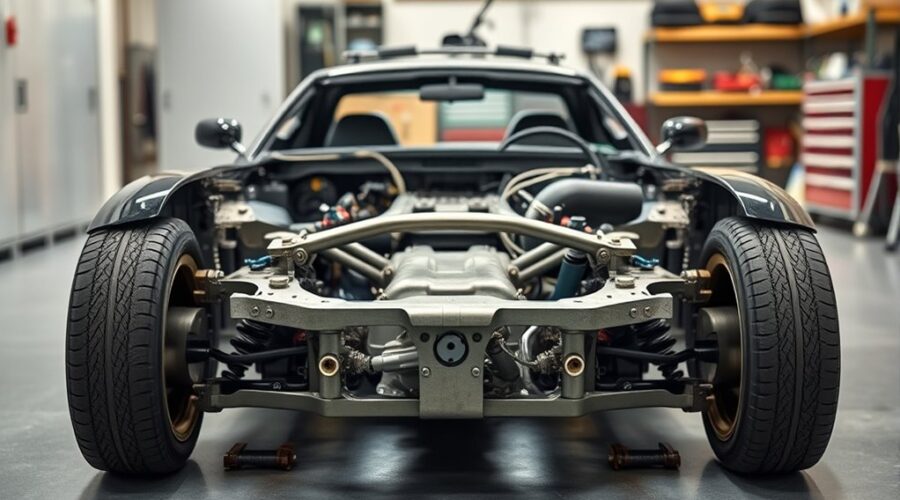
The 1997 Toyota Supra rode on the A80 chassis, a rigid unibody built for strength, low mass, and precise handling. Its 4,480 mm length and short-wheelbase layout supported a near 50/50 weight balance, while double wishbone suspension and careful steering geometry sharpened response. Paired with the 2JZ-GTE inline-six, the platform became more than a sports car foundation. The details behind that result are where the story turns more interesting.
1997 Supra Chassis Overview
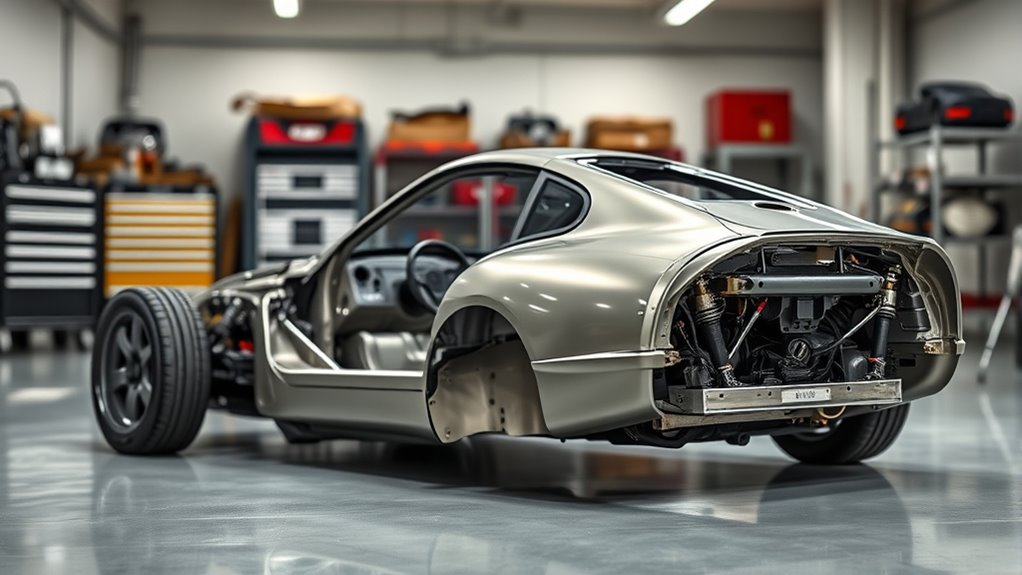
The 1997 Toyota Supra, an A80-generation model, employed a short-wheelbase chassis measuring 4,480 mm in length and 1,810 mm in width, a layout chosen to sharpen agility and high-speed stability.
In the 1997 Supra, the chassis design paired a rigid unibody structure with reduced mass, cutting about 100 kg from the preceding model and strengthening performance. Its short wheelbase supported quick handling responses without sacrificing control at speed.
Front and rear double-wishbone suspension maintained precise wheel motion, improving road contact and ride quality. A low center of gravity and near-perfect weight distribution further refined driving dynamics, allowing the car to change direction with measured authority.
This architecture gave the 1997 Supra a balanced, liberated character: responsive, composed, and mechanically exact. Within its era, the platform stood as a technically advanced basis for performance driving, uniting stability, comfort, and control in a single, disciplined package.
What Toyota Used to Build the A80 Chassis
Toyota built the A80 Supra chassis around a rigid unibody structure that combined high-strength construction with lightweight materials to improve stiffness, reduce mass, and sharpen response.
On the A80 chassis, Toyota paired this shell with double wishbone suspension at both ends, a choice that increased control, stability, and cornering precision for the Toyota Supra.
The platform was engineered for multiple engine options, especially the 2JZ-GTE turbocharged inline-six, whose packaging supported the Turbo model’s 320-horsepower output.
Balance was central to the design: near-ideal 50/50 weight distribution helped the car remain composed under acceleration, braking, and lateral load.
Toyota also shaped the body around aerodynamic priorities, using smooth surfaces and a low drag coefficient to aid high-speed stability and efficiency.
In technical terms, the chassis represented a disciplined blend of structure, motion control, and airflow management, giving drivers a freer, more capable machine.
1997 Supra Chassis Dimensions and Layout
Measured against its mechanical ambitions, the 1997 Supra’s chassis dimensions were tightly arranged for stability and control, beginning with a 2,550 mm (100.4 in) wheelbase that supported predictable high-speed handling.
Overall length reached 4,510 mm (177.6 in), with a width of 1,810 mm (71.3 in) and a low height of 1,270 mm (50.0 in), producing a compact stance and aerodynamic profile.
Overall length, width, and low height gave the Supra a compact, aerodynamic stance.
In 1997 Supra form, the front-engine, rear-wheel-drive layout preserved balanced weight distribution, a trait central to its handling characteristics and performance.
Curb weight varied from 1,540 kg (3,395 lb) in naturally aspirated specification to 1,580 kg (3,483 lb) in turbocharged trim, indicating a strong structure built to contain greater output without surrendering composure.
These chassis dimensions reflected an era when liberated driving still depended on disciplined engineering, and the Supra translated that discipline into stability, traction, and confident road behavior.
Suspension and Steering on the 1997 Supra
Beneath the Supra’s compact, rear-drive chassis, the suspension and steering hardware were arranged to match its high-speed composure with precise control.
The 1997 Toyota Supra used a double-wishbone suspension at both ends, a layout chosen for refined handling and disciplined wheel control. Up front, coil springs and gas-filled shock absorbers supported stability and helped the car settle cleanly through load changes, while the rear multi-link design improved wheel articulation and traction across uneven pavement.
Together, these components gave the chassis a firm but controlled response, suiting drivers who valued precision without compromise. Variable ratio power steering added another layer of responsiveness, easing low-speed maneuvering while preserving sharp feedback at speed.
With a front track width of 1,530 mm and rear track width of 1,540 mm, the Supra achieved strong road grip and confident cornering performance, reinforcing its reputation as a technically resolved sports coupe.
Why the 1997 Supra Chassis Still Stands Out
The 1997 Supra’s chassis continues to stand out because its underlying engineering balanced power, stability, and control in a way that was unusually advanced for its era.
In the A80 generation, the 1997 Supra paired the 2JZ-GTE engine, a turbocharged inline-six, with a lightweight design and near-perfect weight distribution, giving the car exceptional handling under hard acceleration and at high speed.
Its double-wishbone suspension sharpened cornering while preserving composure on uneven pavement, a rare combination that appealed to motorsport builders and independent drivers alike.
The aerodynamic profile, with a 0.31 drag coefficient, reduced lift and supported performance without sacrificing efficiency.
Its 0.31 drag coefficient reduced lift, supporting speed and stability without sacrificing aerodynamic efficiency.
Even the cabin reflected the model’s dual purpose, blending luxury features such as leather seating and premium audio with advanced safety equipment.
That synthesis of engineering discipline and usable power explains why the 1997 Supra remains a benchmark for liberated driving ambition.
Related Reading
Frequently Asked Questions
What Are Some Interesting Facts About the Toyota Supra?
Supra Legends cite Engine Evolution, Racing Heritage, and Design Influence; Iconic Models gained Performance Upgrades and huge Aftermarket Support. Community Culture and Market Value rose through Comparison Rivals, especially turbo A80s, revered for balance and durability.
What Year Is the Most Sought After Supra?
1997 is generally the most sought-after Supra, though enthusiasts quarrel like unpaid philosophers; the 1994 model also attracts collector interest. Its racing heritage, iconic design, engine variants, tuning potential, aftermarket support, market trends, maintenance tips matter.
What Are the Technical Specs of the Toyota Supra?
Toyota Supra technical specs include engine performance from a 3.0-liter inline-six, turbo specifications, transmission options, suspension setup, brake system, fuel efficiency, interior features, weight distribution, aftermarket modifications, and racing heritage, reflecting disciplined engineering and liberated driving.
Is a Supra Faster Than a Hellcat?
No; like a scalpel versus a sledgehammer, the Hellcat outruns stock Supra performance comparison. Yet Engine tuning options, Aftermarket modifications, Turbocharger upgrades, and Racing heritage influence can transform Drag racing results, while Handling characteristics, Weight distribution analysis favor track performance metrics.
Conclusion
In 1997, the Supra’s A80 chassis remained a finely judged platform, combining a rigid high-strength unibody with compact dimensions, double wishbone suspension, and near-perfect weight balance. Its 2JZ-GTE powertrain was not merely powerful; it was housed in a structure engineered to convert output into composure. Some may see age in its design, yet the chassis still evokes a machine that plants itself firmly, surges cleanly, and feels unmistakably precise.