

The Formula One chassis is the car’s structural core, but its role extends far beyond supporting the drivetrain and suspension. Its evolution from front-engine frames to carbon-fibre monocoques reflects shifting demands in safety, aerodynamics, and weight control. Modern designs integrate crash structures, driver protection, and airflow management within strict regulations. Yet the next major change is already approaching, and it may alter what a chassis must do in ways that are not yet fully settled.
Key Takeaways
- Formula One chassis are carbon-fiber monocoques that form the car’s structural and safety core.
- Chassis design has evolved from front-engined steel cars to lightweight, highly optimized composite structures.
- Modern chassis integrate the cockpit, suspension, power unit, and bodywork into one load-bearing aerodynamic system.
- Safety features include the Halo, crash structures, fuel bladders, and reinforced survival cells for impact protection.
- Regulations strictly control chassis dimensions, weight, and crashworthiness, with 2026 rules adding shorter cars and active aerodynamics.
What Is an F1 Chassis?
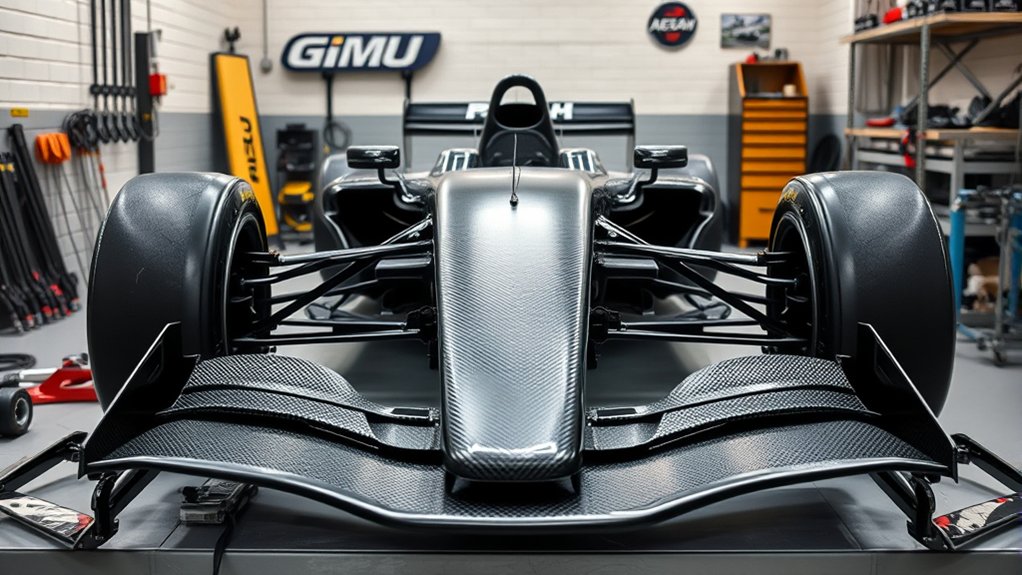
At the core of a Formula One car lies the chassis, a monocoque safety cell built primarily from carbon fiber and other composite materials to maximize stiffness, reduce mass, and protect the driver. This F1 chassis serves as the structural spine of the machine, linking the cockpit, suspension, power unit, and bodywork into a single load-bearing system. Its geometry is shaped by aerodynamics, with a flat floor, controlled airflow routes, and adjustable wing interfaces used to generate downforce and maintain grip. FIA regulations set a minimum car weight of 798 kg, including the chassis, driver, and dry-weather tyres, so every gram is treated as a constraint on performance and freedom of design. Development relies on simulation, crash testing, and iterative engineering, often over 18 months, to refine strength, packaging, and airflow efficiency. The result is a rigid, lightweight shell engineered for speed, safety, and maximal mechanical exploitation.
F1 Chassis History From 1950 to Today
From the heavy, front-engined machines of 1950 to today’s carbon-fiber survival cells, Formula One chassis have undergone a continuous engineering transformation driven by safety, aerodynamics, and material science. Early cars used steel and aluminum structures, with limited rigidity and poor crash resistance. | Era | Technical shift |
| — | — |
|---|---|
| 1950s | Front-engined, heavy layouts |
| 1962 | Aluminum monocoque adoption |
| 1970s | Wings and ground effect |
| 1990s | Carbon fiber adoption |
| 2020s | Narrower, lighter rules |
Lotus’s 1962 monocoque redefined chassis design by separating load paths from the body, improving safety and performance. In the 1970s, aerodynamic innovations changed underbody behavior and elevated cornering speed. By the early 1990s, carbon fiber enabled lighter, stiffer structures, sharpening response without sacrificing protection. Modern regulations continue compressing dimensions, while the 2026 framework adds active aerodynamics and sustainable materials, extending the same historical logic: fewer compromises, more control, and greater technical freedom.
How F1 Chassis Became Carbon Fibre Monocoques
By the late 1970s, Formula One chassis design began shifting toward carbon fibre monocoques as engineers sought a stronger, lighter alternative to aluminum construction. The decisive breakthrough arrived with the McLaren MP4/1 in 1981, the first successful carbon fiber monocoque in F1. Its adoption changed how a chassis could be conceived: the monocoque fused cockpit and structural shell into one rigid unit, improving stiffness without adding mass. Carbon fiber offered a far superior strength-to-weight ratio and high tensile capacity, allowing the chassis to endure extreme loads while preserving performance. Over time, this material became central to the sport’s engineering philosophy, and carbon fiber structures now account for roughly 80-85% of a modern F1 car. Even under the 798 kg minimum weight limit, the composite layout supports aerodynamic efficiency, structural integrity, and the technical freedom that defines contemporary Formula One.
Key F1 Chassis Safety Features
Modern Formula One chassis integrate multiple safety systems into the carbon fibre monocoque, combining exceptional stiffness with controlled deformation in high-impact scenarios. This architecture elevates safety by preserving the survival cell while redirecting crash energy away from the driver. The Halo, introduced in 2018, shields the head from debris and direct strikes, strengthening driver protection without obstructing visibility. Crash-resistant fuel bladders, built from rubber and Kevlar, reduce leakage risk after impact. Energy-absorbing structures and reinforced cockpits further manage loads generated in violent deceleration.
| Feature | Function |
|---|---|
| Carbon fibre monocoque | Rigid survival cell |
| Halo device | Head impact protection |
| Fuel bladder | Leak suppression |
| Crash structures | Energy absorption |
| Reinforced cockpit | Driver protection |
These systems reflect successive responses to accidents, proving that chassis safety can advance freedom to race at the limit.
F1 Chassis Dimensions and Minimum Weight
Formula One chassis are governed by strict dimensional constraints, with typical proportions of about 5.63 meters in length, 2 meters in width, and 0.9 meters in height. The minimum weight limit, including the driver and dry-weather tyres, is set at 798 kg, requiring careful mass distribution within a monocoque structure. FIA weight and size rules continue to shape chassis design, balancing aerodynamic efficiency, safety, and competitive parity.
Chassis Dimensions
The chassis of a Formula One car is tightly regulated in both size and mass, with the current minimum weight set at 798 kg, including the driver and dry-weather tyres. These chassis dimensions are defined by strict homologation rules: approximately 5.63 meters in length, 2 meters in width, and 0.9 meters in height. Such proportions support aerodynamic efficiency while preserving a compact survival cell. The monocoque design, built from carbon fiber and composite materials, creates a rigid yet lightweight structure that resists deformation under load. Regulations require each chassis to pass exhaustive crash tests, confirming its capacity to absorb impact energy and protect the driver. In this framework, technical control becomes a form of liberation, constraining excess while enabling performance, safety, and disciplined innovation.
Minimum Weight Limit
A stringent mass ceiling governs Formula One chassis design: the minimum weight is 798 kg, measured with the driver and dry-weather tyres included. This minimum weight limit compels engineers to allocate mass with surgical precision across the chassis, power unit installation, and safety structures. The monocoque, formed from reinforced carbon fiber, must remain exceptionally light while preserving crash protection and torsional rigidity. Because regulations evolve to balance safety and competition, material choices and structural layouts are tightly constrained. Within this framework, aerodynamics depends not only on shape but on disciplined weight distribution, which affects stability, tire load, and response. The result is a chassis that serves liberty through controlled efficiency: it enables performance without excess, and enforces exacting technical discipline.
Weight And Size Rules
Despite its slender profile, a modern Formula One chassis must comply with strict dimensional and mass regulations: contemporary cars are typically about 5.63 meters long, 2 meters wide, and 0.9 meters high, while the minimum weight limit, including the driver and dry-weather tyres, stands at 798 kg.
| Parameter | Regulation |
|---|---|
| Length | ~5.63 m |
| Width | ~2.0 m |
| Height | ~0.9 m |
| Minimum weight | 798 kg |
| Core material | Reinforced carbon fiber |
These dimensions define the aerodynamic envelope, while weight distribution is tuned to improve cornering stability and braking efficiency. Safety features such as the Halo are integrated with minimal mass penalty, reinforcing driver protection without compromising performance. The result is a controlled engineering space where liberation arises through precision: every gram, contour, and structural choice is governed, yet optimized for speed.
Inside an F1 Chassis
Built around a carbon-fiber monocoque, an F1 chassis combines low mass with exceptional stiffness to protect the driver and support the car’s core systems. Inside the chassis, composite layups form a rigid survival cell that must satisfy the 798 kg minimum while preserving mechanical integrity and responsiveness. The structure houses the power unit, a 1.6 L turbo hybrid V6, along with electronic controls and energy recovery hardware, all packaged to function as one integrated system. This internal architecture is not arbitrary; it reflects deliberate optimization for speed, stability, and driver protection. Aerodynamics is also embedded in the chassis concept, since its surfaces and interfaces help generate downforce through coordinated front and rear wing influence. Teams refine these internal and external relationships continuously using CFD and wind tunnel testing, seeking marginal gains that translate into freed performance on track.
How Chassis Shape Affects Aerodynamics
Nose shape governs the initial conditioning of airflow, influencing how cleanly air is directed toward the front wing, underfloor, and sidepods. Sidepod profile then determines how efficiently that flow is managed around cooling inlets and bodywork, with sharper packaging generally reducing drag and limiting turbulence. Together, these chassis features shape the car’s aerodynamic balance by controlling pressure distribution, flow attachment, and resistance.
Nose Shape and Airflow
The nose shape of a Formula One chassis is engineered to manage airflow with high precision, typically using a pointed or flat profile to reduce drag while promoting front-end downforce. In practice, the nose shape governs how airflow is guided toward the front wing and along the body, directly affecting aerodynamic efficiency. FIA regulations limit height and width, with a maximum height of 550 mm from the reference plane, preserving safety and controlled performance. A narrower nose can lower drag, while a wider section may improve stability at speed, though often at a cost. Recent designs have used a T-wing above the nose to further refine airflow and increase downforce with minimal mass, supporting a chassis that seeks speed without unnecessary constraint.
Sidepod Profile and Drag
Sidepod profile is a major determinant of aerodynamic drag and thermal efficiency in a Formula One chassis, since its geometry must both channel cooling air through radiators and minimize disruption to the flow along the car’s flanks. Modern sidepods are sculpted to reduce drag, preserve balance, and sustain downforce through cleaner airflow toward the rear wing and diffuser. The coke bottle taper is especially effective, narrowing the bodywork aft to accelerate and organize the wake. Because sidepods also house radiators and cooling systems, airflow management must prevent overheating without sacrificing speed. CFD simulation allows engineers to refine each contour with high precision, converting subtle aerodynamic gains into milliseconds per lap. Such optimization supports competitive freedom by letting the chassis exploit airflow rather than resist it.
How an F1 Chassis Affects Performance
Because it is a structural, aerodynamic, and weight-bearing assembly, the F1 chassis has a direct effect on acceleration, cornering, and stability. Built largely from carbon fiber composites, the chassis helps keep mass near the 798 kg minimum, preserving launch response and braking efficiency. Its monocoque form adds rigidity, so suspension loads are transmitted with less flex, improving precision and crash resistance. The chassis also defines aerodynamic design: front and rear wings, floor geometry, and bodywork channel airflow to generate downforce that can approach twice the car’s weight at 190 km/h, increasing grip and composure in fast bends. Active aerodynamics can vary wing angles to balance drag and downforce during a lap. In this sense, chassis, aerodynamic design, and performance are inseparable; each refinement expands the car’s usable speed envelope and gives the driver greater control over energy, line choice, and momentum.
F1 Chassis Rules and 2026 Changes
Although Formula One chassis are engineered for extreme performance, they remain tightly constrained by regulation. The F1 chassis must satisfy a minimum mass of 798 kg, including the driver and dry-weather tyres, a limit intended to preserve safety while controlling design extremes. Modern structures rely on carbon-fiber reinforced polymers, with 80–85% of the body made from composites to maximize stiffness and reduce weight. Compliance extends beyond mass: crash tests, deformation criteria, and devices such as the Halo are mandatory, restricting risk without extinguishing competitive intent. The 2026 regulations will reshape these machines with shorter, narrower chassis and active aerodynamics. Wing angles may change dynamically with track conditions, improving downforce, handling, and aerodynamic efficiency. These rule changes preserve engineering freedom, but only within a defined envelope. The result is not absolute liberation, yet it is a carefully bounded space where performance can still be pursued aggressively and intelligently.
Related Reading
Frequently Asked Questions
How Are F1 Chassis Tested Before Racing?
F1 chassis undergo crash tests, torsional rigidity checks, wind-tunnel validation, and track shakedowns. Engineers assess chassis design, aerodynamic efficiency, and testing simulations to guarantee safety, compliance, and performance before competitive racing.
Do Different Teams Use Different Chassis Suppliers?
Yes—different teams often rely on different chassis suppliers, like artisans shaping separate blades. Chassis design usually remains team-specific, while supplier partnerships vary; these choices can alter performance impact through materials, integration, and development capability.
How Often Are F1 Chassis Replaced During a Season?
F1 chassis are rarely replaced during a season; teams usually run one monocoque per driver unless damage, regulation changes, or major design evolution demand a swap. Chassis lifespan is long, and performance impact from replacement is carefully managed.
Can a Chassis Be Repaired After a Major Crash?
Yes, sometimes. A shattered shell and an intact safety cell stand in stark contrast; after structural analysis, technicians assess chassis integrity, then decide whether crash repairs can restore compliance, or require replacement for liberation from risk.
What Materials Besides Carbon Fiber Are Used in F1 Chassis?
Besides carbon fiber, Formula One chassis incorporate aluminum alloys for inserts and structures, composite materials for bodywork and impact elements, and titanium components for fasteners and suspension hardpoints, optimizing stiffness, weight reduction, and crash performance.
Conclusion
Formula One chassis design has progressed from simple front-engine structures to highly optimized carbon-fibre monocoques, where safety, stiffness, and aerodynamic efficiency are tightly integrated. A notable statistic is that the current minimum car mass is 798 kg, underscoring how modern chassis must balance increasing structural protection with strict weight control. As regulations evolve toward 2026, active aerodynamics and revised dimensions are expected to further reshape chassis architecture and performance priorities.