
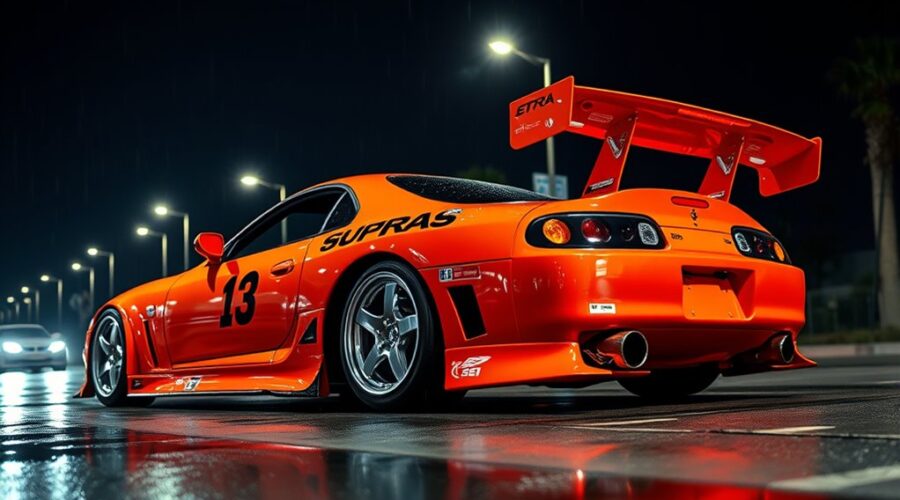
The Fast and Furious Supra specs depend on which car you mean: the documented 1993 stunt car used a naturally aspirated 2JZ-GE rated at 220 hp with a five-speed manual, while Craig Lieberman’s separate 1994 Supra was the production’s primary hero vehicle. Several A80 Supras played Brian O’Conner’s orange car, which is why engine, power and auction claims often conflict.
Quick Answer
Brian O’Conner’s orange Supra was represented by multiple A80 Supras during filming. A documented 1993 stunt car used a naturally aspirated 2JZ-GE, five-speed manual, roll cage, stunt suspension, and fuel cell, while Craig Lieberman’s separate 1994 Supra served as the production’s primary hero vehicle.
Brian O’Conner’s Supra in The Fast and the Furious
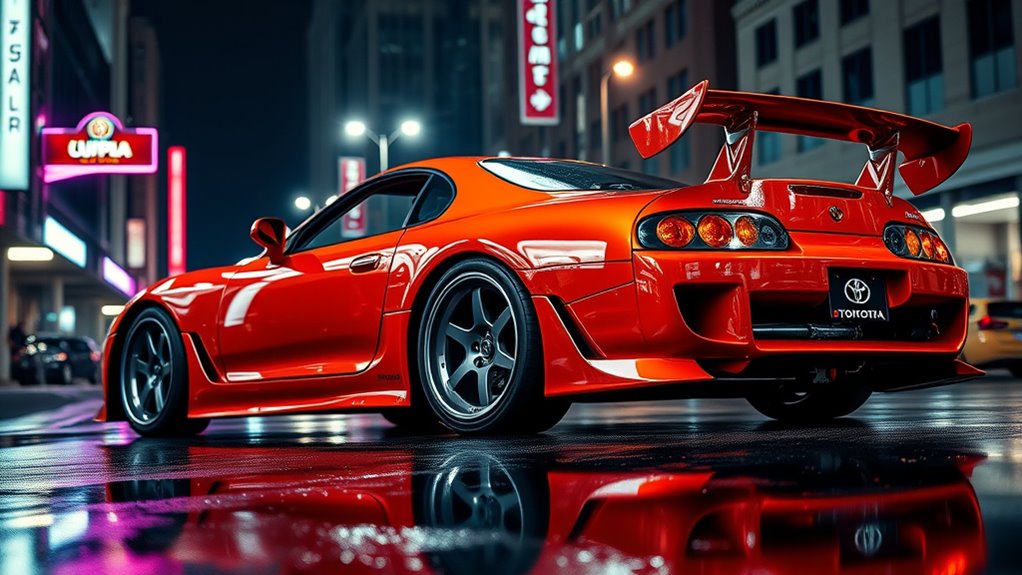
The orange Supra on screen was created with more than one physical car. Film productions commonly separate detailed “hero” cars from stunt cars, and that distinction is essential here: a Toyota interview with technical adviser Craig Lieberman identifies his 1994 Toyota Supra MK IV as the production’s primary hero vehicle.
A separate 1993 Toyota Supra was prepared for stunt work and appeared throughout the 2001 film, including the final race sequence. That car is the source of many familiar 220-hp, five-speed, roll-cage, and fuel-cell specifications.
In the story, Brian’s Supra becomes the “10-second car” he owes Dominic Toretto. Its climactic race against Dom’s Dodge Charger made the orange A80 one of the franchise’s defining cars, but the movie’s fictional performance should not be confused with the mechanical specification of every screen-used chassis.
How Brian O’Conner’s Supra Was Built
The movie look combined a real Toyota A80 platform with highly visible tuner-era styling and production-specific safety changes. The exact mechanical package depended on the car’s filming role, so the 1993 stunt car and the 1994 hero vehicle should be treated as different builds.
Base Supra Platform
The 1993 stunt car used Toyota’s naturally aspirated 2JZ-GE 3.0-liter inline-six, rated at 220 horsepower, with a five-speed manual transmission. It was rear-wheel drive, like other A80 Supras, and its stock-style engine was far less powerful than the twin-turbo Supra that enthusiasts often assume was under every orange movie car.
For context, the U.S.-market A80 Supra Turbo used the 2JZ-GTE and was rated at 320 horsepower. That difference matters because the 1993 stunt car’s screen speed came from filmmaking, not a hidden 500-plus-horsepower engine.
The Shark Shop Build
Eddie Paul and The Shark Shop in El Segundo, California, built the documented 1993 stunt Supra for the film. The Mecum-sourced specifications published by Sports Car Market list the Bomex body kit, APR wing, Dazz alloy wheels, Yokohama tires, and Modern Image graphics.
Those parts did most of the visual work. The low front treatment, tall rear wing, large wheels, and bright graphics made the car readable at a glance on camera and tied it directly to the early-2000s import-tuner scene.
Film-Ready Modifications
The 1993 stunt car was reinforced for production duty rather than converted into the most powerful Supra possible. It received heavy-duty stunt suspension, a full roll cage, competition seats, and a Jaz Products fuel cell.
Twin Holley Performance nitrous bottles were mounted in the rear compartment, but auction documentation said they were not connected to the engine. That is a useful example of the gap between what the audience saw and what the car actually needed to do on set.
The car also used a Sparco steering wheel and simplified race-oriented cabin hardware. Its purpose was repeatable, controllable filming, not a dyno number that matched the fictional “10-second car” description.
Fast and Furious Supra Specs: Which Car Is Which?
The safest way to read Fast & Furious Supra specs is to identify the exact car first. The 1993 stunt car has a well-documented 220-hp naturally aspirated setup, while Craig Lieberman’s separate 1994 Supra was the production’s primary hero vehicle and had its own much more heavily modified specification.
| Spec | 1993 stunt car | Stock U.S. A80 Turbo reference |
|---|---|---|
| Engine | 3.0L 2JZ-GE inline-six | 3.0L 2JZ-GTE twin-turbo inline-six |
| Factory output | 220 hp | 320 hp |
| Transmission | 5-speed manual | 6-speed manual or 4-speed automatic, depending on model |
| Film purpose | Stunt and action work | Production-car comparison only |
This is also why the often-repeated 544-hp figure should not be assigned to the 1993 stunt car. That number is associated with a different, heavily tuned Supra build connected with the hero-car history. The auctioned 1993 stunt car itself was documented at 220 hp.
Which Supra Parts Were Built for Stunts?
The 1993 Supra’s stunt preparation focused on occupant protection, chassis durability, and dependable operation across repeated takes. The major documented changes were the roll cage, heavy-duty suspension, competition seats, and fuel cell.
Roll Cage Reinforcement
A full roll cage was installed in the stunt car’s cabin. Its job was to provide added structure and occupant protection during demanding driving scenes, while also giving the production a more competition-focused interior.
The cage worked with competition seats and simplified interior trim. Those changes are typical of a car prepared for controlled action work, where durability and predictable driver positioning matter more than factory comfort.
Heavy-Duty Suspension
The auction documentation identifies a heavy-duty stunt suspension, but it does not clearly establish the Bilstein, Eibach, Stillen, and custom-bushing combination often repeated in online spec lists for this particular 1993 chassis. Those branded parts are better treated as belonging to other Supra builds unless a chassis-specific record confirms them.
What is clear is the purpose: the stunt car needed a firmer, more durable setup for repeated hard acceleration, braking, cornering, and action takes. That is a different goal from building a comfortable street car or maximizing drag-strip performance.
Stunt-Ready Fuel Cell
A Jaz Products fuel cell replaced the ordinary road-car fuel setup in the documented stunt build. Along with the roll cage and competition seats, it formed part of the car’s production-oriented safety package.
The two nitrous bottles mounted behind the seats were visual hardware rather than an active power adder on this chassis. They were present for the movie look, but the auction description stated that they were not plumbed into the engine.
How the 1993 Stunt Supra Differs From a Stock MKIV
The movie stunt car was a real A80 Supra, but it was not mechanically equivalent to a stock Supra Turbo. Its naturally aspirated 2JZ-GE, five-speed manual, safety hardware, and film-specific bodywork made it a purpose-built production car rather than a normal showroom specification.
- Engine: 220-hp naturally aspirated 2JZ-GE instead of the 320-hp twin-turbo 2JZ-GTE used in the U.S.-market Supra Turbo.
- Interior: roll cage, competition seats, race-style controls, and fuel cell instead of a normal street cabin.
- Exterior: Bomex bodywork, APR rear wing, Dazz wheels, Yokohama tires, and Modern Image graphics.
- Purpose: repeatable filming and visual continuity rather than daily comfort or maximum straight-line speed.
That distinction also explains why comparing the movie’s fictional performance to a stock Supra can be misleading. The screen character was presented as a far faster machine than the documented 1993 stunt chassis actually was.
Why Paul Walker’s Supra Became Iconic
The Supra became iconic because the car’s visual design, Brian O’Conner’s character arc, and the film’s street-racing theme all met in one memorable package. The orange paint, side graphics, huge APR wing, and rounded A80 shape were distinctive enough to identify the car even without a badge.
Its place in the final race against Dom’s Charger gave it a clear narrative payoff. The car was not just background decoration; it represented the build that Brian and Dom’s crew completed, raced, and ultimately used in one of the first film’s defining scenes.
The A80 Supra also had real credibility outside Hollywood. Toyota offered a strong 2JZ platform, rear-wheel drive, and a 320-hp Turbo model, so the movie attached its fictional performance to a car that enthusiasts already knew could support serious tuning.
Auction Value and Collector Appeal
The documented 1993 stunt Supra sold for $199,800 including buyer’s premium at Mecum’s Indy Auction on May 16, 2015. Its value came from screen use and provenance as much as from the underlying Toyota hardware.
That sale should not be treated as a normal market value for an A80 Supra. A movie car can command a premium because collectors are buying a documented piece of film history, and originality to the screen-used configuration can matter more than whether the mechanical specification is the fastest available version.
For this car, details such as the stunt equipment, body kit, graphics, and production records help establish identity. Changing those pieces to make the car “better” as a road or race car could reduce the very provenance that makes it collectible.
Fast & Furious Supra Facts and Specs
The most useful way to summarize Brian O’Conner’s Supra is to keep the hero and stunt cars separate. These are the key facts tied to the best-documented 1993 stunt chassis:
- Year and role: 1993 Toyota Supra used as a stunt car in the 2001 film, including the final race sequence.
- Engine: 3.0-liter 2JZ-GE naturally aspirated inline-six.
- Output: 220 horsepower.
- Transmission: five-speed manual.
- Stunt equipment: heavy-duty suspension, full roll cage, competition seats, and Jaz Products fuel cell.
- Exterior: Bomex body kit, APR wing, Dazz wheels, Yokohama tires, and Modern Image graphics.
- Nitrous display: twin Holley Performance bottles were mounted but not connected.
- 2015 auction result: $199,800 including buyer’s premium.
Separately, Craig Lieberman’s 1994 Supra MK IV served as the production’s primary hero vehicle. Keeping those cars distinct resolves most of the contradictory specifications attached to “Paul Walker’s Supra” online.
More movie cars: the Mustang in Fast and Furious 3, DK’s Nissan 350Z in Tokyo Drift and the Nissan R36 Skyline GT-R. For the era behind the A80, see our guide to 1990s cars.
Frequently Asked Questions
What Are the Specifications of the Supra in Fast and Furious?
There was more than one Supra, so the specifications depend on the chassis. The documented 1993 stunt car used a 220-hp 2JZ-GE 3.0-liter inline-six, five-speed manual, Bomex body kit, APR wing, stunt suspension, roll cage, competition seats, and a Jaz Products fuel cell.
What Are Some Interesting Facts About the Toyota Supra?
The fourth-generation A80 Supra offered both naturally aspirated and twin-turbo 2JZ inline-six engines in the U.S. market. Its rear-wheel-drive layout and strong tuning potential helped make it an enthusiast favorite, while its starring role in The Fast and the Furious pushed the model deeper into pop culture.
What Are the Specifications of Paul Walker’s Supra?
There is no single Paul Walker Supra specification because several cars represented Brian O’Conner’s orange Supra. Craig Lieberman’s 1994 Supra was the primary hero vehicle, while the documented 1993 stunt car had a 220-hp 2JZ-GE, five-speed manual, roll cage, stunt suspension, and fuel cell.
Is a Supra Faster Than a Hellcat?
A stock A80 Supra is generally slower than a Dodge Hellcat in a straight-line acceleration comparison. Modified Supras can be much faster than stock, but the result depends on the engine build, turbo system, tires, transmission, traction, and race distance, so there is no universal answer for tuned cars.
Was Brian O’Conner’s Supra Turbocharged?
The answer depends on which screen-used Supra you mean. Craig Lieberman’s 1994 primary hero Supra was a heavily modified turbo car, while the documented 1993 stunt Supra used a naturally aspirated 2JZ-GE rated at 220 horsepower, so both turbo and non-turbo specifications appear in credible accounts.
Conclusion
Brian O’Conner’s Supra is best understood as a movie-car family rather than one chassis with one spec sheet. The 1993 stunt car’s 220-hp 2JZ-GE, five-speed manual, safety hardware, and unmistakable bodywork are well documented, while the separate 1994 hero Supra explains why much higher performance figures also appear in the car’s history.




[…] movie-car guides: the Supra in Fast and Furious and the Mustang in Fast and Furious 3. For the era of the Nova itself, see our guide to 1970s […]