
Spa-Francorchamps remains one of Formula 1’s defining circuits, stretching 7.004 km through fast corners, heavy elevation changes, and some of the sport’s most demanding sections. Since opening in 1950, it has combined speed with technical complexity, while major safety upgrades and a recent €80 million renovation have reshaped its modern form. Yet its most difficult variable may still be the weather, which can alter everything in a matter of laps.
Key Takeaways
- Spa-Francorchamps is the longest current F1 circuit at 7.004 km, with 19 turns and famous Eau Rouge-Raidillon.
- The track opened in 1950 and was shortened and modernized over time to improve safety while preserving its fast character.
- Spa is defined by high-speed straights, elevation changes, and demanding braking zones that test driver precision.
- Weather can change quickly at Spa, making tire strategy, clean air, and pit timing especially important.
- Major safety upgrades include Armco barriers in 1970, shortening in 1979, public-access closure in 2001, and a 2022 modernization.
Spa F1 Track Guide at a Glance
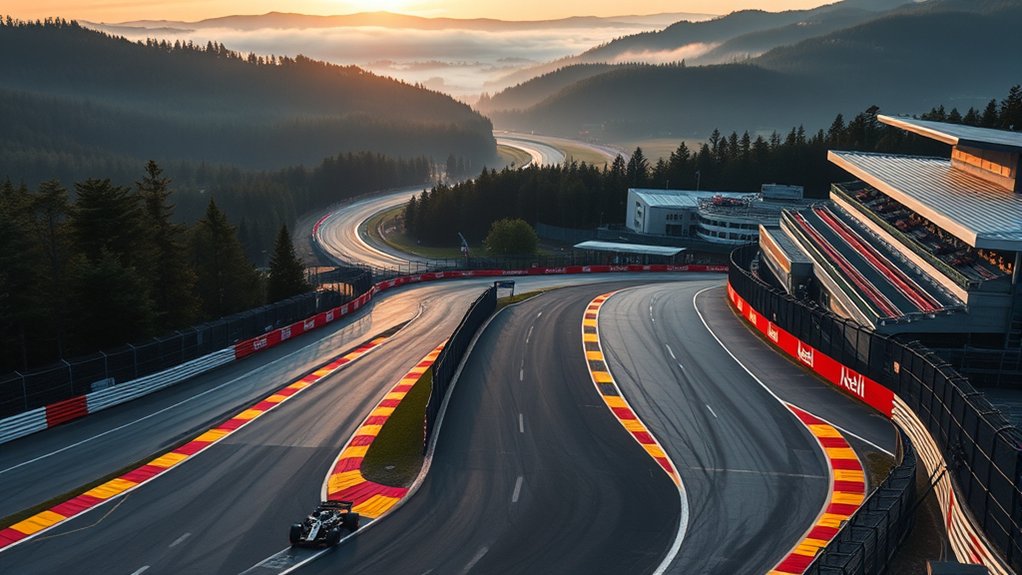
The Circuit de Spa-Francorchamps is Formula 1’s longest current track, stretching 7.004 km with 19 turns and marked by dramatic elevation changes. The Circuit demands disciplined car control, with Eau Rouge and Raidillon forming the best-known test of precision and commitment.
Since 1950, it has hosted the Belgian Grand Prix and evolved through repeated safety and performance revisions, yet its character remains distinct. The layout rewards clean exits, stable balance, and decisive timing across a lap that is longer than most on the calendar.
The current lap record, set by Sergio Pérez in 2024 at 1:44.701, reflects both modern pace and the narrow margin for error. Spa also carries a reputation for shifting weather, which can alter race planning without warning.
That uncertainty keeps teams alert and gives drivers room to assert control over conditions, pace, and outcome.
What Makes Spa So Fast and Technical
Spa-Francorchamps combines exceptional speed with sustained technical demand, covering 7.004 km and 19 turns in a layout that alternates between long straights and difficult corner sequences. Its high-speed sections allow cars to reach major velocity, yet the circuit never becomes simple, because each acceleration zone leads into braking points that punish imbalance.
The elevation changes, especially through Eau Rouge and Raidillon, compress the car and test driver precision, making technical prowess essential rather than optional. The first sector rewards commitment and overtaking, while the later sectors narrow the margin for error with complex turns and repeated changes in rhythm.
Weather can further alter grip and strategy, so the same lap may demand different tire management from one hour to the next. Early weekend asphalt may offer limited traction, but deposited rubber improves surface confidence as running increases, sharpening both speed and control.
Spa’s Layout and F1 History
Opened in 1950, the Circuit de Spa-Francorchamps entered Formula One history with a far longer original layout of 14.982 km, later shortened through major revisions to its present 7.004 km configuration. That change preserved Spa’s core identity while making the circuit fit modern F1 demands.
The current layout still contains 19 turns, including Eau Rouge and Raidillon, where elevation shifts and rapid direction changes define its character. The Belgian Grand Prix has remained a constant reference point in the championship, appearing almost every season since F1 began, with only brief interruptions.
This continuity has made Spa a central test of driver skill and team precision. Its layout rewards freedom through speed, but never without risk, especially when weather turns unstable.
Sergio Pérez’s 2024 lap of 1:44.701 shows the circuit’s continuing pace potential. Spa consequently remains both historic and structurally distinctive in F1.
How Spa Got Safer
By the 1960s and 1970s, Spa-Francorchamps was being reshaped as safety concerns mounted, with Armco barriers added in 1970 after a series of fatalities and a major 1979 revision shortening the circuit while introducing further protective features. These safety improvements marked a shift from raw speed toward controlled risk.
| Year | Measure | Effect |
|---|---|---|
| 1970 | Armco barriers | Added protection |
| 1979 | Track shortened | Lowered exposure |
| 2001 | Public access ended | Enabled upgrades |
| 2020 | Run-off expanded | Reduced crash risk |
| 2022 | Modernization project | Modern safety, preserved identity |
The circuit later closed to public traffic in 2001 so renovations could proceed without compromise. In 2020, expanded run-off areas and gravel traps were announced, strengthening margins for error. A €80 million modernization project completed in 2022 consolidated these changes. The result was a safer Spa that kept its historic character, offering faster driving with fewer unforgiving consequences.
Why Strategy Matters at Spa
At Spa, strategy often determines more than outright pace because the circuit’s 7.004 km layout combines fast, technical, and tire-sensitive sections that reward precise planning.
The long lap amplifies time lost in traffic, so teams shape strategy around clean air, tire management, and pit windows. With pit stops costing a median 18.4 seconds, two-stop plans are often preferred, especially when an undercut can recover track position; historically, it works 71% of the time here.
The Ardennes weather adds another layer, as sudden rain can force rapid shifts between slicks and intermediates, turning the race into a live exercise in adaptation.
Eau Rouge and Raidillon further increase the stakes, since speed through those corners depends on setup confidence and tire condition.
At Spa, freedom on track belongs to those who read conditions faster than rivals and commit with precision.
Frequently Asked Questions
What Technologies Have Been Used in Formula 1?
Formula 1 has used Hybrid Engines, Aerodynamic Innovations, and Tire Management systems, alongside telemetry, energy recovery, DRS, and advanced materials. These technologies help teams maximize speed, efficiency, control, and strategic flexibility on track.
What Are 10 Interesting Facts About Formula 1?
Formula 1 features 10 notable facts: extreme acceleration, hybrid power units, strict engine limits, varied circuits, record laps, evolving regulations, Driver rivalries, Pit stop strategies, Race day traditions, and constant engineering innovation.
Why Was Spa Removed From F1?
Spa was removed because safety concerns and costly circuit changes made it untenable. The Spa controversy centered on fatalities and required upgrades. Fan reactions were strong, but financial strain and FIA standards forced exclusion until renovations were completed.
Why Is Spa Circuit so Famous?
Spa is famous for its brutal layout, changing weather, and legendary corners, while Spa legends, Iconic races, and Scenic views amplify its allure; these elements create racing drama, technical challenge, and enduring motorsport prestige.
Conclusion
Spa-Francorchamps stands as a rare blend of speed, technical challenge, and history. Its long lap, dramatic elevation changes, and flowing sequence through Eau Rouge and Raidillon continue to test precision and courage. Over decades, safety upgrades and modern infrastructure have reduced risk without diluting character. The track’s changing weather still shapes strategy, making outcomes difficult to predict. Spa remains, in effect, a visual map of Formula 1’s evolution from raw danger to refined performance.