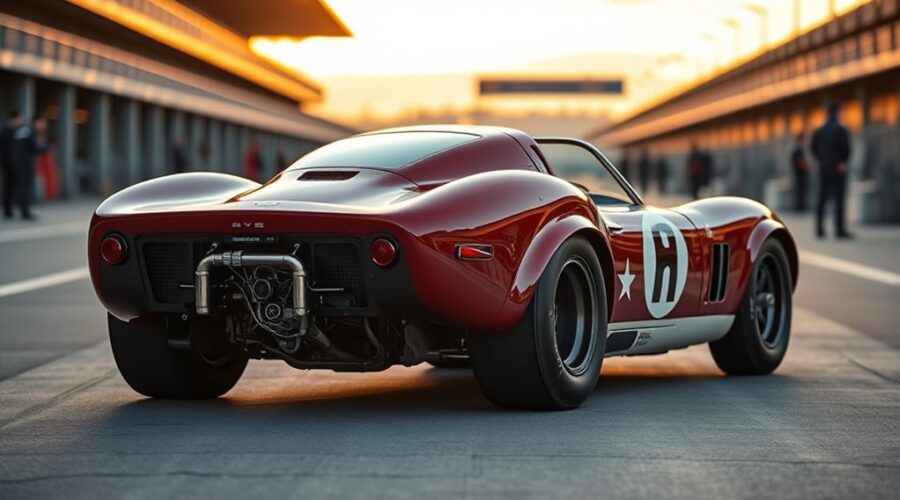
The Mazda 787B remains one of the most significant race cars in endurance history. Debuting in 1990, it paired a lightweight carbon-and-Kevlar chassis with the unusual R26B four-rotor rotary engine, producing about 700 PS. Its 1991 Le Mans victory marked the first for a Japanese manufacturer. The car’s technical design, race strategy, and reliability explain much of its success, but several details behind that result are more revealing.
Key Takeaways
- The Mazda 787B debuted in 1990 and became the first Japanese car to win the 24 Hours of Le Mans in 1991.
- It used a 2.6-liter R26B four-rotor rotary engine producing about 700 PS with strong, reliable endurance performance.
- The car featured a lightweight carbon-and-Kevlar monocoque chassis and advanced aerodynamics for high-speed stability.
- Mazda built the 787B to win through efficiency, reliability, and race management rather than sheer top speed.
- Its Le Mans victory, driven by Weidler, Herbert, and Gachot, made the rotary-powered Mazda a motorsport icon.
Mazda 787B and Its Le Mans Victory
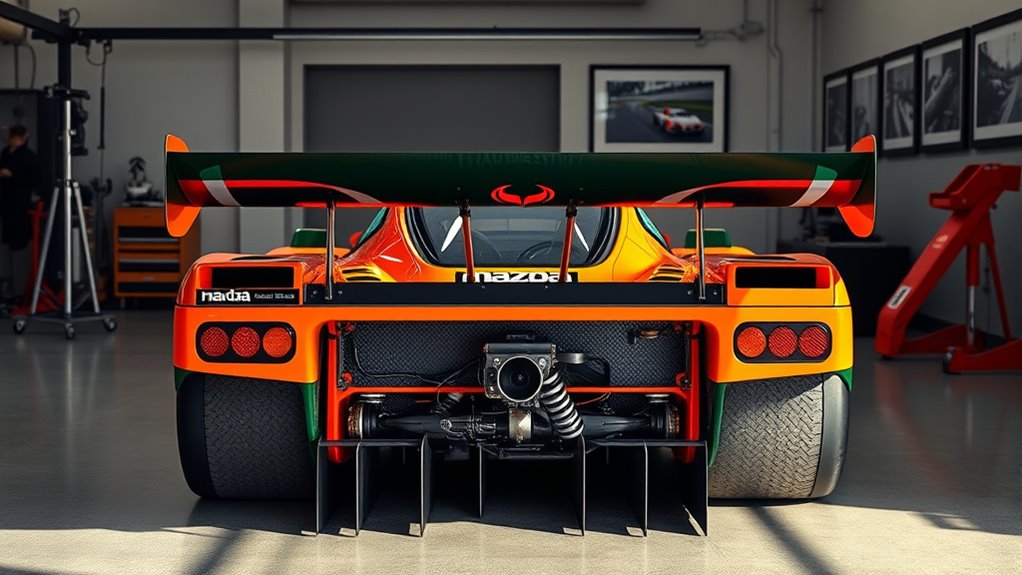
The Mazda 787B won the 1991 24 Hours of Le Mans as the first Japanese car to take overall victory, powered by a 2.6L R26B four-rotor rotary engine producing 700 PS.
The 787B combined this rotary engine with a lightweight 830 kg carbon-and-Kevlar monocoque, giving Mazda a distinct advantage in endurance racing. Its technical details included a three-plug ignition system and variable-length intake, supporting high engine speed and stable power delivery over long stints.
The 787B paired a lightweight carbon-Kevlar monocoque with rotary precision, sustaining speed and endurance over long stints.
At Le Mans, drivers Volker Weidler, Johnny Herbert, and Bertrand Gachot maintained pace, preserved machinery, and converted reliability into victory across 24 demanding hours.
The car’s efficiency and reduced mass aligned with an uncompromising racing philosophy: maximum performance with minimal restraint.
As the only rotary-powered machine to win Le Mans, the 787B remains a precise symbol of technical dissent, mechanical liberation, and competitive proof against convention.
How Mazda Developed the 787B
Mazda developed the 787B as an evolution of the 767 and 767B, using a lighter carbon and Kevlar monocoque to improve structural efficiency and aerodynamic performance.
The car’s R26B 2,616 cc four-rotor engine introduced three spark plugs per rotor and a variable-length intake system, raising output to about 700 hp with improved combustion efficiency.
Its bodywork and chassis were tuned for endurance racing, prioritizing high cornering speed, stable suspension behavior, and compatibility with larger wheels and carbon ceramic brakes.
From 767 to 787B
Building on the earlier 767 and 767B prototypes, the 787B was developed as Mazda’s most advanced rotary sports prototype, combining a revised chassis and body package with a new R26B engine.
Mazda replaced earlier structures with a lightweight monocoque of carbon and Kevlar, reducing mass to 830 kg and improving rigidity. The naturally aspirated four-rotor three-rotor engine layout used variable intakes, three spark plugs per rotor, and a peripheral port system to support output.
Aerodynamic improvements included a nose-mounted single radiator and revised suspension geometry, favoring cornering performance over absolute speed.
For the 1991 Le Mans campaign, the Japanese manufacturer built three cars. No. 55 led in the 22nd hour and delivered Mazda’s Le Mans victory, demonstrating the 787B’s technical maturity.
R26B Engine Advances
At the heart of the 787B was the R26B, a 2,616 cc naturally aspirated four-rotor engine developed from Mazda’s 13B production unit and optimized for endurance competition. The R26B rotary engine delivered 700 PS at 8,500 rpm, with a high-revving character supported by three spark plugs per rotor and a variable-length intake system for stronger torque delivery.
Ceramic apex seals improved durability under endurance racing loads, while peripheral port intake geometry sharpened performance.
- Lightweight construction helped the 830 kg chassis stay agile.
- The engine’s precision favored sustained pace over short bursts.
- Rotary simplicity reduced reciprocating mass.
- Exhaust tuning produced an iconic exhaust note.
- Mazda’s development balanced reliability, power, and freedom from convention.
Aerodynamics And Endurance Focus
Aerodynamic efficiency and endurance reliability shaped the Mazda 787B’s development from the outset, with a carbon-and-Kevlar monocoque that combined structural stiffness with low mass, bringing the car to just 830 kg.
Mazda refined the 787B’s aerodynamics to reduce drag while preserving stability over long-distance racing. Bodywork contours promoted smoother airflow and directed cooling toward critical components, and the integrated single radiator in the nose improved heat rejection without adding resistance.
The continuous variable intake system broadened torque delivery, supporting performance across varied RPM conditions during endurance events.
Suspension geometry was revised for larger wheels and carbon ceramic brakes, improving grip and control under sustained load.
These measures aligned weight reduction, cooling, and intake system tuning with the demands of endurance competition, enabling the 787B to perform efficiently at Le Mans.
Mazda 787B Engine Specs and R26B Details
The Mazda 787B was powered by the R26B, a naturally aspirated 2,616 cc four-rotor rotary engine rated at 700 PS, or about 690 hp, with peak torque of 608 N⋅m at 6,500 rpm.
In the Mazda 787B, this R26B engine used three spark plugs per rotor, peripheral port intake and exhaust, and a variable-length intake system to sustain high-rev output.
Electronic fuel injection and ceramic apex seals supported efficiency and durability under endurance racing loads.
At the 24 Hours of Le Mans, the rotary engine’s distinctive behavior translated into a free-revving character that matched Mazda’s innovative engineering.
With a lightweight body and a Mazda/Porsche 5-speed manual, the car could keep the power band accessible, making its horsepower and torque delivery especially effective.
- Three plugs improved combustion control.
- Peripheral ports maximized breathing.
- Variable intake tuned response.
- Ceramic seals aided longevity.
- Manual gearing enabled rapid shifts.
Mazda 787B Chassis, Weight, and Aerodynamics
The Mazda 787B uses a lightweight carbon-Kevlar monocoque chassis, combining high structural rigidity with reduced mass for endurance racing.
Its 830 kg curb weight and 2,662 mm wheelbase support stability and responsive handling at speed.
Aerodynamic bodywork refinements improve airflow management and cooling efficiency across sustained race conditions.
Lightweight Carbon-Kevlar Monocoque
Built around a lightweight carbon-kevlar monocoque, the Mazda 787B chassis was engineered to maximize stiffness while keeping total mass to just 830 kg (1,832 lb), a figure that supported sharper acceleration, braking, and directional changes on track.
The monocoque preserved structural integrity while reducing weight, allowing the engine and suspension to work within a tightly controlled performance envelope. Derived from earlier Mazda concepts, the chassis balanced aerodynamic efficiency with durability for endurance racing, including a nose-mounted radiator to manage airflow and cooling.
- Lightweight construction improved responsiveness.
- Carbon-kevlar enhanced crash resistance.
- Monocoque design increased torsional stiffness.
- Chassis packaging aided aerodynamic efficiency.
- Variable intake supported engine breathing.
Aerodynamic Bodywork Refinements
Refinements to the Mazda 787B’s aerodynamic bodywork centered on reducing drag while maintaining effective cooling and stability at sustained racing speeds.
Mazda engineers shaped the 787B with smoother airflow paths, and a single integrated nose radiator, to balance aerodynamic efficiency with thermal control. The lightweight carbon-Kevlar monocoque, at 830 kg, supported this packaging without compromising structural integrity.
Variable-length intake hardware further improved airflow management and performance across endurance racing conditions.
Suspension geometry was also revised to accept larger wheels and carbon ceramic brakes, reinforcing cornering capability.
Rather than chase maximum top speed, the 787B prioritized high-speed balance, predictable grip, and durable engineering for the 24 Hours of Le Mans. Its bodywork reflected a disciplined approach to liberated speed through controlled resistance.
The 787B’s 1990–1991 Racing Story
Debuting in April 1990 at the All Japan Sports Prototype Championship, the Mazda 787B introduced its unusual rotary-powered engineering to top-level endurance racing with the R26B 4-rotor engine, rated at 700 PS and paired with a remarkably low 830 kg curb weight.
Across 21 races, the 787B carried Mazda’s rotary heritage into endurance competition, combining light mass, high-revving response, and mechanical distinctiveness.
In 1991, it entered Le Mans with Volker Weidler, Johnny Herbert, and Bertrand Gachot, securing a historic victory as the first rotary-powered winner.
It later placed fourth in the constructors’ championship, reinforcing the car’s competitive credibility.
- Lightweight chassis supported long-distance pace
- Rotary engine delivered a unique power character
- Le Mans result broadened Mazda’s racing legacy
- Distinctive exhaust note became an identifier
- The 787B remained a technical symbol of liberation
Why the Mazda 787B Won Le Mans
Victory at Le Mans came from a combination of engineering efficiency and race management. The Mazda 787B combined the R26B rotary engine, producing 700 PS, with a lightweight body of 830 kg, enabling sustained pace over the 24 Hours of Le Mans. Its advanced aerodynamics and carbon-Kevlar monocoque improved cornering efficiency, while the variable-length intake system broadened usable power. The drivers—Volker Weidler, Johnny Herbert, and Bertrand Gachot—maintained a disciplined rhythm as reliability reduced mechanical losses. In endurance terms, a lower single-lap peak was offset by reduced tire wear and stable fuel usage. The Japanese manufacturer achieved its historic win when the car led in the 22nd hour.
| Factor | Effect | Result |
|---|---|---|
| R26B rotary engine | High-rev output | Consistent thrust |
| Lightweight body | Less mass | Faster through corners |
| Advanced aerodynamics | Controlled drag | Stable speed |
| Reliability | Fewer stops | Race continuity |
| Drivers | Measured execution | Victory |
Yojiro Terada and Mazda’s Racing Culture
Yojiro Terada stands as a central figure in Mazda’s racing culture, having competed at Le Mans 29 times and setting the record for the most active driver in the event’s history. His presence in Mazda endurance racing reflects disciplined motorsport execution, where team spirit matters as much as pace.
Terada helped define Mazda racing culture through consistency, feedback, and trust between drivers, engineers, and crew.
- Mazda linked his approach to organized resilience.
- Terada’s record demonstrates sustained competitive focus.
- His role supported innovation through practical race input.
- Team spirit remained central to Mazda success.
- His legacy still informs future racers.
Within Mazda, his influence extended beyond results, reinforcing a technical philosophy built on cooperation, adaptability, and liberated ambition.
The combination of Yojiro Terada, Mazda, and endurance racing became a durable model of success in motorsport, one that continues to shape the brand’s identity and legacy.
Mazda’s Endurance Racing Legacy
In 1991, Mazda established a defining milestone in endurance racing when the 787B won the 24 Hours of Le Mans, becoming the first Japanese car to achieve that result with Volker Weidler, Johnny Herbert, and Bertrand Gachot as drivers.
The victory reflected Mazda’s innovative rotary engine program, centered on the naturally aspirated R26B four-rotor unit producing 700 hp. Combined with a 830 kg lightweight design, the car sustained high cornering speeds and efficient tire usage across long stints.
This result crowned more than a decade of Mazda Group C development, in which durability, efficiency, and mechanical originality were treated as technical priorities rather than constraints.
For motorsport observers, the 787B demonstrated that endurance racing could reward unconventional engineering under the same rules as established rivals. Its success also expanded the reputation of Mazda as a manufacturer willing to challenge orthodox solutions, using the rotary engine as a platform for competitive freedom in elite international competition.
787B Facts, Records, and Museum Display
Among Mazda’s most documented race cars, the 787B is defined by a compact 830 kg chassis, a 700 PS naturally aspirated R26B four-rotor rotary engine, and the 1991 Le Mans result that made it the first Japanese car to win the event.
Mazda’s 787B combined 830 kg of lightweight chassis design with a 700 PS rotary engine and Le Mans history.
In the 24 Hours of Le Mans, endurance racing discipline was shared by Volker Weidler, Johnny Herbert, and Bertrand Gachot, whose stint management preserved pace and reliability.
The R26B engine’s three spark plugs per rotor and variable-length intake helped the Mazda 787B sustain high revs and a distinctive exhaust signature. Its records extend beyond competition, securing a permanent place in motorsport history and in digital simulation.
- Lightweight packaging supported agile handling.
- Rotary combustion enabled smooth power delivery.
- Driver rotation balanced fatigue and speed.
- Victory reshaped Japanese endurance credibility.
- The winning car is displayed at Mazda Museum in Hiroshima, where it remains a technical artifact of liberated engineering ambition.
Frequently Asked Questions
What Mazda Was Banned From Racing?
Mazda was banned from top-tier endurance racing after rotary-engine concerns; the Mazda 787B and Mazda RX 7 drew scrutiny, unlike Mazda MX 5, Mazda Miata, Mazda 323 GTX, Mazda Furai, Mazda LMP2, Mazda 2, Mazda RX 8.
What Are Some Interesting Facts About Mazda Cars?
Mazda cars are known for Mazda innovations in rotary Mazda technology, strong Mazda reliability, distinctive Mazda design, lively Mazda performance, deep Mazda motorsport and Mazda history, broad Mazda community support, and numerous Mazda awards.
Which Mazda Engine to Stay Away From?
Avoid the older Mazda rotary, especially neglected 12A, 13B, and RX-8 RENESIS units. Their engine reliability suffers from common issues, poor fuel efficiency, and costly repairs; maintenance tips, aftermarket support, and engine upgrades matter.
What Is the Most Famous Mazda Race Car?
The Mazda 787B is generally regarded as the most famous Mazda race car. Unlike Mazda RX 7, Mazda Miata, Mazda RX 8, Mazda MX 5, Mazda 6, Mazda CX 5, Mazda Speed, or Mazda rally models, its Le Mans victory signaled liberation through engineering.
Conclusion
The Mazda 787B remains a landmark in endurance racing history, combining a 2.6L four-rotor R26B engine, lightweight carbon-Kevlar construction, and disciplined race strategy into a winning package. Its 1991 Le Mans victory demonstrated that reliability, efficiency, and engineering innovation could outperform convention. Displayed today as a museum icon, the car continues to symbolize Mazda’s technical ambition. In a modern sense, it stands like a screenshot of peak rotary-era performance, preserved for analysis and remembrance.