
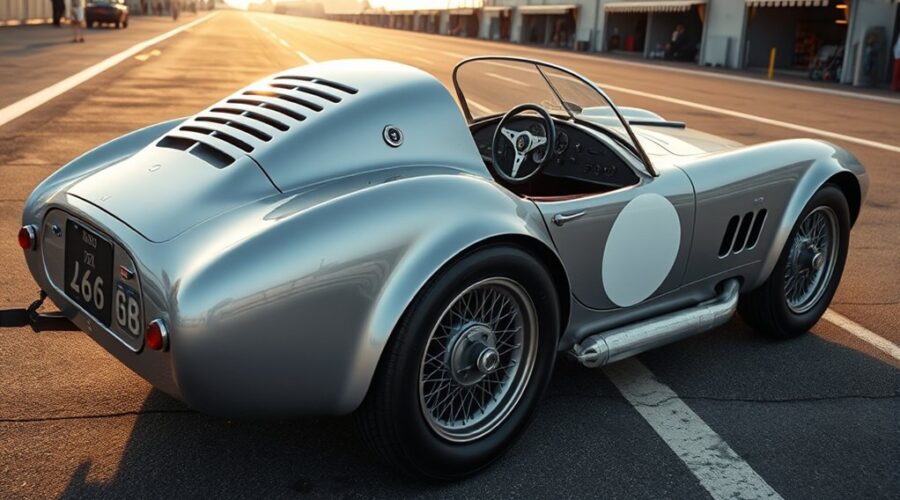
Classic sports cars trace their roots to the post-World War I era, when light weight, simple mechanics, and sharper handling began to define performance. Models such as the Porsche 356 and Jaguar E-Type later set lasting standards in design and engineering. Their body styles, engine layouts, and rarity continue to shape collector interest, but the full story of how these machines evolved is more complex than it first appears.
Key Takeaways
- Classic sports cars are usually two-seaters or 2+2 cars built before the mid-1980s for performance, handling, and driver engagement.
- Early sports cars grew after World War I, with models like the Prince Henry Vauxhall, Porsche 356, Mercedes-Benz 300 SL, and Jaguar E-Type.
- Their hallmark body styles include roadsters and coupes with long hoods, short rear decks, and lightweight construction for better balance.
- Rear-wheel drive and mid-engine layouts improved responsiveness, while all-wheel drive added traction but changed weight distribution and handling.
- Collector value comes from rarity, racing pedigree, historical importance, and lasting influence on modern sports car design.
What Counts as a Classic Sports Car?
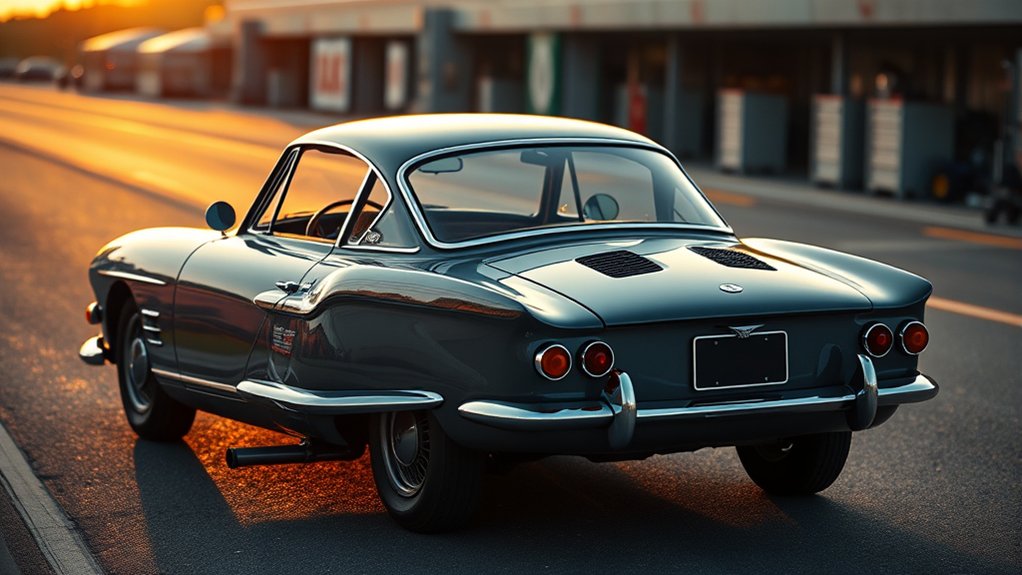
A classic sports car is generally understood as a two-seater or 2+2 automobile built primarily for performance and handling, usually manufactured before the mid-1980s.
Within the category of classic cars, the sports car is defined less by ornament than by purpose: light construction, responsive steering, and handling characteristics suited to fast, controlled driving.
Defined by purpose rather than ornament, the classic sports car favors lightness, precision, and controlled speed.
Early examples such as the 1910 Austro-Daimler 27/80PS helped establish the term in the early 20th century, while later models like the Jaguar E-Type, Porsche 356, and Ferrari 250 GTO became benchmarks of engineering and design.
Rear-wheel or mid-engine layouts are common because they sharpen balance and road feel.
Collectibility usually follows historical significance, racing pedigree, and limited production. The 1963 Corvette Sting Ray illustrates this logic, combining performance reputation with scarcity.
Such machines remain valued because they represent mechanical freedom, not mere transport, and their appeal rests on precision, rarity, and the disciplined pursuit of speed.
The Evolution of Sports Cars
The sports car emerged after World War I, when early models such as the 1910 Prince Henry Vauxhall and Austro-Daimler 27/80PS established a performance-focused formula.
After the war, the category expanded through landmark cars like the Porsche 356, Mercedes-Benz 300 SL, Jaguar E-Type, and Lamborghini Miura, each advancing speed, handling, and design.
In the modern era, turbocharged and hybrid-electric models such as the Ferrari F40, Porsche 959, LaFerrari, and McLaren P1 show how sports cars have evolved toward greater power, efficiency, and technological complexity.
Origins And Early Models
As early motor vehicles began to separate speed from sheer utility, the sports car emerged from racing culture and the demands of competition, rather than from ordinary touring-car design. In automotive history, the 1903 Mercedes Simplex 60 hp signaled a new standard of power, while later machines such as the 1910 Prince Henry Vauxhall 20 hp and Austro-Daimler 27/80PS clarified the term after World War One. The early sports car was a classic car of intent: light, purposeful, and shaped by rally trials like Monte Carlo, where agility mattered.
| Model | Year | Significance |
|---|---|---|
| Mercedes Simplex 60 hp | 1903 | Early high performance |
| Prince Henry Vauxhall 20 hp | 1910 | Evolving sports car |
| Porsche 356 | 1948 | Modern form established |
Modern Performance Evolution
Postwar engineering pushed sports cars beyond the early lightweight formula into a more sophisticated balance of speed, style, and technology.
In the late 1940s and 1950s, the Porsche 356 and Mercedes-Benz 300 SL showed how design could serve performance without surrendering refinement.
Italy’s Gran Turismo class further redirected sports cars toward long-distance speed and controlled luxury, widening their appeal.
The 1960s lightweight roadsters, including the Jaguar E-Type and Lamborghini Miura, sharpened acceleration and handling, giving drivers a stronger sense of motion and release.
By the 1980s, turbocharging in the Ferrari F40 and Porsche 959 expanded performance limits.
Modern hybrids such as the LaFerrari and McLaren P1 now fuse efficiency, power, and advanced control, defining the modern evolution.
Classic Sports Car Body Styles
Classic sports car body styles were generally defined by two-door, two-seater layouts that favored performance and driver engagement over passenger space. In classic sports car history, body styles became a visual statement of speed and independence.
Roadsters embodied this ideal most clearly: open-top forms, reduced mass, and direct exposure to the road supported agility and an unfiltered driving experience.
Roadsters captured the spirit most clearly, with open tops and lighter forms that sharpened agility and connection to the road.
Coupe designs offered a different balance, combining enclosed cabins with streamlined profiles; the Jaguar E-Type remains a benchmark for this fusion of elegance and efficiency.
Some models adopted a 2+2 arrangement, such as the Ferrari 246 GT, adding a modest rear seat while preserving a compact, sporting character.
Early examples also established enduring proportions, including long hoods and short rear decks, which created a poised, aggressive stance.
These classic sports car body styles continue to shape expectations of freedom, motion, and purpose in automotive design.
Why Engine Layouts Matter
Engine layout strongly shapes a sports car’s handling, with rear-wheel drive and mid-engine designs typically offering better balance and responsiveness than front-wheel drive.
Traditional sports cars often use rear-wheel drive to improve acceleration and cornering behavior, while mid-engine cars place mass closer to the center for greater stability.
All-wheel drive adds traction and launch performance, but it changes the driving character by emphasizing grip over the lighter, more direct feel of simpler layouts.
Layout Affects Handling
A sports car’s handling is shaped as much by its layout as by its power output, because engine placement and drive configuration determine how weight is carried, how quickly the chassis responds, and how much traction is available in a corner. Rear-wheel drive and mid-engine designs usually improve weight distribution, letting the car rotate more cleanly and remain poised under load.
| Layout | Handling effect |
|---|---|
| FR | balanced, traction strong |
| MR | agile, stable |
| FF | less responsive |
Lower center of gravity also sharpens turn-in, as seen in compact, low-slung sports cars. The result is not abstraction but measurable freedom: a chassis that answers driver input with precision, stability, and confidence on open road or track.
Drive Type Differences
Drive type is a central determinant of how a sports car behaves, because the layout of the engine and driven wheels changes balance, steering response, traction, and cornering stability.
In rear-wheel drive, the drive is often cleaner and more communicative than in front-wheel drive, giving a classic, liberated feel. Front-engine, rear-wheel drive sports car designs such as the Mazda MX-5 and Dodge Viper preserve familiar handling and a direct connection to the road.
Mid-engine layouts, seen in the Ferrari 488 and Ford GT, place mass near the center, improving weight distribution and cornering precision.
Since the 1990s, all-wheel drive has expanded acceleration and grip in high-powered models.
Each engine layout also shapes aerodynamics and body design, influencing the overall driving experience.
Iconic European Sports Cars
European sports cars defined much of the postwar performance landscape through a combination of engineering innovation, design ambition, and racing-derived identity. Among notable cars, the Porsche 356 (1948) established a durable standard for balanced handling and refined design. The Ferrari 166 Inter Barchetta also appeared in 1948, pairing luxury with competition intent. In 1954, the Mercedes-Benz 300 SL advanced engineering with fuel injection and gullwing doors. The Jaguar E-Type, revealed in 1961, combined speed with a striking body shape that reshaped the design of a sports car. The Lamborghini Miura, released in 1966, pushed liberation further through a mid-engine layout that redefined the sports car category.
| Model | Significance |
|---|---|
| Porsche 356 | Brand foundation |
| Mercedes-Benz 300 SL | Engineering benchmark |
These cars illustrate how European makers linked performance, style, and technical daring into enduring icons.
Early American Sports Cars
Early American sports cars emerged in the 1920s as a limited but technically ambitious segment, with manufacturers such as Mercer and Stutz producing performance-oriented machines in far smaller numbers than their European rivals.
These early American sports cars pursued speed, lightness, and driver engagement, offering a mechanical freedom that contrasted with heavier touring cars. Models from Paige, Kissel, and Stutz demonstrated that American builders could combine robust engines with restrained chassis tuning, even if sales remained modest.
Speed, lightness, and driver engagement defined these cars, proving American builders could blend power with restraint.
In the 1930s, the Auburn Speedster added dramatic styling and strong performance, yet many such efforts struggled commercially. After World War I, production declined sharply, leaving the market thin and inconsistent.
Their rarity now underscores their importance: these cars preserved a lineage of experimentation that later shaped American sporting identity, culminating in the Chevrolet Corvette, introduced in 1953, which transformed the category into a lasting symbol of accessible motion and aspiration.
Postwar Sports Car Breakthroughs
In the postwar period from 1939 to 1959, sports car development moved decisively from niche experimentation toward a broader and more influential automotive class, especially with Italy’s emergence of the Gran Turismo concept for high-speed, long-distance motoring.
This shift gave the sports car a clearer identity: quick, elegant, and intended for drivers seeking mobility beyond ordinary limits.
The Porsche 356, launched in 1948, established a balanced formula of light weight, compact proportions, and disciplined engineering, while the Mercedes-Benz 300 SL, introduced in 1954, demonstrated how advanced structure and performance could coexist.
Racing events such as Mille Miglia and Le Mans exposed these machines to severe demands, turning competition into public proof.
Aerodynamic refinement and new materials improved handling, stability, and speed.
Modern Sports Cars and Hybrid Power
Modern sports cars increasingly merge internal combustion engines with electric motors, creating hybrid powertrains that sharpen acceleration, improve torque delivery, and reduce fuel consumption. This engineering shift has redefined performance by pairing compact batteries with advanced control systems, allowing immediate response and sustained output.
Models such as the LaFerrari, McLaren P1, and Porsche 918 Spyder demonstrate how modern sports cars can exceed 1,000 horsepower while maintaining precise handling and usable road manners. Hybrid powertrains also reduce emissions, aligning speed with environmental responsibility rather than restraint.
Improved energy management lets drivers access power more efficiently, preserving the thrill of acceleration while widening practical range. Across the industry, this approach reflects a larger movement toward sustainable mobility without surrendering mechanical excitement.
For enthusiasts seeking freedom through motion, hybrid sports cars offer a path where liberation is measured not by excess alone, but by intelligent, controlled force.
Why Classic Sports Cars Still Matter
Classic sports cars remain important because they preserve a formative period in automotive history, when design and engineering were evolving rapidly from early examples like the 1910 Austro-Daimler 27/80 to post-war icons such as the Jaguar E-Type and Ferrari 250 GTO.
Their value lies in more than nostalgia: limited production, distinctive styling, and technical innovation make them rare cultural artifacts. Early rear-wheel drive layouts, lighter materials, and compact chassis solutions shaped handling principles still studied today.
Models such as the Porsche 916, with only 11 prototypes, show how scarcity intensifies collectibility. Vintage rallies and concours d’elegance keep these machines visible, letting communities examine craftsmanship without gatekeeping.
The Porsche 916, with just 11 prototypes, proves scarcity can turn engineering into legend.
The market also remains active, supported by collector car insurance and sustained demand from buyers seeking tangible links to the first sports era.
Manufacturers around the world continue to reference this legacy, drawing lessons from classic proportions and mechanical purity while pursuing performance freedom in modern designs.
Frequently Asked Questions
What Are Some Interesting Facts About Sports Cars?
Sports cars fascinate with rear-wheel-drive balance, lightweight design, and iconic models like the Porsche 911. Vintage racing, classic restorations, and performance upgrades preserve their appeal, while rare Ferraris prove collectors value speed, beauty, and heritage.
What Are the Different Types of Old Sports Cars?
Like a finely tuned rebellion, old sports cars fall into Vintage Racing pre-war types, post-war Classic Designs, early American variants, and Gran Turismo grand tourers, each defined by performance, heritage, and Legendary Models.
What Are the Key Features of Old Muscle Cars?
Old muscle cars feature potent V8 engines, rear-wheel drive, aggressive Design aesthetics, and upgraded suspension. Engine specifications emphasize displacement and torque; Performance metrics prioritize straight-line acceleration, quarter-mile speed, and accessible, liberating power for drivers seeking freedom.
What Is the History of Sports Cars?
Sports cars began after World War I, like lightning gathering form, as performance-focused machines. Racing innovations, iconic designs, and vintage events such as Monte Carlo and Prince Henry Tours shaped their evolution into symbols of liberated driving.
Conclusion
Classic sports cars remain significant because they combine historical importance, technical innovation, and distinctive design. Their lightweight bodies, precise handling, and influential engine layouts helped shape modern performance vehicles, while models from Europe and America continue to define collector interest. Even as hybrid systems and advanced electronics transform today’s cars, the appeal of older sports cars endures, like a well-preserved instrument that still plays with clarity, balance, and timeless character.