
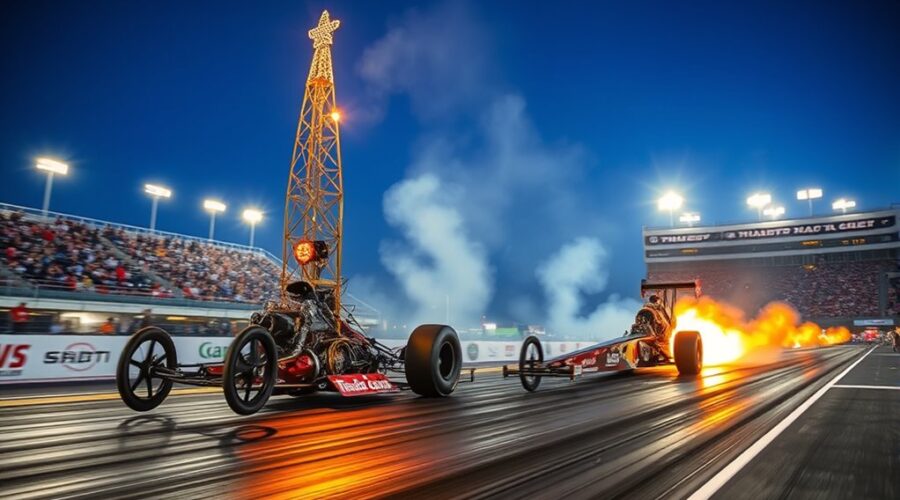
How drag racing works: two vehicles launch from a standing start and race over a measured straight distance, with the first across the line winning unless handicap rules apply. In NHRA competition, Top Fuel and Funny Car race 1,000 feet, while other professional classes run the quarter-mile. Staging beams, the Christmas Tree, reaction time and elapsed time make every run measurable.
Quick answer
- Format: head-to-head elimination rounds until one racer remains.
- Distance: 1,000 feet for Top Fuel and Funny Car, a quarter-mile for classes such as Pro Stock.
- Start: staging beams, then the Christmas Tree.
- Disqualification: leaving too early can lose the run.
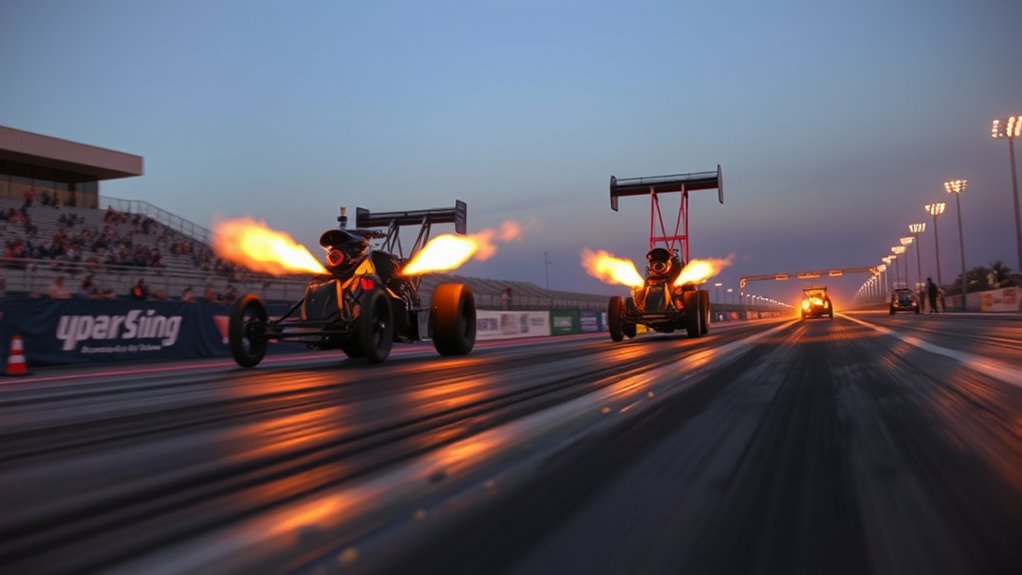
How a drag race works, step by step
- Pre-stage: the front tires break the pre-stage beam, about 7 inches before the starting line.
- Stage: the car rolls forward until the front tires sit on the line and the stage bulb lights.
- Tree: the starter activates the Tree once both cars are staged. On a Pro Tree all three ambers flash together and the green follows 0.4 seconds later. On a Sportsman Tree the ambers flash one by one.
- Run: each lane is timed separately, and speed is measured in a 66-foot trap that ends at the finish line.
Details are on NHRA’s NHRA 101 guide.
Reaction time and elapsed time
Elapsed time (e.t.) starts when the car leaves the staging beams and stops at the finish line. Reaction time is separate, and NHRA says it was rebased in 2003 so zero is a perfect start and red-lights show as negative numbers. A quick reaction does not improve the car’s elapsed time.
NHRA professional classes
NHRA’s class guide lists these figures.
| Class | Engine | Speed | Elapsed time |
|---|---|---|---|
| Top Fuel | Supercharged 500 cu in, about 11,000 hp, nitromethane | Over 330 mph | Under 3.7 s |
| Funny Car | Same supercharged 500 cu in engines | Over 330 mph | 3.8 s range |
| Pro Stock | Fuel-injected, up to 500 cu in, over 1,300 hp | Over 210 mph | 6.5 s range |
| Pro Stock Motorcycle | V-twin or inline-four, 92 to 160 cu in | Over 195 mph | Under 6.8 s |
Why Top Fuel and Funny Car run 1,000 feet
NHRA moved those classes from 1,320 feet to 1,000 feet starting at the 2008 Mile-High Nationals, following the death of Scott Kalitta at Englishtown that year, as described in an NHRA history article.
Safety rules in drag racing
- Flame-proof suits became mandatory for fuel-class drivers in 1963.
- Parachutes became mandatory for cars with national records above 150 mph in 1966.
- Nitromethane in Top Fuel and Funny Car was limited to 90% in 2000.
- After Eric Medlen’s death in 2007, changes included wider roll cages, thicker helmet padding and seven seat belt attachment points, per NBC Sports.
NHRA history in brief
Wally Parks founded the NHRA in 1951, and its first official race was held in 1953 at the Los Angeles County Fairgrounds in Pomona, California. See the NHRA history page. For other forms of racing, read our guides to NASCAR, lawn mower racing and race track types and layouts.
How drag racing works FAQ
What is drag racing?
Drag racing is a two-vehicle acceleration contest from a standing start over a measured distance. Losers are eliminated in rounds until one racer remains.
How long is an NHRA drag race?
Top Fuel and Funny Car run 1,000 feet, a change made from 1,320 feet starting in 2008. NHRA’s other professional classes, including Pro Stock and Pro Stock Motorcycle, run the quarter-mile.
What is the Christmas Tree in drag racing?
It is the starting light system. Blue lights show pre-stage and stage, then three ambers and a green start the race. On a Pro Tree the three ambers flash together and the green follows 0.4 seconds later.
What is reaction time versus elapsed time?
Reaction time measures how quickly a driver leaves after the Tree starts. Elapsed time is how long the car takes from the starting line to the finish line.
How fast is a Top Fuel dragster?
NHRA says Top Fuel cars make about 11,000 hp, run more than 330 mph and finish in under 3.7 seconds.
What happens if you leave early in drag racing?
A racer can be disqualified for leaving the starting line too soon, which shows as a red light.




[…] How Drag Racing Works: Classes, Staging and Safety Rules […]