
The BMW E28, built from 1981 to 1987, was the second-generation 5 Series and introduced a broader engine range, from efficient inline-fours to the high-output M88/3 in the M5. It combined a 4.62-meter body, 2.65-meter wheelbase, and rear-drive chassis with balanced road manners and competitive fuel use. Its details vary by market and trim, and the most significant figures are not always the ones that defined its reputation.
Key Takeaways
- The BMW E28 5 Series was produced from 1981 to 1987, with 722,328 units built.
- It measures 4.62 meters long, 1.70 meters wide, and has a 2.65-meter wheelbase.
- Engine choices ranged from inline-four and inline-six gasoline units to diesel, including efficient eta models and the 286 hp M5.
- The M5 reached 100 km/h in 6.5 seconds and a top speed of 245 km/h.
- Rear-wheel drive, independent suspension, ABS availability, and 460-liter boot space made it practical and well-balanced.
BMW E28 Overview
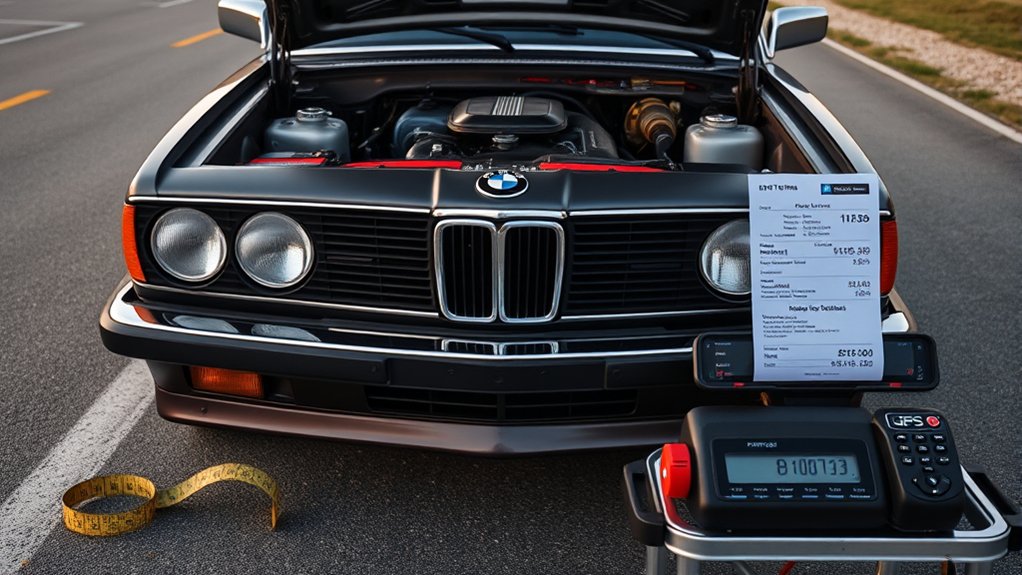
The BMW E28 5 Series, produced from 1981 to 1987, was the second generation of the model line and totaled 722,328 units.
Produced from 1981 to 1987, the BMW E28 was the refined second-generation 5 Series.
The BMW E28 5 Series established a refined balance between engineering discipline and driver autonomy, combining a rigid body structure with a cabin arranged around the operator.
Its 4.62 meter length, 1.70 meter width, and 2.65 meter wheelbase supported stable handling while preserving agile responses on open roads.
Powertrain selection ranged from the 518’s 1.8 liter straight four to the M5’s 3.5 liter straight six, which delivered 286 hp and 245 km/h capability.
The 1983 524td added diesel propulsion to the series, while ABS expanded control under braking.
Luxury appointments and robust construction reinforced its premium position, with launch pricing near $40,000, roughly $85,000 today.
For drivers seeking mechanical competence and personal freedom, the platform represented controlled performance.
BMW E28 Production Years and Key Changes
Introduced in 1981 and remaining in production through 1987, the BMW E28 marked the second generation of the 5 Series and replaced the E12 with a more developed chassis, updated packaging, and broader powertrain coverage.
Over its seven-year run, the platform evolved incrementally rather than through abrupt redesign, allowing refinement of body structure, cabin ergonomics, and control placement.
In 1983, BMW added a diesel variant, the 524td, extending the model range into efficient long-distance use.
By 1984, anti-lock brakes became available, reinforcing active control and occupant protection.
The angled center console reflected a driver-focused layout that improved accessibility and reduced distraction.
The E28 M5, launched in 1984, established the first high-performance M derivative in this series and defined a new benchmark for luxury sport sedans.
Production ended in December 1987 after 722,328 units, though North American sales continued briefly as a 1988 model, closing a highly consequential chapter.
BMW E28 Engines and Power
Powertrain range defined much of the BMW E28’s character, with the chassis engineered to support a broad spread of inline-four, inline-six, gasoline, and diesel variants.
Engine choices began with efficiency-focused models such as the 525e and 528e, whose 2.7L M20 prioritised usable torque and restrained consumption. At the other end of the spectrum, the 528i Euro used the 2.8L M30, a straighter, larger six-cylinder unit aimed at stronger response and higher output.
The 524td added diesel capability and marked BMW’s first diesel engine in a 5 Series, introduced in 1983. Within the BMW M5 § E range, the M88/3 represented the peak specification, delivering 210 kW (286 hp) and demonstrating the platform’s engineering headroom.
Straight-four and straight-six layouts both appeared, giving buyers a technically diverse, mechanically disciplined set of options suited to different priorities without surrendering the model’s core emphasis on driver autonomy and precision.
BMW E28 Performance and Fuel Economy
Performance in the BMW E28 spans a wide range, from economy-oriented six-cylinder models to the high-output M5.
At the top of the range, the M5’s M88/3 engine produces 210 kW (286 hp), reaching 100 km/h in 6.5 seconds and 245 km/h, establishing serious performance credentials.
The 535i, with its 3.4L inline-six, adds strong midrange thrust and supports brisk road use.
By contrast, the 525e and 528e prioritize fuel economy through the eta tuning concept, including a 2.7L M20 with a 4700 RPM redline, trading acceleration for lower consumption.
The 528i (Euro) uses the more powerful 2.8L M30, offering a sharper response.
Across the lineup, the E28 delivers a measured balance of performance and fuel economy, giving drivers a technically competent sedan that preserves efficiency without surrendering driving authority.
BMW E28 Dimensions and Weight
The BMW E28 measures 4.62 meters in length and 1.70 meters in width, with a 2.65-meter wheelbase that supports balanced proportions and agile handling.
Its kerb weight varies from 1,140 to 1,410 kg depending on model and engine specification, reflecting notable differences in equipment and mechanical layout.
Practical capacity is similarly varied, with a 460-liter boot and fuel tank sizes of either 63 or 70 liters.
Overall Size And Proportions
Sized as a typical mid-1980s executive sedan, the BMW E28 measures 4.62 meters in length and 1.70 meters in width, with a 2.65-meter wheelbase that supports its balanced stance and agile handling.
This overall size and proportions package placed the BMW 5 Series in a practical yet restrained footprint, suitable for urban use and open-road stability. The body’s compact width and long wheelbase promote precise turn-in and controlled lane placement, reinforcing driver confidence.
Depending on specification, curb weight varies, but the chassis dimensions remain constant in defining the car’s road presence. A 460-liter boot adds useful load capacity without distorting the sedan’s clean profile, while the fuel tank options preserve range-oriented utility.
The result is a disciplined, efficient format designed for responsive, liberated motoring.
Kerb Weight Range
Kerb weight adds another layer to the BMW E28’s dimensional profile, with figures ranging from 1,140 kg (2,513 lb) in lighter specification to 1,410 kg (3,109 lb) in heavier variants. This kerb weight span reflects engine choice, equipment, and trim, while preserving disciplined road manners and a liberated, responsive feel.
| Variant | Kerb weight | Character |
|---|---|---|
| Lightest | 1,140 kg | Agility |
| Mid-range | — | Balanced |
| Heaviest | 1,410 kg | Stability |
The self-supporting body contributes structural rigidity without excessive mass. Weight distribution is tuned to support predictable turn-in and composure, helping the E28 combine sedan practicality with a sporting chassis response.
Boot And Fuel Capacity
Boot space is one of the E28’s more practical strengths, with a capacity of 460 liters (122 US gallons) offering substantial room for luggage and cargo. This boot capacity supports everyday utility without compromising the sedan’s balanced proportions.
Fuel storage varies across versions, with either a 70-liter (18 US gallon) tank or a 63-liter (17 US gallon) tank fitted depending on model specification. Combined with the E28’s self-supporting body structure, these packaging choices reflect efficient use of space and structural rigidity.
The car’s 4.62-meter length and 2.65-meter wheelbase help maintain a compact footprint, while the varying kerb weight range of 1,140 kg to 1,410 kg indicates model-dependent equipment differences.
BMW E28 Body, Cabin, and Practicality
The BMW E28 uses a self-supporting welded platform body structure, with a reinforced passenger cell designed to improve occupant safety and overall rigidity.
At 4.62 meters long and 1.70 meters wide, the shell balances compact external proportions with usable interior volume, a trait that made the BMW M5 § E platform particularly adaptable for executive and performance applications.
The cabin layout prioritizes control access through an angled center console, positioning key switches within direct reach and supporting an efficient, driver-centered environment.
Driver-focused cabin layout places key controls within easy reach for efficient operation.
Material specification varies by trim, but higher-grade versions offer full leather upholstery and electrically adjustable sports seats, increasing comfort without compromising restraint.
Practicality is strengthened by a 460-liter boot, sufficient for long-distance travel, luggage, and everyday cargo.
BMW E28 Drivetrain and Suspension
Drivetrain layout centers on a rear-wheel-drive configuration paired with either a 5-speed manual or 3- to 4-speed automatic transmission, allowing the E28 to match a range of engine outputs and market requirements. This drivetrain strategy preserves direct power delivery and predictable chassis balance, supporting confident control under varied driving conditions.
The suspension package uses independent MacPherson struts at the front and semi-trailing arms at the rear, a combination tuned for compliance and precise road holding. Together, these components give the E28 a measured response to steering inputs, while maintaining ride quality over uneven surfaces.
Kerb weight, spanning roughly 1,140 to 1,410 kg, further influences agility and stability by keeping mass controlled within the platform’s limits. The result is a mechanically coherent sedan whose chassis and drivetrain work in concert to provide efficient, disciplined dynamics without sacrificing the sense of freedom associated with rear-driven handling.
BMW E28 Brakes and ABS
Braking hardware completes the E28’s chassis package by translating its rear-wheel-drive balance and suspension control into confident stopping performance. The braking hardware uses hydraulic dual-circuit assistance, improving pedal effort distribution and failure resilience. Most versions employ internally ventilated front disc brakes, while rear axle equipment varies by output. | Axle | Typical hardware | Notes |
| — | — | — |
|---|---|---|
| Front | Ventilated disc brakes | Standard across most models |
| Rear | Disc brakes | For engines 2.5 L and above |
| Rear | Drum brakes | On lesser-powered models |
ABS appeared as an option in 1984 and became standard on North American cars from 1985, helping maintain steerability during hard stops. This arrangement supported the car’s high-speed character while preserving stability on demand. Regular inspection of brake fluid, pads, and related components remains essential, since worn parts or degraded fluid can reduce effectiveness and compromise the liberated, responsive driving feel the E28 was designed to deliver.
BMW E28 M5 Specs and Highlights
BMW’s E28 M5 pairs a 3.5 L M88/3 straight-six with a 5-speed manual transmission, delivering 210 kW (286 hp) and 340 Nm of torque through a rear-wheel-drive layout.
In BMW M5 § E, this specification established a liberated driving formula: measured, mechanical, and focused on direct control. The sedan reached 100 km/h in 6.5 seconds and attained 245 km/h, figures that made it the fastest production saloon at launch.
Its chassis balanced luxury trim with motorsport intent, while the classic notchback profile retained executive discretion.
- Spoiler lip improves high-speed stability.
- Distinctive M5 emblems signal model identity.
- Manual gearing sharpens throttle response and engagement.
Objectively, the E28 M5 fused understated bodywork with elite performance, setting a benchmark for later performance sedans.
Its technical brief favored precision over excess, giving drivers an uncommon level of autonomy for the era.
BMW E28 North American Models
The North American E28 lineup was broad enough to cover economy, touring, and performance roles, with variants including the 528e, 533i, 535i, 524td, and M5.
Introduced in 1982, the 528e used a 2.7L M20 engine tuned for efficiency, while the 533i and 535i moved toward stronger six-cylinder output with 3.2L and 3.5L engines.
The 528e prioritized efficiency, while the 533i and 535i delivered progressively stronger six-cylinder performance.
The 524td added diesel economy to the range. From 1985 onward, all North American E28s received ABS as standard, improving stability and braking confidence.
The 535is, derived from the 535i, added sport-oriented trim and chassis detail for drivers seeking sharper response.
At the top sat the BMW M5 § E, built from 1984 to 1988 with a 3.5L M88/3 engine producing 210 kW and 286 hp.
Its 0-100 km/h time of 6.5 seconds placed it among the most capable sedans of its era, combining control with driving freedom.
Frequently Asked Questions
What Makes the E28 BMW Special?
What makes the E28 BMW special is its Design Legacy: a driver-focused chassis, M1-derived M88/3 performance, first M5 badge, first BMW diesel option, and disciplined safety engineering, combining liberation, precision, and enduring 1980s craftsmanship.
What Are the Common Problems With the BMW E28?
Common problems include rust in floor pans, doors, and trunks, corroded electrics, weak grounds, cracked ECU solder joints, and worn suspension, brakes, and tires; Maintenance Tips require routine inspection, leak checks, and component replacement.
Is the 128TI a Fast Car?
Yes—the 128ti is fast, posting 0–100 km/h in 6.1 seconds. In Performance Comparison terms, its 265 hp turbocharged four, 8-speed automatic, and 250 km/h limit make it objectively brisk and dynamically capable.
Is the BMW E28 Reliable?
The BMW E28 is generally reliable, a steel-backed workhorse, provided Maintenance Tips are followed. Its M20 and M30 engines endure, though timing belts, water pumps, rust, and corroded electrics demand disciplined inspection and upkeep.
Conclusion
The BMW E28 stands as a finely tuned bridge between analog simplicity and modern precision, its inline engines and balanced chassis forming a mechanical symphony of restraint and vigor. Across its production run, it delivered measured performance, disciplined handling, and enduring engineering clarity. From efficient four-cylinder variants to the formidable M5, the E28’s legacy remains a polished steel benchmark—quietly influential, technically coherent, and still resonant, like a well-composed blueprint that never lost its cadence.