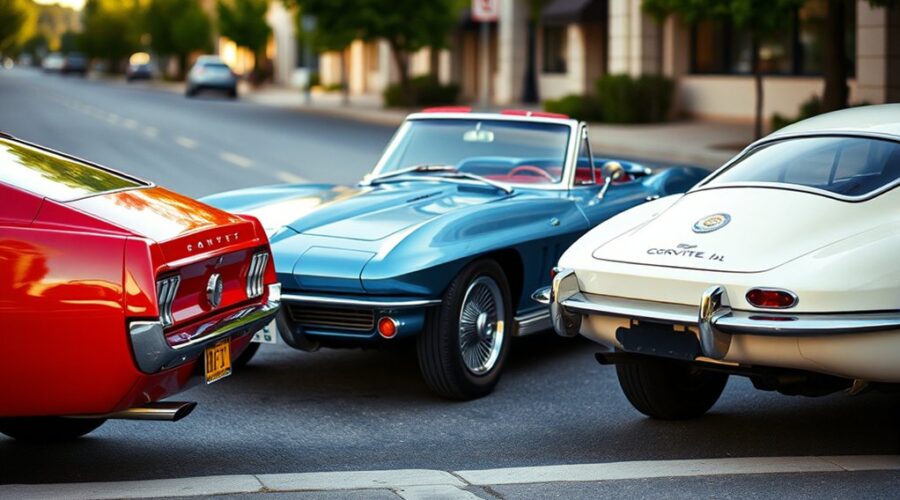
The 1960s produced classic cars that reflected a changing industry and a shifting public taste. American makers favored larger engines, sharper styling, and new performance packages, while European brands pursued lighter chassis and refined handling. Models such as the Pontiac GTO, Ford Mustang, and Chevrolet Corvette became benchmarks for the decade. Their appeal rested on more than speed. Condition, originality, and scarcity soon determined which examples would stand apart, and the details behind that distinction are revealing.
Key Takeaways
- 1960s classic cars blended performance, bold styling, and accessible power, reshaping American and European automotive culture.
- The 1964 Pontiac GTO and Ford Mustang defined the muscle-car era, while the Ferrari 250 GTO set sports-car standards.
- V8 engines, including big-blocks and the 426 HEMI, delivered over 350 horsepower and pushed speed limits.
- Design cues featured long hoods, short decks, vivid paint, hidden headlights, chrome accents, and aerodynamic bodylines.
- Value depends on rarity, originality, and condition, including rust, mechanical health, interior wear, and historical significance.
What Defined a 1960s Classic Car?

A 1960s classic car was defined by a combination of performance, design, and cultural impact, with the decade’s automotive landscape shaped by the rise of American muscle cars and influential European sports models.
In automotive history, classic cars from this era were judged not only by style but by measurable performance and engineering ambition. The 1964 Pontiac GTO is often cited as the first muscle car, establishing a formula of large-engine power in an accessible body.
Classic 1960s cars were defined by more than style, blending performance, engineering ambition, and accessible power.
The Ford Mustang, launched in 1964, broadened that ideal, becoming a symbol of freedom and youth. At the same time, European machines such as the Ferrari 250 GTO and Lamborghini Miura raised standards for speed, handling, and form.
Automatic transmissions and improved safety features also reflected changing consumer expectations. For collectors, rarity and condition later became decisive, especially for limited-production models like the 1969 Dodge Charger Daytona.
Why the 1960s Became a Golden Age for Cars
Postwar prosperity gave many Americans greater purchasing power, helping make car ownership and frequent replacement more common.
At the same time, the rise of V8 performance, led by models such as the Mustang and GTO, turned speed and power into central measures of automotive appeal.
Style and innovation also advanced together, as sleek design, automatic transmissions, and power steering made 1960s cars both visually distinctive and easier to drive.
Post-War Prosperity
Economic prosperity in the 1950s and 1960s gave many Americans greater disposable income, and that financial expansion helped turn the automobile into both a practical necessity and a symbol of status.
In the post-World War II era, expanded wages and consumer credit allowed families to choose from increasingly varied classic vehicles, while manufacturers responded with more style, comfort, and advanced safety.
Better suspension, automatic transmissions, and refined interiors made driving easier and more accessible, supporting a culture of mobility and personal autonomy.
Demand also rose for sporty, expressive models, and muscle cars became emblematic of confidence and independence.
The 1964 Ford Mustang and 1964 Pontiac GTO showed how quickly tastes shifted.
V8 Performance Boom
As prosperity expanded consumer choice, the 1960s automobile market increasingly centered on power, and the V8 engine became the clearest expression of that shift.
Manufacturers such as Chevrolet and Ford produced V8 engines in growing numbers, using displacement and output as decisive selling points.
The 1964 Pontiac GTO transformed that formula into the muscle car template, proving that over 350 horsepower could attract a mass audience.
Ford’s 1965 Mustang V8 widened access further, turning performance into a broadly desired freedom.
By decade’s end, larger 427-cubic-inch engines and Chrysler’s 426 HEMI pushed speed higher, while the Dodge Charger and Charger Daytona illustrated how street appeal and racing success converged.
NASCAR regulations soon adjusted, confirming the era’s mechanical escalation and cultural release.
Style And Innovation
Style and innovation gave the 1960s its reputation as a golden age for automobiles, when design, technology, and performance advanced together. Bold bodylines, vivid paint, and cleaner proportions replaced earlier ornament, and classic car enthusiasts still recognize the decade’s decisive break with restraint.
The Ford Mustang’s 1964 debut, with nearly 22,000 sales on its first day, showed how accessible excitement could be. The Chevrolet Corvette and Dodge Charger expressed the shift toward sleek, aerodynamic form. Automatic transmissions and power steering broadened comfort without sacrificing speed.
Meanwhile, muscle cars such as the Pontiac GTO redefined performance expectations. European makers, including Ferrari and Porsche, intensified the competition with precision engineering. In this climate, style and innovation became instruments of liberation.
Iconic 1960s Classic Cars That Still Matter
The 1964 Ford Mustang endures as a measure of American style and accessibility, its rapid debut at the 1964 World’s Fair signaling a broad public appetite for performance with mass-market appeal.
Pontiac’s 1964 GTO and the 1967 Chevrolet Camaro established the muscle-car formula in different but complementary ways, the former defining the class and the latter sharpening it as a direct rival.
Rarer sixties icons such as the 1969 Dodge Charger Daytona and the 1966 Toyota 2000GT remain significant for their racing success, engineering ambition, and lasting collector demand.
Mustang’s Enduring Appeal
Debuting in 1964, the Ford Mustang quickly became one of the defining machines of American automotive culture, selling nearly 22,000 units on its first day and drawing a younger audience with its affordable price, sleek lines, and accessible performance.
Lee Iacocca’s design gave the classic car a disciplined profile that suggested freedom without excess. Its success helped establish the pony car category, prompting rivals such as the Chevrolet Camaro, while observers from the Automobile Club of America noted its broad public reach.
Performance versions like the Mustang GT and Shelby trims added V8 authority, strengthening racing credibility and street appeal.
The model’s endurance lies in that balance: attainable style, mechanical vigor, and an image of personal autonomy that still resonates in modern production and collector culture.
Camaro And GTO Legacy
If the Mustang defined the pony car’s broad appeal, the Pontiac GTO and Chevrolet Camaro showed how quickly 1960s performance could harden into a lasting muscle-car legacy.
The 1964 GTO is widely treated as the first true muscle car, pairing a lightweight body with strong V8 power and a clear focus on youthful freedom and speed.
The Camaro, launched in 1966, answered with sharp styling, accessible pricing, and engines ranging up to a 396-cubic inch V8.
Together, GTO and Camaro turned the classic car market toward choice, power, and identity.
Their endurance among collectors reflects more than nostalgia; it marks a lasting standard in American engineering, where the muscle car became a symbol of motion, self-assertion, and technical ambition.
Rare Sixties Performance Icons
Among the rare performance icons of the 1960s, a handful of cars still define the era’s most important shifts in speed, style, and market identity.
The 1964 Pontiac GTO is widely treated as the first muscle car, pairing a strong V8 with accessible size and altering American priorities.
Ford’s 1964 Mustang turned the classic car market toward youthful independence, moving nearly 22,000 units on day one.
The 1966 Chevrolet Camaro answered with sharper intent, combining clean design and performance credibility.
The 1967 Shelby GT500 added rarity, force, and collector car appeal.
The 1969 Dodge Charger Daytona pushed NASCAR past old limits, then helped trigger rule changes.
Each machine carries historical significance, proving liberation on the road can become lasting automotive culture.
What Made 1960s Classic Cars So Fast?
What made 1960s classic cars so fast was the combination of larger, more powerful engines and lighter, better-shaped bodies built to use that power efficiently. In many classic cars, V8 engines delivered the horsepower and torque needed for hard launches and sustained speed. Chrysler’s 426 HEMI exemplified this era’s engineering, while big-block machines such as the Pontiac GTO pushed performance capabilities into new territory.
The 1964 Ford Mustang added a lighter structure and varied high-output engines, making speed accessible without excess mass. Improvements in aerodynamics and reduced weight helped these cars cut through air with less resistance, while better suspension systems improved control at higher speeds.
Automatic transmissions also broadened usability, translating raw output into more manageable acceleration. In automotive culture, these advances gave drivers a tangible sense of freedom: machines that could move with force, respond quickly, and turn open roads into an assertion of independence.
Signature 1960s Design Cues
Beyond sheer speed, 1960s classic cars were defined by a distinct visual language that made them instantly recognizable on the road. Long hoods and short decks gave these machines a stretched, assertive posture, while early-1960s tailfins carried forward the exuberance of the previous decade, as seen on the 1961 Chrysler Newport. Bold paint schemes, often paired with contrasting roof colors, reflected a culture enthusiastic for self-expression.
As the decade progressed, design elements grew more aerodynamic, signaling a shift toward performance-oriented thinking; the 1967 Chevrolet Camaro embodied this cleaner, lower profile. Hidden headlights and sleek chrome accents added both drama and refinement, most famously on the 1963 Corvette Stingray.
Together, these cues formed an iconic vocabulary that balanced motion, style, and mechanical intent. For observers of classic cars, the era’s aesthetics were not decoration alone: they announced freedom, confidence, and a new relationship between design and speed.
How to Judge a 1960s Classic Car’s Condition
Judging a 1960s classic car’s condition begins with a close inspection of the body, where rust, dents, and uneven paint can reveal both neglect and the extent of future restoration work.
A classic car’s body first reveals its story through rust, dents, and uneven paint.
A careful observer then studies the engine bay and mechanical systems, noting whether the car retains original components and whether the engine runs smoothly. Proper function in brakes, steering, and suspension also matters, since worn parts can hide costly repairs.
The interior deserves equal scrutiny: upholstery, dashboard, trim, and controls should be checked for wear, replacements, or age-related damage. Original materials often strengthen a classic car’s historical integrity.
Attention should also turn to modifications and aftermarket parts, which may compromise authenticity.
Finally, service records, ownership papers, and restoration notes offer evidence of care and help establish how honestly the vehicle has survived time.
In this condition analysis, the whole car must be read as a historical document.
Why 1960s Classic Cars Still Command Top Prices
1960s classic cars command top prices because they sit at the intersection of cultural memory, engineering significance, and scarcity. Models such as the Ford Mustang and Chevrolet Camaro became emblems of American mobility and self-expression, giving classic cars a symbolic power that still resonates.
Their value is reinforced by the era’s technical shift toward muscle cars, with potent engines like the Chrysler HEMI and improved performance hardware appealing to both drivers and investors. Limited production runs, especially for cars such as the 1967 Shelby GT500, reduce supply and intensify demand.
In the collector community, rarity and authenticity matter as much as style. High-profile sales, including the $3.5 million auction price for a 1967 Ferrari 275 GTB/4, demonstrate how auction prices can reflect history, performance, and prestige.
For many buyers, ownership is not merely acquisition; it is a claim on a liberated, mechanically vivid past.
Frequently Asked Questions
What Are Some Interesting Facts About Classic Cars?
Classic cars often feature powerful V8s, limited production, and distinctive styling. Iconic car models like the GTO and Mustang shaped culture. Classic car maintenance and vintage car restoration sustain classic car appreciation and historical liberation.
What Is the $3000 Rule for Cars?
As the adage goes, penny wise, pound foolish: the $3000 rule means repairs above $3000 often justify replacement. In a classic car, it becomes an investment strategy, balancing vehicle depreciation, restoration costs, and sentimental value.
What Color Car Is Least Stolen?
White and silver cars are least stolen, according to car theft statistics and color safety rankings. Yet vehicle security features matter more than hue. Theft prevention tips include alarms, steering locks, and vigilant parking.
What Is a Poor Man’s Supercar?
A poor man’s supercar is a coincidence of speed and affordability: budget performance in iconic models like the GTO or Camaro, sustained by an enthusiast community, with affordable upgrades granting liberating, historically grounded excitement.
Conclusion
To sum up, 1960s classic cars remain enduring symbols of a decade when styling, performance, and cultural ambition converged. Their V8 power, distinctive proportions, and mechanical simplicity helped define the American muscle-car era, while rarity and condition continue to shape collector value. Models such as the Pontiac GTO and Ford Mustang still attract attention because they embody a historic turning point in automotive design. Their appeal is so strong it could make even a modern supercar seem a bit ordinary.