
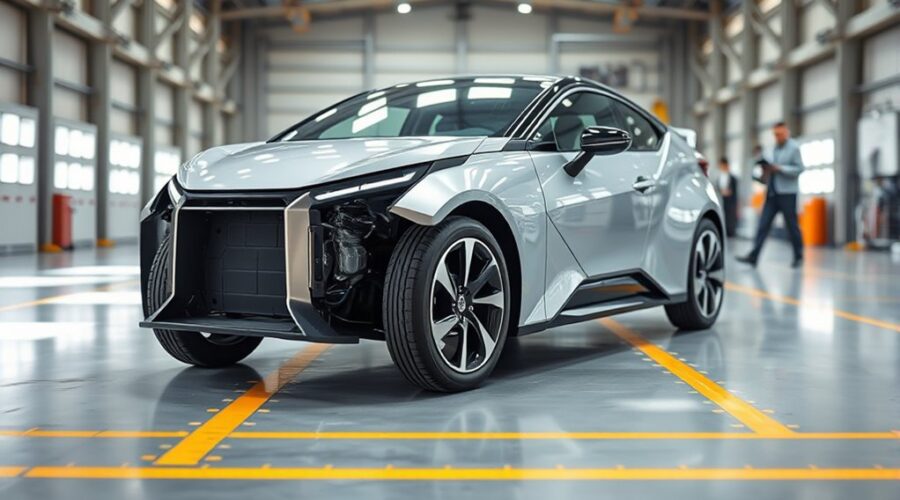
The Toyota IMV 0 is a compact utility truck built around simplicity, low cost, and adaptability. Its expected specifications point to a 2.0L gasoline engine with 137 horsepower, with diesel options in some markets, a five-speed manual transmission, and a curb weight near 3,300 to 3,500 pounds. At 208.7 inches long with a 121.5-inch wheelbase, its layout raises a key question about how much practicality Toyota has engineered into such a modest package.
Key Takeaways
- Toyota IMV 0 is a budget compact truck aimed at commercial and personal use, starting around $10,000 in Thailand.
- It measures 208.7 inches long, 70.3 inches wide, 68.5 inches high, with a 121.5-inch wheelbase.
- Engine options include a 2.0L gasoline engine, 2.4L diesel engine, and 2.7L gasoline engine.
- The standard drivetrain is rear-wheel drive with a five-speed manual transmission, with four-wheel drive available.
- Its minimalist, modular design includes vinyl seats, basic gauges, and customizable bed mounting points for utility.
What Is the Toyota IMV 0?

The Toyota IMV 0 is a budget-oriented compact truck developed as a modular, utilitarian vehicle for commercial and personal use.
The Toyota IMV 0 concept centers on low-cost accessibility, with a starting price of roughly $10,000 in Thailand, positioning it as an instrument of practical mobility rather than status.
Its architecture emphasizes adaptability, allowing owners to configure the truck for work, transport, or stripped-down private use.
The cabin follows the same logic: basic vinyl seats, a simple instrument cluster, and minimal ornamentation reduce complexity and support straightforward operation.
Dimensions measure 208.7 inches in length, 70.3 inches in width, and 68.5 inches in height, with a 121.5-inch wheelbase.
Those proportions place it in a size class associated with larger vehicles, while its modular body encourages independent customization and flexible deployment across different tasks.
Toyota IMV 0 Key Specs
The Toyota IMV 0 is offered with a 2.0-liter inline-four engine rated at 137 horsepower, with additional 2.4-liter diesel and 2.7-liter gasoline options, paired to a standard five-speed manual transmission and available in RWD or 4WD layouts.
Its exterior measures 208.7 inches in length, 70.3 inches in width, and 68.5 inches in height, on a 121.5-inch wheelbase, with curb weight ranging from 3,300 to 3,500 pounds.
Inside, the design remains intentionally minimal, using vinyl seats and essential gauges to support practical, utility-focused operation.
Powertrain Options
Available powertrain choices for the Toyota IMV 0 center on simplicity and versatility, with three engine options offered: a 2.0L gasoline unit rated at 137 horsepower, a 2.7L gasoline engine, and a 2.4L diesel engine. These powertrain options let drivers match output to use case without excess complexity. Standard five-speed manual transmission supports direct control and mechanical transparency, reinforcing a practical driving ethos.
| Option | Type |
|---|---|
| 2.0L | Gasoline |
| 2.7L | Gasoline |
| 2.4L | Diesel |
Rear-wheel drive comes standard, while four-wheel drive remains available for added traction and terrain freedom. The layout prioritizes straightforward serviceability, efficient torque delivery, and adaptable utility for regions where independence from highly specialized systems is valued.
Dimensions And Weight
Built around a compact, utility-focused package, the Toyota IMV 0 pairs its simple powertrain layout with dimensions suited to practical work use. Its overall dimensions measure 208.7 inches long, 70.3 inches wide, and 68.5 inches high, giving it a narrow footprint for access in confined sites.
A 121.5-inch wheelbase supports stability under load and across mixed surfaces. The curb weight varies from 3,300 to 3,500 pounds, depending on configuration, balancing durability with efficiency. Seating for two preserves cargo capacity and reinforces the vehicle’s work-first purpose.
- Length: 208.7 inches
- Width: 70.3 inches
- Height: 68.5 inches
- Wheelbase: 121.5 inches
- Curb weight: 3,300-3,500 pounds
Minimalist Utility Features
Stripped to essentials, the Toyota IMV 0 uses a minimalist cabin layout with basic vinyl seating and only the necessary gauges, reinforcing its work-focused role rather than a comfort-oriented one.
These minimalist utility features on the IMV 0 reduce complexity, lower cost, and preserve easy maintenance for commercial operators.
The standard five-speed manual transmission supports direct control, while engine choices include a 2.0L gasoline unit rated at 137 horsepower, a 2.7L gasoline option, and a 2.4L diesel variant.
Pre-drilled mounting points expand configurability, enabling cargo, service, or expedition attachments without structural modification.
With dimensions comparable to larger SUVs and a base price near $10,000 in Thailand, the IMV 0 presents a practical platform for users seeking functional independence.
What Engines Can Power the IMV 0?
The Toyota IMV 0 is offered with three engine choices: a 2.0L gasoline unit rated at 137 horsepower, a 2.7L gasoline engine, and a 2.4L diesel engine. Each IMV 0 powerplant is matched to a five-speed manual transmission, reinforcing direct control, mechanical simplicity, and durability. This setup supports users seeking practical independence in demanding conditions.
- 2.0L gasoline: balanced efficiency and output
- 2.7L gasoline: larger-displacement alternative
- 2.4L diesel engine: torque-oriented option
- Five-speed manual: standard across the range
- Engine tuning: reliability-focused design philosophy
The IMV 0 uses a standard rear-wheel drive layout, with optional 4WD for greater terrain access.
Its engine lineup prioritizes function over excess, enabling work, transport, and mobility with minimal complexity. This approach suits drivers who value liberation through straightforward, dependable hardware rather than unnecessary refinement.
How the Toyota IMV 0 Drives
The Toyota IMV 0 uses a standard five-speed manual transmission, giving the driver direct control over the available 2.0L gasoline, 2.4L diesel, or 2.7L gasoline powertrains.
Its rear-wheel drive layout is the default configuration, with an optional four-wheel drive system extending traction for difficult surfaces.
Built with oversized tires, a reinforced front bumper, and auxiliary lighting, the platform is oriented toward practical off-road utility rather than refined on-road dynamics.
Manual Transmission Feel
With a standard 5-speed manual transmission, the Toyota IMV 0 delivers a direct, mechanically involved driving feel that suits traditional truck users. This manual transmission feel gives the driver precise gear control, reinforcing a sense of autonomy and command.
- 137 hp from the 2.0-liter I4 supports clean shifts
- 3,300 to 3,500 lbs curb weight aids responsiveness
- Five forward ratios help balance efficiency and utility
- Stable 121.5-inch wheelbase supports controlled placement
- Overall size suits confined routes and uneven terrain
The transmission’s calibration favors predictable engagement over isolation, which can improve confidence in urban traffic and on rough surfaces.
Combined with its compact stance and moderate output, the setup creates a practical, freedom-oriented driving character without unnecessary complexity.
Rear-Wheel Drive Setup
Paired with the 5-speed manual transmission, the Toyota IMV 0’s standard rear-wheel drive layout gives the truck a balanced, work-oriented character.
This rear-wheel drive configuration places propulsion at the rear axle, helping separate steering duties from driving force and supporting stable control under load. The 2.0L gasoline engine, rated at 137 horsepower, supplies adequate output for varied use, while the long 121.5-inch wheelbase contributes to composed tracking and predictable handling.
In practical terms, the layout supports efficient weight distribution, which benefits commercial duty and keeps the vehicle responsive without unnecessary complexity. For drivers seeking mobility with fewer constraints, the setup offers direct mechanical engagement and a clear, functional driving format suited to demanding everyday tasks.
Off-Road Utility Focus
Designed for off-road utility, the Toyota IMV 0 emphasizes practical capability over refinement, using oversized tires, a robust front bumper with auxiliary lighting, and a minimalist structure suited to rough terrain.
This off-road utility focus gives the IMV 0 clear advantage in remote work and travel, where mechanical simplicity supports freedom of movement and easy repair. Built on the durable Hilux production line, it is engineered for reliability under sustained abuse.
- Oversized tires improve ground contact
- Auxiliary lighting aids low-visibility travel
- Two-door cab supports functional access
- Flatbed layout expands cargo versatility
- Modular roof rack options increase utility
Early prototypes keep components accessible, reducing maintenance burden and helping the IMV 0 remain serviceable in demanding environments.
Toyota IMV 0 Dimensions and Bed Size
The Toyota IMV 0 uses compact proportions suited to utility and maneuverability, measuring 208.7 inches long, 70.3 inches wide, and 68.5 inches high. These IMV 0 dimensions create a small footprint for dense streets while preserving load utility.
A 121.5-inch wheelbase supports straight-line stability and improves control on rough surfaces, reinforcing its work-ready character. Ground clearance benefits from oversized tires, which also contribute to traction beyond pavement.
The bed size is configured for adaptability rather than fixed use, allowing racks, compartments, and other modular additions to expand cargo management. A robust front bumper and bed-mounted roof rack further extend function for hauling, field tasks, and equipment transport.
The adaptable bed accepts racks and compartments, while a roof rack and bumper expand hauling versatility.
The result is a platform that prioritizes freedom of use, enabling owners to configure the vehicle for transport, labor, or outdoor access without excess bulk.
Inside the Toyota IMV 0 Cabin
The Toyota IMV 0 cabin uses a sparse, utilitarian layout built around essential functions rather than comfort features.
Basic vinyl seats, straightforward controls, and a single-speedometer instrument cluster reflect its emphasis on practicality and easy operation.
Pre-drilled mounting points further support customization, allowing occupants to add storage or accessories as needed.
Sparse Cabin Layout
Inside the Toyota IMV 0 cabin, utilitarian simplicity defines the layout, with basic vinyl seats, a plain instrument cluster centered on a single speedometer, and materials chosen for durability and low maintenance.
This sparse cabin layout reduces weight, cost, and unnecessary complexity, leaving only what supports practical use and freedom from excess. Seating is limited to two occupants, reinforcing the vehicle’s work-oriented mission.
Pre-drilled mounting points improve adaptability, allowing owners to add accessories or tailor the interior to specific tasks. The arrangement resembles a U-Haul rental truck in its stripped-back logic, yet it remains intentionally modular.
- Minimal trim
- Two-seat capacity
- Durable surfaces
- Customizable mounting points
- Low-cost, functional design
Basic Controls And Gauges
Beyond the sparse seating and bare-bones trim, the Toyota IMV 0’s cabin extends that same functional logic to its controls and gauges. The instrument cluster is intentionally limited, centered on a speedometer and other essential readouts, so information remains immediately legible.
The basic controls are arranged for intuitive operation, reducing distraction during work, loading, or low-speed maneuvering in demanding environments. Materials and switchgear favor durability over refinement, supporting long service intervals and straightforward upkeep.
Pre-drilled mounting points inside the cabin allow accessories, tools, or storage solutions to be added without complex fabrication. This practical interface serves users who need a dependable workspace on wheels, with a layout that prioritizes access, resilience, and efficiency over ornamentation or comfort features.
How the IMV 0’s Modular Bed Works
Built for versatility, the IMV 0’s modular bed uses a flatbed layout with pre-drilled mounting points that allow racks, storage units, and other accessories to be installed quickly and securely.
This modular bed is engineered as a functional platform for users who want adaptable hauling without fixed-body constraints. Its structure supports multiple configurations while preserving load-carrying strength and durability.
- Pre-drilled points simplify accessory fitment
- Flatbed geometry improves cargo access
- Compartments can be added for commercial use
- Layout supports delivery and utility roles
- Heavy loads are handled with durable engineering
Toyota IMV 0 Off-Road Features
The Toyota IMV 0 is configured with several off-road-oriented features, including oversized tires, a reinforced front bumper with auxiliary lighting, and a bed-mounted roof rack for additional cargo capacity.
On uneven ground, the IMV 0 benefits from the larger tire footprint, which supports traction and stability while reducing susceptibility to loose surfaces. The robust bumper improves approach protection, and the integrated lighting extends visibility in low-light trail conditions.
Its durable flatbed architecture reinforces utility, especially where cargo must be secured without compromising mobility. Rendered as a compact, baby off-roader, the vehicle emphasizes practical clearance and maneuverability rather than excess mass.
An available extra cabin section can increase seating, supporting collective travel and expedition use. Together, these elements position the IMV 0 as a technical platform for difficult terrain, where adaptable storage, dependable footing, and structural durability expand operational freedom.
Toyota IMV 0 Price and Market Position
With its utility-focused hardware established, the Toyota IMV 0 is positioned in the market as an unusually low-cost pickup, with pricing in Thailand around $10,000.
This Toyota IMV 0 price point places it below many conventional compact trucks, reinforcing a role centered on access, not status. The model is engineered for buyers seeking practical mobility and cargo capability, especially in markets where vehicle affordability constrains economic freedom.
- Budget-oriented commercial truck
- Minimalist cab and body structure
- Prioritizes essential performance
- Engine choices for varied duty cycles
- Aims at cost-sensitive fleet operators
Why the IMV 0 Isn’t Coming to the U.S
Although the Toyota IMV 0 is engineered as a low-cost utility pickup, multiple barriers make a U.S. launch unlikely. The IMV 0 would need extensive reengineering to satisfy American crash, lighting, and emissions regulations, adding cost and delay. A 25% chicken tax on imported trucks would further raise its landed price, eroding the economic advantage that defines the platform.
Market fit is also problematic: U.S. buyers generally expect higher levels of comfort, infotainment, and driver-assistance technology than the IMV 0’s stripped-down configuration provides. Toyota already sells overlapping small and midsize trucks in North America, so the model could cannibalize existing products rather than expand demand.
Even if compact truck demand reaches 100,000 to 150,000 units annually, the IMV 0’s minimalist architecture may not align with liberated consumer expectations. In practical terms, the vehicle suits markets prioritizing affordability and utility, not the U.S. regulatory and preference environment.
Frequently Asked Questions
Is the Toyota iMV 0 Coming to America?
No, the Toyota IMV 0 is not expected to reach America. Market Potential exists, but U.S. regulations, import tariffs, and overlap with existing trucks make introduction economically unlikely despite niche demand.
What Is Toyota’s Most Powerful Engine?
Toyota’s most powerful engine is the 5.7-liter iForce V8, delivering 381 horsepower and 401 lb-ft. In any Engine Comparison, it stands out for towing strength, Dual VVT-i efficiency, and robust six-speed automatic power delivery.
What Is Toyota’s Biggest Weakness?
Toyota’s biggest weakness is market competition: a steel bridge under tariff storm and consumer tides, where utilitarian minimalism meets premium expectations. Regulatory costs, thin margins, and overlapping models constrain North American expansion.
Which Hilux Model Is the Strongest?
The strongest Hilux model is the Hilux Rugged X. Its Engine Options center on a 2.8L turbo-diesel, 201 horsepower, 369 lb-ft torque, reinforced chassis, upgraded suspension, and 3,500 kg towing capacity for demanding terrain.
Conclusion
In conclusion, the Toyota IMV 0 is a utilitarian workhorse shaped like a blank canvas, built to haul, adapt, and endure rather than impress with luxury. Its modest engines, compact footprint, and modular bed give it the mechanical simplicity of a reliable tool and the flexibility of a custom-built platform. Though unlikely to reach U.S. showrooms, it stands as a pragmatic answer to basic transport needs, where function leads and every component earns its place.