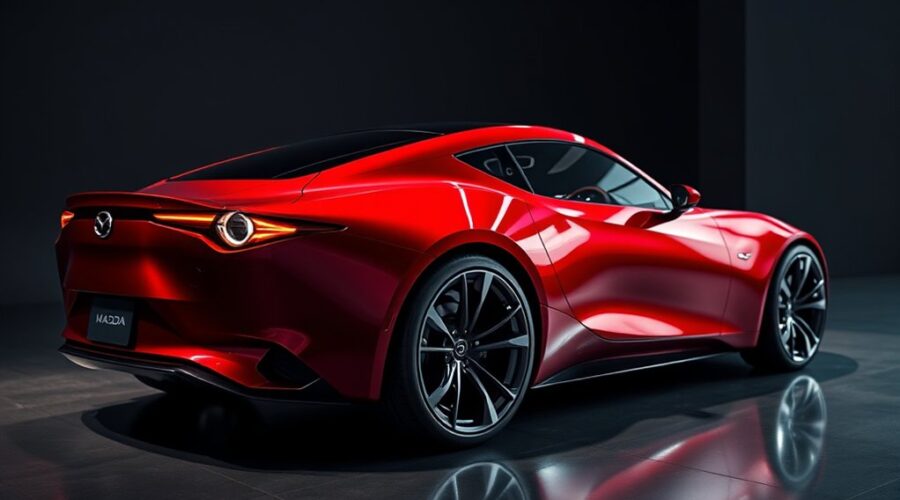
Mazda’s concept cars trace a clear line from early industrial experimentation to modern design studies shaped by electrification and KODO styling. From rotary-engine showpieces like the RX-500 to the MX-02’s compact proportions and handling ideas, each prototype has tested new mechanics before production use. The pattern is consistent, but the next step in Mazda’s concept strategy raises a more complicated question about performance, efficiency, and identity.
Key Takeaways
- Mazda concept cars began with the 1931 Mazda Go, later evolving into rotary-powered and aerodynamic prototypes like the RX-500 and MX-02.
- These concepts test new designs, chassis layouts, powertrains, and control systems before Mazda commits them to production.
- Mazda’s rotary engine legacy shaped many concepts, offering compact, high-output performance and smooth operation.
- Modern concepts preview Mazda’s KODO design language, advanced packaging, and electrification-focused technologies.
- Mazda concept cars help refine future models by gathering feedback on styling, usability, and driving dynamics.
Mazda Concept Car History
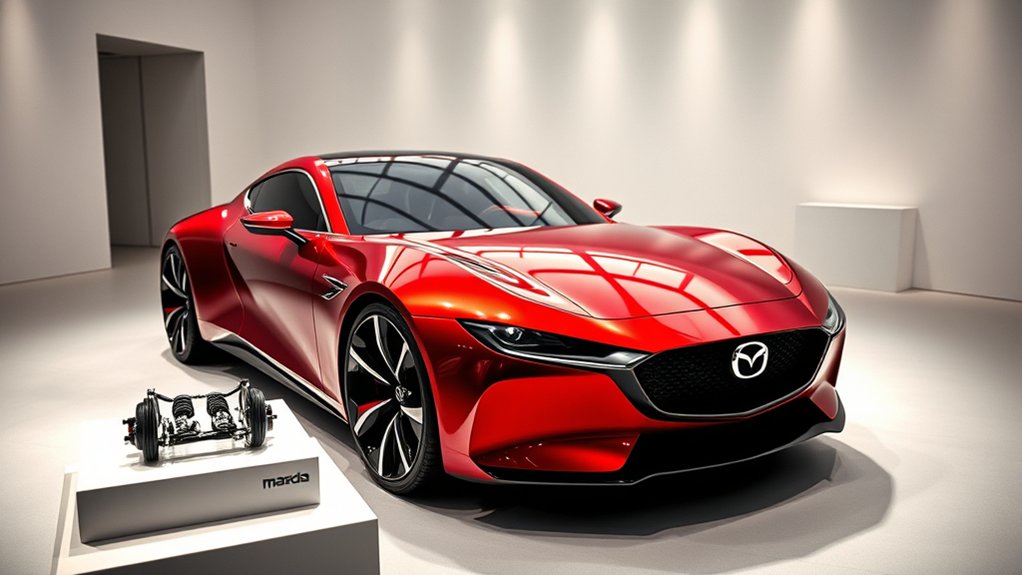
Mazda’s concept car history traces a steady progression from utilitarian beginnings to advanced design and engineering showcases. The Mazda Go, introduced in 1931, was the company’s first concept vehicle and reflected its shift from cork production to automotive manufacturing. In 1970, the RX-500 advanced Mazda concept cars through a futuristic body and the rotary engine, establishing a technical signature that would define later development. By 1984, the MX-02 demonstrated rear-wheel steering and an aerodynamic profile, indicating Mazda’s willingness to test unconventional chassis and airflow solutions. During the late 1980s, additional concepts emphasized performance and visual precision, reinforcing the brand’s sporty identity. Mazda’s innovation strategy continued into 2010 with KODO – Soul of Motion, a design philosophy that translated motion into sculpted form. Across these stages, Mazda used concept cars as disciplined experiments in liberation through engineering, expanding design boundaries while preserving functional clarity and mechanical purpose.
Why Mazda Builds Concept Cars
Mazda builds concept cars to evaluate new design directions and validate technical concepts before production commitment. Prototypes such as the MX-02 and later rotary-powered studies allow the company to test chassis layouts, powertrain concepts, and advanced control systems while measuring public response. They also function as previews of future technologies and design languages, including electrification strategies and the KODO aesthetic.
Design Exploration
Concept cars provide a controlled environment for exploring new design directions, allowing the company to test unconventional forms, such as the MX-02’s five-door hatchback layout and integrated side mirrors, without immediate production constraints. This approach reflects Mazda’s design philosophy, where innovative design balances aesthetics with functionality. 1. Advanced technologies, including 4WS, are evaluated for maneuverability and packaging efficiency. 2. Engine specifications, such as the MX-02’s 1.3-liter DOHC unit, are assessed for fit and performance. 3. Consumer feedback is gathered to refine proportions, lighting elements, and cabin interfaces, including heads-up displays.
Through this process, Mazda examines which solutions support liberated driving while preserving practical usability. The result is a technical design exploration that informs future models without compromising experimentation.
Future Technology Preview
Future-focused prototypes function as rolling laboratories, allowing Mazda to demonstrate emerging design language and advanced engineering before those ideas reach production. These concept cars present innovative design cues, evaluate packaging solutions, and test systems such as heads-up windshield displays and rear-wheel steering, as seen in the MX-02 Concept. Mazda also uses them to measure public response to features that may shape future interiors, interfaces, and drivability. Technically, they preview the integration of rotary engine heritage with electrification, a direction exemplified by the MX-30 e-Skyactiv R-EV. This approach supports sustainability goals by aligning experimentation with efficiency, reduced emissions, and adaptable mobility. Through continual concept development, Mazda stays responsive to industry change while preserving driver engagement and broadening technical freedom.
Mazda MX-02 Concept Design
Introduced in 1984, the Mazda MX-02 Concept presented a five-door hatchback layout with a large greenhouse and clear visual continuity with the earlier MX-81 Concept. The Mazda MX-02 emphasized aerodynamic design through integrated side mirrors, enclosed rear wheels, and a clean, forward-looking profile. Dual square headlights framed the nose, giving the vehicle a precise, technical appearance. Its innovative design also included rear-wheel steering, a 4WS system that activated below 25 mph to improve agility and low-speed maneuverability, supporting a sense of liberated motion in confined spaces. Key elements included:
Introduced in 1984, the MX-02 blended aerodynamic clarity, five-door practicality, and rear-wheel steering agility.
- Five-door body with expansive glass area
- Aerodynamic surfaces and wheel enclosure
- Rear-wheel steering for responsive handling
The engine specifications, a 1.3-liter, 4-cylinder, DOHC, 16-valve Mazda 626 unit, reflected pragmatic engineering rather than excess. Together, these features positioned the concept as a disciplined study in efficiency, modernity, and driver-focused flexibility.
Mazda MX-02 Specs and Dimensions
The Mazda MX-02 presents a five-door hatchback body style that combines compact practicality with a modern, streamlined profile. Its 1.3-liter 4-cylinder DOHC engine is reported to reach a top speed of 200 km/h, while rear-wheel steering (4WS) supports low-speed maneuverability. The concept measures 4500 mm in length, 1700 mm in width, 1400 mm in height, and 2800 mm in wheelbase, with a curb weight of 890 kg.
Design and Body Style
Mazda’s MX-02 adopted a five-door hatchback body with a generous greenhouse of glass, echoing the MX-81 Concept while giving the car a light, airy profile. Its design combined clean surfaces with purposeful engineering, producing a compact yet spacious form that suggested freedom through efficiency. The body measured 4500 mm long, 1700 mm wide, 1400 mm high, with a 2800 mm wheelbase.
- Integrated side mirrors reduced visual clutter and supported aerodynamics.
- Enclosed rear wheels sharpened the profile and reinforced the innovative hatchback stance.
- Dual square headlights on each side created a distinctive technical signature.
At 890 kg, the MX-02 reflected Mazda’s design intent: disciplined packaging, advanced aerodynamics, and an innovative approach aimed at liberation from conventional styling limits.
Engine and Performance
Powered by a 1.3-liter, 4-cylinder, DOHC, 16-valve engine, the Mazda MX-02 was engineered to deliver efficient performance within a compact, lightweight package. The engine supported responsive output, while advanced engineering balanced acceleration and drivability. Rear-wheel steering improved low-speed agility by countersteering with the front wheels, reducing turning effort and increasing maneuverability. This technical arrangement reflected a pursuit of driver freedom through precise chassis control.
| Specification | Value |
|---|---|
| Engine | 1.3-liter, 4-cylinder |
| Valvetrain | DOHC, 16-valve |
| Rear-wheel steering | 4WS system |
| Top speed | 200 km/h |
| Weight | 890 kg |
The performance profile combined lightweight construction with controlled dynamics, giving the concept a credible balance of efficiency and motion.
Dimensions and Weight
Measuring 4500 mm in length, 1700 mm in width, and 1400 mm in height, the Mazda MX-02 presents a compact hatchback profile shaped for aerodynamic efficiency and controlled proportions. Its dimensions support a restrained footprint while preserving interior and mechanical balance.
- Wheelbase: 2800 mm, a layout that strengthens stability and handling.
- Weight: 890 kg, reducing inertial load and improving performance response.
- Aerodynamics: integrated side mirrors and enclosed rear wheels, limiting drag and supporting higher-speed efficiency.
The compact 1.3-liter DOHC 16-valve package and 200 km/h top speed reflect engineering aimed at liberated, agile motion. With low mass and balanced packaging, the MX-02 illustrates how careful dimensions and weight management can sharpen handling without sacrificing technical sophistication.
Mazda’s Rotary Engine Legacy
Among Mazda’s most distinctive engineering contributions is its long association with the rotary, or Wankel, engine, a compact powerplant defined by a triangular rotor moving within an oval housing rather than the reciprocating pistons of a conventional engine. Mazda refined this rotary engine into a signature solution, valued for its small footprint, high power-to-weight ratio, and exceptionally smooth operation. It appeared in the RX-7 and later the RX-8, where its character supported a sense of mechanical freedom uncommon in mainstream automobiles. Yet the Wankel design also carried penalties: elevated fuel and oil consumption, plus more demanding maintenance than piston engines. Even so, Mazda has not abandoned it. The brand has returned to rotary technology as a range extender in electrification, including the MX-30 e-Skyactiv R-EV. This approach preserves the rotary legacy while adapting it to contemporary efficiency goals and reinforces Mazda’s identity as a maker of unconventional, technically distinct machines.
How Rotary Power Shaped Mazda Concepts
Mazda’s rotary engine shaped its concept cars by providing a compact, high-output mechanical package that allowed designers and engineers to explore performance-oriented proportions and unconventional packaging. From the Cosmo Sports era onward, the rotary engine enabled liberated cabin and body layouts, while preserving agility and visual tension. In concept studies such as the MX-02, the layout supported experimentation with low mass concentration and responsive handling targets.
- The RX-7 demonstrated how rotary power could deliver smooth operation and strong performance in a compact form.
- The MX-30 e-Skyactiv R-EV reintroduced rotary logic as a range extender, linking heritage to electrification.
- Mazda concepts used rotary architecture as a platform for innovation, not merely as a power source.
This technical identity gave Mazda a distinct design language: efficient packaging, refined dynamics, and a persistent commitment to engineering freedom.
What SKYACTIV Changed for Mazda Concepts
Introduced in 2011, SKYACTIV fundamentally altered Mazda’s concept development by treating the powertrain, chassis, and body as a single engineering system rather than isolated components. SKYACTIV technology fused engine, transmission, structural, and aerodynamic decisions into one program, giving concept cars a clearer technical purpose. The SKYACTIV-G engine used high compression ratios to improve combustion efficiency, raising fuel efficiency while lowering emissions without surrendering performance. At the same time, SKYACTIV-Vehicle Architecture reduced mass and refined airflow, enabling sharper handling and more stable dynamics. These principles migrated from concepts into production vehicles such as the Mazda CX-5 and Mazda3, both recognized for balanced driving enjoyment and economy. For Mazda concepts, the result was a more disciplined design language: lighter structures, cleaner proportions, and engineering freedom aligned with real-world efficiency. That same logic now informs plans to electrify future models while preserving responsive performance.
Mazda Concept Cars Today
Mazda’s current concept cars present refined exterior geometry and advanced packaging, with KODO-based surfaces used to signal motion, proportion, and aerodynamic intent. Electrification is central to these studies, as models such as the MX-30 and connected concept vehicles emphasize urban efficiency, sustainable mobility, and integrated digital systems. Rotary technology remains under evaluation through range-extender applications like the MX-30 e-Skyactiv R-EV, indicating continued engineering interest in compact, efficient powertrain solutions.
Current Concept Designs
Modern Mazda concept cars continue to evolve the brand’s design and engineering language through vehicles such as the MX-81, MX-02, and MX-30 e-Skyactiv R-EV. These current concept designs translate KODO – Soul of Motion into fluid surfaces and taut proportions that suggest motion without constraint. They also integrate advanced driver-assistance systems and sustainable materials to support safer, freer mobility.
- MX-81: early experimentation with compact, aerodynamic packaging.
- MX-02: refined form language and technology integration.
- MX-30 e-Skyactiv R-EV: rotary range-extender concept linked to Mazda’s heritage.
Across these studies, SKYACTIV technology supports responsive dynamics, efficiency, and structural balance. The result is a disciplined vision of mobility that preserves driver engagement while advancing technical freedom.
Electrification and Innovation
Electrification now shapes Mazda’s concept-car strategy, with the MX-30 e-Skyactiv R-EV demonstrating how a rotary engine can function as a range extender to support battery charging without abandoning the brand’s focus on driving dynamics. Mazda frames this work within a Multi-Solution strategy, combining mild hybrids, plug-in hybrids, and battery-electric models to preserve choice while advancing sustainable mobility. The company targets full electrification of its lineup by 2030, supported by battery development that improves efficiency and range. In parallel, concept programs emphasize innovative technology and eco-friendly production, including low-VOC paints and solar-energy systems. These measures indicate a technical evolution designed to reduce emissions, maintain responsiveness, and widen access to cleaner mobility without sacrificing the lightweight, free-flowing character associated with Mazda vehicles.
Future Rotary Applications
Rotary technology is reappearing in Mazda’s concept cars as a compact, lightweight solution aligned with the brand’s electrification roadmap. Mazda positions the rotary engine as a range extender, not a primary driveline, in the MX-30 e-Skyactiv R-EV. This architecture supports battery charging while preserving efficient packaging and responsive motion, reinforcing the company’s technical identity.
- Compact mass improves vehicle balance.
- Range-extension supports plug-in hybrid electrification.
- Rotary geometry enables innovative solutions for future electric performance.
Mazda’s multi-solution strategy targets electrifying 100% of its lineup by 2030, combining rotary systems with hybrid platforms. In concept vehicles, this approach retains driving enjoyment while expanding freedom from charging constraints, demonstrating a disciplined path toward liberated mobility.
KODO Design in Mazda Concepts
Introduced by Mazda in 2010, KODO design, or “Soul of Motion,” became a defining element in the brand’s concept cars by emphasizing graceful, dynamic surfaces that suggest movement even at rest. The philosophy translates natural forms into dynamic shapes, with proportions, tensioned lines, and a bold front fascia that reinforce a disciplined visual identity. Across Mazda concept cars, the approach balances fluidity and restraint, producing bodies that appear light, agile, and ready to move. The first production model to fully embody KODO design, the Mazda CX-5, arrived in 2012 and established a template for later vehicles. Its formal language carried the concept into series production without losing visual coherence. KODO design has also earned multiple awards, reflecting recognition of its aesthetic precision and its effect on the driving experience. In technical terms, it links styling, motion, and emotional clarity into a single design system.
What Defines a Mazda Concept Car
A Mazda concept car is defined by its role as a design and engineering testbed that combines advanced technologies, experimental proportions, and expressive styling into a single prototype. Such concept cars translate innovative design into tangible research, allowing Mazda to evaluate aerodynamics, packaging, and performance before production. The MX-02 Concept of 1984 exemplified this method with integrated side mirrors and rear-wheel steering, signaling a practical pursuit of efficiency and control.
- Engineering: prototypes examine systems such as the rotary engine, which informed models like the RX-7 and RX-8.
- Design: each vehicle reflects KODO – Soul of Motion, using fluid surfaces and dynamic stance.
- Forecasting: concept cars identify future directions in sustainability, driver experience, and performance.
Related Reading
Frequently Asked Questions
What Are the Key Features of Concept Cars?
Concept cars feature design innovation, future technology, and responses to automotive trends, while testing consumer impact and confronting engineering challenges. They showcase advanced propulsion, autonomous systems, sustainable materials, and experimental styling before production commitment.
What Are Some Interesting Facts About Mazda Cars?
Mazda cars, unsurprisingly, are not mere transport. Mazda innovations include Rotary engines, SkyActiv efficiency, and KODO Design philosophy. Racing heritage peaks with Le Mans glory, while Environmental initiatives target carbon neutrality and electrification by 2030.
Can You Legally Own a Concept Car?
Yes, concept car ownership is sometimes legal when manufacturers sell prototype vehicles or auction them; however, legal regulations, registration, and emissions compliance often limit use. In the collector’s market, automotive innovation remains alluring but restricted.
What Was Mazda Originally Called?
Mazda was originally called Toyo Cork Kogyo Co., Ltd.; like a chassis beneath polished bodywork, Mazda origins reveal Early innovations, Company evolution, Automotive design, and Brand identity, before the 1927 renaming and later automotive transformation.
Conclusion
Mazda’s concept cars have consistently functioned as rolling laboratories, translating design theory into production-ready engineering. From the rotary-powered RX-500 to the MX-30 e-Skyactiv R-EV, each prototype has tested a new boundary in styling, propulsion, or handling. The 2010 KODO philosophy reinforced this trajectory by tying motion to form, while SKYACTIV improved efficiency and packaging. Like a wind tunnel for ideas, Mazda concepts refine the brand’s future one measured experiment at a time.