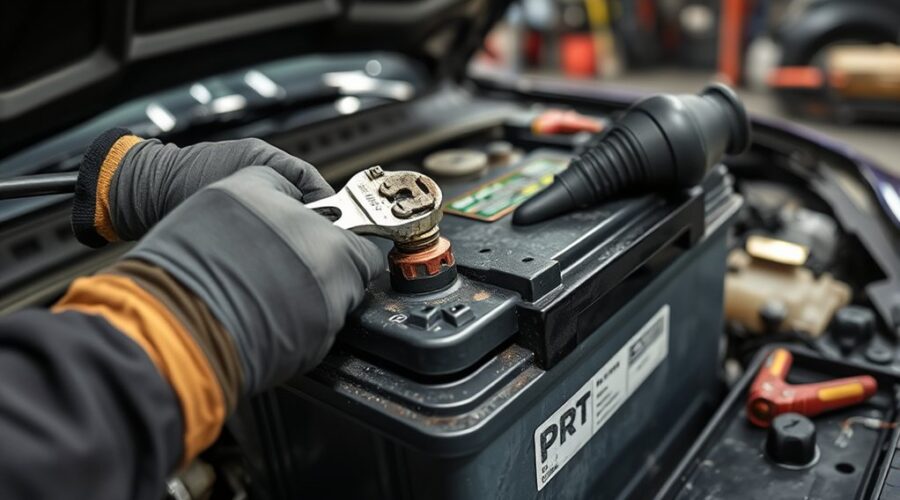
Here is how to remove a car battery safely: switch the vehicle off, disconnect the negative terminal first and the positive second, release the hold-down, then lift the battery out with both hands. Wear eye protection and gloves, keep sparks and metal tools away from the terminals, and check your owner’s manual first because some vehicles need a battery reset.
Quick answer: negative off first, positive off second. When you install the new battery, connect positive first, negative last. Never work on a cracked, swollen, leaking or frozen battery.
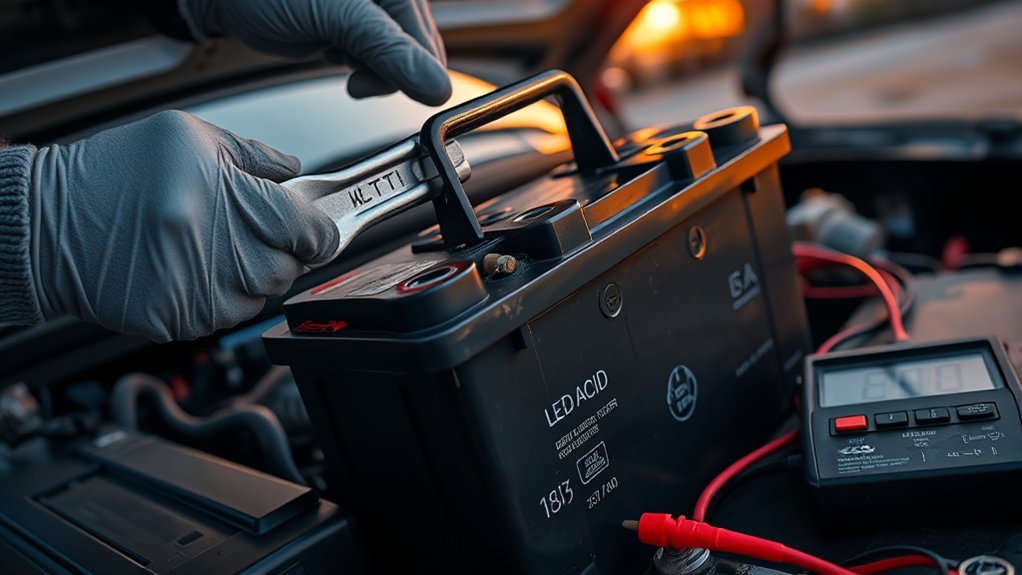
Tools You Need to Remove a Car Battery
- Wrench or socket that fits the terminal clamps (do not assume 10 mm or 12 mm; side-post, rear-mounted and European setups differ)
- Safety glasses and gloves
- Terminal brush or battery-terminal cleaner
- Optional memory saver, if your manual allows it
How to Remove a Car Battery Step by Step
- Prepare. Park on a flat surface, switch everything off and remove the key. Take off rings and other conductive jewelry.
- Find the battery. It is under the hood in most cars, but some are in the trunk or under a seat; your manual will show where.
- Disconnect the negative (-) terminal first and tuck the cable away from the post.
- Disconnect the positive (+) terminal. Never let a metal tool bridge the positive post and the car body.
- Release the hold-down clamp or bracket that secures the battery.
- Lift the battery out using both hands or the carry strap, keeping it upright. Batteries are heavy, so bend your knees.
- Clean the tray and terminals and check the cables for corrosion or damage.
AAA’s battery removal guide uses the same negative-first order and reverses it for installation.
Installing the New Battery
- Match the size, terminal position and type. VARTA’s selection guide explains how to choose the right battery.
- Set the battery in the tray and fit the hold-down so it cannot move.
- Connect the positive (+) terminal first, then the negative (-).
- Tighten the clamps until they do not twist, then start the car and check the lights and settings.
For AGM or EFB batteries, see VARTA’s note on changing an EFB or AGM battery. Some vehicles must be told a new battery is installed, so follow your manual.
Troubleshooting After a Battery Change
- Car will not start: check that both clamps are tight and clean, and that you used the correct battery.
- Warning lights or lost settings: some systems relearn after a short drive; if lights stay on, have the vehicle scanned.
- Battery drains again quickly: test the charging system; see how to test an alternator.
Recycle the Old Battery
Retailers commonly accept old lead-acid batteries for recycling. The EPA describes lead-acid battery collection and used batteries. In Canada, check your province’s program or ask the retailer.
If you need a replacement, see our best car batteries and, for storage, the automatic battery maintainer guide. For battery life, AAA explains how long car batteries last.
Frequently Asked Questions
Which battery terminal do I disconnect first?
Disconnect the negative (-) terminal first, then the positive (+). When installing, connect the positive first and the negative last. This lowers the risk of a spark or a short from a wrench touching metal.
Do I need to reset anything after disconnecting a car battery?
Possibly. Some vehicles lose radio presets, clock settings or learned idle values, and some modern cars need the new battery registered with the vehicle. Check your owner’s manual before you disconnect.
Can I remove a battery that looks swollen or is leaking?
No. Do not work on a cracked, swollen, leaking or frozen battery. Wear eye protection and gloves, keep flames and sparks away, and ask a shop or roadside service to handle it.
Where should I take an old car battery?
Most battery retailers and many auto shops take old lead-acid batteries for recycling, often with a core or return program. Never put a car battery in household trash. Check your municipality or provincial recycling program.
Do AGM and EFB batteries need special handling?
They are removed the same way but may need to be replaced with the same type, and the vehicle may need to be told a new battery is installed. VARTA and your manual give model-specific guidance.