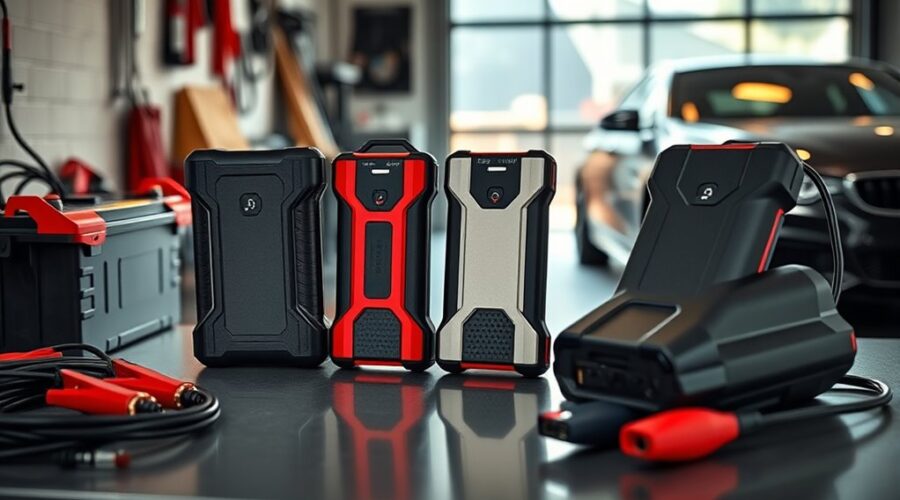
The best portable car jump starter for most drivers is a lithium unit rated for your engine size, such as the NOCO Boost GB50 for cars and light trucks or the GB70 for large gas and diesel engines. Choose by the engine size the maker lists, not by peak amps alone, and keep it charged. For a basic compact car, the NOCO GB40 is enough.
Disclosure: As an Amazon Associate we earn from qualifying purchases. If you buy through links on this page we may earn a commission at no extra cost to you.

This guide is based on manufacturer and retailer specs, not hands-on testing. Engine-size limits and starts per charge are the makers’ figures, so check the current listing. If a dead battery keeps coming back, the cause may be the battery or charging system, not the missing jump.
Quick comparison
| Model | Peak amps | Engine limit (per listing) | Link |
|---|---|---|---|
 NOCO Boost GB40 |
1,000 A | 6.0 L gas, 3.0 L diesel | Check price on Amazon |
 NOCO Boost GB50 |
1,500 A | 7.0 L gas, 4.5 L diesel | Check price on Amazon |
 NOCO Boost GB70 |
2,000 A | 8.0 L gas, 6.0 L diesel | Check price on Amazon |
 NOCO Boost GBX45 |
1,250 A | 6.5 L gas, 4.0 L diesel | Check price on Amazon |
 GOOLOO GP3000 |
3,000 A | 9 L gas, 7 L diesel | Check price on Amazon |
 NEXPOW 2000A |
2,000 A | 7.0 L gas, 6.5 L diesel | Check price on Amazon |
NOCO Boost GB40 (1000A)
NOCO lists the GB40 for up to 6.0 L gas and 3.0 L diesel engines, with up to 20 starts per charge, a 100-lumen light and a USB power bank function. It weighs about 2.5 lb and has spark-proof and reverse-polarity protection.
Best for: compact cars and small SUVs.
- Pros: small, safety features, USB output.
- Limits: not for large diesels.
NOCO Boost GB50 (1500A)
The GB50 is listed for up to 7.0 L gas and 4.5 L diesel engines, around 30 starts per charge, and has a 200-lumen light, an IP65 body and USB-C. It weighs about 2.7 lb.
Best for: most cars, SUVs and light trucks.
- Pros: good engine range for its size, rugged body.
- Limits: 12V only, and more than a small car needs.
NOCO Boost GB70 (2000A)
The GB70 is listed for up to 8.0 L gas and 6.0 L diesel engines, with up to 40 starts per charge, a 400-lumen light and an IP65 body. It weighs about 5 lb and the listing says it takes about 6 hours to recharge.
Best for: pickups, vans and large engines.
- Pros: large engine range, many starts per charge.
- Limits: heavier and slower to recharge.
NOCO Boost GBX45 (1250A)
The GBX45 uses USB-C Power Delivery for recharging, which the listing says takes about 48 minutes, and is rated for 6.5 L gas and 4.0 L diesel engines. It lists six starts per charge, a 60 W USB-C port and a one-year warranty.
Best for: people who value quick recharging and want a USB-C power bank too.
- Pros: fast USB-C recharge, compact.
- Limits: fewer starts per charge than the other NOCO units.
GOOLOO GP3000 (3000A)
The listing rates it for up to 9 L gas and 7 L diesel engines and lists 10 protections, metal clamps, a 400-lumen light, USB charging and a 15V accessory outlet. The listing advises recharging about every three months.
Best for: large trucks, vans and boats.
- Pros: very high rating, extra outputs.
- Limits: overkill for small cars, and needs regular recharging.
See the GOOLOO GP3000 on Amazon
NEXPOW 2000A
The NEXPOW is a 2,000 A unit that the listing says covers up to 7.0 L gas and 6.5 L diesel engines, with USB Quick Charge 3.0 and an LED light. Check the listing for the exact model and number of starts.
Best for: larger engines on a budget-minded kit.
- Pros: high rating, Quick Charge USB.
- Limits: 12V only, and less detail is listed than for the NOCO units.
See the NEXPOW starter on Amazon
How to choose a portable car jump starter
- Engine size: match the maker’s gas and diesel liter limits to your engine, with some margin. Diesels need more power than gas engines of the same size.
- Peak amps: a higher figure usually means a larger engine range, but it is a peak value, not a guarantee.
- Safety: spark-proof clamps and reverse-polarity protection reduce mistakes.
- Cold climate: in Canadian winters, keep the unit inside the cabin where possible. Lithium packs lose output when very cold, so check the maker’s operating range.
- Recharging: top it up every few months and after every use.
How to jump start a car with a portable starter
- Turn off the ignition and all accessories. Do not use it on a frozen or swollen battery.
- Connect the red clamp to the positive terminal and the black clamp to the negative terminal, or an unpainted metal ground point.
- Turn the jump starter on, wait for the ready indicator, and start the engine.
- Disconnect the clamps right away once the engine starts, then recharge the unit.
If the battery is old, see our car battery guide and learn how to remove a car battery. A trickle charger or car battery charger keeps it healthy between trips.
Frequently asked questions
How should I store a jump starter long term?
Keep it in a cool, dry place and recharge it every few months, following the maker’s schedule. Avoid leaving it in a hot car for long periods.
Can one jump starter work on motorcycles and boats?
A 12V unit usually can, provided the battery is 12V and the engine is within the listed limits. Check your owner’s manual and the starter’s instructions.
How often should I recharge a portable jump starter?
Many makers advise every three to six months, and after every use. The GOOLOO listing suggests about every three months. Check your manual.
What prevents reverse-polarity damage?
Match red to positive and black to negative, and choose a unit with reverse-polarity protection. Never let the clamps touch each other.
Do jump starters work in extreme cold?
They can, but output drops in the cold. Keep the unit warm before use, and expect weaker performance below its stated temperature range.
Will a jump starter fix a bad battery?
No. It only gets the engine started. If the battery keeps dying, have the battery and charging system tested and replace the battery if it is worn out.