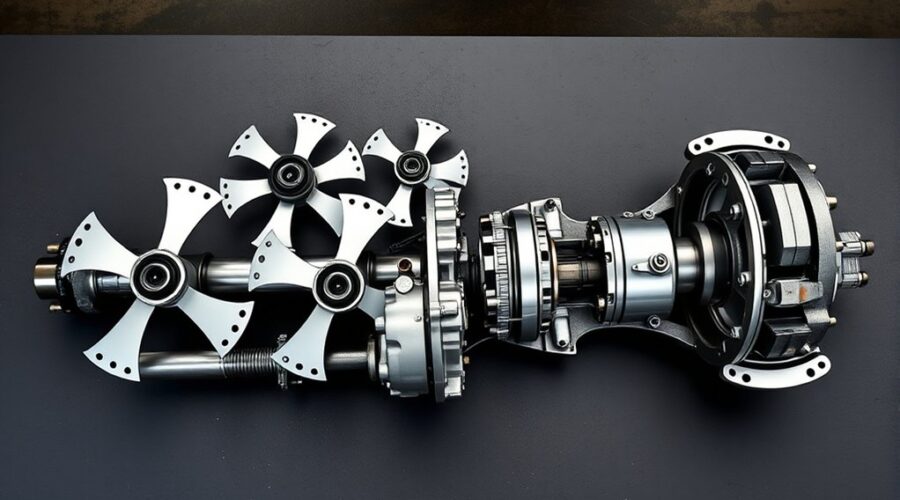
A 4 rotor rotary engine uses four Wankel rotors arranged in separate housings along a shared eccentric-shaft system. Mazda’s best-known example is the R26B race engine that powered the 787B to victory at the 1991 24 Hours of Le Mans. It is important not to confuse it with Mazda’s 20B, which is a three-rotor engine.
Quick Answer
A 4 rotor rotary engine combines four Wankel rotor housings to produce smooth, closely spaced power pulses and high output from a compact package. Mazda’s R26B is the defining example: 654 cc × 4, naturally aspirated, and rated at 700 PS at 9,000 rpm. Mazda’s 20B, by comparison, uses three rotors.
What Is a 4 Rotor Rotary Engine?
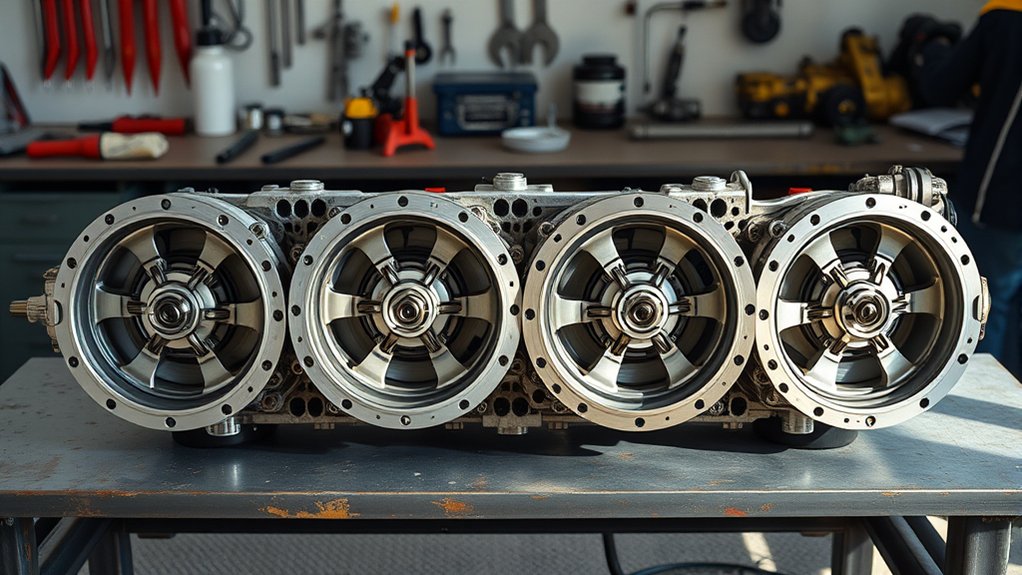
A four-rotor rotary engine is a Wankel-type internal-combustion engine with four separate rotors and rotor housings connected through an eccentric-shaft assembly. Instead of pistons moving up and down, each roughly triangular rotor moves inside an epitrochoid-shaped housing and creates changing combustion chambers.
The most significant factory example is Mazda’s R26B four-rotor racing engine. Mazda specifies four 654 cc rotor chambers, giving the engine a nominal displacement of 2,616 cc under Mazda’s conventional rotary-engine measurement.
The R26B should not be confused with the Mazda 20B. Mazda’s 20B-powered Eunos Cosmo used a three-rotor engine and became notable as a production multi-rotor road car.
| Mazda Engine | Rotors | Nominal Displacement | Known Application |
|---|---|---|---|
| 13B | 2 | 654 cc × 2 | Various Mazda production cars and race cars |
| 20B-REW | 3 | 654 cc × 3 | Eunos Cosmo |
| R26B | 4 | 654 cc × 4 | Mazda 787B racing program |
How Does a 4 Rotor Rotary Engine Work?
A four-rotor engine follows the same Wankel combustion process as a one-, two-, or three-rotor engine. Adding rotors increases the number of working chambers and power events without adding conventional pistons, connecting rods, camshafts, or a valve train.
Engine Design and Layout
Each rotor has three faces. As the rotor moves around its housing, the space between each face and the housing expands and contracts through the intake, compression, combustion, and exhaust phases.
The rotor turns more slowly than the eccentric shaft. During one complete rotor revolution, its three faces each complete a working cycle while the eccentric shaft makes three revolutions. That works out to one power event per rotor for each eccentric-shaft revolution.
A two-rotor engine therefore has two power events per shaft revolution, while a four-rotor engine has four. This closely spaced delivery is one reason multi-rotor engines can feel exceptionally smooth at high engine speeds.
The R26B was much more sophisticated than simply joining two production 13B engines. Mazda’s engineering program included a multi-piece eccentric shaft, peripheral-port breathing, electronic fuel injection, a variable-length intake system, three spark plugs per rotor, and special sealing and housing technology.
Performance and Efficiency Metrics
The R26B shows what a purpose-built four-rotor engine can achieve when it is optimized for endurance racing. Mazda’s factory figures provide a much more useful benchmark than horsepower claims from heavily modified street builds.
| R26B Specification | Factory Figure |
|---|---|
| Configuration | Naturally aspirated four-rotor rotary |
| Displacement | 654 cc × 4 |
| Maximum output | 700 PS at 9,000 rpm |
| Maximum torque | 62 kg-m at 6,500 rpm |
| Intake | Linear variable-length intake system |
| Ignition | Three spark plugs per rotor |
High power density does not automatically mean high fuel efficiency. Rotary combustion chambers have different sealing, heat-loss, and emissions challenges from piston engines. Mazda’s R26B program specifically targeted output, fuel consumption, and reliability because all three mattered in a 24-hour endurance race.
Maintenance and Reliability Factors
Reliability in a rotary engine depends heavily on sealing, lubrication, temperature control, and correct engine calibration. However, it is misleading to treat apex seals as parts that simply require replacement at a fixed routine interval.
The R26B used two-piece ceramic apex seals and specialized coatings to cope with endurance-racing loads. The SAE technical paper on the R26B also describes its three-piece eccentric shaft, telescopic intake system, three-plug ignition, peripheral-port injection, and measures intended to improve durability and fuel consumption.
A custom street or competition four-rotor is a different case from Mazda’s factory R26B. Reliability depends on the exact housings, eccentric shaft, seals, porting, cooling system, lubrication system, induction setup, engine management, and intended power level. There is no single maintenance schedule that applies to every four-rotor build.
What’s the History Behind 4 Rotor Rotary Engines?
Mazda developed its four-rotor technology through racing rather than mass-production road cars. The program evolved rapidly from the first 13J four-rotor to the R26B that won Le Mans in 1991.
Key Milestones Achieved
Mazda’s corporate history records the development of the 13J four-rotor racing engine in 1987. Mazda separately identifies the 20B as a three-rotor design, which is an important distinction because the two names are often confused in rotary discussions.
- 1987: Mazda developed the 13J four-rotor racing engine.
- 1988: The Mazda 767 raced with the new four-rotor design, although the early program suffered reliability and development problems.
- 1989: Development of the 767B and revised four-rotor engine improved both performance and race results.
- 1990: Mazda’s four-rotor race-engine development reached the 700 PS level as intake, ignition, and fuel-control systems evolved.
- 1991: The R26B-powered Mazda 787B won the 24 Hours of Le Mans overall.
The 1991 version added a linear variable air-intake system, revised peripheral fuel injection, and three-plug ignition. Mazda also conducted a 24-hour endurance test before Le Mans.
Notable Models Produced
The most important four-rotor Mazdas were competition vehicles. Production Mazda road cars used other rotary configurations, including the two-rotor 13B family and three-rotor 20B.
The definitive example is the Mazda 787B. Mazda’s specifications identify its engine as the R26B with four 654 cc rotor chambers. The No. 55 car completed 362 laps on its way to the company’s historic overall victory at Le Mans in 1991.
This also corrects a common misconception surrounding the RX-7 and RX-8. Mazda did not sell either model from the factory with a four-rotor production engine. Four-rotor RX-series cars seen today are generally specialized motorsport or custom builds rather than normal factory powertrains.
What Are the Performance Benefits of a 4 Rotor Engine?
A four-rotor layout can provide high power density, smooth power delivery, strong high-rpm performance, and compact packaging relative to many piston engines of comparable output. Those benefits made the layout especially attractive for prototype racing.
- More power events: Four rotors provide four power events during each eccentric-shaft revolution, helping deliver smooth torque.
- No conventional valve train: A Wankel uses ports rather than the pistons, connecting rods, camshafts, and poppet valves found in a typical four-stroke piston engine.
- High-rpm capability: The R26B’s peripheral ports, variable intake system, and specialized ignition were designed to support strong breathing at high engine speeds.
- Compact combustion architecture: Rotary engines can package substantial output into a relatively small cross-section.
More rotors also bring tradeoffs. A four-rotor engine needs additional housings, seals, intermediate sections, and a longer eccentric-shaft arrangement. Mazda’s own history notes that its first 13J four-rotor was initially longer and heavier than engineers wanted, so adding rotors does not automatically make the complete engine lighter or simpler.
Four-figure horsepower figures sometimes associated with modern four-rotor builds come from highly modified engines and should not be treated as a standard specification. Turbocharging, porting, fuel choice, boost pressure, engine management, and internal construction can change output dramatically.
How Have 4 Rotor Engines Influenced the Automotive Industry?
Four-rotor engines have influenced motorsport and enthusiast engineering far more than mainstream car production. Their greatest historical impact came from showing that a rotary-powered prototype could combine high-rpm performance with the durability needed to win a major endurance race.
The 787B’s 1991 victory made the R26B one of the best-known Wankel engines ever built. The engineering work also demonstrated how variable intake geometry, specialized ignition, improved seals, coatings, fuel control, and multi-rotor construction could be developed together as one endurance-racing system.
The broader rotary concept has continued beyond pure racing. Mazda reported that rotary-engine vehicle production resumed in June 2023 with the MX-30 e-SKYACTIV R-EV, where the rotary engine is used in an electrified powertrain rather than as a conventional four-rotor sports-car engine.
That distinction matters. The historical success of the R26B does not mean four-rotor engines are becoming mainstream. Their current importance is primarily technical, historical, and enthusiast-focused.
What Is the Future of 4 Rotor Rotary Technology?
There is no confirmed modern Mazda production four-rotor road engine in the company’s current public rotary program. Instead, Mazda’s recent work shows how the broader Wankel architecture may continue through electrified powertrains, generator applications, alternative fuels, and research into regulatory compliance.
In February 2024, Mazda formally re-established its Rotary Engine Development Group. Mazda said the group would continue developing rotary engines used as generators while researching regulatory compliance and carbon-neutral fuels.
The Mazda Iconic SP concept provides another clue about the direction of current development. Its announced Rotary-EV system uses two rotors, not four, with the rotary engine used to generate electricity as part of the electrified powertrain concept.
Rotary technology is also being developed outside passenger cars. Companies such as Advanced Innovative Engineering offer compact Wankel engines for UAV and aerospace-related applications. Their small size and power density show why the basic rotary architecture remains useful, although these applications should not be interpreted as evidence that automotive four-rotor engines are about to become common.
For now, the four-rotor configuration remains most closely associated with specialized racing and custom performance builds. The broader rotary engine, however, continues to evolve in roles where compact packaging can provide a clear advantage.
Frequently Asked Questions
How much power did Mazda’s four-rotor R26B make?
Mazda lists the R26B at 700 PS at 9,000 rpm. It used four 654 cc rotors, was naturally aspirated and powered the 787B to victory at the 1991 24 Hours of Le Mans.
What Is the History of the 3 Rotor Engine?
Mazda developed three-rotor engines before putting the 20B-REW into the Eunos Cosmo in 1990. The 20B became an important production multi-rotor engine, but it should not be described as a four-rotor. Mazda developed separate four-rotor racing engines such as the 13J and R26B.
What Killed the Rotary Engine?
The rotary engine was not completely killed. Fuel-consumption, emissions, sealing, and market challenges contributed to the end of the RX-8 in 2012, but Mazda returned rotary engines to vehicle production in 2023 with the MX-30 e-SKYACTIV R-EV, using a rotary engine as part of an electrified powertrain.
What Is the Function of the Rotor in a Rotary Engine?
The rotor creates the changing combustion chambers that perform intake, compression, combustion, and exhaust. Expanding combustion gases push against a rotor face, and the rotor transfers that force through the eccentric shaft to produce usable rotational output.
Is the Mazda 20B a 4 Rotor Engine?
No. The Mazda 20B is a three-rotor rotary engine. Mazda’s famous four-rotor racing engines include the 13J and R26B, with the R26B best known for powering the 787B at Le Mans.
Did Mazda Sell a Production 4 Rotor Road Car?
Mazda’s documented factory four-rotor engines were developed for racing rather than a normal production road model. Its best-known production multi-rotor road car, the Eunos Cosmo, used the three-rotor 20B-REW. Four-rotor road-going Mazdas seen today are typically custom conversions.
Related reading: see the story of the Mazda 787B Le Mans winner and a wider look at Japanese race cars.
Sources
- Mazda Motor Corporation — Transformation of the Racing Rotary Engine: R26B specifications, 13J history, variable intake, ignition, sealing, and four-rotor development.
- Mazda Motor Corporation — Mazda 787B: 787B specifications and 1991 Le Mans results.
- Mazda Motor Corporation — History 1980–1989: Development of the 13J four-rotor and 20B three-rotor engines.
- Mazda Australia — 20B Eunos Cosmo: Production Eunos Cosmo and three-rotor 20B context.
- SAE International — Mazda 4-Rotor Rotary Engine for the Le Mans 24-Hour Endurance Race: R26B structure, durability, fuel-consumption, sealing, ignition, and intake engineering.
- Mazda Newsroom — Rotary Engine Development Group: Modern rotary-engine R&D, generator applications, regulatory compliance, and carbon-neutral fuels.
- Mazda Newsroom — Mazda Iconic SP: Two-rotor Rotary-EV concept and modern electrified rotary direction.
- Advanced Innovative Engineering — Wankel Rotary UAV Engines: Current non-automotive rotary applications and compact power-density examples.