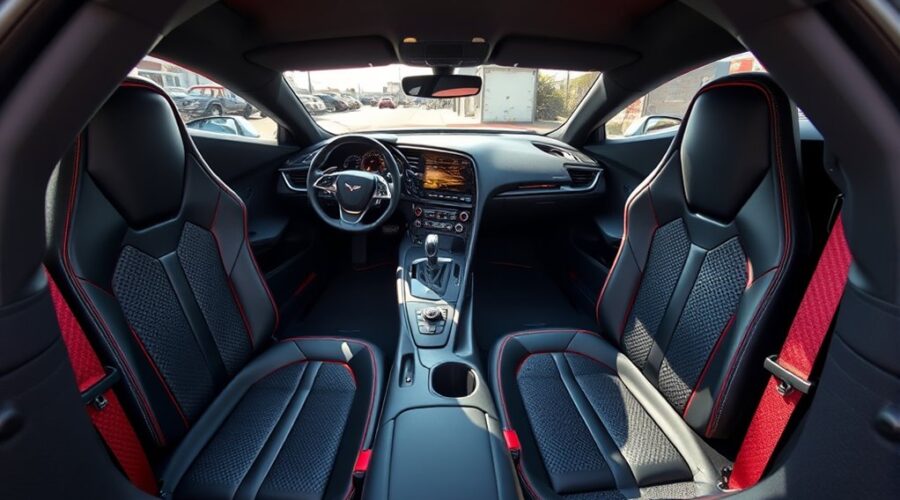
The C8 interior stands apart from earlier Corvette cabins with a mid-engine layout that reshapes packaging, visibility, and driver focus. Its two-seat cockpit uses a three-screen display system, tight control placement, and seat options that alter support and posture. Materials and trim vary by model, while coupe and convertible versions change the sense of space. The layout suggests practicality, but the details determine how usable it is day to day.
Key Takeaways
- The C8’s mid-engine layout creates a lower dashboard, thinner cowl, and better sightlines for a more open cockpit.
- Despite its compact exterior, the cabin seats two adults comfortably with efficient front and rear cargo storage.
- Driver-focused controls and wrapped switchgear provide quick, intuitive access with less hand travel and distraction.
- A three-screen cockpit, Google Built-in, and performance data displays keep infotainment and driving information clearly organized.
- GT1, GT2, and Competition Sport seats offer varying support levels, while Coupe and Convertible models balance comfort and performance.
Why the C8 Cabin Feels Different
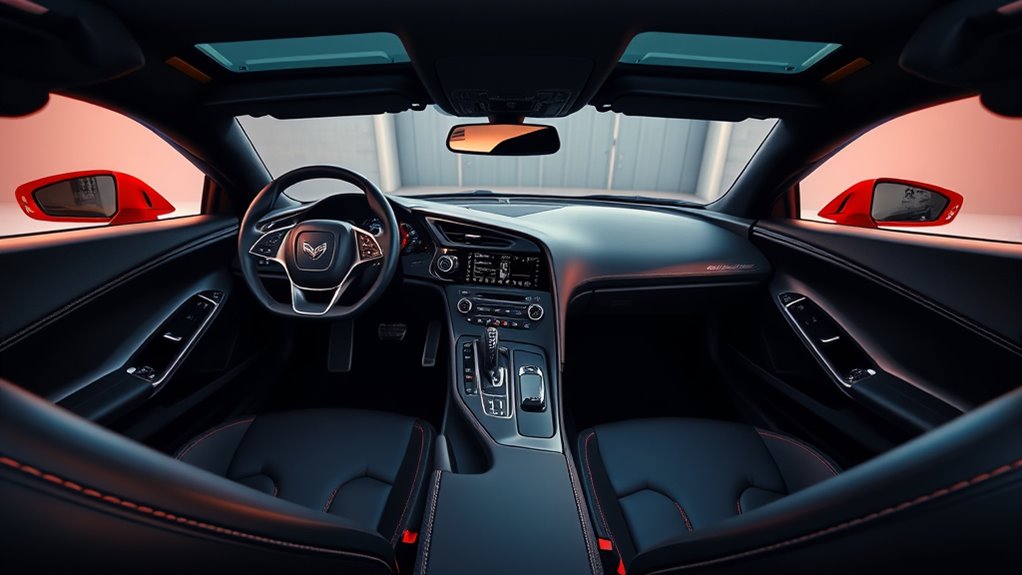
The C8 Corvette cabin feels distinct largely because its mid-engine architecture enables a lower dashboard and thinner cowl, improving sightlines while creating a more open, driver-focused environment.
In the C8 Corvette, the mid-engine layout allows packaging decisions that reduce visual mass ahead of the occupant, so the cockpit reads as compact yet spacious. The low dash line and 19-millimeter air vents limit obstruction and keep the upper fascia visually light.
Mid-engine packaging trims visual mass, creating a cockpit that feels compact, open, and remarkably light.
Controls are arranged in a wraparound pattern inspired by fighter jet cockpits, placing major interfaces within immediate reach without unnecessary movement. A three-screen interface further reinforces this logic: a 12.7-inch center display, a 14-inch driver information center, and a 6.6-inch auxiliary touchscreen provide layered data access.
The result is not decorative excess, but a technically organized interior that supports clear visibility, efficient operation, and an unambiguous sense of release behind the wheel.
How the C8 Puts the Driver First
Building on the C8’s open, technically organized cabin, the interior is structured to keep the driver at the center of every interaction. A low dashboard improves sightlines, while the cockpit-style control layout wraps primary switches and interfaces around the driver for immediate reach. This reduces dependence on touchscreen menus and supports faster input under load. The three-screen arrangement adds clear data access without distraction.
| Feature | Driver Effect |
|---|---|
| Low dashboard | Better visibility |
| Wrapped controls | Faster access |
| Ergonomically designed seats | Stable support |
The 12.7-inch center display and 14-inch driver information center present key information at a glance, preserving focus on the road. Meanwhile, ergonomically designed seats in GT1, GT2, or Competition Sport form maintain comfort during extended sessions. Together, the hardware favors precise control, intuitive operation, and a sense of liberation through direct engagement.
How Much Space Is in the C8 Interior?
Measured against its performance-focused layout, the C8 Corvette interior provides a surprisingly spacious cabin that comfortably seats two adults while preserving a low, open driving position.
The C8 interior uses a low dashboard and carefully managed sightlines to expand perceived room, reducing enclosure and supporting confident control. The layout balances driver and passenger ergonomics with a wide center structure that does not intrude on shoulder or leg movement.
Innovative storage solutions further improve usability, with a front trunk and rear cargo area adding practical volume without diluting the car’s liberated, track-ready character. The result is a cabin that feels compact in footprint yet efficient in packaging, making space serve performance rather than limit it.
- Open visibility supports spatial awareness.
- Twin-seat packaging maximizes personal room.
- Frunk storage adds everyday utility.
- Rear cargo space extends versatility.
C8 Seats: GT1, GT2, or Competition Sport
The C8’s GT1 seats emphasize a measured balance of comfort and support, using standard leather upholstery and an adjustable structure suited to extended road use.
GT2 seats increase lateral restraint with additional bolstering and available carbon fiber trim, shifting the focus toward more assertive driving dynamics.
Competition Sport seats are the most track-oriented, employing aggressive bolstering to maintain occupant stability during high-speed cornering.
GT1 Comfort And Support
GT1 seats in the C8 Corvette are engineered to balance comfort and support, making them well suited to both everyday driving and spirited use. The GT1 seats emphasize comfort through cushioning that reduces fatigue during extended travel, while the ergonomic design maintains secure positioning in aggressive cornering.
A standard manual adjustment system lets the driver tailor posture with minimal complexity, supporting a freer, more intuitive driving environment. High-quality upholstery contributes durability and a refined cabin presentation.
Relative to more aggressive alternatives, these seats deliver a relaxed, accessible feel without sacrificing essential lateral control.
- Manual adjustment for precise positioning
- Balanced cushioning for long-distance comfort
- Ergonomic support in fast turns
- Durable, premium upholstery finish
GT2 And Competition Sport
GT2 and Competition Sport seats move the C8 Corvette farther toward performance-focused support, with each trim increasing lateral containment beyond the more balanced GT1 layout.
GT2 seats add firmer side bolsters for sustained cornering, improving torso control during aggressive road use without fully sacrificing comfort.
Competition Sport raises that threshold further, using a more sculpted shell and deeper restraint for track-oriented driving and rapid shifts.
The tradeoff is clear: as support rises, long-distance comfort can decline, especially for drivers sensitive to firmer thigh and shoulder pressure.
Even so, all three seating choices remain ergonomically considered for extended use.
Selection should be based on fit, intended duty cycle, and personal tolerance, since the best seat is the one that preserves control and comfort simultaneously.
C8 Materials and Color Options
C8 material and color selections are engineered to balance visual impact with a premium cabin presentation, offering combinations such as Asymmetrical Adrenaline Red, Jet Black, and Very Dark Atmosphere with Natural Tan accents.
These C8 materials establish clear interior colorways while preserving a purposeful, driver-focused atmosphere. Jet Black suede trim adds tactile depth, and available stitching customization gives the cabin a more individual expression without compromising cohesion.
- Natural Dipped treatment emphasizes bold luxury.
- Hand-wrapped cupholders improve finish quality.
- Ambient lighting supports visual definition.
- Crossed flags details reinforce brand identity.
This palette strategy serves occupants seeking freedom through personalization, allowing the cabin to feel tailored rather than generic.
The result is a controlled blend of contrast, texture, and restraint, with Jet Black suede acting as a technical anchor for the overall design language.
C8 Tech: Screens, Google, and Apps
The C8 cockpit centers on a three-screen layout that includes a 12.7-inch center display, a 14-inch driver information center, and a 6.6-inch auxiliary touchscreen.
Google Built-in adds voice control and direct app access, supporting navigation, media, and connected services within the native interface.
Wireless charging, Apple CarPlay, Android Auto, and performance-focused apps extend the system’s utility for both daily use and track-oriented monitoring.
Three-Screen Cockpit
A three-screen cockpit anchors the C8 Corvette’s interior, combining a 12.7-inch center console display, a 14-inch driver information center, and a 6.6-inch auxiliary touchscreen to create a highly configurable digital control environment.
This three-screen cockpit gives the driver information center clear priority, while the infotainment system centralizes key functions without excess distraction. Repositioned HVAC controls and a larger volume knob support quick, tactile adjustments.
- 12.7-inch center display for primary controls
- 14-inch driver information center for driving data
- 6.6-inch auxiliary touchscreen for secondary access
- Physical controls tuned for efficient operation
The layout favors direct command and measurable feedback, giving occupants a liberated sense of control through precise interface placement and streamlined ergonomics.
Google Built-In Apps
Building on the three-screen cockpit, the C8 Corvette’s infotainment architecture adds Google Built-in to its already screen-centric layout, extending functionality through voice assistance, native app access, and tighter smartphone integration.
The custom infotainment system supports Google Chrome, HBO Max, and Prime Video, enabling direct access to navigation, browsing, and streaming without relying on external devices. Apple CarPlay and Android Auto remain available for wireless phone projection, preserving cross-platform compatibility.
The 12.7-inch center console display and 14-inch driver information center organize controls and data with clear hierarchy. The Performance App supplies acceleration timers and G-force gauges in real time, giving the Corvette driver measurable feedback.
The result is a system designed for informed control, reduced friction, and greater independence.
C8 Controls and Everyday Ergonomics
Emphasizing driver focus over display-heavy interfaces, the C8 Corvette arranges its hard controls in a fighter jet-inspired layout that wraps essential functions around the cockpit for immediate reach.
The C8 controls are placed to support fast inputs, while the ergonomics reduce hand travel and cognitive load. A low dashboard and 19-millimeter air vents preserve outward visibility, and the driver information center remains readable without dominating the field of view.
Fast controls, reduced reach, and a low dashboard keep the driver informed without crowding the view.
The center console adds a larger, lit volume knob and clearly assigned HVAC switches, allowing quick adjustments without menu hunting. This configuration favors direct mechanical access over layered touchscreens, supporting liberated, high-speed operation.
- Physical controls for rapid changes
- HVAC functions positioned for clarity
- Thin vents to improve sightlines
- Lit knob for confident use
C8 Coupe vs. Convertible Cabin Feel
The C8 Coupe’s removable Targa roof preserves a more enclosed cabin profile, which can improve headroom perception, reduce noise, and maintain a firmer structural feel.
The Convertible’s power retractable hardtop lowers in 16 seconds at speeds up to 30 MPH, providing easier open-air access and a more exposed cabin environment.
In both body styles, seat fit and comfort remain driver-focused, with supportive ergonomics and a layout that keeps controls and sightlines closely aligned.
Coupe Headroom and Targa
Headroom in the C8 Coupe is shaped by the removable targa roof and a low-profile dashboard, creating a cabin that feels open while still preserving structural rigidity and usable space for taller drivers.
In the coupe, the Targa roof supports a liberated, airy impression without surrendering the driver-focused geometry.
- Headroom remains generous for long-distance comfort
- The low dash reduces visual confinement
- Structural strength supports stable chassis behavior
- Visibility and reach stay intentionally optimized
This layout gives the cabin a technical balance: open-air sensation, compact packaging, and ergonomic control placement.
The result is a cockpit that feels less enclosed than many fixed-roof sports cars, yet still secure and precise.
For occupants seeking freedom without sacrificing support, the coupe cabin delivers a measured sense of space.
Convertible Roof and Access
By contrast, the C8 Convertible replaces the coupe’s removable Targa panel with a power retractable hardtop that lowers in about 16 seconds at speeds up to 30 mph, giving the cabin a more seamless open-air shift without altering the core performance layout.
This convertible roof changes access from manual panel removal to powered operation, reducing interruption and making the car feel more liberated in motion. As a hardtop convertible, it preserves the structural and acoustic advantages expected when closed, including better isolation and aerodynamics than an exposed roof.
The cabin architecture remains aligned with the Coupe’s performance driving intent, so features and layout are retained. The main difference is atmospheric: the open configuration delivers a freer visual and sensory experience, while the closed configuration remains refined and technically composed.
Seat Fit and Comfort
Seat fit in the C8 Corvette is shaped by a range of seating choices, including GT1, GT2, and Competition Sport seats, each tuned for a different balance of support and comfort.
These options refine seat fit and comfort for varied body types while preserving driver control.
- Coupe and convertible layouts both use disciplined interior cabin space.
- Headroom and legroom remain generous for daily use.
- The asymmetrical dashboard design improves sightlines and opens the cockpit visually.
- A tighter seat profile improves long-distance support versus the C7.
In the hardtop convertible, the power roof lowers without compromising structure, so open-air freedom does not distort the cabin feel.
The result is a technical, liberated environment that feels secure, efficient, and less confined.
How Comfortable Is a C8 on Long Drives?
Comfort on long drives in the C8 Corvette is supported by its ergonomic seating choices, including GT1, GT2, and Competition Sport seats, which are designed to provide sustained support over extended periods.
The interior balances performance intent with usable comfort, giving the driver a low dashboard, generous legroom, and a relaxed posture that reduces strain. Premium materials and refined finishes add a higher-grade feel, making extended travel less austere than in earlier mid-engine layouts.
A three-screen interface supplies key data without forcing excessive attention shifts, helping maintain focus and limiting fatigue.
The mid-engine architecture also contributes to stable weight distribution, which improves ride composure on winding roads and during steady high-speed cruising.
Together, these elements create a cabin that supports freedom of movement, controlled driving effort, and longer-distance usability without sacrificing the car’s performance character.
C8 Interior Features That Change Seating Position
The C8 Corvette’s seating position is shaped by several interior features that let the cockpit adapt to different drivers and use cases.
Factory GT1, GT2, and Competition Sport seats alter support, bolstering, and overall snugness, making the cabin easier to tailor for varied body types. The low dashboard and optimized sightlines help preserve visibility while keeping the driver low in the chassis.
Its asymmetrical layout supports a more personalized fit, with controls and seat geometry arranged to suit primary driver and passenger needs without wasting space. Advanced ergonomic design keeps major interfaces within easy reach, reducing reach strain and maintaining posture.
The mid-engine balance also influences perceived comfort by stabilizing the cabin’s dynamic feel.
- GT1 seats favor broad comfort
- GT2 seats add firmer lateral support
- Competition Sport seats increase track-focused containment
- Layout and control placement support liberated, intuitive driving
Frequently Asked Questions
What Are the Key Features of the C8 Corvette Interior?
Key features include interior materials, seating comfort, and dashboard technology, plus a low dashboard, three-screen layout, Google built-in infotainment, wireless projection, physical controls, and ergonomic GT1, GT2, and Competition Sport seating for enhanced usability.
What Are Some Hidden Features on the Corvette C8?
Hidden Corvette technology includes Performance Data Recorder telemetry, Google built-in voice control, customizable three-screen instrumentation, and lit console controls. These design innovations enable performance enhancements, intuitive access, and a liberated, driver-focused cockpit without visual clutter.
Why Is the C8 Not Selling?
Because pricing strategy exceeds many buyers’ budgets, market demand is constrained by shortages, and competition analysis favors Porsche 911 and Audi R8 alternatives; the C8 remains caught between a rock and hard place.
What Is the Average Income of a C8 Corvette Owner?
The average income of a C8 Corvette owner is roughly $150,000 to $200,000 annually. Corvette demographics skew affluent; owner lifestyle favors performance and prestige, while income effects support luxury purchases and discretionary spending.
Conclusion
The C8 interior stands out for its mid-engine packaging, driver-centered layout, and efficient use of space. Its three-screen cockpit, supportive seat options, and practical storage solutions create a cabin that is both functional and focused. Material and color choices add a refined, technical feel, while Coupe and Convertible versions preserve the same core ergonomics. For long-distance or everyday use, the cabin is impressively balanced, delivering a cockpit-like experience that borders on engineered perfection.