Motorcycle helmet speakers in 2026 are no longer just about volume. Riders now expect clear sound, easy controls, and reliable performance in changing conditions. The Cardo PACKTALK Edge, LEXIN B4FM, and Sena 50S each bring different strengths to the road, from group communication to premium audio. The choice is not simple, and the details behind each model may matter more than expected.
Cardo PACKTALK Edge Motorcycle Bluetooth Headset Intercom
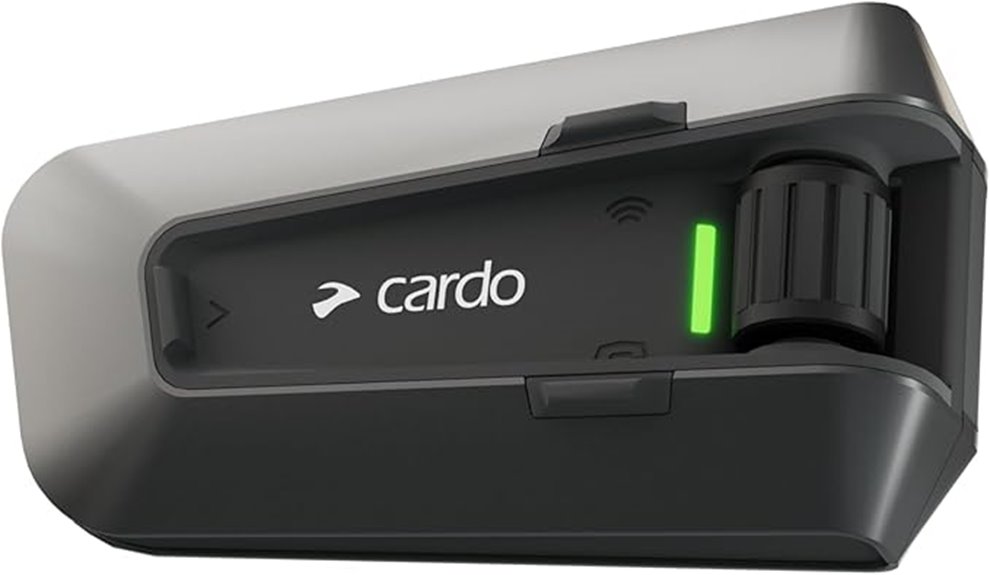
The Cardo PACKTALK Edge Motorcycle Bluetooth Headset Intercom is a strong pick for riders who want a waterproof, voice-controlled communication system that stays easy to use in changing conditions. This single-pack Bluetooth headset uses natural voice operation, so commands can be handled without reaching for buttons. Its Air Mount magnetic system supports quick installation, while universal Bluetooth compatibility broadens pairing options. The unit also adjusts volume automatically as road noise changes. Audio features include FM radio with RDS, music streaming, and active noise cancellation. Battery life reaches 13 hours, and 20 minutes of charging adds 2 hours.
Best For: Riders who want a waterproof, easy-to-use Bluetooth intercom with voice control, automatic volume adjustment, and solid battery life for everyday motorcycle communication.
Pros:
- Natural voice operation makes it easy to control without taking hands off the ride.
- Waterproof design and Air Mount magnetic installation add convenience and durability.
- Strong audio features, including FM radio with RDS, music streaming, active noise cancellation, and up to 13 hours of talk time.
Cons:
- Single-pack setup means it’s not ideal for riders who need a ready-to-use pair.
- Premium feature set may come with a higher price than simpler motorcycle headsets.
- Bluetooth headset performance can vary depending on helmet fit, noise levels, and pairing compatibility.
LEXIN B4FM Motorcycle Bluetooth Headset for 10 Riders
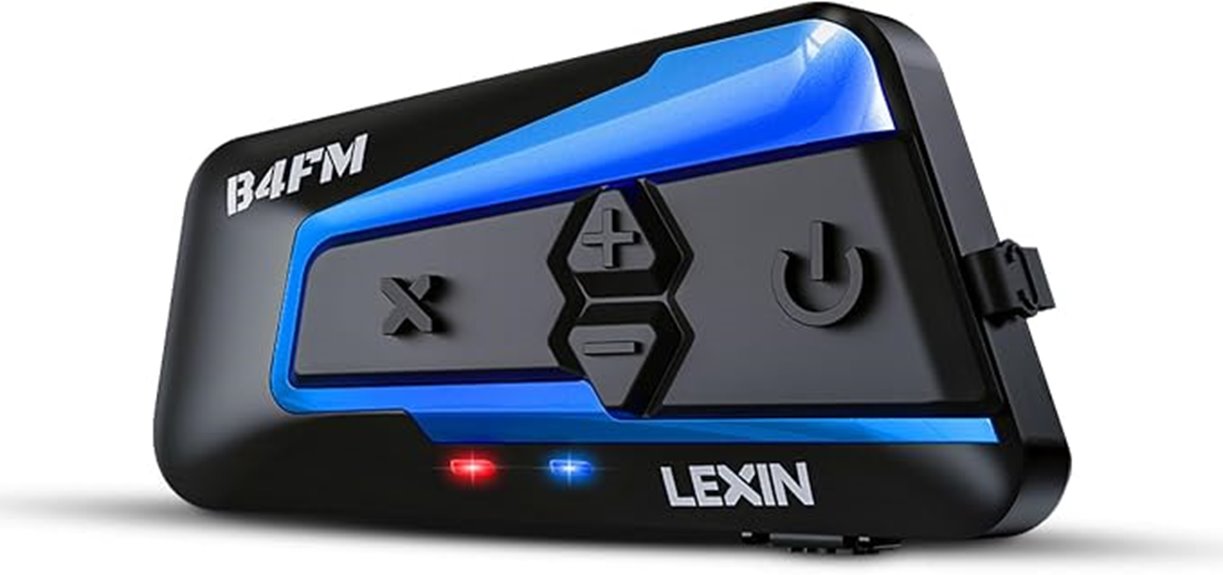
With 10-way intercom and strong 2-rider music sharing, the LEXIN B4FM suits group riders. It supports up to 10 connected riders, though it performs best with four, over a range of 2000 meters. A double-click lets two riders share the same track, while Mylar coaxial speakers, DSP, and CVC help deliver clear 3D audio. Active noise cancellation preserves speech at speeds up to 120 km/h. The IP67 build handles harsh weather, and the 800mAh battery offers up to 15 hours of use. Boom and button mics, plus voice and touch controls, broaden helmet compatibility.
Best For: Group motorcycle riders who want long-range intercom, shared music, and weather-resistant helmet communication on longer rides.
Pros:
- Supports up to 10 riders with a solid 2000 m intercom range, making it great for group rides.
- Music sharing for 2 riders plus Mylar coaxial speakers, DSP, and CVC for clearer audio.
- IP67 waterproofing, long battery life, and both boom and button mic options improve versatility.
Cons:
- Performs best with only about 4 riders, despite supporting 10-way intercom.
- Sound and call clarity can still be affected by high-speed wind and road noise.
- Touch and voice controls may take time to get used to while riding.
Sena 50S Motorcycle Bluetooth Headset with Mesh Intercom
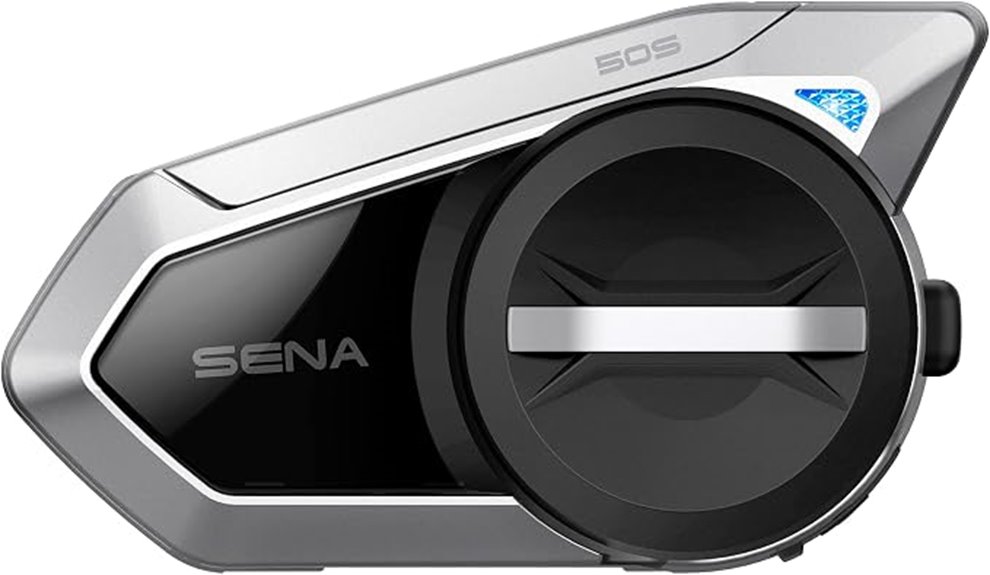
Sena 50S suits riders who want premium helmet audio and long-range mesh communication. The headset combines an integrated Mesh Intercom system with Bluetooth 5.0, giving riders wireless connectivity with a claimed 5-mile range. Harman Kardon-tuned speakers and microphone are built for clear voice pickup and rich sound, supported by a 20 Hz to 16,000 Hz response. Control is handled through a jog dial and touch interface, while voice assistant access adds convenience. Battery life averages 16 hours, and a 20-minute charge can provide up to 2 hours of use.
Best For: Riders who want premium helmet audio, reliable long-range mesh communication, and easy-to-use controls for group rides and everyday motorcycle use.
Pros:
- Integrated Mesh Intercom and Bluetooth 5.0 offer flexible wireless communication options.
- Harman Kardon-tuned speakers and microphone deliver clear voice pickup and strong audio quality.
- Fast charging and 16-hour battery life make it practical for long rides.
Cons:
- The premium feature set may come at a higher price than basic helmet headsets.
- Full charging still takes 2.5 hours if you need a complete top-up.
- Advanced controls and features may feel more complex for riders who want a simple headset.
Factors to Consider When Choosing Motorcycle Helmet Speakers 2026: Clear Ride Audio
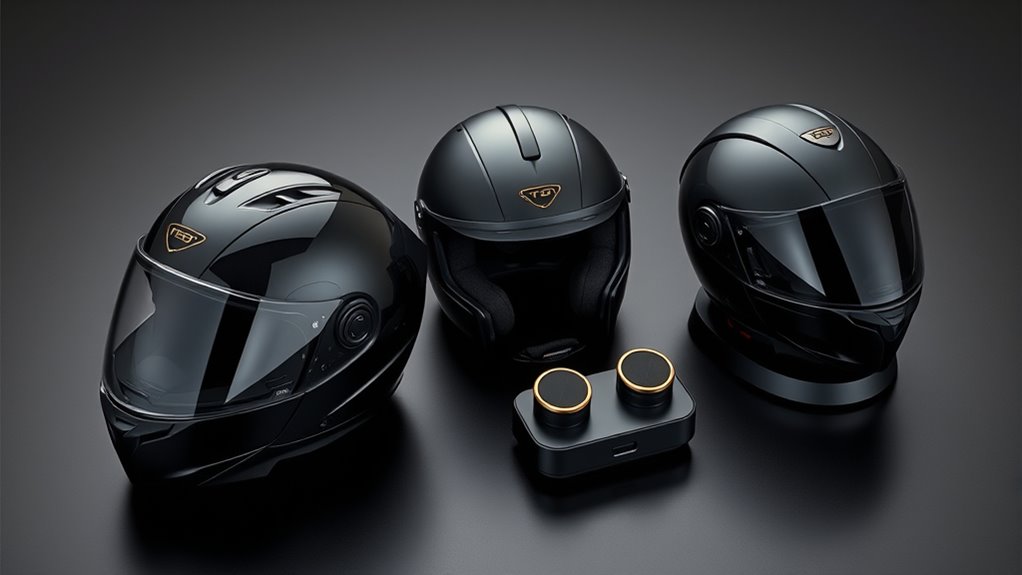
Clear ride audio begins with strong sound clarity, so speech and music remain easy to hear over wind and traffic noise. Battery longevity, waterproof durability, and connectivity range also shape how reliably the speakers perform on long rides and in changing weather. Voice control adds convenience by letting the rider manage calls, music, and navigation without losing focus.
Audio Clarity
Audio clarity remains one of the most important factors when choosing motorcycle helmet speakers in 2026, because riders need dependable voice communication and music playback even at highway speeds and in noisy conditions. Clear performance depends on a wide frequency range, ideally from 20 Hz to 20,000 Hz, which preserves deep bass, balanced mids, and crisp treble. Active noise cancellation further improves intelligibility by reducing wind and road noise, especially at speeds up to 120 km/h. Speaker impedance also matters, with values around 2 to 80 ohms influencing efficiency and output quality. Quality dynamic drivers help reproduce speech and music with greater precision. Together, these elements determine whether helmet audio remains sharp, usable, and enjoyable during everyday riding.
Battery Longevity
After sound quality, battery longevity becomes the next major factor in choosing motorcycle helmet speakers for 2026. Many leading models deliver 13 to 16 hours of talk time on a single charge, which supports long commutes and full-day rides without interruption. Battery capacity, often listed in milliamp hours, helps indicate endurance; an 800mAh unit may reach about 15 hours of operation. Fast charging adds practical value, with some systems gaining up to 2 hours of use from a 20-minute charge. Standby time also matters, since a headset that lasts more than 168 hours remains ready between rides. Charging method influences convenience too, and USB Type C usually offers broader compatibility than proprietary connectors.
Waterproof Durability
Waterproof durability is a key consideration for motorcycle helmet speakers, since rain, mud, and dust can quickly affect performance on the road. Models with an IP67 rating or higher offer strong protection against dust and temporary water immersion, making them well suited for unpredictable weather. Construction quality matters as well: sealed ports, tight gaskets, and moisture-resistant materials help prevent internal damage and support longer service life. Temperature tolerance is another useful benchmark, because electronics and audio output can degrade in harsh cold or heat; some units remain reliable down to -22°F. Waterproof designs may also support active noise cancellation more effectively, helping preserve clear audio and communication when conditions become wet, cold, and demanding for riders.
Connectivity Range
Beyond weather resistance, connectivity range determines how well motorcycle helmet speakers keep riders in contact on the road. Many modern systems advertise ranges from 1.2 miles to as much as 5 miles, giving riders flexibility for solo commutes or group travel. Bluetooth remains the standard connection method, and Bluetooth 5.0 improves stability and reach compared with older versions. Intercom units often support several riders at once, but only within their rated limits. Speed, hills, trees, and traffic can reduce effective range, so performance should be judged in real riding conditions, not just specifications. Systems built for clear high-speed communication are preferable. Regular firmware updates also matter, since manufacturers can refine connectivity, extend range, and improve reliability over time for better group coordination.
Voice Control
Voice control has become a key convenience factor in motorcycle helmet speakers, allowing riders to manage calls, music, and volume without taking their hands off the controls. It improves safety by reducing the need for physical adjustments during a ride. Modern Bluetooth headsets often support natural voice operation, so commands can be triggered simply by speaking. This lets the rider place calls, change tracks, or alter volume with minimal effort. Effective systems also rely on noise cancellation so spoken commands remain accurate at speed or in wind. In addition, voice integration with digital assistants adds practical access to navigation and other smartphone functions. For riders seeking streamlined control, responsive voice features can make helmet speakers more intuitive and less distracting on every trip.
Intercom Compatibility
Intercom compatibility is a major factor when comparing motorcycle helmet speakers for 2026, especially for riders who need reliable communication on longer trips or in groups. Universal Bluetooth connectivity matters because it lets the system pair with different headsets and devices without friction. Group riding benefits from intercoms that support multiple users, with some models connecting up to 10 riders over distances as far as 2000 meters. Noise cancellation also plays a key role, preserving speech clarity at highway speeds and in wind. Control options should be practical, including voice commands or touch controls for safer operation. Finally, helmet fit cannot be ignored; boom or button microphones must match the helmet style to maintain clear audio and dependable performance.
Frequently Asked Questions
How Do Helmet Speakers Affect Wind Noise Reduction?
Helmet speakers do not directly reduce wind noise; they mainly improve audio clarity so the rider can hear music, calls, or navigation over surrounding turbulence. Some models sit flush and can slightly limit gaps or pressure points, but the helmet’s shell, visor seal, and fit matter far more. If wind noise is excessive, proper helmet aerodynamics, a snug chin curtain, and earplugs will usually help more than speakers alone.
Can Helmet Speakers Connect to Older Motorcycle Intercom Systems?
Yes, they often can, yet compatibility and limitation sit side by side. Older motorcycle intercom systems may connect through Bluetooth, wired jacks, or adapter cables, but mismatched protocols, outdated firmware, and proprietary pairing can block seamless use. A detached assessment would note that checking connector type, Bluetooth version, and manufacturer support is essential before assuming success. In practice, some systems communicate easily, while others remain stubbornly isolated.
Are Helmet Speakers Compatible With Prescription Eyeglasses?
Yes, many helmet speakers are compatible with prescription eyeglasses, especially when the helmet has speaker pockets and enough interior space. Thin speakers and low-profile pads usually reduce pressure on the arms of glasses. Fit varies by helmet shape, speaker thickness, and frame style. A proper trial fitting remains important, since some riders may feel discomfort at the temples or ears during longer rides, even with compatible gear.
How Often Should Helmet Speaker Batteries Be Replaced?
Helmet speaker batteries should be replaced when their runtime drops noticeably, charging becomes unreliable, or the battery no longer holds enough power for a typical ride. For many rechargeable units, this happens after about 2 to 4 years of regular use. Heavy riders may need replacements sooner. Proper charging habits, avoiding extreme heat, and storing batteries partially charged can help extend service life and delay replacement.
Do Helmet Speakers Work Well in Heavy Rain?
Around 60% of waterproof-rated helmet speakers keep functioning in heavy rain, giving a useful picture of their limits. Helmet speakers can work well in downpours if they are properly sealed and rated IPX5 or higher. Sound may become less clear because rain, wind, and helmet noise interfere, but music and calls usually remain usable. Non-waterproof models are more likely to fail, so protection matters when riding in wet conditions.
Conclusion
In 2026, the best motorcycle helmet speakers balance clarity, range, and convenience. The Cardo PACKTALK Edge leads with waterproof, voice-controlled operation and a quick magnetic mount, while the LEXIN B4FM impresses group riders by supporting up to 10 riders with strong audio and noise cancellation. The Sena 50S rounds out the top three with a 5-mile range and Harman Kardon-tuned sound. With options like these, riders can enjoy safer, clearer communication on every trip.