Automatic old cars marked a major shift in automotive history. Before them, drivers had to manage every gear change by hand, often with effort and skill. General Motors’ Hydra-Matic, introduced in 1940, used hydraulic fluid and torque converters to shift automatically. These systems improved ease of use and helped reshape postwar driving habits. Yet the details behind their rise, and the cars that made them famous, reveal a more complex story.
Key Takeaways
- Early automatic cars evolved from manual gear systems, with GM’s Hydra-Matic becoming the first mass-produced automatic in 1940.
- Torque converters, hydraulic fluid, bands, and clutches enabled smooth gear changes and power transfer without constant driver input.
- Automatic transmissions reduced driver effort, improved comfort, and made driving easier for beginners and long-distance travel.
- Adoption surged after World War II, with automatics passing 50% of U.S. new car sales by 1950.
- Classic automatic cars from the 1950s to 1970s are prized today, and restoration often requires rare parts and expert knowledge.
What Makes an Old Car Automatic?
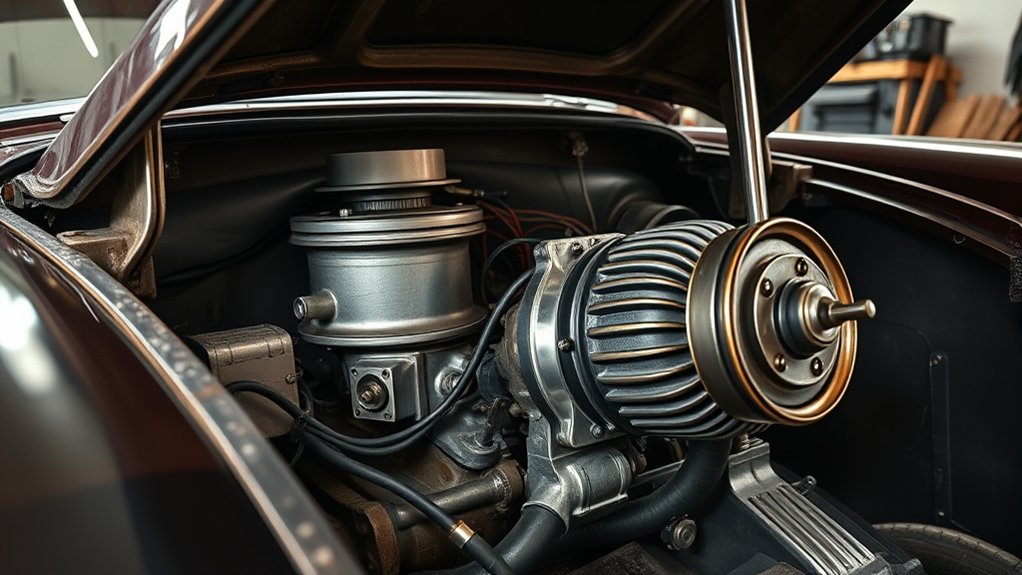
Old cars became automatic through the introduction of transmissions that shifted gears without direct driver input, a development that gained prominence in the 1940s with General Motors’ Hydra-Matic.
In these automatic transmissions, early automatic systems used hydraulic fluid to engage gears, reducing the need for constant coordination and easing the burden long imposed by manual transmissions. A torque converter later became a defining component, allowing power to flow smoothly during acceleration and deceleration without a clutch pedal.
The Ford Model A, introduced in 1927, even offered a two-speed automatic option, signaling an early mass-market experiment in freer motoring.
Cars Before Automatic Transmissions
Before automatic transmissions arrived, most cars relied on manual gearboxes that required the driver to operate a clutch pedal and gear stick in careful coordination. This manual transmission era defined early motoring, from simple runabouts to heavier touring cars, where each shift demanded timing and skill.
The 1908 Ford Model T used a two-speed planetary setup, yet it still required manual control for changing ratios and obtaining better performance on hills and roads. Many pre-automatic cars also used sliding gear or cone clutches, mechanisms that were rugged but often inefficient and demanding.
Drivers had to master them to keep motion smooth and keep machines responsive. Such systems reflected an age when mobility was possible, but not fully liberated from mechanical effort.
In the 1930s, the Torque Converter pointed toward easier operation, preparing the ground for automatic transmission designs that would later transform driving freedom.
How Hydramatic Changed Driving
General Motors introduced the Hydramatic in 1940 as the first mass-produced automatic transmission, and it first appeared in the 1940 Oldsmobile.
By removing the need for constant clutch use and manual gear changes, it allowed smoother acceleration and made driving easier for a wider public.
Its torque converter improved power delivery and reduced mechanical wear, helping establish automatic transmission as a major feature of postwar automobiles.
Hydramatic Basics
Introduced by General Motors in 1940, the Hydramatic transmission became the first mass-produced automatic gearbox, transforming driving by removing the need for constant manual shifting.
Its Hydramatic transmission used hydraulic controls, planetary gears, and clutches to manage gear shifting with little driver effort, a decisive advance in the automatic transmission era.
- First appeared in the 1940 Oldsmobile
- Delivered smoother acceleration and fewer interruptions
- Used vehicle speed and engine load as signals
- Expanded across GM brands by 1949
- Became common in American cars by the mid-1950s
For drivers seeking liberation, it reduced fatigue in traffic and widened access to easier motoring.
Its engineering marked a historical step toward modern convenience, making the road less demanding and more open to movement.
Transmission Shift Impact
The Hydramatic’s effect on driving was immediate and far-reaching: by automating gear changes, it removed one of the most demanding tasks behind the wheel and let drivers concentrate more fully on traffic and road conditions.
Introduced by General Motors in 1940, the transmission became the first mass-produced automatic, using hydraulic control to shift gears without constant manual input.
This advance altered the driving experience by reducing strain and making travel more accessible to a broader public. It also improved fuel efficiency relative to many conventional manuals, while delivering smoother acceleration.
By 1949, Hydramatic units were standard in many GM models, and their success accelerated automatic adoption across the industry.
In time, mass production helped make liberation from shifting a mainstream automotive expectation.
Driving Experience Changes
With gear changes no longer requiring constant attention, the Hydramatic reshaped daily driving as much as it changed automotive engineering.
Introduced by General Motors in 1940, the first mass-produced automatic transmission offered a new driving experience marked by ease and control. Its hydraulic fluid system delivered smoother acceleration and deceleration, especially useful in stop-and-go city traffic.
- Manual shifting receded
- Driver fatigue declined
- Long journeys felt less taxing
- Cadillac adoption surged
- Automotive design shifted toward automation
Torque Converters, Bands, and Fluid Couplings
By the 1940s, automatic transmissions had begun to rely on torque converters, bands, and fluid couplings to improve ease of operation and reduce the need for manual gear changes.
The torque converter, built around an impeller, turbine, and stator, used hydraulic fluid to transmit and multiply engine power with smooth acceleration and deceleration.
Bands applied pressure to drums to hold gears in place, while fluid couplings allowed controlled slippage between engine and transmission for steadier shifts.
Torque Converter Basics
Torque converters have long served as the hydraulic bridge between an engine and an automatic transmission, letting the engine spin independently while power is transferred smoothly to the driveline. In early automatic vehicles, this fluid coupling helped free drivers from clutch work.
- A torque converter uses an impeller, turbine, and stator.
- It multiplies torque during launch.
- It manages engine RPMs across changing loads.
- Stall speed shapes acceleration and efficiency.
- Lock-up lowers slippage, heat, and fuel efficiency losses.
Bands And Fluid Couplings
In early automatic transmissions, fluid couplings and torque converters provided the hydraulic link between engine and drivetrain, allowing the engine to keep running while the car remained stationary and then transfer power smoothly as speed increased.
These fluid couplings used rotating impellers and hydraulic fluid to move torque without a direct mechanical connection, a notable advance in automatic transmissions.
Bands then worked within the transmission case, gripping drums in planetary gear sets to secure or release elements for each ratio. A hydraulic system regulated bands and clutches by sensing throttle and road speed, helping shifts occur with precision.
Why Automatics Replaced Manual Shifts
Automatic transmissions rose to prominence because they made driving simpler and less demanding, especially as car ownership expanded after World War II.
In the 1940s and 1950s, automatic transmissions answered consumer preferences for ease, letting motorists travel without constant clutch work or gear changes. This freed attention for the road and improved the driving experience.
- Smoother starts and shifts
- Less fatigue in traffic
- Broader appeal to new drivers
- Better comfort on long trips
- Improving fuel economy and performance
Automatic Transmissions in Classic Cars
Although manual gear shifting remained common in early motoring, automatic transmissions became a defining feature of many classic cars after General Motors introduced the Hydramatic in 1940. The system freed drivers from constant clutch work and helped shape a more relaxed, liberated style of travel. By using two-speed or three-speed designs, these units delivered smoother acceleration and better ease in a mass-produced automobile.
| Feature | Historical note |
|---|---|
| Hydramatic | First widely adopted automatic |
| Gears | Usually two-speed or three-speed |
| Appeal | Strong driver convenience |
| Effect | Improved performance feel |
Classic Cars That Popularized Automatics
Key classic cars helped turn automatic transmissions from a novelty into a mainstream expectation. The 1940 Oldsmobile introduced the Hydramatic, the first production automatic transmission, and proved that shifting could be surrendered to machinery without sacrificing progress. This breakthrough altered the direction of classic cars and widened the appeal of driving freedom.
- Oldsmobile: first fully automatic production system
- Cadillac: 1950 Park gear improved driver safety
- Chevrolet Corvette: brought automatic transmission to sports cars
- Chrysler Windsor: featured push-button controls in 1960
- Late 1960s: automatics exceeded 80% of U.S. sales
Cadillac’s Park gear added a practical safeguard, while the 1953 Chevrolet Corvette showed that performance cars could also embrace ease.
The 1960 Chrysler Windsor’s push-button design suggested a future in which control became simpler, cleaner, and less demanding. By the late 1960s, automatics dominated American sales, confirming that convenience and independence had become central to motoring.
Collecting and Restoring Automatic Old Cars
Interest in collecting automatic old cars has grown steadily, especially for models from the 1950s through the 1970s, as their distinctive styling, cultural importance, and association with classic car shows continue to attract enthusiasts. Collectors value automatic cars for design and era, while restoring them demands careful study of vintage transmission systems and period-correct hardware.
| Focus | Detail |
|---|---|
| Collecting | Muscle-era models are prized |
| Restoring | Rare parts often require search |
| Support | Classic car clubs aid sourcing |
| Value | Well-kept examples can reach six figures |
Early automatics such as the Ford C4 and GM Powerglide present distinct service requirements, and unavailable components raise both challenge and worth. Restoration thus becomes a precise act of preservation, not mere repair. For many, membership in classic car clubs and online forums provides access to guidance, parts, and shared expertise. In this way, the work sustains automotive freedom through informed stewardship and historical respect.
Major Milestones in Automatic Transmission History
The history of automatic transmissions began in 1921, when Alfred Horner Munro developed a hydraulic system that could shift gears without driver input, establishing the basic idea of automatic gear changing. This early hydraulic transmission offered motorists relief from manual effort and pointed toward greater mechanical freedom.
- 1930s: the Torque Converter improved smooth acceleration and reduced strain on engines.
- 1940: General Motors introduced Hydra-Matic, the first mass-produced automatic transmission in the U.S.
- 1950: automatic transmission adoption passed 50% of new U.S. car sales.
- Late 1960s: availability expanded rapidly across mainstream models.
- 1970: more than 80% of new U.S. cars used automatic gear shifting.
Each milestone widened access to easier driving, allowing more drivers to travel with less fatigue and more control over the machine.
Frequently Asked Questions
What Is the $3000 Rule for Cars?
The $3000 rule for cars advises that if repairs exceed roughly half a vehicle’s value, owners should reconsider. In car maintenance, classic models, transmission types, vintage restorations, and driving experience, prudence often means replacement.
What Are Some Interesting Facts About Old Cars?
Old cars fascinate through iconic car models like the Ford Model T and Chrysler Airflow, early automotive innovations, classic car restoration, vintage car shows, and antique car insurance, preserving history while inspiring freedom on roads.
What Color Car Is Least Stolen?
Silver is least stolen. In insurance statistics, its quiet shade aids car theft prevention, aligning with color psychology and vehicle tracking; historical theft hotspots show darker or brighter vehicles are more often spirited away.
What Is the Oldest Automatic Car?
The oldest automatic car is generally the 1940 Oldsmobile with Hydra-Matic, an early automatic among vintage car innovations, marking transmission evolution. Its automatic benefits improved driving experience, reflecting liberation through easier, clutch-free motoring.
Conclusion
Automatic old cars marked a turning point in automotive history: they reduced driver effort, they improved everyday comfort, and they helped transform the automobile from a mechanical challenge into a mainstream necessity. From early hydraulic experiments to Hydra-Matic and beyond, automatic transmissions reshaped classic motoring and set the standard for modern driving. Their legacy endures in restored survivors, in collector garages, and in the broader story of how technology changed the road.