
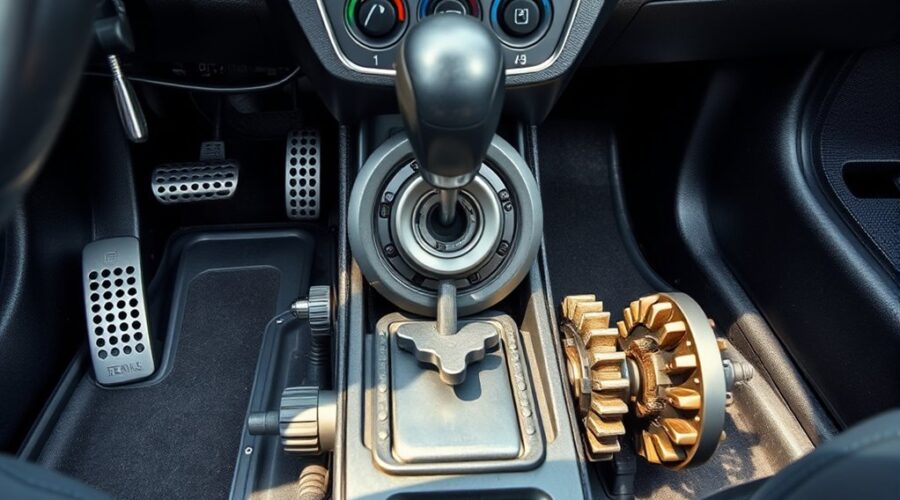
A manual transmission gives the driver direct control over gear selection through a clutch pedal and shift lever. Inside the case, input, counter, and output shafts work with synchronizer rings to match speeds and reduce gear clash. The system is simple in principle, but each component affects drivability, wear, and efficiency. Understanding how these parts interact reveals why some shifts feel clean while others do not.
What Is a Manual Transmission?
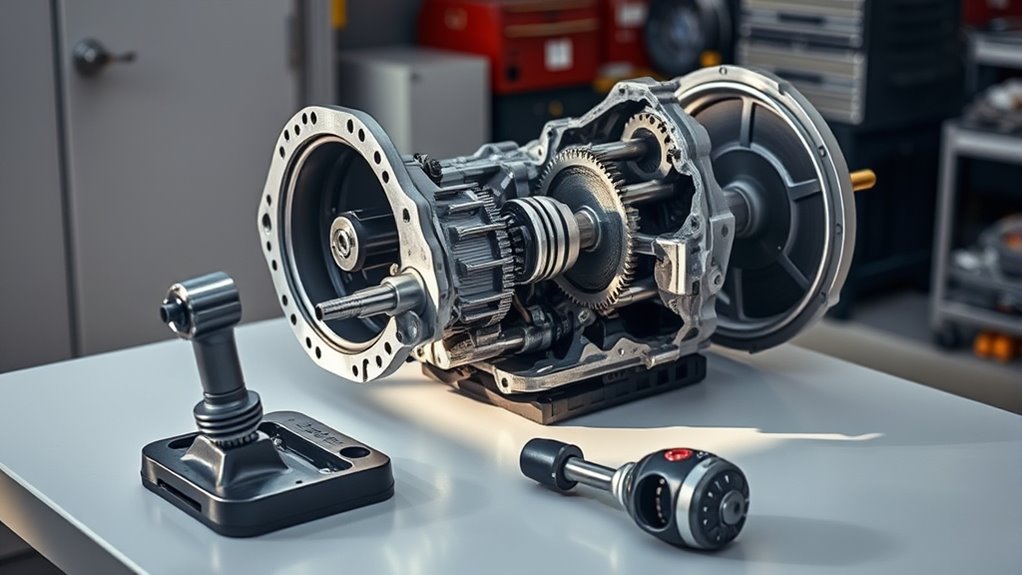
A manual transmission (MT) is a drivetrain system that requires the driver to operate a clutch pedal and gear stick to select gear ratios manually, providing direct control over engine speed, vehicle speed, and handling.
In a manual transmission, the operator selects among typically five or six forward gears and one reverse gear, matching the ratio to terrain, load, and acceleration demands. This arrangement gives the driver a measurable degree of autonomy, since shifting gears is performed intentionally rather than by automated logic.
The design has long been valued for mechanical simplicity, durability, and reduced maintenance burden, with oil changes often spaced at 30,000 to 60,000 miles. The 1929 Cadillac introduced synchromesh, making clutch operation and gear changes smoother by aligning gear speeds.
Mastery of the manual transmission also sharpens attentiveness, because the driver must remain engaged with vehicle dynamics and timing, strengthening skill, discipline, and command over motion.
How a Manual Transmission Works
Power flows through a manual transmission only when the driver depresses the clutch pedal and selects a gear with the shift lever. The input shaft receives engine torque, while the countershaft and output shaft route it to the driveshaft. In neutral, the shafts rotate independently, so no power reaches the wheels; this grants control without imposed motion. A brief clutch release reestablishes connection, and synchronizer rings align speeds so the chosen ratio engages cleanly. The gear lever then fixes the driver’s selected path, making acceleration, engine braking, and low-speed maneuvering deliberate rather than automatic. For those seeking mechanical autonomy, this system offers direct command over power transfer.
| State | Effect |
|---|---|
| Clutch depressed | Drive disconnected |
| Neutral selected | No transfer |
| Gear engaged | Torque transmitted |
| Sync rings active | Speed matched |
| Clutch released | Motion resumes |
Regular gear oil changes every 30,000 to 60,000 miles support durable operation.
Manual Transmission Parts You Should Know
A manual transmission depends on the input, counter, and output shafts to route engine torque through staged gear ratios to the wheels.
The clutch assembly, including the flywheel and pressure plate, separates and reconnects the engine and transmission during shifts, while the shifter and forks position the selected gear.
Synchronizers then match gear speeds before engagement, reducing friction and preventing grinding.
Input, Counter, Output Shafts
At the core of a manual transmission, three shafts coordinate torque flow and gear selection. The input shaft receives engine power through the clutch, the countershaft carries permanently meshed gears, and the output shaft sends torque to the driveshaft and wheels. This arrangement enables precise ratio changes while preserving mechanical agency.
| Shaft | Function | State |
|---|---|---|
| Input shaft | Receives engine torque | Engaged |
| Countershaft | Hosts meshed gears | Selective |
| Output shaft | Delivers drive power | Driven |
During shifting, the clutch is disengaged so the input shaft can rotate independently of the output shaft, allowing synchronization without forceful engagement. In neutral, all gears are disengaged, and both shafts rotate freely. The system gives drivers direct control over power flow, a mechanical freedom valued for disciplined, efficient driving.
Clutch, Flywheel, Pressure Plate
The clutch, flywheel, and pressure plate form the primary interface between engine output and transmission input in a manual gearbox.
The clutch connects and disconnects power flow, permitting controlled engagement without stalling the engine. The flywheel, fixed to the crankshaft, supplies a stable friction surface and stores rotational momentum, preserving smoothness during shifts.
The pressure plate clamps the clutch disc against the flywheel with calibrated force, creating a rigid link when engaged. Depressing the pedal reduces that force, separating the disc from the flywheel and freeing the transmission from engine load.
This mechanism grants the driver precise command over torque delivery, an essential condition for mechanical autonomy. Wear on any of these components degrades shifting quality, so maintenance remains critical.
Shifter, Forks, Synchronizers
Once engine torque has been coupled and released by the clutch assembly, the next task falls to the shifting mechanism that selects the desired gear ratio. The shifter is the driver interface, moving a lever linked to the transmission so a chosen gear can be engaged.
Inside the case, shift forks translate that motion, guiding the synchronizer and selected gear into precise alignment. Synchronizers, usually brass or composite, equalize shaft speeds before engagement, reducing grinding, heat, and wear.
In constant-mesh designs, dog clutches within the synchronizers lock the gear to the output shaft, creating direct power flow. When shifter, shift forks, and synchronizers operate correctly, gear changes remain clean, efficient, and mechanically transparent, allowing control without unnecessary compromise.
Why a Manual Transmission Uses a Clutch Pedal
A manual transmission uses a clutch pedal to temporarily separate the engine from the geartrain, allowing the transmission to change ratios without mechanical conflict.
This disengagement permits smooth gear changes by stopping torque transfer long enough for the input shaft to synchronize with the selected gear. It also prevents engine stall by breaking the direct load connection between the engine and drivetrain during shifts and at low vehicle speeds.
Engine And Gear Separation
Pressing the clutch pedal temporarily disconnects the engine from the transmission, allowing gear changes without stalling the engine or forcing the gears to mesh under load. In this state, the clutch separates the flywheel from the clutch disc, halting power flow and letting the driver engage and disengage different gear ratios with controlled precision. The pressure plate and release bearing regulate this separation, preserving engine speed while limiting wear on transmission parts.
| Component | Function | Result |
|---|---|---|
| Clutch pedal | Initiates separation | Power flow stops |
| Flywheel and disc | Disconnect | Engine and transmission free |
| Pressure plate | Controls contact | Gear selection enabled |
This engine-and-gear separation gives the driver direct mechanical agency, replacing automatic constraint with deliberate control.
Smooth Gear Changes
Smooth gear changes depend on the clutch pedal disengaging the engine from the transmission long enough for the driver to select a new ratio without forcing moving parts under load.
When pressed, the clutch separates the clutch disc from the flywheel, so the input shaft can rotate independently of the engine. This interruption reduces mechanical stress and gives synchronizer rings time to match gear speed with the output shaft.
The result is a smooth transfer between ratios, with less drag and greater precision. Proper timing in clutch use improves control during acceleration and deceleration, letting the driver command the drivetrain rather than submit to it.
In manual operation, the clutch is consequently not excess hardware, but a deliberate mechanism for efficient, liberated motion.
Preventing Engine Stall
Beyond preserving gear quality, the clutch pedal also keeps the engine running during shifts by temporarily disconnecting the engine from the transmission. When the clutch is depressed, the clutch disc separates from the flywheel, so torque no longer reaches the wheels. This disengage action prevents engine stall while the driver selects a new gear or pauses on an incline.
Full pedal travel is critical; partial release can reintroduce load and destabilize engine speed. During low-speed maneuvers, throttle input must be coordinated with clutch control to maintain RPM and avoid abrupt shutdown.
In practical terms, the pedal grants controlled separation, giving the driver freedom to command motion without forcing the engine to labor beyond its threshold.
How to Shift a Manual Transmission Smoothly
To shift a manual transmission smoothly, the driver must fully depress the clutch pedal before moving the shifter, which disengages the engine from the transmission and prevents gear clash or stalling.
In manual transmissions, this separation lets the drivetrain accept the next ratio with minimal shock. The shift should be completed with a deliberate, neutral hand motion, then the clutch released progressively while throttle is applied. This sequence helps the vehicle shift smoothly and preserves mechanical control.
During upshifts, timing should follow speed and engine sound, with many drivers changing around 2,500 to 3,000 RPM for efficient, stable operation.
On downshifts, rev-matching briefly raises engine speed so the lower gear engages at a compatible rate. Gears should be selected in order, first to second to third, rather than skipped, to maintain traction and balance.
When slowing to a stop, sequential downshifts reduce load and keep the vehicle ready to move again.
Manual vs. Automatic Transmission
Manual and automatic transmissions differ primarily in how gear changes are executed and controlled. In manual transmissions, the driver selects each ratio with a gear stick and clutch, directly managing power delivery and vehicle dynamics. This arrangement grants greater control over speed, engine braking, and handling, which can suit a driver seeking mechanical autonomy.
By disengaging the engine from the transmission during shifts, the clutch enables smoother changes; techniques such as rev-matching and double-clutching can further refine performance.
By disengaging engine from transmission, the clutch smooths shifts; rev-matching and double-clutching can sharpen performance.
Automatic transmissions shift without driver input, using a torque converter to maintain continuity and reduce operational load. That simplicity appeals to convenience, yet it also reduces tactile involvement.
Manual vehicles require a third pedal, adding complexity but preserving choice and engagement. As automatics dominate the market, fewer new drivers learn stick shifts, and available manual options continue to decline, limiting access to a more participatory form of motoring.
Common Types of Manual Transmissions
Among the principal manual transmission designs, the synchronized manual transmission is the most widely used in modern vehicles, relying on synchronizer rings to equalize gear speeds and reduce grinding during engagement. This arrangement supports controlled, low-drift shifting and gives drivers a direct mechanical interface with the drivetrain.
A constant-mesh transmission keeps gears permanently engaged, while a dog clutch locks the chosen gear, enabling rapid ratio changes with reduced interruption in power flow.
The sequential manual transmission, common in racing and motorcycles, permits only adjacent gear selection, improving shift speed, precision, and command under demanding conditions.
A dual-clutch transmission is not a manual in the strictest sense, yet it merges manual logic with automated actuation through separate clutches for odd and even gears, producing fast, efficient shifts without a torque converter.
An automated manual transmission retains manual architecture but automates clutch and gear operation, reducing pedal dependence while preserving operational control.
Manual Transmission History and Evolution
The evolution of manual transmissions began in 1891 with the Panhard et Levassor, which used a simple three-speed layout that established the basic framework for later gear systems. Early designs routed torque through the transmission input shaft, then gears along fixed ratios to balance speed and load. In the 1920s, Cadillac introduced synchromesh, reducing clash and increasing mechanical autonomy. By the mid-1930s, synchronized units were common across North America, broadening access to manual control.
| Era | Development | Effect |
|---|---|---|
| 1891 | Three-speed layout | Base architecture |
| 1920s | Synchromesh | Easier shifting |
| 1930s | Wide adoption | Greater accessibility |
| 1980s | Five-speed standard | Efficiency gains |
| 1990 | Six-speed BMW 850i | Performance expansion |
Later five-speed manuals became standard in many vehicles, while the 1990 BMW 850i demonstrated six-speed capability in high-performance use. Compared with manual and automatic systems, these advances preserved driver involvement while improving refinement, offering greater freedom through precise mechanical choice.
Manual Driving Techniques That Help
Building on the refinement achieved by synchronized gearboxes, effective manual driving depends on techniques that improve speed matching, control, and component longevity.
Among manual driving techniques, rev-matching is central: a brief throttle blip during downshifts raises engine speed to align with the slower input shaft, reducing shock and producing cleaner changes.
Double-clutching, still relevant in older drivetrains and some motorsport contexts, separates disengagement and engagement with an intermediate neutral clutch action, improving synchronization when gear sets resist smooth meshing.
Hill starts require disciplined proper clutch use, coordinated throttle, and parking brake support to prevent rollback while preserving control.
Drivers also benefit from understanding gear ratios, since lower gears multiply torque for launch and higher gears trade acceleration for relaxed cruising.
Mastery of these methods grants a more direct, liberated connection between driver and machine, while limiting unnecessary strain during every shift.
Manual Transmission Maintenance Basics
Manual transmission maintenance centers on scheduled gear oil replacement, typically every 30,000 to 60,000 miles, with shorter intervals near 15,000 miles under aggressive use.
Clutch condition should be inspected routinely for wear indicators, since slip, inconsistent engagement, or abnormal pedal feel can signal deterioration.
Proper shift technique and limited clutch slipping reduce internal wear, helping extend transmission service life.
Fluid Change Intervals
Fluid change intervals in a manual transmission typically fall between 30,000 and 60,000 miles, with severe or aggressive driving conditions sometimes requiring service as early as 15,000 miles.
These fluid change intervals protect the manual transmission by limiting heat buildup and reducing mechanical wear. Fresh transmission fluid improves lubrication, supports consistent synchronizer action, and helps preserve shift quality under load.
The specified fluid type matters; the owner manual should be consulted before any service to avoid compatibility errors that can damage internal components. Regular checks of fluid level and condition can also reveal leaks or contamination before they escalate into expensive failures.
High-quality transmission fluid further extends service life by maintaining stable protection, enabling drivers to sustain reliable performance with minimal dependence on avoidable maintenance neglect.
Clutch Wear Signs
Clutch wear typically presents through a few distinct mechanical symptoms that signal reduced engagement performance. A slipping sensation, where engine speed rises without matching acceleration, often indicates a glazed or worn clutch disc in the manual transmission.
Pedal feel also matters: a spongy pedal or one demanding excessive force can point to hydraulic faults or deteriorated components. Overheating may be revealed by a burning smell during driving, usually from repeated slip or improper operation, and it accelerates clutch wear.
Grinding or rattling during shifts can suggest a failing clutch assembly or a worn release bearing. These symptoms reduce mechanical control, but they also restore agency by identifying faults early.
Prompt inspection is essential, because accurate diagnosis preserves function and prevents further damage.
Extending Transmission Life
Once wear signs have been identified, transmission life is best preserved through routine maintenance and disciplined operation.
The driver must replace gear oil every 30,000 to 60,000 miles, or near 15,000 miles under aggressive use, to limit particle buildup and fluid breakdown. Correct manufacturer-specified gear oil maintains film strength and protects synchronizers, gears, and bearings.
Proper clutch adjustment reduces drag, stabilizes engagement, and extends both clutch and transmission service life. Responsible technique matters: avoid riding the clutch, and downshift smoothly to reduce shock loads and heat.
- Inspect fluid condition regularly.
- Match oil grade to specifications.
- Adjust clutch linkage precisely.
- Moderate throttle and shift timing.
- Reduce unnecessary load on the transmission.
Frequently Asked Questions
Can You Explain How a Manual Transmission Works?
A manual transmission uses clutch operation to disconnect engine power, enabling gear shifting through synchronized shafts. Engine coordination occurs as the driver selects ratios, transferring torque efficiently from input shaft, through gears, to the wheels.
What Does Gear 1, 2, 3, 4, 5 Mean?
Gear 1, 2, 3, 4, and 5 mark progressively taller ratios: low gears favor torque, higher gears favor speed and efficiency. Like a well-tuned ascent, gear shifting techniques, clutch engagement tips, and common mistakes matter.
What Is the Hardest Part of Driving a Manual?
The hardest part is clutch control: coordinating pedal release with throttle input. Precise gear shifting depends on timing, feel, and rpm awareness. Mastery of these driving techniques frees the driver from stalls, jerks, and hesitation.
How to Drive a Manual Transmission for Dummies?
To drive a manual, one imagines a gate opening: clutch control disengages power, shifting techniques move the lever through the H-pattern, and rev matching smooths downshifts. Neutral, first gear, throttle, and patience liberate motion.
Conclusion
To sum up, a manual transmission combines mechanical simplicity, driver control, and efficient power delivery. It depends on coordinated clutch use, precise gear selection, and synchronized shaft engagement. It rewards smooth shifting, disciplined technique, and regular maintenance. It requires attention, mechanical understanding, and consistent inspection. For drivers who value control, engagement, and efficiency, the manual transmission remains a practical, durable, and instructive drivetrain system.