
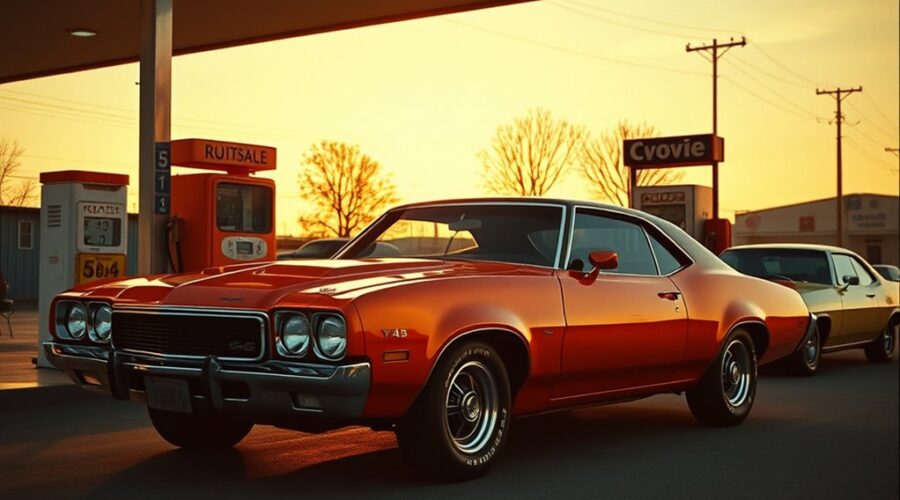
The 1970s stood at a turning point for automotive design, when performance, regulation, and fuel economy collided. Muscle cars like the Camaro and Mustang still carried cultural weight, yet sharper lines, bolder graphics, and smaller engines signaled a new direction. The oil crisis forced manufacturers to rethink speed and size, setting up a decade whose influence still shapes what followed.
What Defined 1970s Car Design?
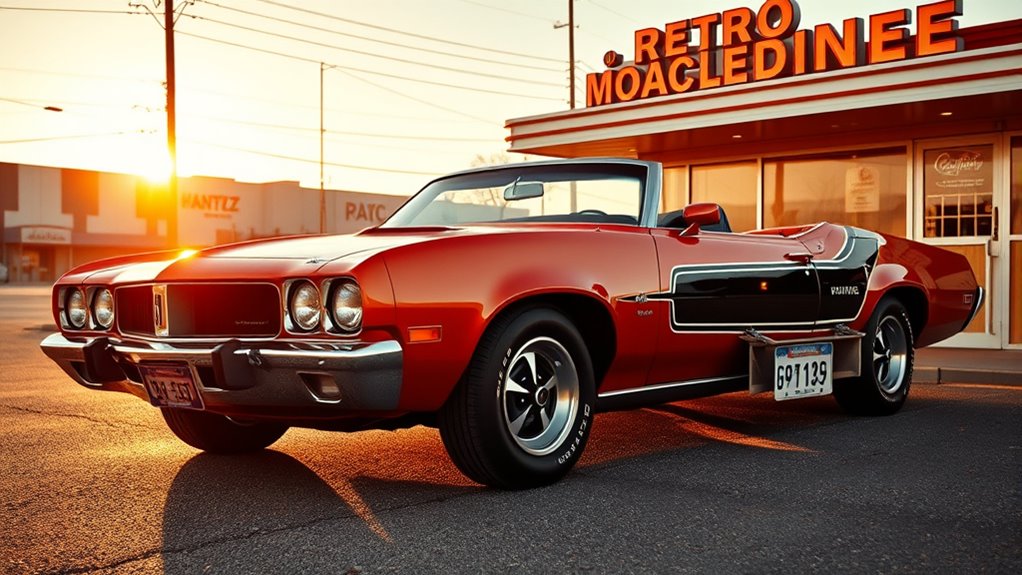
1970s car design was defined by a tension between performance, regulation, and economy, as automakers balanced the appeal of muscle cars such as the Ford Mustang and Chevrolet Camaro with rising demands for safety and fuel efficiency.
Aerodynamic design gained importance, but styling still favored aggressive styling, long hoods, and pronounced grilles that signaled power. Government mandates pushed safety features forward, most visibly through energy-absorbing bumpers and improved seat belts.
Aerodynamic design rose in importance, yet aggressive lines and bold grilles still projected power.
At the same time, oil shocks forced manufacturers to prioritize fuel efficiency, leading to smaller, lighter compact cars and more practical engineering. Environmental concerns also shaped the period, encouraging experimentation with alternative fuels and subcompact formats.
The result was not a retreat from freedom, but a redefinition of it: performance remained desirable, yet now it had to coexist with regulation, resource limits, and a broader awareness of responsibility.
Iconic 1970s Cars That Shaped the Decade
A handful of models came to define the decade, each reflecting a different response to the same shifting pressures of performance, regulation, and fuel economy.
In the 1970s, American muscle cars still carried cultural force, with the Chevrolet Camaro and Ford Mustang serving as benchmark names. Their powerful V8 engines and bold stance expressed speed as a form of personal refusal.
Yet safety regulations and the oil crisis altered expectations, forcing manufacturers to reconsider size, weight, and restraint. The 1974 Ford Mustang II marked that adjustment, while luxury performance cars such as the Porsche 911 showed that refinement and urgency could coexist.
Design trends also moved toward angular shapes, bright graphics, and sharper surfaces, visible in the Pontiac Trans Am and related models.
Together, these cars traced a decade of tension between indulgence and limitation, preserving freedom through form even as the market demanded compromise.
How Muscle Cars, Sports Cars, and Luxury Cars Evolved
As the decade progressed, the automobile landscape diverged into three distinct paths: American muscle cars reached a final, forceful peak before regulatory and economic pressures curbed their excess.
European sports cars gained stature through balance and precision, and luxury cars increasingly turned toward comfort and technology.
In automotive history, iconic models such as the Ford Mustang Boss 351 and Chevrolet Camaro Z28 embodied muscle cars with potent V8 engines and assertive design trends.
Meanwhile, sports cars like the Porsche 911 and Ferrari 365 GTB/4 advanced the era’s ideals of handling, aerodynamic form, and driver control.
Luxury cars, including the Cadillac Eldorado and Lincoln Continental, embraced advanced technology, spacious interiors, and refined amenities.
Safety innovations, including seat belts and crash testing standards, shaped engineering across segments.
How the Oil Crisis Changed Car Design?
The 1973 oil crisis abruptly redirected automotive design toward efficiency, compelling manufacturers to replace the era’s appetite for large, powerful engines with smaller, more economical alternatives.
In 1970s cars, consumer demand shifted quickly as gas prices rose and supply tightened, leaving muscle cars less attractive and compact models far more desirable. Automakers answered with vehicles such as the Honda Civic and Volkswagen Rabbit, proving that fuel efficiency could coexist with usable performance.
Foreign makers, especially Japanese brands, gained momentum because their reliability and mileage aligned with new priorities. At the same time, government regulations, including CAFE standards, forced manufacturers to treat economy as a measurable obligation rather than a marketing slogan.
These pressures reshaped design trends, replacing flamboyant forms with aerodynamic shapes and reduced mass. In automotive history, the oil crisis marked a decisive break: freedom increasingly meant mobility achieved with less fuel, less waste, and less dependence on excess.
Why 1970s Car Design Still Matters Today?
1970s car design still matters because it established a lasting template for how automakers balance style, regulation, and market demand. In the 1970s, car design shifted toward angular forms and bold colors, reflecting consumer preferences for individuality while acknowledging tighter rules.
The oil shock accelerated fuel efficiency priorities, pushing compact proportions, lighter bodies, and cleaner aerodynamics into mainstream practice. Iconic models such as the Ford Mustang II and Chevrolet Camaro preserved muscle cars’ appeal while adapting to safety features and emissions limits, proving that performance could survive constraint.
Their performance legacy remains visible in modern vehicles that seek freedom through efficiency, control, and visual distinction. Contemporary automotive trends still borrow from retro aesthetics, using familiar cues to evoke emotion and identity.
For designers, the decade remains a case study in disciplined innovation, showing how liberation in driving can emerge from necessity rather than excess.
Frequently Asked Questions
What Are the Top Three Trends in the Automotive Industry?
Three trends dominate: fuel efficiency and sustainability efforts, safety innovations with technology integration, and design evolution balancing performance upgrades, retro styling, electric vehicles, consumer preferences, and expansion into international markets.
What Truck Will Last 500,000 Miles?
Toyota Tundra and Ford F-250 are strongest bets; one statistic: well-kept fleet Silverado units can surpass 500,000 miles. Durability ratings, Maintenance tips, Engine longevity, Fuel efficiency, Truck models, Owner testimonials, Warranty comparisons, Repair costs, Resale value, Technology features.
What Color Car Is the Hardest to Sell?
Orange and purple cars are often the hardest to sell, according to car color psychology and resale value factors; buyer preferences, market demand shifts, and color popularity trends favor neutrals, while regional color differences, seasonal color trends, luxury car colors, vintage car colors, and color impact perceptions persist.
What Are the Latest Trends in Car Design?
Like a wind-tuned prism, today’s car design favors electric vehicles, minimalist interiors, sustainable materials, retro aesthetics, autonomous technology, bold colors, smart features, aerodynamic shapes, urban mobility, and customizable options, enabling cleaner, freer, more adaptable movement.
Conclusion
To sum up, 1970s cars represented a pivotal shift in automotive history, where style, performance, and practicality were forced into a new balance. Iconic models such as the Camaro and Mustang captured the era’s spirit, while the oil crisis and regulation reshaped design priorities toward efficiency and safety. Like a bridge between excess and restraint, the decade’s cars helped define modern automotive thinking and continue to influence vehicle design today.