
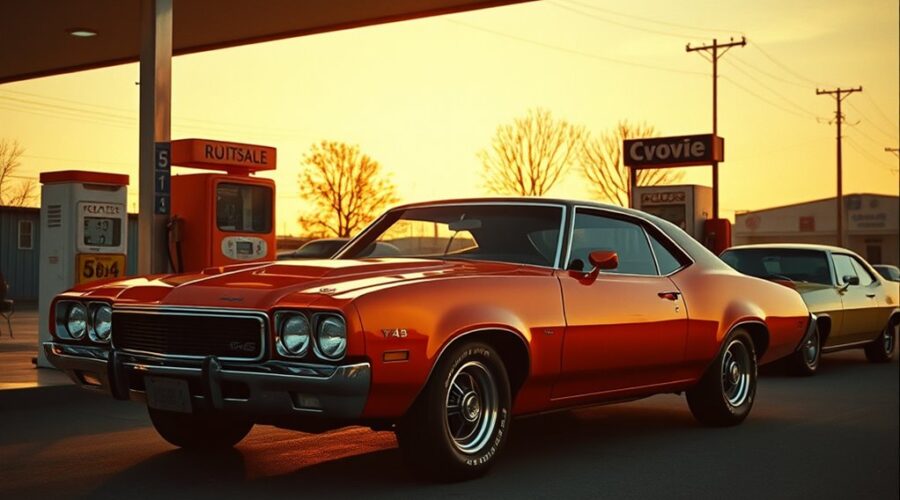
1970s cars shifted from long-hood muscle styling toward smaller, lighter and more angular designs as safety rules, emissions limits and the 1973–1974 oil crisis changed what automakers built. This guide covers the main design trends, the iconic models and why the decade still matters.
Quick Answer
1970s car design shifted from the long-hood muscle-car look toward smaller, lighter, and more angular vehicles as safety, emissions, and fuel-economy pressures grew. The change was uneven: big luxury cars and performance models survived, while compacts, hatchbacks, impact bumpers, and wedge-shaped sports cars became increasingly important.
What Defined 1970s Car Design?
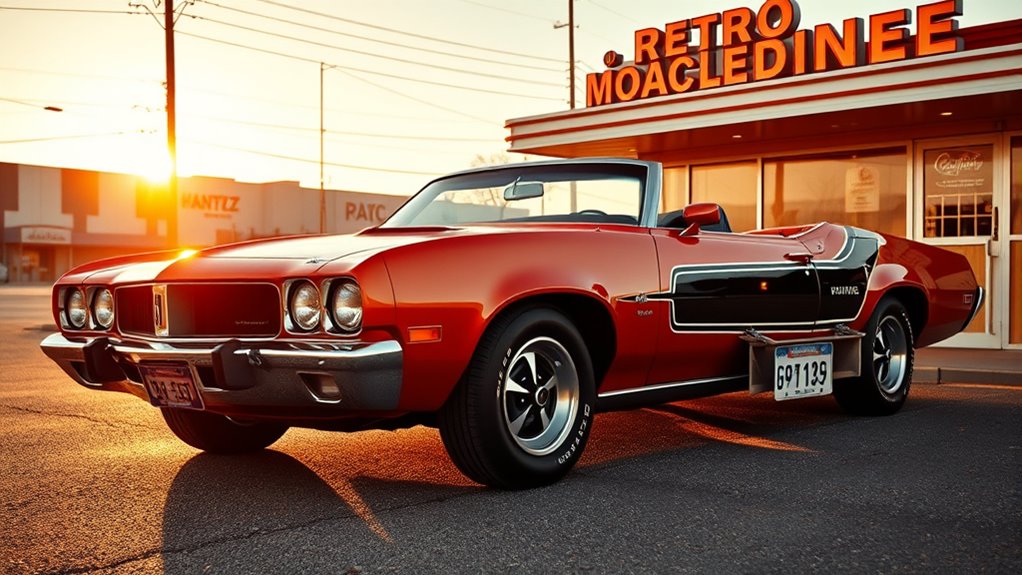
1970s car design was defined by contrast. Traditional American cues such as long hoods, prominent grilles, vinyl roofs, and muscular proportions remained visible, while European designers pushed lower, sharper, more geometric forms. The Petersen Automotive Museum describes the period as a major move away from earlier curves and excess toward angular silhouettes, faceted planes, and wedge-shaped bodies.
That styling shift did not happen everywhere at once. Many family and luxury cars remained upright and boxy, while sports cars and concepts explored dramatic wedge forms. Bright striping, hood graphics, spoilers, blacked-out trim, and contrasting body details also became strong visual signatures on performance cars.
Regulation changed appearance as much as fashion did. NHTSA’s original bumper standard, effective September 1, 1972, required passenger cars to protect specified safety-related components in a 5 mph front and 2.5 mph rear barrier impact. Automakers often answered with stronger, more projecting bumper systems, which became one of the easiest ways to recognize a U.S.-market 1970s car.
Emissions rules also changed engineering under the sheet metal. The EPA’s transportation timeline notes that first-generation catalytic converters appeared in 1975 and that unleaded gasoline was introduced because lead damaged catalysts. Those systems affected engine tuning, fuel requirements, packaging, and the balance between power and drivability.
| Pressure | Design response | Visible result |
|---|---|---|
| Safety rules | Stronger bumper systems and restraint requirements | Larger impact bumpers and revised front/rear styling |
| Emissions rules | New emissions-control hardware and engine calibration | Catalytic converters, unleaded-fuel systems, and changing powertrains |
| Fuel costs | More attention to weight, engine size, and packaging | Greater interest in compact cars and hatchbacks |
| Styling trends | Sharper lines and simplified surfaces | Wedge profiles, angular hatchbacks, and graphic-heavy performance models |
Iconic 1970s Cars That Shaped the Decade
No single car represents the whole decade because 1970s automotive design moved in several directions at once. The Chevrolet Camaro and Ford Mustang carried the muscle and pony-car image forward, while the Honda Civic, Volkswagen Golf, and Porsche 911 showed how efficiency, packaging, safety, and performance were being rethought.
- Chevrolet Camaro: The second-generation car kept the long-hood, short-deck performance formula alive with a lower, more sculpted shape. Later versions added increasingly bold graphics, spoilers, and bumper treatments.
- Ford Mustang II: The 1974 redesign made the Mustang smaller and more economy-minded than the large 1971–1973 cars. It became a clear symbol of Detroit’s move toward more compact products.
- Honda Civic: Honda began U.S. Civic sales in 1973. After the oil crisis, buyers placed more value on practicality and fuel economy, and Honda credits that shift with helping the Civic gain momentum. Its CVCC technology also addressed strict U.S. emissions requirements.
- Volkswagen Golf/Rabbit: The first Golf entered production in 1974 with a transverse front engine, front-wheel drive, practical hatchback packaging, and an angular body designed by Giorgetto Giugiaro and Volkswagen Design. Volkswagen describes the change from Beetle to Golf as a move from round forms to an angular new layout.
- Porsche 911: The 1974-model G-Series showed how a familiar sports-car shape could adapt to regulation. Porsche says its bellows-style bumpers were designed to meet U.S. impact requirements without abandoning the 911 silhouette.
- Pontiac Trans Am: Large hood graphics, spoilers, shaker-style hood details, and strong color-and-stripe combinations made the Trans Am a lasting example of how graphics became part of the body design itself.
These cars also show why the decade cannot be reduced to “slow, boxy cars.” The period produced conservative sedans, flamboyant personal-luxury coupes, practical hatchbacks, and radical sports-car shapes at the same time.
How Muscle Cars, Sports Cars, and Luxury Cars Evolved
Muscle, sports, and luxury cars did not disappear in the 1970s, but their priorities changed. Muscle cars lost some of the raw power emphasis of the late 1960s, sports cars put more attention on handling and aerodynamics, and luxury models added comfort and electronic features even while fuel economy became harder to ignore.
Muscle and Pony Cars
Early-decade models such as the Ford Mustang Boss 351 and Chevrolet Camaro Z28 still represented the traditional formula: a dramatic coupe body, rear-wheel drive, and strong engine performance. As emissions rules, insurance costs, and fuel concerns grew, manufacturers increasingly sold the look of performance through stripes, spoilers, hood treatments, wheels, and trim even when engine output was less extreme.
The Mustang II represented the clearest visual break. Its smaller proportions traded some of the earlier Mustang’s road presence for easier packaging and better alignment with a market that was becoming more sensitive to fuel use.
Sports Cars
European sports cars kept performance alive through different ideas. The Ferrari 365 GTB/4 carried its low, fast grand-touring shape into the early 1970s, while newer wedge designs pushed sharp noses, steep windshields, and geometric side profiles. The Porsche 911 followed another path by preserving its recognizable rounded silhouette while steadily updating bumpers, comfort, engines, and turbocharging.
The Porsche 911 Turbo, introduced during the decade, is a useful reminder that efficiency pressures did not end high-performance engineering. Instead, the 1970s widened the range of solutions designers used to create speed.
Luxury Cars
American luxury cars such as the Cadillac Eldorado and Lincoln Continental continued to favor long bodies, formal roofs, plush interiors, and visual presence. Their design language remained intentionally different from compact imports.
At the same time, technology became a stronger part of the luxury story. Power accessories, more advanced audio systems, electronic displays, and convenience features began to share attention with chrome, upholstery, and exterior size. That split between traditional luxury and more technology-led luxury became increasingly important in later decades.
How Did the Oil Crisis Change Car Design?
The 1973–1974 oil crisis accelerated a shift toward fuel-efficient cars, but it did not single-handedly create 1970s design trends. Some compact-car programs were already underway. What the crisis changed most quickly was buyer demand: fuel economy, operating cost, and practical size became much harder to ignore.
During the Arab oil embargo, petroleum exports to the United States were restricted and oil production was cut. The U.S. State Department’s history of the 1973–1974 embargo records fuel shortages, long gas lines, and oil prices that first doubled and then quadrupled. That environment made smaller cars more attractive and weakened the assumption that bigger engines and heavier bodies were always better.
Japanese manufacturers were well positioned because they already offered compact, fuel-conscious cars. Honda’s own history says U.S. buyers who had favored large luxury cars began placing more value on practicality and fuel efficiency after the first oil crisis. Domestic manufacturers also pushed harder into smaller segments, with cars such as the Chevrolet Chevette reflecting the same market pressure.
Government policy made the efficiency shift longer-lasting. The U.S. Department of Energy notes that the 1975 Energy Policy and Conservation Act established Corporate Average Fuel Economy standards, with requirements for on-road vehicles beginning in model year 1978. Fuel economy was no longer only a selling point; it had become a fleet-level regulatory target.
Why Does 1970s Car Design Still Matter Today?
1970s car design still matters because the decade established several ideas that remain familiar today: compact hatchback packaging, sharper geometric surfaces, visible aerodynamic thinking, regulated crash protection, and the need to balance performance with fuel use and emissions. Modern cars use far more advanced technology, but the design problem is similar.
The decade also proved that regulation does not produce only one visual answer. Porsche adapted the 911’s bumpers without abandoning its core shape. Volkswagen used an all-new angular hatchback form to replace the Beetle. American manufacturers mixed downsizing with luxury and performance cues rather than simply making every car look alike.
Retro design continues to borrow from the period because the 1970s created such distinct visual signatures. Wedge silhouettes, black trim, bold striping, flat surfaces, squared-off details, and reinterpretations of classic pony-car proportions still appear in concept cars and production vehicles.
For designers and enthusiasts, the decade is most useful as a study in adaptation. It shows how styling changes when fuel supply, regulation, engineering, and consumer taste all move at once.
Compare the decade with its neighbours in our guides to 1980s cars and 1990s cars, or see how a small-car icon was built in the classic Mini Cooper guide.
Frequently Asked Questions
What are the main features of 1970s car design?
The main features include angular body lines, wedge-shaped sports cars, long-hood performance coupes, bold graphics, larger impact bumpers, and growing use of compact hatchback packaging. The decade was transitional, so traditional luxury styling existed alongside much sharper and more practical designs.
Why did many 1970s cars have large bumpers?
Many 1970s U.S.-market cars had large bumpers because federal rules required passenger cars to protect specified safety-related components during low-speed impacts. Automakers often met those requirements with stronger, projecting bumper assemblies, which changed the proportions of front and rear styling.
Did the 1973 oil crisis end muscle cars?
No. The oil crisis accelerated demand for better fuel economy, but muscle-car performance was already being reshaped by emissions rules, insurance costs, and changing market conditions. Performance models continued, although many relied more heavily on styling, handling, and smaller or detuned engines than earlier muscle cars.
Which cars best represent 1970s design?
Representative examples include the Chevrolet Camaro, Ford Mustang II, Pontiac Trans Am, Honda Civic, Volkswagen Golf, and Porsche 911. Together they show the decade’s mix of muscle-car styling, compact efficiency, hatchback practicality, safety-driven changes, and evolving sports-car design.
Conclusion
1970s cars sit between two eras. They began with much of the size, power, and visual drama of the 1960s, then absorbed new safety rules, emissions hardware, fuel shortages, and efficiency standards. The result was not one design style but a decade of rapid experimentation whose compact layouts, angular forms, graphics, and performance solutions still influence cars today.
Sources
- Petersen Automotive Museum: 1970s wedge styling and angular design trends.
- National Highway Traffic Safety Administration: early-1970s federal bumper requirements.
- U.S. Environmental Protection Agency: Clean Air Act milestones, catalytic converters, and unleaded gasoline.
- U.S. Department of State, Office of the Historian: the 1973–1974 oil embargo and fuel shortages.
- U.S. Department of Energy: the 1975 Energy Policy and Conservation Act and CAFE standards.
- Honda Global: Civic sales, the oil crisis, CVCC, and fuel economy.
- Volkswagen Newsroom: Golf production, layout, and angular design.
- Porsche Newsroom: 911 G-Series bumper design and 1970s development.





[…] reading with our guides to 1970s cars and 1990s cars, or dig into the BMW E30 specs for a closer look at one of the decade’s […]
[…] More movie-car guides: the Supra in Fast and Furious and the Mustang in Fast and Furious 3. For the era of the Nova itself, see our guide to 1970s cars. […]