

The Volkswagen ID. R is a fully electric prototype built for record-setting runs rather than conventional racing. It uses a dual-motor powertrain rated at 680 hp and 650 N⋅m of torque, paired with a carbon monocoque chassis and a curb weight below 1,100 kg. Its 0 to 60 mph time is 2.25 seconds, but the numbers only begin to explain what made this machine significant.
What Is the Volkswagen ID. R?
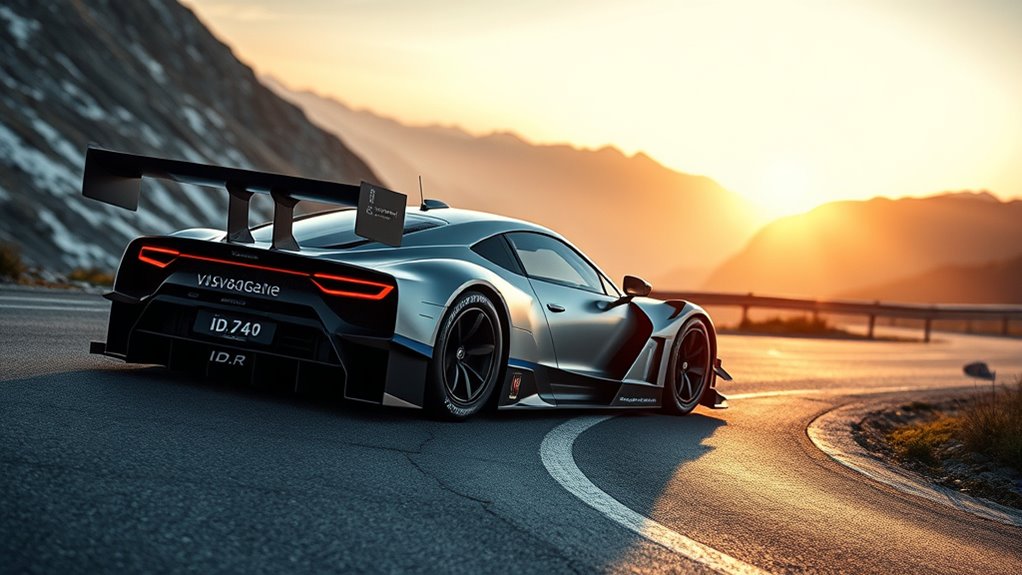
The Volkswagen ID. R is a fully electric prototype race car developed by Volkswagen Motorsport to demonstrate the capabilities of electric mobility in elite competition.
Built as a purpose-designed machine rather than a road vehicle, the Volkswagen ID.R combines a carbon monocoque chassis with aggressive aerodynamic packaging, including a large rear wing that supports stability at high speed.
Its layout prioritizes low mass, structural rigidity, and efficient airflow, producing a machine engineered for performance without dependence on internal combustion. At under 1,100 kg, it achieves a notable power-to-weight advantage that supports rapid acceleration and precise control.
The car also serves as a technical statement of liberation from conventional drivetrain limits, showing how electric engineering can redefine motorsport benchmarks.
A technical statement of liberation from drivetrain limits, redefining what electric engineering can achieve in motorsport.
Its record-setting runs at Pikes Peak and the Nürburgring Nordschleife confirm its status as a reference point in modern racing.
Volkswagen ID. R Powertrain Specs
The Volkswagen ID. R uses a dual-motor electric powertrain that produces a combined 500 kW, or about 680 horsepower, and 650 N⋅m of torque.
Energy is supplied by a single 45-kWh lithium-ion battery, supporting rapid acceleration and high output delivery.
An all-wheel-drive layout distributes this power to maximize traction, while the lightweight chassis helps keep total mass under 1,100 kg.
Dual-Motor Powertrain
Beneath its streamlined body, the Volkswagen ID. R uses a dual-motor powertrain, with one electric motor driving each axle. This arrangement creates all-wheel-drive traction, improving stability on uneven surfaces and allowing the car to put power down with minimal waste.
The system is paired with a single 45-kWh lithium-ion battery, selected for efficient energy delivery during racing duties. Together, the components form a compact layout that supports rapid response and controlled torque distribution.
The combined output reaches 650 N⋅m of torque, giving the car immediate thrust from rest. In testing, the ID. R has reached 60 mph in 2.25 seconds, reflecting the effectiveness of its motor pairing, battery management, and chassis integration for liberated, high-precision performance.
500 kW Output
With the dual-motor layout already establishing the ID. R, Volkswagen’s electric prototype reaches a combined 500 kW output, or about 670 horsepower.
The fully electric car designed under the Volkswagen I.D program uses two electric motors, one per axle, to deliver balanced traction and immediate response.
Peak torque of 650 N⋅m supports 0 to 60 mph in 2.25 seconds, a figure that underlines its liberation from conventional lag.
As an electric vehicle, it also employs regenerative braking to recover energy during hard deceleration.
This power figure helped the machine set reference pace at the Nürburgring Nordschleife, Pikes Peak International Hill climb, and the Goodwood Festival of Speed, where its low mass and power density proved decisive.
Battery And Drive Layout
At the core of the Volkswagen ID. R is a single 45-kWh lithium-ion battery, selected to balance energy density, mass, and thermal control for competition use.
The pack supports dual electric motors that together produce 500 kW, or about 680 horsepower, while delivering 650 N⋅m of peak torque. This configuration feeds an all-wheel-drive layout, with power sent to both axles for superior traction and stability under extreme load.
The system enables 0 to 60 mph in 2.25 seconds, a figure that reflects immediate torque delivery and efficient energy deployment.
In racing terms, the battery and drive arrangement prioritizes responsive propulsion, precise control, and the freedom to exploit maximum acceleration without sacrificing composure in high-speed corners or changing surface conditions.
Volkswagen ID. R Dimensions and Weight
The Volkswagen ID. R presents dimensions that support a highly compact, race-oriented footprint. Its body measures 5,219 mm in length, 2,350 mm in width, and 979 mm in height, giving it a low, wide stance suited to controlled track use.
The 2,850 mm wheelbase aids stability, while the low profile reduces aerodynamic resistance and supports efficient weight distribution across the chassis.
- Length: 5,219 mm, extending overall balance.
- Width: 2,350 mm, maximizing lateral confidence.
- Height: 979 mm, lowering the center of gravity.
- Weight: under 1,100 kg, preserving agility and responsiveness.
The carbon monocoque structure keeps mass low without sacrificing rigidity, reinforcing the vehicle’s technical efficiency.
The carbon monocoque keeps weight low and rigidity high, strengthening the ID. R’s technical efficiency.
Combined with an aerodynamic shape designed for high downforce and minimal drag, these proportions help the ID. R translate liberated motion into precise, disciplined performance on demanding circuits.
Volkswagen ID. R Battery, Chassis, and Suspension
The Volkswagen ID. R uses a single 45-kWh lithium-ion battery pack to supply its dual electric motors, supporting a combined 500 kW and 650 N⋅m output.
Its chassis is built around a lightweight carbon monocoque reinforced with a steel roll cage, keeping total mass below 1,100 kg.
Suspension duties are handled by a double wishbone layout, with carbon fiber brakes and race-oriented tires contributing to grip, stability, and braking performance.
Battery Pack Layout
Built around a single 45-kWh lithium-ion battery pack, the Volkswagen ID. R allocates energy to twin motors with a measured 500 kW output.
Battery Efficiency is supported by compact packaging and low vehicle mass, enabling controlled discharge under extreme track demand. The layout serves a machine engineered for liberation through speed, not excess.
- Pack capacity: 45 kWh
- Motor output: 500 kW
- Vehicle mass: under 1,100 kg
- Power-to-weight ratio: 0.28
This arrangement favors consistent current delivery, rapid acceleration, and stable thermal behavior during repeated full-load runs.
The battery system complements the car’s aerodynamic mission, allowing performance to remain focused, efficient, and technically direct.
Chassis And Suspension
Carbon and steel define the Volkswagen ID. R. Its carbon monocoque chassis, reinforced by a steel roll cage, combines low mass with high crash integrity, supporting the demands of endurance-style sprint racing.
The layout houses a single 45-kWh lithium-ion battery, positioned for efficient energy delivery and balanced weight distribution. Double wishbone suspension controls wheel motion with precision, improving camber management, cornering stability, and response at extreme speeds.
Suspension tuning is calibrated for rapid load transfer and minimal compliance loss, allowing the car to remain composed over aggressive surfaces. Carbon fiber braking elements improve thermal resistance and fade control.
Bridgestone Potenza and Michelin Pilot Sport GT SLICK tires complete the package, maximizing grip and enabling controlled freedom through technical racing environments.
Volkswagen ID. R Aerodynamics and Braking
Aerodynamic efficiency is central to the Volkswagen ID. R, where a large rear wing and tightly sculpted bodywork generate high downforce with minimal drag, supporting Aerodynamic Stability at speed.
The lightweight carbon monocoque further reduces mass, helping the chassis respond cleanly to airflow loads and cornering forces.
The lightweight carbon monocoque trims mass, sharpening chassis response to airflow loads and cornering forces.
Braking hardware is equally purposeful: regenerative braking recovers energy during deceleration, while carbon fiber brakes deliver repeatable stopping force for severe race conditions.
- Large rear wing for downforce
- Streamlined bodywork for low drag
- Carbon monocoque for rigid lightness
- Regenerative and carbon fiber braking
This configuration enables a controlled, efficient platform suited to liberation through precision, allowing the driver to exploit velocity without surrendering stability.
On demanding courses such as the Nürburgring and Pikes Peak, the system prioritizes composure, energy recovery, and braking authority over excess complexity.
Volkswagen ID. R Performance and 0–60 Time
Powered by dual electric motors, the Volkswagen ID. R produces a combined 500 kW, or about 670 hp, and 650 N⋅m of torque. That output, paired with a total mass below 1,100 kg, gives the car an exceptionally favorable power-to-weight ratio.
The result is a 0–60 mph time of 2.25 seconds, a figure that places it among the quickest electric competition machines ever built. Acceleration remains immediate and linear, with no shift interruptions and minimal mechanical delay. Top speed is rated at 170 mph, reinforcing its broad performance envelope.
This level of response reflects Electric Innovation applied with disciplined engineering, where propulsion is used to maximize speed, control, and driver confidence.
In technical terms, the ID. R translates electrical energy into forward motion with remarkable efficiency, delivering performance that is both measurable and liberated from the limitations of conventional combustion systems.
Volkswagen ID. R Track Records and Lap Times
The Volkswagen ID. R established benchmark track results, beginning with its 2018 Pikes Peak International Hill Climb record of 7:57.148, the first sub-8-minute electric run on that course.
It later posted a Nürburgring Nordschleife electric lap of 6:05.336 on June 3, 2019, while also recording a 39.90-second Goodwood Festival of Speed hillclimb and a 7:38.585 ascent at Tianmen Mountain.
These times illustrate the prototype’s high-efficiency power delivery, rapid transient response, and sustained performance under diverse circuit and hillclimb conditions.
Pikes Peak Record Run
At Pikes Peak International Hill Climb on June 24, 2018, Volkswagen ID. R delivered Electric Innovation through a record ascent in 7:57.148, the first electric vehicle under eight minutes. Its run reflected controlled efficiency and technical freedom on a course defined by altitude, hairpins, and steep gradients.
- Dual motors produced 680 horsepower.
- Torque output reached 650 Nm.
- Carbon monocoque mass stayed under 1,100 kg.
- Average speed held at 150.9 km/h.
The chassis and aerodynamics, including a large rear wing, were calibrated for downforce, traction, and stability.
The result was a precise demonstration of how lightweight structure and electric propulsion can convert mountain adversity into measurable performance.
Nürburgring Lap Achievement
On June 3, 2019, Volkswagen ID. R completed Nürburgring in 6:05.336, establishing the fastest electric-vehicle lap on the circuit and producing clear Record Impact.
| Metric | Value | Significance |
|---|---|---|
| Lap time | 6:05.336 | Circuit benchmark |
| Power | 680 hp | Strong acceleration |
| Torque | 650 Nm | Corner-exit drive |
Its 680-horsepower electric powertrain and 650 Nm output supported sustained pace, while a large rear wing and carbon monocoque chassis improved stability and grip. The lap implied an average speed of about 157.9 km/h, a demanding figure on a technically severe course. The result confirmed the ID. R as a reference point for electric motorsport and demonstrated that liberated, high-performance mobility can be engineered with precision, efficiency, and competitive authority.
Goodwood And Tianmen Times
Volkswagen ID. R delivered Record Highlights at two demanding venues, proving an electric race car could challenge traditional performance hierarchies.
Its Goodwood Festival of Speed Hillclimb run in 2019 stopped the clock at 39.90 seconds, a benchmark built on rapid torque delivery, low mass, and high downforce.
At Tianmen Mountain, on September 2, 2019, it climbed the route in 7:38.585, sustaining control on steep, technical pavement.
- Goodwood time: 39.90 seconds
- Tianmen time: 7:38.585
- Date of Tianmen ascent: September 2, 2019
- Core enablers: electric powertrain and aerodynamics
These results reinforced Volkswagen’s engineering strategy: validate liberation from combustion limits through measurable, competitive electric mobility.
Volkswagen ID. R Media Features and Awards
Media exposure helped cement the Volkswagen ID. R as a reference point for electric performance and Media Recognition in motorsport discourse.
Top Gear, season 28, episode 5, presented its acceleration and stability in a controlled television format, translating laboratory-grade engineering into accessible observation.
Top Gear’s controlled format made the ID. R’s acceleration and stability legible beyond the test track.
In digital culture, appearances in V-Rally 4, Forza Horizon 4, and Gran Turismo 7 extended visibility to simulation audiences, where the car’s handling model reinforced its technical reputation.
Award recognition followed in 2018 with the Dewar Trophy, granted for its electric motors and their contribution to innovation in electric mobility. That distinction aligned with the car’s 2019 Nürburgring Nordschleife record lap, where it reached 273 km/h.
Volkswagen then announced the I.D. R Evo in February 2020, signaling continued development of the platform.
Together, these milestones show a vehicle that advanced engineering freedom through public documentation, competition results, and institutional acknowledgment.
Volkswagen ID. R Tires and Race Setup
Tire choice and chassis layout were central to the Volkswagen ID. R. Tire Selection paired Bridgestone Potenza 330-40/18 and Michelin Pilot Sport GT SLICK 31/71-18 compounds with race-focused setup demands, matching surface conditions and load transfer.
The carbon monocoque reduced mass and sharpened response, letting the suspension work with minimal delay. Its double wishbone geometry maintained consistent camber control and lateral grip, supporting stable cornering under high aerodynamic load.
The large rear wing added downforce, increasing tire contact and enabling freer exploitation of available traction. Regenerative braking further balanced energy recovery with deceleration stability.
- Low-mass chassis structure
- Double wishbone suspension
- High-downforce aerodynamic package
- Race-specific Tire Selection
Together, these elements formed a disciplined platform for competitive running, where mechanical grip, efficiency, and composure were aligned for maximum speed.
Volkswagen ID. R Evo Development
Introduced in February 2020, the ID. R Evo developed as an upgraded derivative of the original electric prototype, built to extend Volkswagen’s motorsport envelope.
Its engineering emphasis centered on aerodynamic refinement and higher efficiency, with revisions intended to reduce drag while increasing stability at speed. The car retained the twin electric motors, preserving a combined output of 680 horsepower and 650 Nm of torque, yet the package targeted quicker lap times through more effective energy deployment and cornering load.
An advanced aero suite, including an adjustable rear wing, enabled downforce to be tuned for track-specific demands. This approach reflected a technical philosophy of liberation from combustion-era limits, using electric drive to reveal new performance freedom.
The Evo program also reinforced Future Innovations in EV racing, while continuing Volkswagen’s record-setting trajectory at venues such as the Nürburgring and Pikes Peak.
Frequently Asked Questions
Which VW ID. Model Is Considered the Best?
The Volkswagen ID.4 is generally considered the best VW ID. model. Model Comparison shows its strong value, spacious interior, and practical range make it the most balanced choice for liberated drivers seeking efficiency and comfort.
Why Is ID 4 so Cheap?
It is cheap because Volkswagen applies Cost Analysis, efficient production, and scale economies to reduce manufacturing expense. A single-motor 282-hp setup limits complexity, enabling lower pricing while preserving accessible electric mobility for budget-conscious consumers.
How Fast Does the VW ID.3 Go From 0 to 60 Mph?
0 to 60 mph arrives in about 7.3 seconds for the single-motor ID.3, while the dual-motor version reaches it in roughly 4.8 seconds, shaped by Acceleration Factors that suggest brisk, clean liberation.
What Is the Fastest Electric Car From Volkswagen?
Volkswagen’s fastest electric car is the ID. R, a record-setting prototype emphasizing Battery Efficiency, extreme aerodynamics, and lightweight engineering, delivering exceptional acceleration, Nürburgring pace, and Pikes Peak dominance for performance-focused drivers seeking liberation.
Conclusion
The Volkswagen ID. R stands as a benchmark in electric prototype racing, combining a twin-motor 680 hp drivetrain, ultra-light carbon construction, and advanced aerodynamics into a remarkably efficient package. Its record-setting runs at Pikes Peak and the Nürburgring confirmed its engineering depth and competitive intent. In motorsport terms, the car is a lightning bolt in carbon fiber: brief, precise, and intensely powerful, leaving a clear legacy in the development of high-performance electric vehicles.


