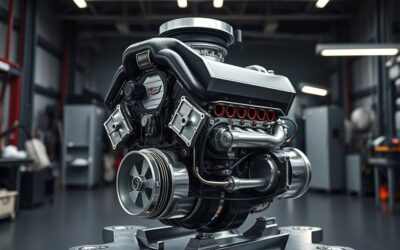
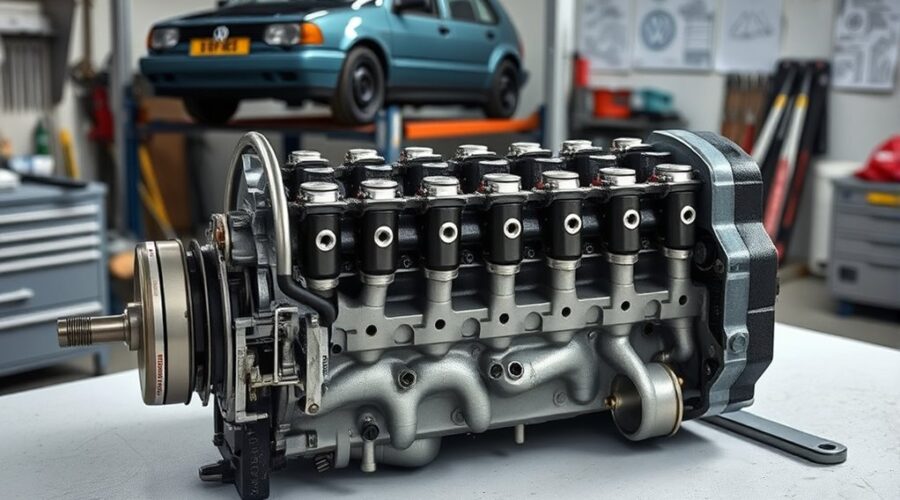
The Volkswagen VR5 engine is a naturally aspirated 2.3-litre five-cylinder engine with its cylinders staggered at a narrow 15-degree angle under a single cylinder head. It was derived from the VR6 and sold in the Golf Mk4, Bora, New Beetle, Passat B5 and SEAT Toledo Mk2. Early AGZ engines made 150 PS and later 20-valve versions made 170 PS, per Volkswagen training material.
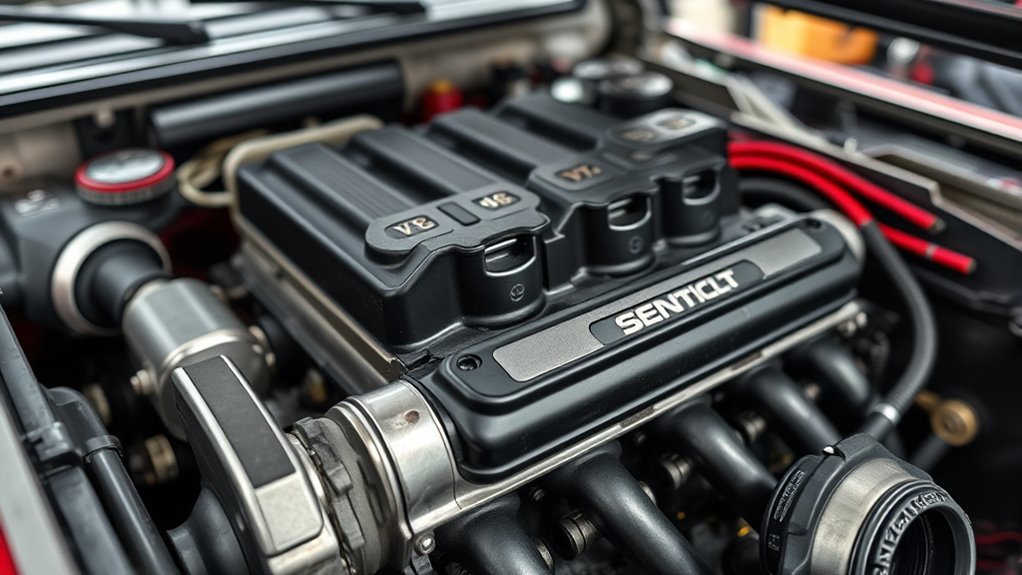
Quick answer
- Layout: five cylinders, 15-degree stagger, one cylinder head.
- Displacement: about 2.3 L (2,324 cc on the AGZ).
- Output: 150 PS (10-valve AGZ), 170 PS (20-valve AZX).
- Firing order: 1-2-4-5-3.
VR5 engine specs
Figures are from Volkswagen Self-Study Programmes 195 and 251. Application-specific figures can differ, so match specs to your engine code.
| Spec | AGZ (10-valve) | AZX (20-valve) |
|---|---|---|
| Displacement | 2,324 cc | 2,326 cc |
| Bore x stroke | 81.0 x 90.2 mm | 81.0 x 90.3 mm |
| Compression ratio | 10.0:1 | 10.75:1 |
| Power | 110 kW / 150 PS at 6,000 rpm | 125 kW / 170 PS at 6,200 rpm |
| Torque | 220 Nm at 3,600 rpm | 225 Nm at 3,200 rpm |
| Firing order | 1-2-4-5-3 | 1-2-4-5-3 |
Volkswagen’s vehicle pages sometimes list different torque for specific cars, for example 205 Nm on some 150 PS applications, so treat the table as engine-level training data.
How the VR5 works
VR is a blend of “V” and Reihenmotor, the German word for inline engine. Volkswagen’s SSP 195 explains the V5 was derived from the VR6 concept by removing one cylinder. The two staggered rows (two and three cylinders) share one head, so the engine is shorter than a straight-five and far narrower than a wide-angle V.
- Packaging: it fit transversely in the Golf, Bora and New Beetle and longitudinally in the Passat B5.
- 20-valve update: four valves per cylinder, camshaft timing control and a revised intake raised output from 150 to 170 PS.
- Vibration control: crankshaft design and firing order manage balance, and manual cars could use a dual-mass flywheel to reduce torsional vibration reaching the gearbox.
Cars that used the VR5
| Model | Installation |
|---|---|
| Volkswagen Golf Mk4 | Transverse |
| Volkswagen Bora | Transverse |
| Volkswagen New Beetle | Transverse |
| Volkswagen Passat B5 | Longitudinal |
| SEAT Toledo Mk2 | Transverse |
Why the VR5 stayed niche
Its packaging was clever, but it gave no decisive performance advantage over Volkswagen’s turbocharged four-cylinders, which offered similar power. Motor1’s history of the engine notes it was largely a European-market engine. For other unusual layouts, see our guides to the Toyota 86 boxer engine and the rotary engine, or how a twin-scroll turbo helps small engines.
Buying a VR5 car: what to check
- Confirm the engine code (AGZ, AQN or AZX) before ordering parts.
- Ask for service history, especially timing chain and cooling system work.
- Parts availability varies by market, so check supply before committing to a project car.
Frequently asked questions
What is the Volkswagen VR5 engine?
It is a 2.3-litre five-cylinder engine with cylinders staggered at 15 degrees under one cylinder head, derived from the VR6 concept.
How much power does the VR5 make?
The early 10-valve AGZ makes 150 PS, and the later 20-valve AZX makes 170 PS, according to Volkswagen training documents.
Which cars have the VR5 engine?
The Volkswagen Golf Mk4, Bora, New Beetle, Passat B5 and SEAT Toledo Mk2 used it.
What does VR mean in VR5?
VR blends V engine and Reihenmotor, the German term for inline engine. It describes narrow, staggered cylinder rows sharing one head.
Is the VR5 the same as an inline-five?
No. Both have five cylinders and a 1-2-4-5-3 firing order, but the VR5’s cylinders are staggered at 15 degrees rather than in one straight line.
What is the VR5 firing order?
The firing order is 1-2-4-5-3, giving evenly spaced combustion events.