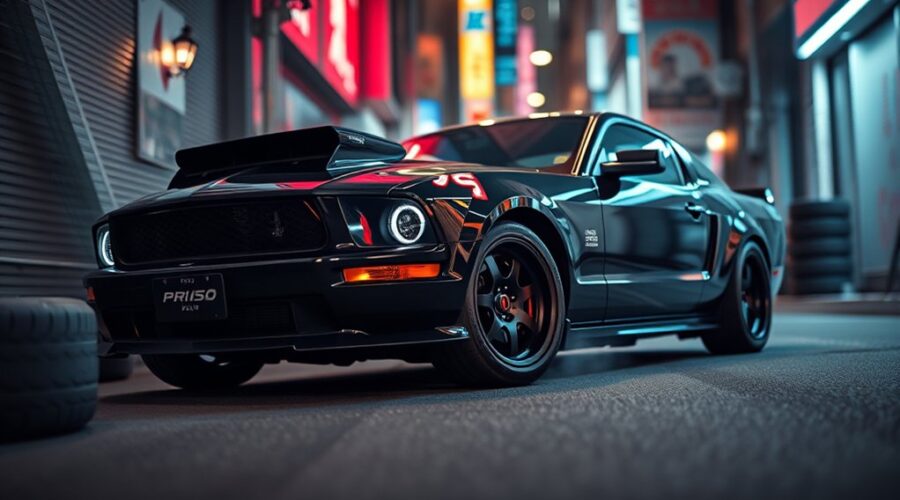
The 1967 Ford Mustang Fastback in *Tokyo Drift* serves as more than a background car. It links Sean Boswell’s story to American muscle while fitting the film’s Japanese tuning culture. The hero car used an RB26 inline-six for visual accuracy, while stunt versions handled the hard drifting. Its build, power, and restoration history make it one of the franchise’s most discussed machines, and the details behind that swap are not as straightforward as they first appear.
Key Takeaways
- The 1967 Ford Mustang Fastback symbolizes Sean Boswell’s heritage and rebuild journey in *The Fast and the Furious: Tokyo Drift*.
- Its hero car used a Nissan RB26 inline-six with a single turbo, producing about 340 horsepower and 264 lb-ft of torque.
- The film’s close-up Mustang was built for visual authenticity, while separate stunt cars with V-8s handled drifting scenes.
- The original Mustang’s 289 Windsor V8 was replaced to fit the movie’s styling and performance requirements.
- After a six-year restoration, the Mustang returned road-ready with a Roush 347 stroker V8 and Tremec TKO600 transmission.
The Mustang’s Role in Tokyo Drift
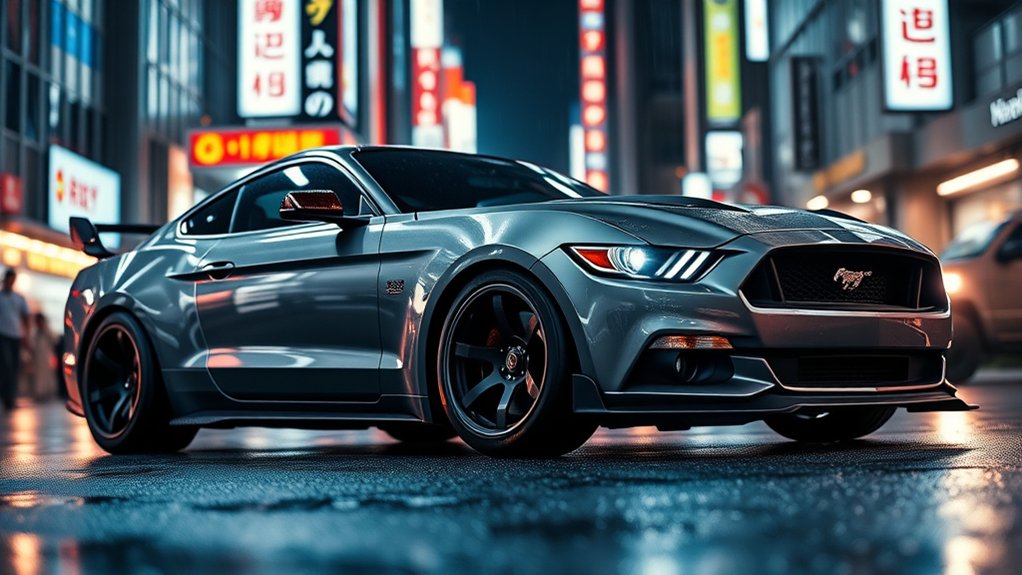
In *Tokyo Drift*, the 1967 Ford Mustang Fastback serves as both a narrative link to Sean Boswell’s past and a technical showcase of the film’s car culture.
In Tokyo Drift, the Mustang is transferred from Sean’s father, making it more than a machine; it is inherited history. At first, it appears unusable, yet Sean and his crew rebuild it, exposing hands-on skill, discipline, and mechanical autonomy.
The car also functions as a cultural bridge, joining Detroit muscle with Japanese tuning practice in a single platform. That hybrid identity mirrors the film’s larger argument: liberation comes through mastery of machinery and rejection of limits.
The Mustang becomes a cultural bridge, fusing Detroit muscle with Japanese tuning into a single, liberated machine.
In the final race, the Mustang stands as a serious competitor to the Drift King, proving its relevance on the street and in the narrative. Its presence gives Tokyo Drift a clear mechanical focus and a distinct symbol of self-directed transformation.
Why the Tokyo Drift Mustang Got an RB26
The Tokyo Drift Mustang received an RB26 inline-six because the film needed a powerplant that matched its Japanese tuning ethos while delivering far more performance potential than a stock Mustang V8.
The Tokyo Drift Mustang, a 1967 Ford, became a deliberate fusion of American muscle and Japanese modification culture, symbolizing mechanical freedom across borders.
The RB26 engine from the Nissan Skyline GT-R was selected for its strong reputation, compact packaging, and tuning headroom, making it a credible upgrade for a cinematic drift car.
A single-turbo setup was used on the film build to solve clearance constraints while preserving serious output.
Sean Morris, who built the car, confirmed the swap and helped dispel rumors about alternative engines such as the SR20 inline-4.
In narrative terms, the choice reinforced the film’s exchange of ideas: a liberated machine, reshaped by precision, not nostalgia.
Tokyo Drift Mustang Engine Specs
The Tokyo Drift Mustang uses a Nissan RB26, a 2.6-liter inline-6 originally developed for the Skyline GT-R, adapted here with a single-turbo setup to fit the Mustang’s engine bay.
It is coupled to an FS530RA 5-speed manual transmission, supporting the car’s performance-oriented build.
Dyno testing recorded output at 340 horsepower at 7300 rpm and 264 lb-ft of torque at 5950 rpm.
RB26 Engine Setup
Under the hood, the Tokyo Drift Mustang was fitted with a 2.6-liter RB26 inline-six engine sourced from the Nissan Skyline GT-R, chosen for its strong tuning potential and high-performance character.
For the film, the RB26 engine used a single-turbo setup instead of the original twin-turbo arrangement, simplifying packaging within the Mustang’s tight engine bay and supporting a cleaner installation.
The swap paired the engine with an FS530RA 5-speed manual transmission, giving the car a direct mechanical connection and a more assertive driving feel.
This combination merged American muscle with Japanese engineering, reflecting the film’s broader theme of cross-cultural exchange and automotive freedom.
The result was a purpose-built performance package, engineered for response, control, and the pursuit of open-road independence.
Dyno Power Numbers
Dyno testing showed the Tokyo Drift Mustang’s RB26 producing 340 horsepower at 7,300 rpm and 264 lb-ft of torque at 5,950 rpm, figures that underscored the engine’s high-revving character and strong tuning potential. The single-turbo layout preserved clearance in the engine bay, supporting airflow and service access.
| Metric | Result |
|---|---|
| Horsepower | 340 hp |
| Torque | 264 lb-ft |
| Peak rpm | 7,300 |
| Setup | Single turbo |
On the dyno, that output placed the car beyond a stock Skyline GT-R, giving the Mustang a freer, sharper response. After filming, the swap to a Roush 347 stroker raised power to 450 horsepower, but the RB26 numbers remain the defining benchmark.
How the Tokyo Drift Mustang Was Built
The Tokyo Drift Mustang began as a 1967 Ford Mustang with a 289 cubic inch Windsor V8.
It then received a twin-turbo RB26 swap from a Nissan Skyline GT-R for the film build.
Sean Morris oversaw the fitment and revised the layout to a single-turbo configuration after clearance constraints emerged in the engine bay.
The car was one of six Mustangs prepared for production, with this unit set up for close-up shots while other builds used V-8 power for stunt work.
Engine Swap And Fitment
| Component | Specification | Effect |
|---|---|---|
| RB26 | 2.6L I6 | Proven power |
| Turbo | Single | Compact fitment |
| Transmission | FS530RA 5-speed | Control |
Misread as an SR20 by some, the confirmed RB26 reinforced the car’s liberated drift identity.
Film Build And Setup
Built by Sean Morris, the 1967 Ford Mustang in *Tokyo Drift* was more than a simple body swap; it was a purpose-built film car centered on an RB26 2.6-liter inline-6 taken from a wrecked Nissan Silvia.
The Mustang was RB26-swapped for visual authenticity and tuned for camera work, not just speed. Clearance problems forced the original twin-turbo layout to become a single-turbo setup, simplifying packaging under the hood.
Dyno testing showed 340 horsepower at 7,300 rpm and 264 lb-ft at 5,950 rpm, giving the chassis enough urgency for controlled drift scenes.
Six or seven Mustangs were built for production, including one close-up car with Skyline power and others fitted with V-8s for stunts.
Stunt Cars vs. the Hero Mustang
A clear division separated the hero Mustang from the drifting machines in *Tokyo Drift*: the 1967 Ford Mustang Fastback was built for close-up shots, visual presence, and character emphasis, while five to six dedicated stunt cars handled the actual drifting. The hero car carried an RB26 engine, but it never drifted on screen; its sound was dubbed, preserving the image of American muscle. The stunt cars used 403 cubic-inch V-8 crate engines and were engineered for punishment, not polish.
| Role | Build | Function |
|---|---|---|
| Hero Mustang | 1967 Fastback | Close-ups |
| Hero car | RB26 swap | Visual presence |
| Stunt cars | V-8 crate power | Drift action |
| Film sound | Dubbed audio | Match scenes |
| Design focus | Aesthetics | Character impact |
This split let the movie present freedom through style and control, while the stunt machines absorbed the demands of speed, angle, and repeated takes.
Tokyo Drift Mustang Performance Facts
Dyno results gave the RB26-swapped 1967 Ford Mustang fastback a documented output of 340 horsepower at 7,300 rpm and 264 lb-ft of torque at 5,950 rpm, placing its performance well above a stock Mustang and even ahead of a stock Nissan Skyline GT-R.
In Tokyo, the build fused American bodywork with Japanese turbo engineering, using a single-turbo RB26 for clearance and packaging while preserving the Mustang silhouette. The result was a mechanically disciplined machine with strong top-end pull, not merely a showpiece.
Although the Mustang appeared in drifting scenes, it did not perform the slides itself; that work came from five to six V-8 stunt cars. The hero Mustang’s measured output confirmed that the swap delivered genuine speed, responsive power delivery, and a liberated identity that crossed borders without diluting its muscle-car character.
What Happened to the Mustang After Filming
After the film wrapped, the 1967 Ford Mustang’s life continued far from the screen, moving from a Southern California enthusiast to a Florida classic car dealer in 2011. Documented as a stunt car, the Mustang was the only example fitted with a Skyline engine for close-up filming, giving the Fast and Furious machine a singular production identity.
In Florida, the car entered a six-year ground-up restoration completed in 2017 by R&A Motorsports. The rebuild replaced and refined major systems while preserving its visual cues and stunt provenance. Power now comes from a Roush 347 cubic inch stroker motor rated at 450 horsepower, paired with a Tremec TKO600 5-speed manual transmission.
The restored Mustang still carries official stunt car branding from the Fast & Furious franchise, keeping its cinematic record intact while returning it to road-ready condition. Its post-film path shows how a movie artifact can remain mechanically serious and historically legible.
Frequently Asked Questions
What Are the Specifications of the Tokyo Drift Mustang?
It uses an RB26 inline-six, single-turbo, 340 horsepower at 7,300 rpm and 264 lb-ft at 5,950 rpm, plus an FS530RA five-speed manual. The restored version carries a Roush 347 stroker, emphasizing Engine performance and Drift mechanics.
What Are the Specifications of the Cars in Tokyo Drift?
Tokyo Drift cars varied widely: tuned imports, V-8 muscle, and drift builds prioritized car performance and drifting techniques. The Mustang used an RB26 inline-six, while stunt cars often ran 403-cubic-inch crate V-8s and manual transmissions.
What Are the Key Features of the Ford Mustang?
Its key features include a RB26 engine swap, 5-speed FS530RA manual, PPG Dark Moss paint, white Shelby stripes, Volk Racing wheels, and Shelby GT500-trim interior. This Mustang history reinforces Racing legacy, performance, and mechanical rebellion.
Is the Mustang From Tokyo Drift Real?
Yes—the Tokyo Drift Mustang is real, a steel-and-fire chimera built for film. Its Mustang authenticity is documented, and its Drift performance came from a purpose-built chassis with authentic stunt-car origins, not mere cinematic illusion.
Conclusion
The Tokyo Drift Mustang stands as a striking contradiction: American body, Japanese heart, and cinematic presence. Its RB26 inline-six gave the hero car visual authenticity, while V-8 stunt builds supplied the sideways violence the camera never fully showed. Restored after years of work, the 1967 fastback remains more than a prop. It is a technical hybrid, a film artifact, and a reminder that in *Tokyo Drift*, identity was built as much as horsepower.