Manual cars use a clutch pedal and a gear lever to let the driver control engine power more directly. That basic design has changed since early synchromesh systems made shifting smoother in the 1920s and 1930s. Today, manuals are less common, yet they still appear in performance models and entry-level cars. Their mechanics, advantages, and decline reveal more than nostalgia, and the details begin to matter quickly.
Key Takeaways
- Manual cars use a clutch pedal and gear stick so the driver selects gears directly.
- Most manuals have five or six forward gears, plus reverse, with synchromesh for smoother shifts.
- Key parts include the clutch, input shaft, countershaft, gear stick, and dog clutches.
- Techniques like rev-matching, double-clutching, and hill starts improve smooth, controlled driving.
- Manuals are now niche, but remain popular in sports cars like the Civic Type R, MX-5 Miata, and Nissan Z.
What Is a Manual Transmission?
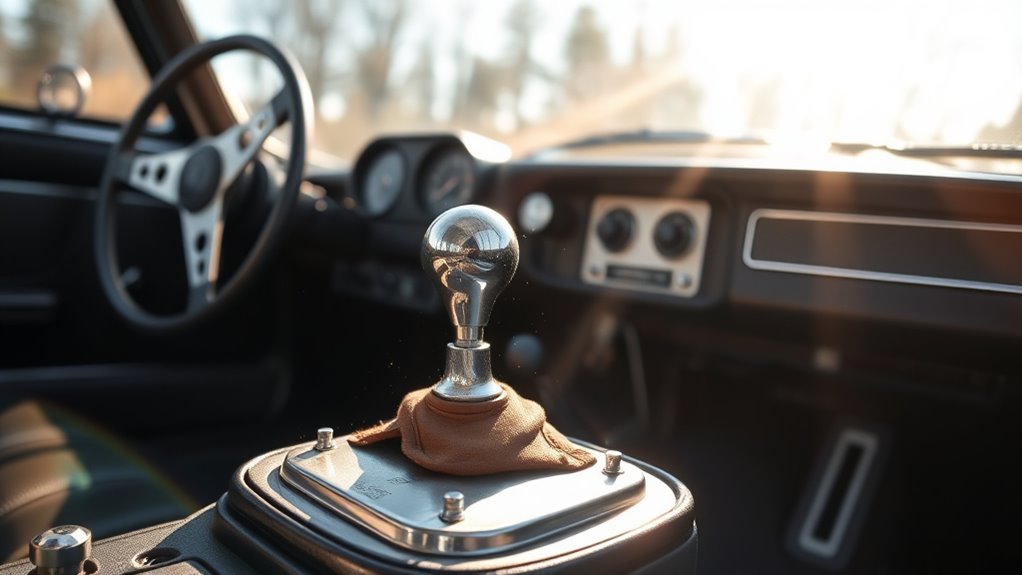
A manual transmission requires the driver to select gears by hand using a gear stick and clutch pedal, typically with five or six forward gears plus reverse. In this layout, the manual transmission gives direct authority over engine speed and road load, reducing dependence on automatic control.
The first synchromesh system, introduced in the 1929 Cadillac, improved gear engagement by preventing gear clashing, making operation smoother and more precise. By the 1990 BMW 850i, the six-speed manual had become a refined option in high-end vehicles, adding closer ratios for efficient use of power.
This setup supports driver engagement, since each shift demands attention and timing. For those seeking liberation from passive motoring, it can create a dynamic driving experience that feels more connected.
Although less common today, manual transmissions remain available in select performance-oriented models for enthusiasts who value control and mechanical involvement.
How a Manual Transmission Shifts Gears
To change gears in a manual transmission, the driver presses the clutch pedal with the left foot to disconnect the engine from the transmission, then moves the gear stick through an H-pattern to select the desired ratio. This mechanical routine gives direct command over gear changes, letting the driver shift gears according to speed, load, and road conditions. The clutch must be coordinated with the accelerator pedals so engine speed matches the next ratio; otherwise, the shift may be harsh or the engine may stall. In a neutral position, all gears are disengaged, and the shafts rotate independently.
| Step | Action | Result |
|---|---|---|
| 1 | Press clutch | Power flow stops |
| 2 | Move gear stick | Ratio chosen |
| 3 | Release clutch | Drive resumes |
| 4 | Match throttle | Smooth engagement |
| 5 | Select neutral position | Transmission disengaged |
This process lets drivers control motion with precision and a sense of mechanical freedom.
Manual Transmission Parts That Matter
The manual gearbox depends on a small set of parts working in precise sequence. In a manual transmission, the clutch connects and disconnects engine torque so shifting can occur without stalling. The gear stick carries the driver’s command into the selector mechanism, choosing a ratio suited to speed or load.
Inside the case, the input shaft turns with the engine when engaged, while the countershaft carries permanently meshed gears that keep power flowing through the box.
- A clutch frees the driveline for each shift.
- A gear stick selects the desired gear path.
- Dog clutches lock a chosen gear to the shaft.
- Neutral leaves shafts free to rotate independently.
Dog clutches are used in constant-mesh designs to secure engagement without grinding. Neutral is essential for starting and for safe changes between ratios.
Together, these parts give the driver direct command over motion, making mechanical control clear, deliberate, and independent of automatic intervention.
Why Enthusiasts Still Prefer Manuals
Enthusiasts often prefer manual transmissions because the direct clutch-and-shifter interaction increases driver engagement and provides finer control over engine output and gear selection.
That mechanical feedback creates a stronger connection between the driver, the drivetrain, and the vehicle’s performance.
In many sports cars, the continued availability of manual options reflects a performance heritage that still values skill, precision, and tactile involvement.
Driver Engagement
Manual transmissions give drivers direct control over gear choice, which creates a stronger sense of involvement and connection to the vehicle, especially in performance models such as the BMW M Series and Mazda MX-5 Miata.
For many automotive enthusiasts, this level of driver engagement defines the driving experience in performance-oriented models. A precise shifter, like the Honda Civic Type R’s, provides tactile feedback that helps create a more satisfying, immersive driving experience.
Techniques such as rev-matching and double-clutching also support skill development, rewarding precision and timing.
Although overall sales have declined, roughly 34 new models still offer manuals in 2024, including the Nissan Z and Subaru WRX.
- Direct gear selection
- Satisfying tactile feedback
- Skill-building techniques
- Continued enthusiast demand
Control And Connection
Direct gear selection gives drivers a higher degree of control over vehicle behavior, which remains a major reason many enthusiasts prefer manual transmissions.
By choosing each gear, the driver shapes the driving experience, manages engine speed, and can use downshifts and rev-matching for precise throttle control and engine braking.
In performance situations, that authority can improve response and stability.
The clutch pedal and shifter also provide tactile feedback, creating a direct mechanical connection that many find more satisfying than automated shifting.
This level of driving engagement helps explain why manual cars retain a niche market, even as sales decline.
For drivers seeking liberation from abstraction, the manual transmission still offers an immediate, hands-on method of interacting with the machine.
Performance Heritage
That sense of control and mechanical feedback has long been tied to a broader performance heritage, where manual transmissions are valued for the way they keep the driver closely involved in the car’s dynamics.
Driving enthusiasts often seek this directness in performance models such as the BMW M2 and Honda Civic Type R, where precise shifts support a more liberated driving experience.
Lightweight sports car designs like the Mazda MX-5 Miata translate that interaction into agile, responsive movement.
Even luxury vehicles such as the Cadillac CT5-V Blackwing preserve the format, proving that power and engagement can coexist.
- Nissan Z manual availability
- Subaru WRX and Toyota GR Corolla
- Engaging handling and balance
- Traditional driver participation
Manual vs. Automatic: What Changes Behind the Wheel
Manual transmissions require the driver to control gear changes with the clutch pedal and gear stick, while automatic systems handle shifting without direct input.
This difference alters both vehicle response and driver workload, with manuals demanding timing and techniques such as rev-matching and hill starts.
The result is a distinct level of engagement behind the wheel, as manuals place more control in the driver’s hands and automatics emphasize ease and consistency.
Shifting Control Differences
Unlike automatic systems, manual transmissions place gear selection and clutch operation in the driver’s hands, allowing direct control over engine speed, acceleration, and power delivery. This arrangement lets the operator use the clutch pedal and stick for precise gear changes, shaping how the vehicle responds under load.
Key technical details include rev-matching and, in some cases, double-clutching, both used to smooth shifts and maintain momentum. By choosing ratios manually, the driver can control acceleration and select lower gears for steep hills or other demanding conditions.
- Engine and road feedback remains direct
- Starting requires clutch pedal use
- Gear choice stays fully manual
- Automatic systems shift without input
Driver Engagement Factors
Driver engagement differs significantly between manual and automatic transmissions because a manual requires active input for each gear change, increasing tactile involvement and driver participation.
With manual transmissions, driver engagement rises through deliberate clutch work and gear shifting, which can sharpen awareness of engine speed, road load, and traction. This direct process gives greater control over acceleration and deceleration, allowing specific gear choices to suit traffic, hills, or spirited driving.
The learning curve can deepen understanding of vehicle dynamics, since coordination between throttle, clutch, and transmission affects balance and response. Manual cars also support rev-matching and engine braking, useful in performance cars where precision matters.
Although automatics reduce effort, manual transmission retains enthusiast appeal by preserving a more physical, liberated connection between driver and machine.
How to Start and Drive a Manual
To start a manual car, the gear shifter should be in neutral while the clutch is fully depressed with the left foot; if the car is on an incline, the brake should also be held with the right foot to prevent rolling. In manual transmissions, this establishes control before movement.
The driver then eases the clutch pedal upward while pressing the accelerator, watching for the bite point where engine and transmission connect. At that moment, the vehicle begins to move with smooth shifts rather than a stall.
- Learn the gear pattern, usually an H layout.
- Match clutch release with light throttle input.
- Use the brake on hill starts until launch is stable.
- Repeated practice builds accurate, independent control.
If the clutch is released too quickly, the engine may stall; if the accelerator remains absent, the car may hesitate. Mastery comes from deliberate, precise coordination, giving the driver direct command over motion and terrain.
Common Manual Driving Techniques
Once a manual car is moving, several control techniques help maintain smooth, efficient operation.
Clutch Control remains fundamental in manual transmissions, because precise pedal modulation lets the driver connect and disconnect engine power without stalling during gear shifts.
Rev-Matching is used before downshifting to align engine speed with road speed, lowering drivetrain stress and producing cleaner changes.
In some performance settings, Double-Clutching adds another synchronization step: the clutch is released in neutral, the engine is revved, and the clutch is engaged again before the lower gear is selected.
Hill Starts require careful coordination; a handbrake can hold the vehicle on an incline while throttle and clutch are balanced to move forward without rollback.
Mastery of Shifting Patterns, usually the H-pattern, helps the driver place each gear accurately.
These methods reflect mechanical skill and the practical freedom manual driving can offer.
How Manual Transmissions Became Rare
Manual transmissions have become rare as automatic systems have grown dominant in the market, leaving manuals on only a small fraction of new vehicles.
Consumer demand for convenience, improved automatic fuel efficiency, and the spread of driver-assistance technologies have reduced the practical appeal of shifting by hand.
As a result, fewer manufacturers offer manual options, with availability now concentrated in niche performance models.
Rising Automatic Dominance
Over the past decade, manual transmissions have become increasingly rare, with their share of new vehicle sales falling by roughly 90% to less than 5%. In 1980, manual cars represented about 35% of sales, but consumer preferences shifted toward the automatic transmission as technology improved.
Better fuel efficiency, smoother operation, and semi-automatic systems reduced the practical advantage of clutch-based control. Urban driving conditions, with frequent stops and congestion, further favored ease of use over constant shifting.
- Automatics now dominate mainstream fleets.
- Manuals persist in sports cars for driving engagement.
- Convenience has become a primary purchase criterion.
- Performance tuning and driver control remain key appeals.
Fewer Manual Options
As automatic transmissions became the default choice in most market segments, manual options steadily disappeared from mainstream model lineups.
Manual transmissions lost over 90% of their popularity in a decade, and fewer than 5% of new vehicles now offer them. Shifting consumer preferences favor automatic transmissions for convenience in urban traffic, while improved fuel efficiency and advanced driver-assistance systems reduce the practical advantage of a clutch pedal.
Manufacturers have responded by removing manual variants from mass-market models, concentrating development on higher-volume automatic platforms.
Only sports cars and performance vehicles still preserve some manual offerings, where driver control remains part of the appeal. Enthusiast demand continues, yet market share keeps shrinking as driving technology and expectations evolve toward easier, more liberated mobility.
Best New Manual Cars for 2026
For 2026, a small but compelling group of new cars still offers three-pedal engagement, ranging from lightweight sports cars to high-output performance sedans and hot hatches.
Among the best, the 2026 Honda Civic Type R pairs a six-speed manual transmission with sharp chassis tuning and no automatic option, reinforcing its reputation as a driver-focused benchmark.
The 2026 Mazda MX-5 Miata remains the purest open-top expression, its 2.0-liter inline-four working through a six-speed manual to preserve tactile control.
The 2026 Cadillac CT5-V Blackwing adds luxury and force, using a six-speed manual behind a 668-hp supercharged V-8.
The 2026 Subaru WRX keeps rally-derived traction with a standard manual and turbocharged flat-four.
The 2026 Nissan Z rounds out the field with 400 hp and manual availability across most trims.
- Civic Type R: precision
- MX-5 Miata: lightness
- CT5-V Blackwing: authority
- WRX and Z: accessible performance
Which Manual Cars Are Worth Buying?
The manual cars worth buying in 2026 span a wide price and performance range, but each one delivers a distinct advantage that justifies its three-pedal layout.
The Honda Civic Type R pairs phenomenal handling with a six-speed manual, making it a benchmark for hot hatch control.
The Mazda MX-5 Miata remains the lightweight choice, its manual transmissions sharpening an already engaging driving experience.
For performance-oriented drivers, the Nissan Z adds a 400-hp twin-turbo V-6 and a six-speed manual at a competitive price.
Buyers seeking one of the best-driving sedans will find the Cadillac CT5-V Blackwing compelling, despite its higher cost, because the supercharged V-8 and manual gearbox preserve driver authority.
The Subaru WRX rounds out the field with strong all-wheel-drive performance and broad trim availability, delivering accessible grip and control.
Collectively, these models preserve mechanical involvement while meeting different budgets and use cases.
Frequently Asked Questions
What Are the Top 10 Best Manual Cars?
Top manual cars include Civic Type R, Miata, Nissan Z, CT5-V Blackwing, WRX, GR Corolla, Supra, Mustang Dark Horse, M2, and Elantra N, prized for Driving Experience, Performance Enhancement, Enthusiast Communities, and stronger Driving Skills.
What Is the $3000 Rule for Buying Cars?
The $3000 rule advises spending no more than $3000 on a used car, preserving Budget considerations. It prioritizes Vehicle reliability, modest Maintenance costs, Resale value, Insurance rates, Fuel efficiency, and a gratifying Driving experience.
What Cars Only Came in Manual?
Certain classic models, including the Honda Civic Type R and Nissan Z, came only with manual transmissions. Their driving experience delivered performance benefits, maintenance simplicity, and reflected enthusiast preferences, despite market trends shaping the future of manuals.
What Percent of Gen Z Can Drive Manually?
About 18% of Gen Z can drive manually; parchment-era wisdom notes declining manual transmission popularity. Manual driving benefits, manual cars advantages, manual vs automatic, learning manual skills, driving experience differences, historical manual trends persist amid liberation from automatics.
Conclusion
Manual transmissions remain a rare but enduring coincidence of heritage and control: as automated gearboxes grew dominant, the cars that are manual became more specialized, more purposeful, and often more rewarding to drive. Their clutch, gearbox, and shifter link driver input directly to mechanical response, preserving a skill once universal in motoring. For buyers, the manual now signifies more than cost or simplicity—it marks intention, engagement, and a continuing connection to automotive history.