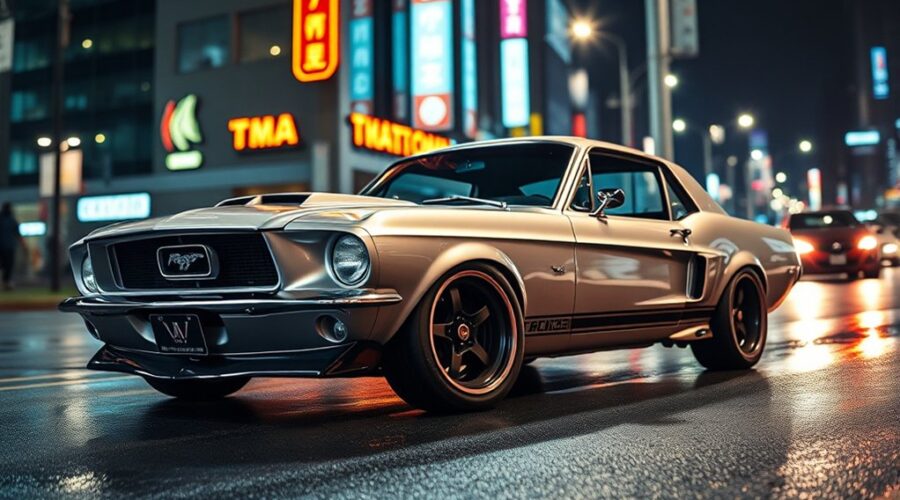
The Tokyo Drift Mustang is one of the film’s most unusual hero cars, combining a classic 1967 fastback body with a Nissan RB26 inline-six instead of a V8. Built for *The Fast and the Furious: Tokyo Drift*, it became a mechanical exception in the franchise. Its engine choice, performance figures, and on-screen role raise a larger question: how much of the car was real, and how much was movie engineering?
Key Takeaways
- The hero Mustang in *Tokyo Drift* is a 1967 Ford Mustang fastback, often mistaken for a 1968 model.
- It used a Nissan RB26 inline-six engine instead of a traditional Mustang V8.
- The RB26 build made about 340 wheel horsepower and 264 lb-ft of torque.
- V8 stunt Mustangs handled drifting scenes, while the RB26 car was used mainly for close-up beauty shots.
- The car was built by Sean Morris and Tri-C Engineering, becoming a famous muscle-meets-import film icon.
What Is the Tokyo Drift Mustang?
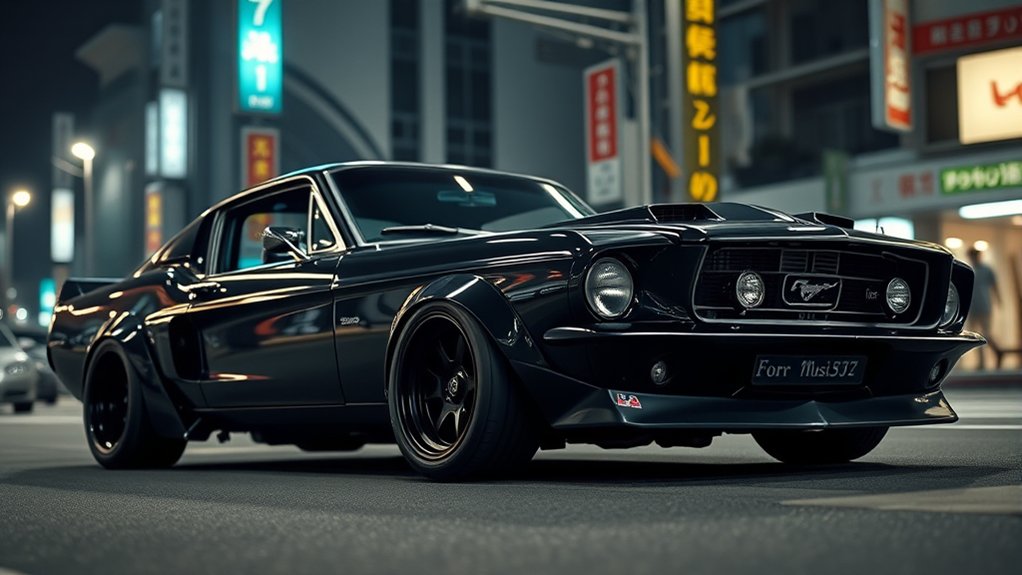
The Tokyo Drift Mustang is a 1967 Ford Mustang fastback modified for *The Fast and the Furious: Tokyo Drift* with a Nissan RB26 inline-six engine, the same engine family used in the Nissan Skyline GT-R.
In the Furious franchise, it served as the Hero #1 car for close-up photography, presenting an RB26-powered Ford Mustang as a deliberate technical anomaly. The powertrain was reported at 340 wheel horsepower at 7,300 rpm and 264 pound-feet of torque at 5,950 rpm, figures that exceeded the V8 stunt cars used for drifting sequences.
Hero #1 close-up car: a Mustang with an RB26 heart, outpacing the V8 drift stunt machines.
This made the Tokyo Drift Mustang both a functional film vehicle and a symbol of mechanical cross-pollination: American body, Japanese performance hardware. For many enthusiasts seeking liberation from fixed automotive identities, it represents a refusal of convention.
The car is scheduled for exhibition at Petersen Automotive Museum in “A Fast & Furious Legacy: 25 Years of Automotive Icons,” running March 14, 2026, through April 4, 2027.
Why Does the Tokyo Drift Mustang Use an RB26?
Because the Tokyo Drift Mustang was intended to stand out as a visual and mechanical hybrid, the RB26 inline-six was chosen for its high output, broad tuning headroom, and proven performance in the Nissan Skyline GT-R lineage.
In the RB26 Mustang, the engine swap replaced the expected muscle-car V8 logic with Japanese tuning engineering, creating a machine that signaled freedom from fixed categories. The 2.6-liter turbocharged six offered stronger horsepower potential and a better power-to-weight balance than typical stunt V8s.
Packaging demands in the left-hand-drive chassis led to a single-turbo conversion from the original twin-turbo layout. Dyno testing later showed 340 wheel horsepower at 7,300 rpm, confirming the setup’s capability.
On screen, the car served mainly for beauty shots, preserving the integrity of the build while V8 stunt cars handled drifting duties. This separation reinforced the RB26 Mustang’s role as a technical symbol rather than a pure action tool.
Where Did the RB26 Come From?
The RB26 in the Tokyo Drift Mustang was sourced from a wrecked Nissan Skyline GT-R application, then adapted for the film build rather than taken as a complete factory package.
Sean Morris oversaw the conversion to a single-turbo configuration, reshaping the engine to suit the Mustang’s chassis and packaging constraints.
This modification established the film car’s hybrid technical identity, combining Nissan powertrain architecture with an American body shell.
Engine Sourced From Skyline
For the Mustang used in *Tokyo Drift*, the RB26 did not come from a Skyline GT-R directly, but from a wrecked S15 Nissan Silvia used as part of the film’s storyline.
In this build, the Mustang, RB26 engine, and Nissan Skyline GT-R lineage were fused into a single machine. Sean Morris confirmed the swap, correcting claims that the car carried an SR20 inline-4.
The donor engine, originally a twin-turbo inline-6 from the Nissan Skyline GT-R, gave the chassis a distinctly Japanese performance identity while retaining American form.
The result was more than a prop: it produced 340 WHP at 7,300 RPM and 264 LB-FT at 5,950 RPM. That combination embodied technical freedom, crossing borders between muscle and tuner culture.
Morris’s Single-Turbo Conversion
Sean Morris converted the Mustang’s RB26 from its original twin-turbo R34 Skyline GT-R configuration to a single-turbo setup to solve clearance and packaging constraints inside the Mustang chassis.
The engine swap used an RB26 sourced from a wrecked S15 Nissan Silvia, creating a hybrid of Japanese performance hardware and American bodywork. That conversion required precise fabrication around the firewall, transmission tunnel, and accessory layout.
Morris faced major mechanical challenges in mounting the drivetrain while preserving serviceability and load control.
The resulting single-turbo arrangement delivered 340 WHP at 7,300 RPM and 264 LB-FT at 5,950 RPM, outperforming many stock V8 stunt-car packages.
Its execution remains a technical reference point in cinematic car culture, showing how liberated design can emerge through disciplined engineering.
Who Built the Tokyo Drift Mustang?
Who built the Tokyo Drift Mustang is traced to mechanic Sean Morris, whose high-performance background made him a natural fit for the project. The Mustang paired a Nissan R34 Skyline GT-R RB26 engine with a Ford chassis, and Sean Morris helped guide the conversion toward credible road presence and film-ready function.
He worked closely with Craig Lieberman, a senior producer, to align fabrication with the car’s intended performance character and visual authenticity. The core structure and engine integration were handled by Tri-C Engineering in Valencia, California, where the RB26 engine was installed into the Mustang chassis.
The build demanded extensive problem solving, since the swap introduced packaging, cooling, and driveline complications. Morris documented those challenges, presenting the project as a technical case study in liberated mechanical adaptation.
The result reflected disciplined engineering rather than theatrical improvisation, with each modification serving stability, fitment, and operational coherence.
Tokyo Drift Mustang Hero Car vs. Stunt Cars
The Tokyo Drift Mustang was split into two distinct roles on set: the RB26-powered Hero #1 car served mainly for beauty shots and close-ups, while five to six V8 stunt cars handled the drifting and action work.
The Mustang hero car carried the RB26 engine from a Nissan Skyline GT-R, adapted to a single-turbo layout for left-hand-drive packaging and visual fidelity. It was presented as the clean, controlled face of the machine, but it did not actually drift in the film.
The hero Mustang wore an RB26, single-turbo adapted for left-hand-drive, but never handled the film’s drifting.
Those movements came from the V8 stunt cars, each fitted with 403 cubic-inch crate engines chosen for durability under repeated high-stress use. This division let the production pair precise camera work with freer, harder-driving chassis.
The result was a disciplined system: one car for appearance, several for physical performance, all serving a vision of speed without compromise.
How Much Power Did the RB26 Mustang Make?
At peak output, the RB26-powered Mustang delivered 340 wheel horsepower at 7,300 rpm and 264 lb-ft of torque at 5,950 rpm, figures that placed it well above a typical street build and gave the car the sharp, high-revving character associated with Nissan’s inline-six.
The RB26 conversion used a single turbo arrangement, replacing the original twin-turbo layout to suit the left-hand-drive Mustang chassis and preserve packaging efficiency. Dyno data showed the engine’s power delivery was not merely theoretical: the car recorded a 13.5-second quarter-mile at 109.8 mph, a strong result for a film car with real mechanical intent.
Chassis testing also indicated a 46.4% better horsepower-to-weight ratio than the V8 Mustang used in the film, and it reached 60 mph 1.3 seconds sooner. In practical terms, the RB26 Mustang combined measured horsepower, disciplined airflow, and liberated acceleration into a focused performance package.
How Did the RB26 Mustang Compare to the V8 Car?
The RB26 Mustang outperformed the V8 car in measured testing, producing 340 WHP at 7,300 rpm and running the quarter-mile in 13.5 seconds at 109.8 mph, with a 46.4% better horsepower-to-weight ratio.
It was also quicker to 60 mph by 1.3 seconds and carried a 13.1 mph trap-speed advantage, indicating stronger acceleration and top-end pull.
In film use, the V8 cars handled drifting duties while the RB26 Mustang served as the Hero car for beauty shots, reflecting its role as the more technically distinct build.
RB26 Vs V8 Performance
On paper and on track, the RB26-powered Mustang was markedly quicker than the V8 car, producing 340 WHP at 7,300 RPM and 264 LB-FT at 5,950 RPM. These figures translated into a 13.5-second quarter-mile at 109.8 mph and a 46.4% better horsepower-to-weight ratio.
The RB26, adapted from a Nissan Skyline GT-R twin-turbo engine and converted to single-turbo form, fit the Mustang chassis with greater efficiency than the original V8 layout. Real-world testing showed a 1.3-second gain to 60 mph and a 13.1 mph trap-speed advantage, underscoring superior RB26 performance.
In cinematic use, however, the V8 cars handled drifting scenes, while the RB26 Mustang served as the hero vehicle for close-up shots.
Dyno And Quarter-Mile
Dyno and track testing showed the RB26 Mustang delivering 340 WHP at 7,300 RPM and 264 LB-FT at 5,950 RPM, with the single-turbo setup selected to improve performance while solving clearance constraints in the Mustang chassis.
On the dyno, the package posted a 46.4% better horsepower-to-weight ratio than the V8 car, indicating a more efficient transfer of power to motion.
- 0-60 mph: 1.3 seconds quicker
- Quarter-mile: 13.5 seconds
- Trap speed: 109.8 mph
- Power curve: strong high-RPM pull
These results show a liberated, mechanically focused build: the RB26 Mustang converted rotational output into usable acceleration with clear gains in dyno validation and quarter-mile execution, while the V8 version lagged in outright performance.
Stunt Use Differences
Raw performance numbers highlight why the RB26 Mustang and the V8 stunt cars served different roles on set.
The RB26 Mustang, fitted with a single-turbo RB26 engine, delivered 340 WHP, ran the quarter mile in 13.5 seconds at 109.8 mph, and reached 60 mph 1.3 seconds sooner than the V8 cars. Those figures made it the Hero #1 car for beauty shots and close-ups, where precision and visual clarity mattered most.
By contrast, the V8 stunt cars used 403 cubic-inch crate engines and were assigned to drifting scenes and high-intensity maneuvers. Their setup favored durability, controllability, and repeated abuse over straight-line speed.
This division let the production pair elite performance with practical stunt freedom, using each chassis where its strengths advanced the film’s kinetic style.
Did the Tokyo Drift Mustang Really Drift?
The Tokyo Drift Mustang did not actually perform the drifting seen on screen. In *Mustang Fast and Furious 3*, the Hero car was protected for beauty shots, close-ups, and static passes, while V8 stunt cars executed the liberation of motion in the drifting sequences.
Those stunt units, five or six in number, used 403 cubic-inch V8 crate engines and were built for controlled slides, allowing the production to separate presentation from performance.
- Mustang: reserved for visual focus.
- Drifting: handled by dedicated stunt chassis.
- V8: supplied the practical slide power.
- Sound: dubbing and enhancement completed the illusion.
The film’s audio design further distanced the hero machine from actual track work; engine notes were added and intensified in postproduction.
The result was a technically capable Mustang portrayed as if it were drifting, while the real physical action remained with specialized substitutes.
1967 or 1968 Mustang: Which Is It?
Often mislabeled in fan discussion as a 1967 Mustang, the Tokyo Drift hero car is officially identified by the Petersen Automotive Museum as a 1968 Ford Mustang fastback. In Fast and Furious discourse, the distinction matters, yet the body differences are subtle. The 1967 and 1968 Mustang shells share nearly identical rooflines, quarter panels, and fastback proportions, so visual identification requires close inspection.
| Trait | 1967 | 1968 |
|---|---|---|
| Grille | Horizontal bars | Fewer openings |
| Side markers | Absent or different | Revised |
| Hood trim | Varies | Simpler |
| Interior cues | Shared layout | Shared layout |
Multiple film cars were used, including an RB26-powered version, which added confusion. Marketing, editing, and fan repetition reinforced the 1967 label. Still, the documented museum classification favors 1968. For enthusiasts drawn to liberated mobility, the exact year remains secondary to the Mustang’s symbolic force and its enduring Fast and Furious presence.
Where Is the Tokyo Drift Mustang Now?
The RB26-powered Mustang from *Tokyo Drift* is believed to have at least two surviving production cars, while at least one V-8 stunt example later appeared on the private market with a 2019 asking price of $179,900.
Sean Morris’s original build, using a single-turbo RB26 from a wrecked S15 Nissan Silvia, remains a reference point for the car’s unusual specification and film significance.
Its current visibility is set to increase further through the Petersen Automotive Museum exhibition, scheduled for March 14, 2026 through April 4, 2027, where it is identified as a 1968 Mustang.
Known Surviving Cars
At least two surviving RB26-powered Mustangs from *Tokyo Drift* are believed to still exist, making them some of the most significant remnants of the film’s hybrid muscle-and-import build program. The Mustang, surviving cars, and RB26 swap remain central to analysis of the film’s engineering choices.
- One hero car survives in museum condition.
- Its modified RB26 straight-six reflects Skyline GT-R power.
- Additional V8 stunt Mustangs dispersed into private hands.
- The engine swap reshaped drifting and muscle-car discourse.
These cars demonstrate a deliberate liberation from conventional Mustang identity, replacing V8 orthodoxy with Japanese turbocharged hardware. Their rarity, build complexity, and cultural impact sustain technical interest, while preserved examples provide evidence of the production’s broader influence on tuning, fabrication, and transnational performance aesthetics.
Museum And Private Owners
Following the surviving RB26-powered examples from *Tokyo Drift* naturally leads to their post-production locations, where the cars split between private collections and public display. Reports indicate at least two Mustang survivors remain from filming, underscoring the car’s value as a cinematic artifact.
After production, examples moved to private owners, and one V8 stunt car was offered for $179,900 in 2019. The Petersen Automotive Museum will present the Mustang in “A Fast & Furious Legacy: 25 Years of Automotive Icons” from March 14, 2026, to April 4, 2027.
The museum identifies it as a 1968 fastback, despite frequent 1967 references. That classification emphasizes the film car’s role in fusing Detroit muscle with Japanese tuning, a combination that continues to interest collectors seeking mechanical independence and cultural cross-pollination.
Frequently Asked Questions
What Kind of Mustang Was in Fast and Furious?
It was a 1967 Ford Mustang fastback, fitted with iconic modifications: a Nissan RB26 engine swap. Its Mustang legacy merged with Drift culture, creating an objective, technical symbol of liberation through hybrid performance engineering and film presence.
What Are the Key Features of the Ford Mustang?
The Ford Mustang’s key features include Iconic design, Mustang history, and Performance upgrades. Its fastback profile, muscular stance, rear-wheel-drive layout, and adaptable V8 or swapped engines make it a technically celebrated, freedom-associated performance coupe.
Is the Tokyo Drift Mustang Still Alive?
Yes—the Tokyo Drift Mustang is still alive, ironically outliving many assumed relics. Two RB26 examples reportedly survive, preserving Mustang legacy, Drift culture, and iconic films’ technical footprint through collector interest and exhibition-grade preservation.
What Was the Actual HP of a Boss 429?
Actual Boss 429 output often exceeded factory ratings, with dyno-tested examples reaching roughly 500 horsepower. Boss 429 performance reflected strong Mustang engine specifications, making the vintage muscle machine a technically formidable engine of liberation.
Conclusion
The Tokyo Drift Mustang remains one of the film’s most distinctive builds: a 1967 Ford Mustang fastback reengineered with Nissan’s RB26 inline-six. Its most striking figure is 340 wheel horsepower, a benchmark that helped the hero car surpass the V8 stunt cars in acceleration and overall performance. That engineering contrast gave the Mustang its visual drama and technical credibility, cementing its place as a rare example of American bodywork paired with Japanese drivetrain precision.