

Car race movies began as simple stunt vehicles in the silent era, then grew into technical showcases as sound, editing, and camera rigs improved. Their appeal rests on more than speed. They mix danger, rivalry, and mechanical detail in ways that can feel grounded or exaggerated. Some films chase realism, others spectacle, and the difference often hides in the filmmaking choices that follow.
How Car Race Movies Began
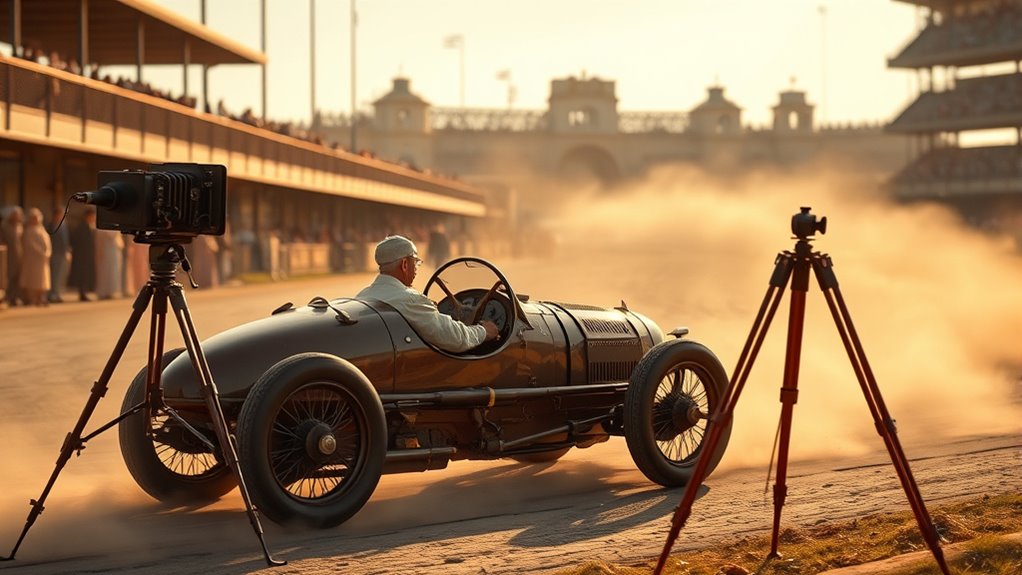
Car race movies began in the silent era, when early filmmakers quickly recognized the cinematic appeal of speed, danger, and spectacle. The earliest example, Barney Oldfields Race for a Life (1913), paired Mabel Normand with Barney Oldfield and established a template for racing-themed films. In this silent film, motion itself became argument: the screen could dramatize velocity, risk, and public excitement without dialogue.
By the 1920s, the form expanded. Speed Madness (1925) and The Checkered Flag (1926) linked motorsport to competition and romance, showing that the genre could carry more than novelty. The shift toward sound at the decade’s end encouraged dramatic narratives, pushing racers into clearer conflict and consequence.
Later titles such as Born to Speed (1947) reflected a more mature view of motorsport, centering personal struggles as much as technical achievement. This early evolution suggests a genre built not only on machines, but on liberation through movement.
Silent-Era Racing Films and Early Stunts
Silent-era racing films established the genre’s basic formula by pairing automobile speed with staged spectacle, as seen in *Barney Oldfields Race for a Life* and other early titles.
Charlie Chaplin and Roscoe Arbuckle helped widen that appeal, using comic disruption and physical stunt work to turn racing scenes into broader entertainment.
These films also relied on early technical tricks, including rear projection and camera trucks, to make danger appear immediate and convincing.
Early Racing Silent Films
Though racing films began as brief novelty attractions, the earliest examples quickly established the genre’s core appeal: speed, danger, and spectacle. *Barney Oldfields Race for a Life* (1913), often cited as the first racing film, paired auto-race thrills with Mabel Normand’s comic energy, while *Kid Auto Races at Venice* (1914) used Charlie Chaplin’s disruptive presence to turn a race setting into physical comedy.
In these silent films, motion became argument: machines, bodies, and crowds revealed racing culture as both entertainment and social theater. Later titles such as *Speed Madness* and *The Checkered Flag* expanded the formula with romance and personal stakes.
Chaplin And Arbuckle Stunts
In the silent years, Chaplin and Arbuckle helped turn racing films into a laboratory for comic timing and physical risk.
*Kid Auto Races at Venice* (1914) cast Chaplin as an intrusive spectator, using his interference to satirize the spectacle around him rather than the race itself, while *The Speed Kings* (1913) gave Fatty Arbuckle a similar role in a broader slapstick framework.
Their Silent Film Contributions reveal Stunt Innovations built on Creative Stunt Work, camera tricks, and practical effects that implied High-Speed Racing without sound.
These films read racing culture as a stage for Personal Conflicts, public impatience, and motion that could be bent toward laughter.
In Early Automobile Racing, such experiments helped define a freer cinematic language, where danger, speed, and mockery advanced together.
How Talkies Changed Car Race Movies
The arrival of talkies gave car race movies a new layer of intensity, as engine roars, tire screech, and crowd noise sharpened the impact of each sequence.
Dialogue also shifted the genre’s focus, letting films present racers as defined by motive, rivalry, and conflict rather than motion alone.
In works such as *Speedway* and *Burning Up*, sound marked a clear turn from spectacle toward more dramatic storytelling.
Sound Brought New Intensity
Sound transformed car race movies in the late 1920s, when talkies could finally combine speeding visuals with engine noise, shouted dialogue, and musical scores.
*Burning Up* (1930) helped establish the formula by making auto racers central to a sound-driven narrative, while *The Racing Strain* (1932) showed how synchronized dialogue could deepen character investment alongside the competition.
For racing films, sound became more than decoration: it created an immersive experience, sharpened dramatic tension, and gave motion a tangible edge.
As advanced audio technology improved, later works such as *Grand Prix* (1966) captured engine roar with cinematic realism.
Jazz and orchestral scoring further widened emotional depth, letting audiences feel speed as pressure, risk, and release rather than mere spectacle.
Dialogue Deepened Racing Drama
Dialogue gave car race movies a new layer of human conflict once talkies arrived in the late 1920s. In racing film history, dialogue shifted attention from mere speed to character relationships and personal struggle, expanding emotional stakes around auto racing.
*Burning Up* (1930) marked a first for talkie racers; *Speedway* (1929) and *The Crowd Roars* (1932) showed how spoken exchanges could expose redemption, rivalry, and pressure.
- Dialogue clarified motives.
- Sound preserved high-octane action.
- Character conflicts became central.
High Gear (1933) demonstrated the pattern: thrilling tracks remained, yet talk sharpened insight into racers’ fears and loyalties.
This change helped free the genre from silent spectacle alone, establishing a durable model where racing excitement and human tension advanced together.
Classic Car Race Movies That Still Matter
| Film | Core strength | Lasting effect |
|---|---|---|
| Grand Prix | Authentic car race visuals | Defined classic spectacle |
| Days of Thunder | Stock car racing energy | Kept the genre popular |
| Senna | Documentary intensity | Linked speed to human cost |
These films show how racing cinema can document motion, conflict, and freedom without excess.
Real Racing Stories Behind These Films
Behind the enduring spectacle of racing cinema lies a second layer of appeal: many of these films draw directly from real drivers, real rivalries, and real tracks. Ford v Ferrari frames a true story: Ford’s 1966 Le Mans challenge, with Ken Miles and Carroll Shelby pushing a racing team against Ferrari’s control. The result is less fantasy than industrial history.
- Senna follows Ayrton Senna through Formula One, treating rivalry with Alain Prost as a political and human struggle.
- Rush reconstructs the 1976 Formula One season, measuring James Hunt against Niki Lauda and his recovery.
- Heart Like a Wheel documents Shirley Muldowney’s entry into top drag racing, exposing barriers built by gender and custom.
Le Mans, with Steve McQueen, preserves the endurance race itself, using sparse dialogue and controlled observation.
Across these films, the pattern is clear: racing cinema borrows liberation from fact, then tests it against speed, risk, and refusal.
What Makes Racing Scenes Feel Real?
Racing scenes feel real when filmmakers treat motion as a physical event rather than a digital illusion. They place cars on actual tracks, sometimes using authentic race cars as camera dollies, so speed is recorded through impact, vibration, and risk.
Practical effects matter more than glossy special effects because real-life stunts give the viewer evidence of gravity, tire grip, and mechanical strain. Sound design reinforces the racing environment: engines roar, tires scream, and each shift registers as pressure.
Close-ups of the race car driver expose concentration, fear, and resolve, while dynamic camera angles track movement without flattening it. Editing techniques then shape perception, using quick cuts for urgency and slow-motion for consequences.
The result is not decoration but testimony: a controlled study of velocity, freedom, and danger. When technique serves reality, the scene stops feeling manufactured and starts feeling earned.
Modern Car Race Movies Worth Watching
- *Senna* (2010) adds documentary force, tracing Ayrton Senna with emotional clarity.
- *Days of Thunder* still marks the genre’s commercial momentum and NASCAR mythology.
- *Hours of Le Mans* remains the endurance test that exposes machine, team, and will.
Viewed together, modern car race movies map freedom against control, making the track a site of resistance.
Related Reading
Frequently Asked Questions
What Are Some Iconic Movies About Car Racing?
Iconic car-racing movies include Le Mans, Ford vs. Ferrari, Grand Prix, Rush, and Senna, each delivering Fast Cars, Classic Scenes, Race Tracks, Legendary Drivers, Adrenaline Rush, Car Technology, Iconic Soundtracks, Cinematic Rivalries.
What Are Some Popular Movies About Car Racing?
Popular car racing movies include *Days of Thunder*, *Ford v Ferrari*, *Senna*, *Rush*, and *Cars*—a silver-streaked roster where Fast Cars, Racing Legends, and an Adrenaline Rush fuel Classic Films, Grand Prix, Muscle Cars, Street Racing, Formula One.
What Is a Interesting Fact About Car Racing?
An interesting fact: speed legends often depend less on lone talent than Racing technology, team dynamics, and pit strategies. At historic tracks, famous drivers still rely on safety innovations and fan culture to shape modern racing’s liberation.
Are There Any Race Car Movies Based on a True Story?
Yes; several race car movies are True Story Adaptations, including Biographical Films about Real life Drivers, Racing Rivalries, and Historical Events. Titles like Rush, Ford v Ferrari, and Senna function as Documentary Features with lasting Cultural Impact, offering Inspirational Tales.
Conclusion
Car race movies have shifted from silent spectacle to sound-driven, story-rich cinema. Their evolution reveals a steady search for speed, spectacle, and significance. From early stunts to modern machine-crafted realism, these films keep racing toward deeper human drama. The finest examples fuse friction, freedom, and fear into fast-moving frames, leaving viewers with a vivid sense of velocity and vulnerability. As technology tightens the thrill, the genre continues to accelerate, adapt, and astonish.




[…] Car Race Movies: From Silent Films to Modern Classics […]