
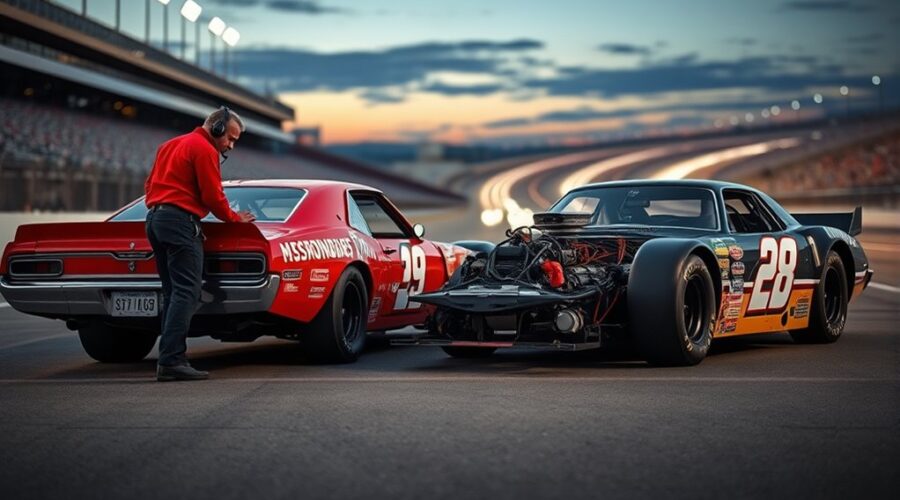
Movies about NASCAR continue to attract attention because they mix speed, competition, and a distinct American history. They often reflect the sport’s roots in stock car racing, while also showing how pit strategy, vehicle setup, and driver skill shape results. Some films aim for realism, while others lean on drama or satire. A few even feature real racers and technical details that reward closer inspection, and the differences between them can be surprising.
Why NASCAR Movies Still Appeal

NASCAR movies continue to appeal because they combine high-speed racing spectacle with stories centered on ambition, rivalry, and personal struggle. These movies turn NASCAR into more than a sport, presenting racing as a cultural arena where skill, risk, and identity collide.
Films such as Days of Thunder and Talladega Nights show how drama and comedy can make the track accessible to audiences beyond devoted fans. The use of real NASCAR legends in cameos strengthens authenticity, helping viewers trust the world onscreen.
Drama and comedy make the track accessible, while NASCAR legends in cameo roles deepen the world’s authenticity.
Documentaries like Dale and Blink of an Eye add emotional depth by focusing on drivers’ lives, losses, and determination. This range of styles, from satire to biography, allows NASCAR films to speak to diverse audiences.
Their appeal rests on a clear balance: entertainment without emptiness, spectacle without detachment, and stories that affirm resilience in a demanding racing culture.
The NASCAR History Behind These Movies
Behind the spectacle and storytelling of NASCAR movies lies a history shaped by American racing culture, regional identity, and gradual mainstream expansion. NASCAR began in 1948 under Bill France Sr., emerging from Prohibition-era moonshine routes and the competitive discipline of stock car racing. The first official race in 1949 at Charlotte Speedway turned a local practice into an organized national sport.
That origin matters because NASCAR Movies often reflect a world built on speed, labor, and working-class ambition. Wendell Scott later expanded that history by becoming the first African American driver to win a NASCAR race in 1963, exposing the barriers that shaped access to the sport.
As NASCAR modernized, with postseason changes like the 2004 Chase for the Nextel Cup, films such as Days of Thunder and Talladega Nights carried the sport into broader popular culture, translating its struggle, spectacle, and identity into mass entertainment.
How Racing Details Show Up on Screen
On screen, racing details are used not just for spectacle but to ground NASCAR films in the sport’s practical realities. Real cars, built or modified with track accuracy, help a racing movie convey speed, weight, and danger with less illusion.
In *Days of Thunder*, that approach is reinforced by Hendrick Motorsports-built machines and real footage, while *Greased Lightning* links racing to history through Wendell Scott. The presence of actual NASCAR drivers or figures, as in *Stroker Ace*, narrows the distance between fiction and the sport’s public memory.
Real machines and real figures anchor *Days of Thunder*, *Greased Lightning*, and *Stroker Ace* in NASCAR’s public memory.
Animated work like *Cars* translates these cues into a more accessible form, yet still borrows from real legends and team culture.
*Talladega Nights: The Ballad of Ricky Bobby* pushes the same logic further, showing pit stops, sponsorship pressure, and competition as systems that shape outcomes. Such details make the screen version of NASCAR feel organized, contested, and recognizably real.
What Makes a Great NASCAR Movie?
A great NASCAR movie typically balances authentic racing detail with a clear sense of the sport’s real-world stakes, often grounding the action in recognizable figures or events.
It also depends on memorable characters whose struggles give the races emotional weight.
When drama is tied to competition and adversity, the result feels both credible and compelling.
Authentic Racing Detail
| Element | Effect | Example |
|---|---|---|
| racing footage | strengthens immersion | *Days of Thunder* |
| historical context | explains the sport’s roots | *The Last American Hero* |
| character development | adds emotional weight | *Greased Lightning* |
| humor and satire | critiques commercialization | *Talladega Nights* |
Taken together, these choices create authentic NASCAR storytelling. They show how technical detail can serve liberation by honoring working-class origins, preserving cultural memory, and exposing the industry without dulling its energy.
Memorable Characters And Drama
Great NASCAR movies usually succeed because the drivers are more than competitors; they become figures shaped by pressure, ambition, and social conflict. Strong memorable characters give the genre its force.
In Greased Lightning, Wendell Scott embodies resistance, confronting racism while claiming space in a segregated sport.
The Last American Hero turns Junior Johnson into a study in character development, tracing growth from bootlegger to disciplined racer.
Talladega Nights uses satire to expose vanity, sponsorship, and the hunger for status, while still giving its protagonist a human arc.
Stroker Ace adds another layer by showing how commercial control can limit freedom.
When humor, conflict, and authenticity work together, NASCAR films create drama that feels both personal and political, inviting viewers to imagine liberation beyond the track.
Six Pack, Speedway, and Greased Lightning
Six Pack distinguishes itself with an orphan-centered plot that combines stock car racing with comic and emotional stakes.
Speedway presents NASCAR through a musical lens, using Elvis Presley and cameo appearances from racing icons to frame the sport as entertainment.
Greased Lightning shifts to a more serious register, telling the story of Wendell Scott and his rise as the first Black NASCAR driver.
Six Pack’s Orphan Plot
Beyond the track, these films show how NASCAR stories often lean on family, struggle, and identity as much as speed.
In *Six Pack*, Brewster Baker becomes an unlikely guardian when orphan children steal his stock car engine, turning a racing premise into a character-driven study of chosen family and freedom. The plot treats the driver not as a lone hero but as someone reshaped by responsibility.
- *Six Pack* uses an orphan group to build emotional stakes.
- *Speedway* centers a stock car driver amid celebrity racing culture.
- *Greased Lightning* frames liberation through Wendell Scott’s resistance to racism.
Together, these films reveal NASCAR cinema as more than competition. They show communities forming under pressure, and they challenge narrow ideas about who belongs in the sport.
Speedway’s Musical NASCAR Showcase
Where the previous films stressed family and struggle, these NASCAR stories also turn the sport into a stage for performance and identity.
Speedway casts Elvis Presley as a stock car driver, using musical numbers to make the speedway feel like a public arena of movement and self-expression. Its NASCAR setting gains texture through appearances by Cale Yarborough and Richard Petty, grounding the spectacle in real racing culture.
Six Pack shifts toward a warmer, more communal mode, blending competition with caregiving and showing how racing can support belonging.
Together, these films treat motorsport as more than mechanics or speed. They frame the track as a site where labor, art, and freedom intersect, and where popular music can expand the emotional reach of NASCAR narratives.
Greased Lightning’s Wendell Scott Story
Greased Lightning shifts NASCAR filmmaking toward biography and social conflict by centering Wendell Scott, the first Black driver to compete in NASCAR, and tracing his rise from bootlegging to racing success under conditions of racial exclusion.
Richard Pryor plays Scott with unusual gravity, making the bootlegger turned competitor a figure of disciplined resistance and self-definition.
The film frames NASCAR not just as sport, but as a site where access, labor, and dignity are contested.
- Greased Lightning presents Wendell Scott as a liberation-minded pioneer.
- Richard Pryor’s serious performance sharpens the film’s political force.
- Compared with Six Pack and Speedway, it broadens NASCAR cinema into struggle, memory, and social critique.
Stroker Ace and The Last American Hero
*Stroker Ace* and *The Last American Hero* offer contrasting but complementary views of NASCAR’s early screen history.
*Stroker Ace* frames the sport through comedy: Burt Reynolds plays a driver trapped by sponsorship demands, even forced into a chicken suit, exposing how corporate spectacle can dominate labor. Real cameos from Dale Earnhardt Sr. and Kyle Petty lend credibility.
*The Last American Hero* is more grounded, tracing Junior Jackson from moonshining to NASCAR success. Jeff Bridges stars as Junior Jackson, and the film, inspired by a Tom Wolfe article, treats racing as an arena of class mobility, risk, and self-making.
Together, *Stroker Ace* and *The Last American Hero* show NASCAR as both entertainment industry and working-class pathway. One satirizes commodification; the other honors perseverance.
Both films preserve early racing culture while hinting at the pressures drivers faced when ambition met commerce, authority, and the desire to move freely on their own terms.
Days of Thunder’s Big-Track Energy
- It translated NASCAR into a high-volume visual language: loud engines, sharp editing, and stylized racing.
- Its rivalries and romance, including Nicole Kidman as a doctor, added accessible drama without diluting track tension.
- It helped move NASCAR beyond its core audience, making the sport legible to mainstream viewers seeking motion, pressure, and self-invention.
Often read as a NASCAR version of *Top Gun*, the film anticipated the later appeal of *Fast and the Furious*: speed as liberation, identity, and collective escape.
Cars: NASCAR for Younger Fans
*Cars* presents NASCAR history in a form younger viewers can easily follow, using animated characters inspired by real racing figures and familiar racing traditions.
The film also connects the sport to recognizable names through cameos from actual NASCAR stars, giving its world added authenticity.
NASCAR History Made Fun
Although it is a family animation, *Cars* (2006) offers a surprisingly effective introduction to NASCAR for younger viewers by framing racing through Lightning McQueen’s journey toward fame, friendship, and belonging.
The movie turns a fast car into a readable lesson in NASCAR history, linking humor with community, teamwork, and perseverance. It also nods to icons such as Dale Earnhardt through broader racing traditions, while keeping the tone accessible.
- Lightning McQueen makes competition easy to follow.
- The film uses authentic NASCAR footage to ground the story.
- Racing culture appears as a shared, liberating community.
Real Racers, Animated Stars
Because it blends animated storytelling with recognizable racing figures, *Cars* offers younger viewers an accessible entry point into NASCAR culture.
The 2006 Cars film uses anthropomorphic vehicles to translate speed, rivalry, and heritage into a format children can grasp. Characters such as King echo Richard Petty, while Doc Hudson draws on the Hudson Hornet legacy. Voice cameos from Dale Earnhardt Jr. and Mario Andretti add a direct link to real NASCAR history.
Set in Radiator Springs, the story ties competition to community, friendship, and respect for tradition. Critics noted pacing issues, yet the film’s depth and emotional clarity helped it reach both children and dedicated fans.
Its success launched a franchise that continued to introduce animated audiences to NASCAR’s values and lineage.
Talladega Nights and NASCAR Satire
- Will Ferrell’s Ricky Bobby embodies the worship of victory, turning slogans into ideology and revealing how fan identity can be shaped by spectacle.
- Sacha Baron Cohen’s rival character sharpens the film’s critique, pushing class conflict and ego into absurd but revealing territory.
- Real NASCAR cameos, including Dale Earnhardt Jr., anchor the comedy in recognizable sport while mocking the influence of endorsements over racing.
The result is a culturally durable film, one whose catchphrases entered public speech and whose irreverence offered viewers a liberated way to question sport, branding, and celebrity.
Which NASCAR Movies Are Most Accurate?
Among NASCAR films, the most accurate tend to be those grounded in specific people and eras rather than broad entertainment. Greased Lightning stands out for its account of Wendell Scott, showing both his skill and the racism that shaped NASCAR’s gatekeeping.
The Last American Hero is similarly strong, tracing Junior Johnson from bootleg roads to the track with rough authenticity. Dale offers the clearest portrait of Dale Earnhardt, using real career milestones and his fatal crash to reflect the pressure of top-level racing.
Days of Thunder is less biographical, yet its racing footage, Hendrick Motorsports vehicles, and pit-lane detail capture NASCAR culture with unusual precision. Talladega Nights, by contrast, is a satire; it is not the most accurate overall, but it does reflect sponsorship dependence and fan-driver spectacle.
For viewers seeking truth, the most revealing films are those that expose NASCAR as a field shaped by labor, risk, exclusion, and ambition.
Related Reading
Frequently Asked Questions
What Is the Best Movie About NASCAR?
Days of Thunder is often judged the best NASCAR film, blending Race car rivalry, Iconic drivers, and Speedway legends with vivid Behind scenes realism. For viewers seeking liberation from formula, its speed and spectacle remain unmatched.
Who Is LGBTQ in NASCAR?
NASCAR has LGBTQ drivers and officials, though many remain private. Public figures and allies like Justin Allgaier highlight NASCAR representation; community support, Pride events, and historical milestones contrast old exclusion with inclusive racing progress.
Is There a Movie About the Origins of NASCAR?
Yes; *The Last American Hero* dramatizes NASCAR history through Junior Johnson, a stock car driver shaped by moonshine runners. It portrays early racers and racing legends, examining how marginalized Southern communities forged a rebellious sport.
What Are Some Interesting Facts About NASCAR?
NASCAR blends daring racing strategies, fan culture, and safety advancements. Notable NASCAR innovations include stage racing and playoffs; famous drivers like Petty and Earnhardt shaped the sport. Its roots in modified cars remain historically distinctive.
Conclusion
Ultimately, movies about NASCAR endure because they turn speed, risk, and competition into accessible drama. The most effective films balance spectacle with credible details, yet their accuracy varies widely. *Days of Thunder* and *Greased Lightning* draw more clearly from real racing culture, while *Talladega Nights* uses exaggeration for satire. The deeper truth is that NASCAR films work best when they capture not just races, but the ambition, conflict, and identity behind them.


[…] NASCAR Movies: The Best Stock Car Racing Films and Their History […]