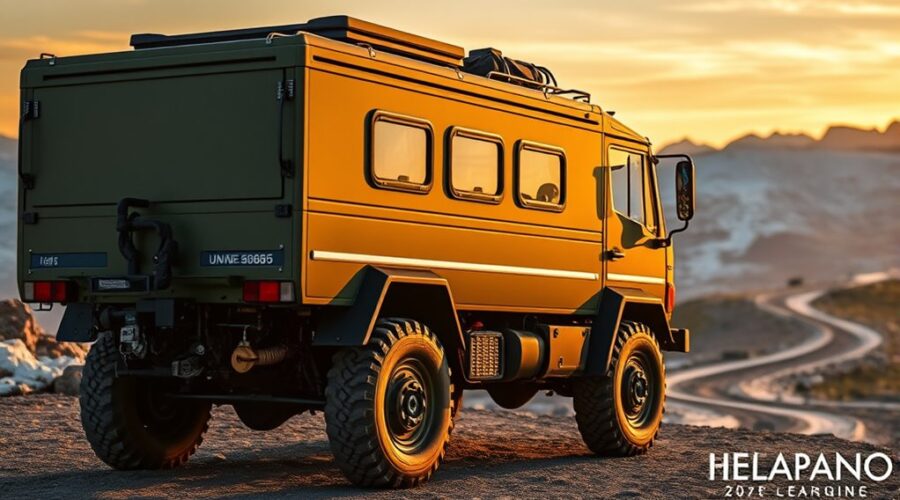
The Mercedes Unimog Camper combines expedition-grade engineering with practical overland utility. Its Euro VI diesel powertrain, permanent all-wheel drive, and lockable differentials support demanding terrain, while 0.49 m ground clearance adds serious mobility. With up to 286 hp, 900 Nm of torque, and a 14-ton gross vehicle weight, it is built for long-range autonomy. The key question is how these figures translate into real-world travel capability.
Key Takeaways
- Mercedes Unimog campers use Euro VI diesel engines, typically 5.1-liter units producing about 228–286 hp and 900 Nm torque.
- Permanent all-wheel drive, lockable differentials, and low-range gearing give strong off-road traction and control.
- Portal axles and 0.49 m ground clearance help the Unimog clear obstacles and handle rough terrain.
- Typical dimensions are about 6 m long, 2.7 m wide, and 3.0–3.3 m high, with a 3,900 mm wheelbase.
- Gross vehicle weight is 14 tonnes, payload is about 7.5 tonnes, and towing capacity can reach 30 tonnes.
What Is a Mercedes Unimog Camper?
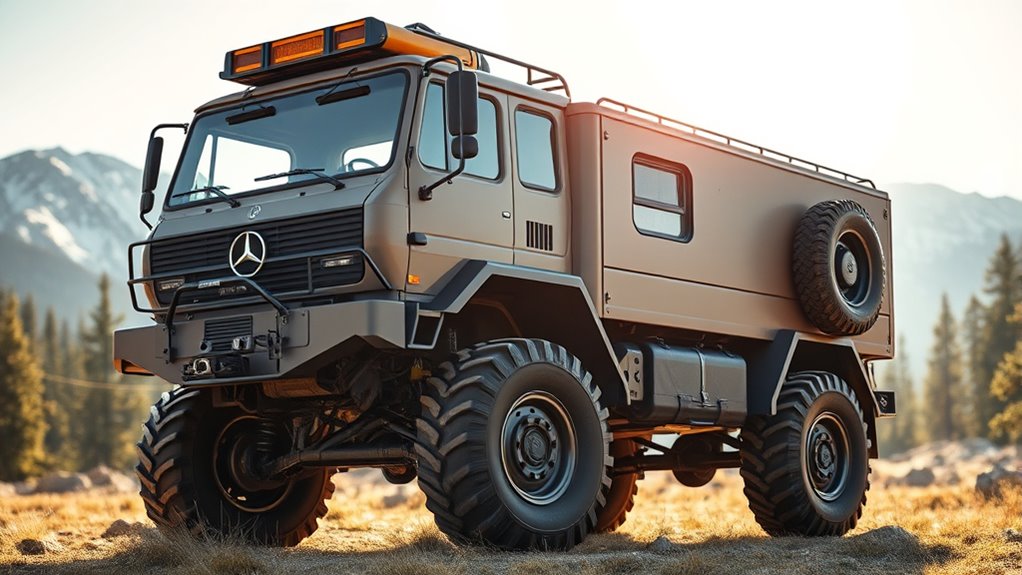
A Mercedes Unimog camper is a purpose-built expedition vehicle based on the Unimog platform, which is valued for its durability and exceptional off-road capability.
It combines a heavy-duty chassis with a flexible ladder frame and live axles to preserve wheel articulation and stability across ruts, rocks, and steep gradients. The Unimog architecture supports high ground clearance and a structure suited to remote travel where infrastructure is absent.
A heavy-duty chassis, flexible ladder frame, and live axles deliver articulation, stability, and high ground clearance for remote terrain.
In camper form, it is configured to carry living modules, water, fuel, and equipment while maintaining off-road mobility. Depending on specification, models such as the U5000 offer substantial gross vehicle mass and load capacity for long-duration self-sufficiency.
Customizable attachment points and expedition options further increase operational flexibility. For those seeking liberation from paved routes and fixed campsites, the Unimog camper functions as a self-contained platform for controlled, independent movement in demanding terrain.
Unimog Camper Engine and Powertrain
Powertrain specification is a defining factor in how a Mercedes Unimog camper performs once the route leaves paved ground. Most camper conversions use Euro VI diesel engines such as the OM934 5.1-liter unit, rated at 170 kW, or about 228 hp, and 900 Nm of torque. This engine power supports sustained travel while maintaining controlled response.
The U4000 and U5000 rely on turbocharged four-cylinder diesel engines, with the U5000 carrying a 14-tonne gross vehicle mass. Engine placement has been shifted one meter aft to improve weight distribution and preserve stability.
A hydrostatic drive broadens usable speed from 0 to 50 km/h, giving the driver precise low-speed control. A rear-of-cab power take-off provides access for hydraulic attachments, helping the platform support expedition equipment and utility systems.
Together, these elements form a drivetrain built for independence, mechanical simplicity, and practical freedom in remote environments.
How a Unimog Camper Handles Rough Terrain
The Unimog camper’s portal hub axles increase ground clearance, allowing it to clear rocks, ruts, and other irregular obstacles without underbody contact.
Its suspension geometry and axle articulation help maintain wheel contact across uneven surfaces, while low-range gearing and all-terrain traction systems support controlled movement on steep or loose ground.
This combination improves stability, climb capability, and descent control in demanding terrain.
Ground Clearance Advantage
With up to 500 mm of ground clearance, the Unimog camper is engineered to move across broken, uneven terrain while minimizing the risk of underbody impact.
This high ground clearance is reinforced by portal axles, which raise driveline components above obstacles and improve approach across ruts, rocks, and ledges. The result is a platform that preserves traction and stability on irregular surfaces without sacrificing structural protection.
Its geometry also supports gradients up to 100%, or 45 degrees, while a wading depth of 1200 mm extends capability through flooded crossings.
A low center of gravity further improves control on severe side slopes, giving the driver technical confidence and terrain freedom.
Together, these traits support liberated travel in demanding off-road environments.
Axle Articulation Control
Portal axle technology gives the Unimog camper exceptional axle articulation, allowing its wheels to maintain contact over deeply uneven ground while preserving substantial clearance beneath the chassis.
This geometry supports controlled wheel travel on broken rock, ruts, and cross-axle obstacles, helping the vehicle remain composed where conventional motorhomes would lose mobility.
Among Unimog models, the combination of a low center of gravity and hydrostatic drive further refines control, enabling precise modulation of speed and torque on steep inclines and severe side slopes.
Tyre pressure control through tyrecontrol® extends this capability by adjusting inflation on the move, matching contact patch to terrain conditions.
The result is a technical platform engineered for terrain independence, stability, and the practical freedom to move beyond paved limits.
All-Terrain Traction Systems
Rough terrain handling in a Unimog camper is built around a coordinated traction package that combines hydrostatic drive, portal hub axles, and central tyre inflation control.
The hydrostatic drive enables smooth acceleration and precise modulation on steep gradients up to 100%, supporting controlled progress where conventional drivetrains lose composure.
Portal hub axles raise ground clearance, allowing the all-terrain chassis to pass over rocks, ruts, and broken surfaces with reduced underbody contact.
tyrecontrol® adjusts pressure for sand, mud, or hardpack, improving grip and lowering wheel slip.
A low centre of gravity, strong engine braking, and a stable steering system help the vehicle remain composed on severe side slopes and descents.
Water crossings to 1200 mm further confirm its liberation-ready off-road capability.
Unimog Camper Dimensions and Weight
The Unimog U5000 camper measures approximately 6 m in length and 2.7 m in width, with a height of about 2.3 m, establishing a compact but substantial exterior profile.
Its 3,900 mm wheelbase and 0.49 m ground clearance support stability and obstacle clearance across uneven terrain.
With a gross vehicle weight of 14 tonnes and a maximum payload of 7.5 metric tons, it is configured for demanding load and off-road use.
Camper Length And Width
Measured dimensions give the Unimog camper its practical balance of space and capability, with most builds landing around 6.0 to 6.2 meters in length and 2.4 to 2.5 meters in width. This camper length supports generous interior planning for storage, habitation, and self-sufficient travel without excess bulk.
The overall height typically reaches 3.0 to 3.3 meters, reflecting roof-mounted equipment or sleeping volumes while remaining within a controlled profile. The wheelbase, near 3.9 meters, helps define a stable chassis layout that supports precise handling in demanding conditions.
With a gross vehicle weight rating of 7.5 to 10.5 tonnes, the platform remains structurally prepared for heavy expedition fittings. The result is a liberated mobile base with measured proportions and durable intent.
Wheelbase And Ground Clearance
With a wheelbase of 3,900 mm, the Mercedes Unimog camper maintains a stable chassis layout that supports controlled handling on uneven ground. This wheelbase contributes to predictable response when the vehicle is traversing remote routes that demand freedom from paved limits.
Its ground clearance reaches 0.49 m, a figure that improves obstacle approach and passage across ruts, rocks, and uneven surfaces. The overall dimensions remain compact for a heavy-duty platform, measuring about 6 m long, 2.7 m wide, and 2.3 m high.
These proportions support practical mobility in confined environments while preserving off-road articulation. Together, the wheelbase, ground clearance, and dimensions create a balanced package for expedition use, emphasizing technical capability, terrain access, and self-reliant movement beyond conventional road constraints.
Payload And Gross Weight
Beyond wheelbase and clearance, the Unimog U5000 camper’s mass ratings define how far its expedition capability can be extended in practice. Its gross weight is set at 14 tonnes, placing it firmly in the heavy-duty class and supporting sustained travel with a full living module and expedition stores.
Payload capacity is approximately 7.5 metric tons, giving substantial latitude for water, fuel, tools, recovery gear, and remote-field supplies. As an equipment carrier, this reserve allows the chassis to remain versatile without immediate compromise to utility.
Combined with its 6-meter length, 2.4-meter width, and 3-meter height, the platform balances load volume with structural control. For users seeking self-directed movement, these ratings translate into robust mobility, endurance, and operational freedom.
Unimog Camper Drivetrain, Axles, and Transmission
A robust drivetrain gives the Unimog camper its off-road capability, pairing four-cylinder turbo-intercooled diesel engines such as the OM904LA and OM924LA with output figures reaching 286 hp and 900 Nm of torque.
The drivetrain combines permanent all-wheel drive with lockable differentials, directing force through the front and rear axles for consistent traction on loose, wet, or uneven surfaces.
Permanent all-wheel drive and lockable differentials send power evenly to both axles for reliable traction on difficult terrain.
Portal hub axles raise ground clearance and extend wheel articulation, helping the vehicle maintain contact on steep grades up to 100 percent, or 45 degrees.
A hydrostatic drive system enables seamless speed changes from 0 to 50 km/h, supporting controlled maneuvering in confined or variable terrain.
The transmission uses an automated-shift mechanism that reduces interruption during gear changes and improves efficiency under changing loads.
Together, these components form a mechanical package designed for autonomy, allowing the camper to move with precision beyond paved roads.
Factory Features That Improve Versatility
Factory features expand the Unimog camper’s utility well beyond recreational travel, making it adaptable to work, transport, and specialized off-road duties.
The new Euro VIe engine reduces emissions while improving fuel efficiency, supporting a wide range of missions with less environmental burden.
A load-sensing hydraulic system automatically adjusts output to attachment demand, allowing implements to operate with controlled, efficient power.
Permanent all-wheel drive, combined with a lockable longitudinal differential, maintains traction on loose, uneven, or degraded surfaces, preserving stability where ordinary vehicles lose composure.
The chassis is also equipped with front and rear PTO shafts, enabling powered implements to be used directly from the vehicle.
A steerable rear axle reduces scrub and helps protect vegetation during tight maneuvers, which is valuable in landscaping and agricultural work.
These elements create a platform that favors autonomy, flexible deployment, and technically demanding tasks across very different operating environments.
Unimog Camper Payload, Towing, and Practical Use
Weight and hauling capability define the Unimog U5000 camper as much as its off-road hardware, with a maximum payload of 7.5 metric tons and a gross vehicle weight of 14 tonnes providing substantial capacity for expedition equipment, supplies, and installed living systems.
This payload capacity supports extended travel without forcing severe compromise on cargo selection or onboard provisioning. Its towing capacity reaches 30 tonnes, enabling the vehicle to move heavy trailers, recovery gear, or auxiliary logistics loads when route conditions demand added flexibility.
This payload capacity supports extended travel without severe compromise, while 30-tonne towing adds flexibility when the route demands it.
In practical applications, the chassis can operate as a mobile base for remote work, field support, or self-sufficient travel across difficult terrain. Advanced hydraulic systems improve attachment control, while the central tyre inflation system allows rapid pressure adjustment for sand, mud, rock, or pavement.
The result is a platform that remains technically capable, adaptable, and structurally prepared for demanding use beyond conventional camper limitations.
Is a Unimog Camper Worth It for Expeditions?
For expedition use, the Unimog camper presents a strong case on technical grounds. Its off-road capabilities, including a 100% gradient rating and 1200 mm water fording, support access to routes that liberate Unimog drivers from conventional limits. The payload capacity of up to 7.5 metric tons allows substantial provisioning without immediate performance loss, which is critical for autonomous travel.
| Factor | Assessment |
|---|---|
| Terrain access | Exceptional |
| Load carrying | High |
| Maneuverability | Strong |
| Fuel efficiency | Favorable |
| Expedition utility | Very high |
The Euro VI engine reduces emissions and improves range efficiency, while the roughly 13-meter turning circle aids navigation in confined terrain. The attachment system further increases utility by enabling rapid conversion between camper and work roles. For operators seeking self-reliant mobility in remote environments, the platform is technically justified, provided the higher cost, size, and operational complexity remain acceptable.
Frequently Asked Questions
What Are the Common Problems With Unimogs?
Common Unimog problems include electrical wiring faults, hydraulic leaks, intake restrictions, gearbox shifting issues, and rust. Unimog maintenance tips emphasize inspections; Unimog off roading and Unimog customization options increase wear, demanding vigilant servicing.
What Are the Specifications of an Unimog Camper?
Like a roaming citadel, the Unimog camper typically uses a 215–300 hp Euro V/VI engine, measures about 6 m long, 2.3 m high, and 2.7 m wide, with 14.5-tonne GVW, central tyre inflation, 30-tonne towing, Unimog customization options, Unimog off road capabilities, Unimog maintenance tips.
Is the Unimog Legal in the US?
Yes, the Unimog can be legal in the US, but legal status depends on import regulations, vehicle classification, and emissions compliance. Its off road capabilities often simplify recreational use, while state registration requirements remain restrictive.
How Many Miles per Gallon Does an Unimog Get?
A Unimog typically gets about 10 to 15 miles per gallon, though fuel efficiency varies with load, terrain capability, driving style, and attachments. Its hydrostatic drive can aid economy, but maintenance costs remain substantial.
Conclusion
The Mercedes Unimog Camper stands out as a highly specialized expedition platform, combining Euro VI diesel power, permanent all-wheel drive, portal-axle clearance, and differential locks with strong payload and towing capability. Its compact footprint and rugged chassis support long-range travel in demanding environments. For operators prioritizing mobility over comfort compromises, it remains a practical choice. As the adage goes, “form follows function,” and this vehicle clearly prioritizes utility, durability, and off-road performance.