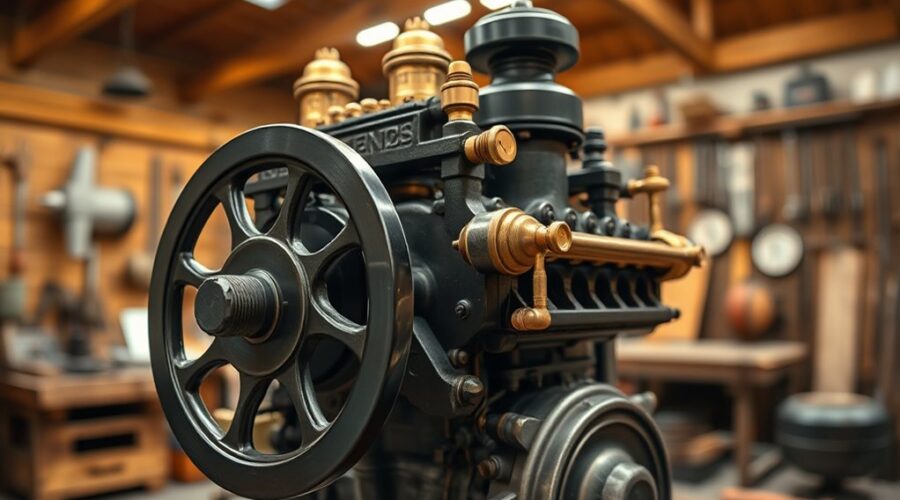
The Benz engine emerged in the late 19th century as Carl Benz’s practical answer to self-propelled road transport. Built for the Patent Motorwagen, it used a 954 cc single-cylinder four-stroke layout and produced about 0.75 horsepower. Its water cooling and ignition system improved reliability. Bertha Benz’s 1888 journey then proved its value on public roads, but its role in shaping modern automobiles went much further.
What Was the Benz Engine?
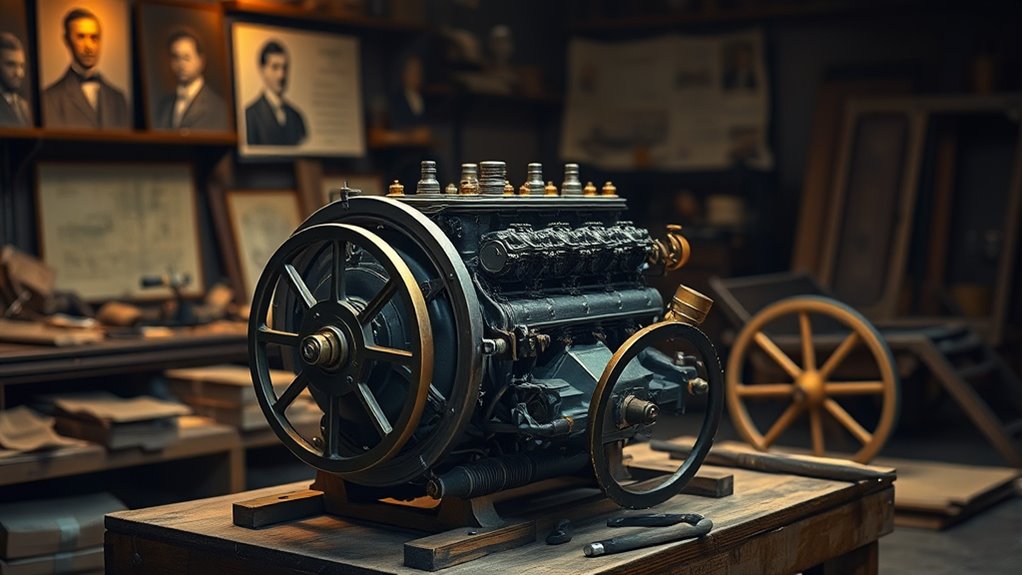
The Benz Engine was the internal combustion engine Carl Benz developed in the late 19th century for use in a vehicle, making it a landmark in automotive history. As a purpose-built power source, the Benz Engine departed from stationary applications and advanced mobility for ordinary users seeking release from horse dependence.
Installed in the Patent Motorwagen, it used a single-cylinder, four-stroke layout that produced about 0.75 horsepower and could move the vehicle to roughly 16 km/h. Its horizontal arrangement, water-cooled cylinder head, carburetor, and ignition system were important technical steps, each improving reliability and control.
In 1888, Bertha Benz’s long-distance journey publicly confirmed its practicality. That demonstration helped legitimize Carl Benz’s work and accelerated acceptance within the automotive industry. The engine’s success established a foundation for later vehicle design and contributed to the rise of Mercedes-Benz as a major automotive name.
How Carl Benz Built the Motorwagen
In 1885, Carl Benz built the Motorwagen as the first automobile powered by an internal combustion engine, combining a single-cylinder four-stroke engine with a tubular steel frame and wooden wheels.
Benz designed it as a practical machine, not a novelty, and the layout reflected a disciplined search for lightness, balance, and motion without horse power.
The Motorwagen’s engineering was patent-protected on January 29, 1886, marking a milestone in modern transport. Its reception was cautious, yet the vehicle advanced the idea that personal mobility could be engineered into reality.
- Benz applied a compact engine to a road vehicle.
- The frame and wheels kept the automobile efficient.
- In 1888, Bertha Benz proved its range and usefulness.
- Public interest grew, helping Benz & Cie. expand.
Benz Engine Specs That Mattered
Benz engine specifications mattered first in 1879, when the patented two-stroke, single-cylinder unit produced about 0.9 horsepower and helped establish a practical internal combustion baseline.
By 1886, the Benz Patent Motorwagen used a rear-mounted four-stroke engine of 954 cc and 0.75 horsepower at 400 RPM, showing how modest output could still support early road use.
Later Benz models, including the 1896 Velo and the 1900 8/18 PS, linked greater power and engine complexity with improved performance and reliability.
Patent Motor Specs
Patented in 1886, the Benz Patent Motorwagen introduced a single-cylinder, four-stroke internal combustion engine rated at 0.75 horsepower, a modest output that nonetheless made powered road travel possible.
Its technical details showed a rear-mounted layout, tubular steel frame, wooden wheels, and solid rubber tires, all part of early automotive history.
- The Benz Patent linked invention to practical mobility.
- The internal combustion design reduced reliance on animal power.
- The single-cylinder arrangement kept the machine compact for one passenger.
- In 1888, Bertha Benz’s journey confirmed its value for freedom-minded travel.
The simple battery ignition and leather-pad brake system further demonstrated functional engineering.
Together, these specifications marked a decisive step toward modern vehicle design, proving that liberation on the road could begin with careful mechanical invention.
Four-Stroke Engine Power
That modest 0.75-horsepower output pointed to a larger technical shift: the four-stroke engine architecture that made Benz’s 1886 Patent Motorwagen workable.
Developed by Gottlieb Daimler, the four-stroke engine followed intake, compression, power, and exhaust strokes, turning limited fuel into usable motion with greater efficiency.
Benz’s patented 1886 unit translated this principle into early automotive technology, replacing the uneven character of many two-stroke designs.
Carburetor mixing and spark plug ignition helped the system operate more cleanly and predictably.
In chronological terms, the engine’s smoothness, fuel economy, and reliability mattered as much as raw horsepower, because they made sustained road use imaginable.
This configuration soon became the standard for motor vehicles, establishing a practical foundation for liberated movement.
Performance And Reliability
Early Benz engines were notable less for raw output than for the specifications that made reliable driving possible. In 1886, the single-cylinder four-stroke Motorwagen produced about 0.75 horsepower, yet its vertical cylinder and water cooling reflected innovative design.
- These features improved reliability in early road use.
- Later two-stroke models raised efficiency and delivered smoother operation.
- Electric ignition and multiple valves introduced advanced technology, strengthening performance.
- By the 1920s, the Benz V8 engine brought superior power to luxury cars.
Across the chronology, Benz specifications show a steady shift from basic motion to controlled performance. Each step reduced mechanical uncertainty and expanded practical mobility, giving drivers a clearer path toward self-directed travel.
Why the Benz Engine Changed Automobiles
When Karl Benz introduced his patented engine in 1886, it marked the first time an internal combustion engine powered a motor vehicle, fundamentally changing transportation. The Benz engine used a single-cylinder, four-stroke layout, and this design established early benchmarks for automotive engineering.
In 1888, Bertha Benz’s long-distance journey proved that the machine could function beyond a workshop demonstration, giving evidence of reliability and practical range. Its water-cooled arrangement also improved performance and efficiency, showing that mechanical independence could be sustained without excessive heat loss.
Chronologically, these advances moved the automobile from experiment to usable transport. By proving internal combustion viable in road use, the Benz engine triggered a revolutionary shift in personal mobility, opening movement beyond horse power and fixed routes.
That change did not merely improve travel; it expanded access, widened choice, and helped create the conditions for the global adoption of automobiles.
How the Benz Engine Powered Early Cars
Patented by Carl Benz in 1886, the Benz engine became the first internal combustion engine used in a motor vehicle and powered the Benz Patent Motorwagen.
Its single-cylinder, four-stroke, vertical-cylinder design produced about 0.75 horsepower, giving early automobiles enough motion to operate with relative smoothness and efficiency.
The engine’s simplicity and reliability helped establish practical motor travel, a fact reinforced by Bertha Benz’s 1888 long-distance journey.
Benz Engine Design
Carl Benz’s engine, developed in the late 19th century, powered the Patent Motorwagen in 1886 as the first practical automobile. As an automobile manufacturer, Benz advanced internal combustion with a compact single-cylinder four-stroke layout. The Benz engine used a horizontal arrangement that supported efficient power output and steadier motion.
- In 1886, it delivered about 0.75 horsepower.
- Its lightweight frame reduced mechanical burden.
- Water-cooling improved reliability and heat control.
- These innovations challenged steam dominance and opened a path toward personal mobility.
Chronologically, the design moved from experimental mechanism to proven transport technology. Its success informed later multi-cylinder engines, increasing power and efficiency.
In technical history, the engine represented a practical step toward liberated movement through self-directed travel.
Powering Early Automobiles
The Benz engine moved from a technical breakthrough to a practical means of propulsion when it was fitted to the Patent Motorwagen in 1886, giving the world’s first true automobile its source of motion.
Patented by Carl Benz that year, the single-cylinder four-stroke internal combustion unit delivered about 0.75 horsepower. Its horizontal layout reduced vibration, helping the early vehicle remain stable on uneven roads.
A water-cooling system sustained operating temperature, improving reliability during repeated runs. With this innovative design, the Patent Motorwagen could reach roughly 16 km/h, a modest speed by later standards but a decisive advance in personal mobility.
Its success demonstrated that motorized transport could be practical, not speculative, and it opened a path toward the modern automotive industry and wider mechanical freedom.
Benz Engine Ignition and Cooling
Early Benz engines used a low-tension ignition system powered by a battery and coil, a practical solution that produced the spark needed for combustion and marked a major technical advance for the period. In the Benz engine, this ignition system worked alongside water-cooling to control heat in early road use.
- The first Benz Patent Motorwagen used a single-cylinder, four-stroke engine of 954 cc and about 0.75 horsepower.
- Its vertical cylinder layout supported compact packaging, improved vehicle handling, and helped preserve mechanical efficiency.
- Water-cooling circulated around the engine, carrying away heat more effectively than many air-cooled arrangements.
- Later L-head changes placed intake and exhaust valves on the same side, improving thermal efficiency and airflow.
Chronologically, these choices show a practical engineering path: controlled ignition, managed temperature, and a layout suited to a lightweight vehicle. They also widened access to mobility by making early motor travel more technically feasible.
Why Benz Engines Were So Reliable
Benz engines gained a reputation for reliability through early use of precision manufacturing, high-quality materials, and careful assembly methods.
In the late 19th century, the four-stroke engine and Benz’s “one man, one engine” approach further improved consistency, durability, and performance.
Rigorous testing and strict production standards then reinforced a record of dependable operation that shaped modern automotive expectations.
Robust Engineering
Precision engineering helped establish Benz engines as unusually dependable from the beginning of automotive development. Early Benz engines relied on precision engineering, which supported reliability through consistent assembly and careful calibration.
- Gottlieb Daimler’s four-stroke engine introduced a stable power source in Benz vehicles, shaping later engine standards.
- Benz engines incorporated innovations in high-quality materials and robust construction, improving mechanical integrity without excess complexity.
- Cooling systems and lubrication techniques arrived early, reducing friction and helping engines run with steadier output.
- The “one man, one engine” philosophy later reinforced this approach, as each engine was individually built and tested for exacting reliability.
Seen chronologically, these choices show a deliberate engineering program: technical control, material discipline, and craftsmanship combined to deliver dependable power for users seeking mobility and autonomy.
Proven Durability
Because durability was built into the design process from the outset, Benz engines earned a reputation for reliability through high-quality materials, precision manufacturing, and careful individual assembly.
Early Benz engines used advanced engineering methods that reduced weak points and extended service life. The one man, one engine philosophy kept quality under close supervision, so each unit reflected consistent workmanship rather than mass-production compromise.
As development continued, multi-point fuel injection and improved ignition systems increased efficiency while limiting wear.
Benz also relied on rigorous testing, including endurance trials and real-world use, to refine designs with evidence rather than assumption.
Over time, this disciplined sequence of material choice, assembly control, and verification gave Benz engines exceptional durability, enabling them to withstand demanding conditions, high mileage, and the mechanical burdens of modern mobility.
Benz Engine vs. Early Daimler Engines
While both engines helped define the earliest automotive era, they differed sharply in purpose and design: Carl Benz’s Patent Motorwagen engine, patented in 1886, was the first internal combustion engine used in a vehicle and relied on a simple single-cylinder, two-stroke layout, whereas early Daimler engines powered the first four-wheeled automobiles and generally used four-stroke, often two-cylinder configurations for greater power, smoother running, and improved fuel efficiency.
- The Benz engine prioritized workable mobility, not speed.
- Daimler engines pursued stronger performance in early automotive trials.
- Benz’s 1888 journey demonstrated practical freedom on public roads.
- Daimler’s racing visibility later highlighted power and refinement.
Chronologically, Benz’s craftsmanship followed a “one man, one engine” method, underscoring careful production.
Daimler’s approach favored scalability and international reach, reflecting a broader market ambition.
In research terms, the Benz engine represents accessible internal combustion progress, while Daimler engines marked a parallel path toward higher output and smoother automotive development.
How the Benz Engine Shaped Mercedes-Benz
The Benz engine, introduced in 1886, established the technical and conceptual basis for Mercedes-Benz by proving that a practical internal combustion automobile was possible. Carl Benz’s patent, built around a four-stroke cycle, became the first point in a chronology of automotive innovations that expanded mobility beyond horse-drawn limits.
| Year | Development | Impact |
|---|---|---|
| 1886 | Benz engine | Practical automobile shown |
| 1888 | Bertha Benz journey | Reliability confirmed |
| 1920s | Mercedes-Benz evolution | Diesel progress advanced |
| Present | Hybrid and electric systems | Innovation continued |
The 1888 long-distance journey demonstrated endurance and won public trust. Later Mercedes-Benz models extended this legacy, including the 260 D, which signaled new directions in passenger transport. This progression shows how the Benz engine shaped Mercedes-Benz through sustained engineering excellence, linking early internal combustion achievement to later efficiency technologies.
7 Key Facts About the Benz Engine
Among the most important facts about the Benz engine is that Carl Benz developed it in the 1880s as the first internal combustion engine designed specifically for a motor vehicle, a breakthrough that made the Patent Motorwagen possible.
Benz invented a machine that freed movement from horse power and opened a new era for an automotive brand.
- The original unit was a single-cylinder, four-stroke design.
- It produced about 0.75 horsepower, enough to move the Patent Motorwagen.
- Patented on January 29, 1886, the three-wheeled vehicle used a horizontally mounted engine.
- In 1888, Bertha Benz’s 66-mile journey demonstrated reliability and practical range.
Later technological advancements brought multi-cylinder engines, higher efficiency, and broader use.
Chronologically, the Benz engine moved from experiment to proof, then to industrial legacy, making it a defining milestone in liberation through mobility and engineering.
Related Reading
Frequently Asked Questions
What Is the Most Reliable Mercedes-Benz Engine?
The most reliable Mercedes-Benz engine is often considered the OM617 diesel, renowned for engine longevity, strong performance ratings, excellent fuel efficiency, and notable engine innovations. Regular maintenance tips further help it exceed 500,000 miles.
What Is the Crappiest Car of All Time?
The Yugo GV is often judged the crappiest car, a rolling cautionary tale. Chronologically, its Car fails, Engine disasters, Design flaws, Consumer reviews, and Performance issues made it infamous, though other contenders remain.
What Mercedes Engine to Stay Away From?
The M272, M273, M156, and early OM651 are often avoided; Mercedes engine issues include common failures, oil consumption, and timing-chain problems. Reliability ratings comparison favors later revisions. Engine maintenance tips outweigh engine performance upgrades for liberation-minded owners.
Which Old Mercedes Is Considered the Best?
The Mercedes-Benz 300 SL is often considered the best old Mercedes, a crown jewel among Classic Models. Its Iconic Design, strong Engine Performance, and high Collector Value endure; Restoration Tips favor thorough originality checks and corrosion inspection.
Conclusion
The Benz engine closed the 19th century’s experiment in motion by proving that a compact, single-cylinder internal combustion unit could move a road vehicle with dependable purpose. In 1886, Benz paired invention with timing; by 1888, Bertha Benz’s journey confirmed what theory suggested. Its water-cooled design, modest 0.75 horsepower, and practical ignition system coincided with the rise of the modern automobile, leaving a technical blueprint that would shape Mercedes-Benz and later engine development.