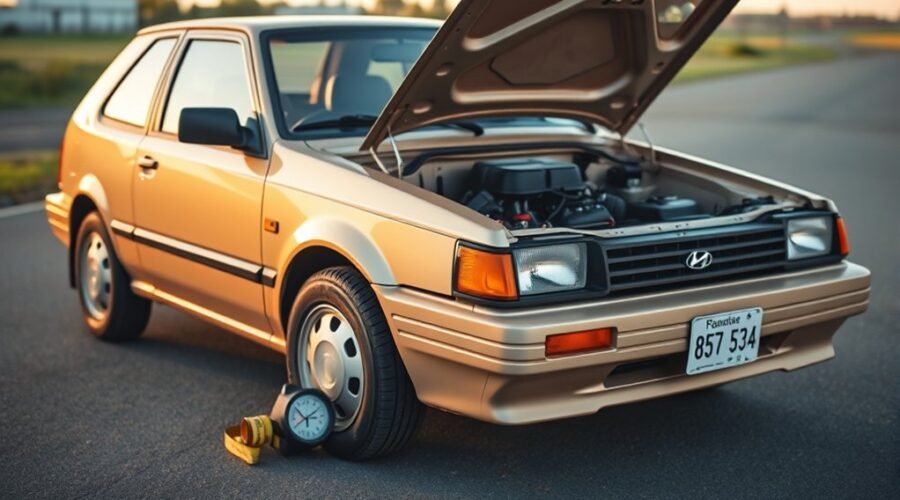
The 1986 Hyundai Pony arrived with a modest but varied powertrain lineup, including 1.5L and 1.6L four-cylinder engines paired to manual or automatic transmissions. Output ranged up to 84 hp, with 0-60 mph performance near 12.8 seconds. Its compact saloon body measured 3,970 mm long and weighed as little as 870 kg. The specifications suggest a simple economy car, yet the broader package reveals a more notable story.
Key Takeaways
- The 1986 Hyundai Pony offered 1.4L and 1.5L engines, including a 1.5i EFI version with 84 hp.
- It used front-wheel drive with four-speed, five-speed manual, or three-speed automatic transmissions.
- Performance was modest, with about 0–60 mph in 12.8 seconds and fuel economy around 30.9 mpg US.
- Dimensions included a 2,340 mm wheelbase, 1,558 mm width, and lengths of 3,970 mm sedan or 4,029 mm hatchback.
- Key facts include front disc/rear drum brakes, 45-liter fuel tank, and trims from basic L to better-equipped GLS/CXL.
1986 Hyundai Pony Engine and Transmission
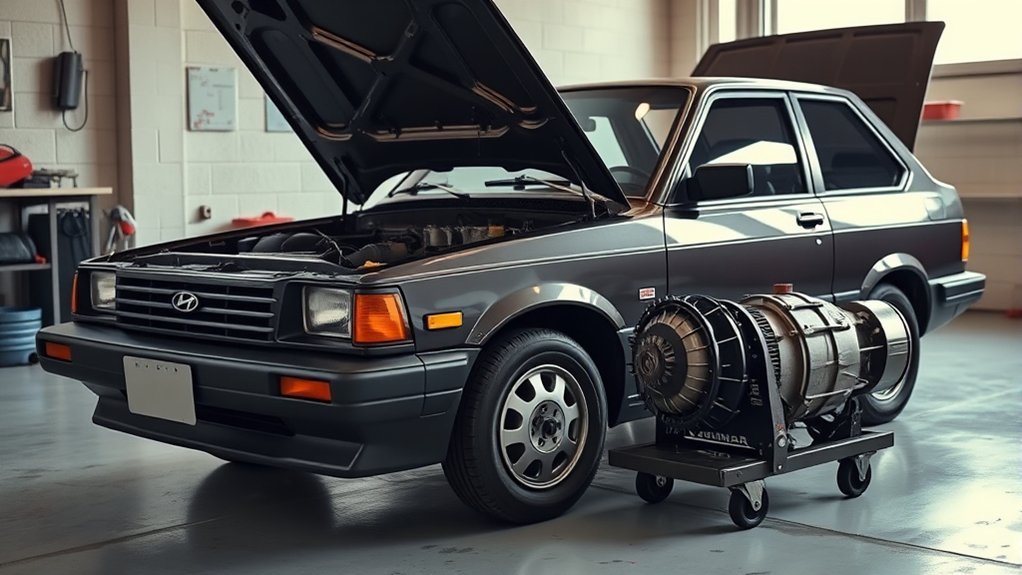
The 1986 Hyundai Pony was powered by a 1.6-liter straight-four engine with a hemispherical crossflow cylinder head and two valves per cylinder, producing 70 hp (52 kW) and 82 lb-ft (111 N⋅m) of torque. This Hyundai Pony specification emphasized simple, durable engineering rather than excess. The valve train, with valves per cylinder kept to a two-valve layout, supported combustion efficiency and accessible maintenance. A 1.4-liter Mitsubishi engine was also offered, matching the same output figures and broadening choice without altering the car’s modest performance profile. Transmission options included a four-speed manual, a five-speed manual, and a three-speed automatic, allowing drivers to select control or convenience. The front-wheel-drive drivetrain shaped predictable handling and efficient packaging, useful for urban mobility and personal independence. Fuel consumption averaged 30.9 mpg US (7.6 L/100 km), reflecting a powertrain tuned for economy and practical use.
1.5 and 1.5I Engine Options
Alongside the 1.6-liter and 1.4-liter offerings, the 1986 Hyundai Pony was also available with two 1.5-liter variants that broadened its powertrain lineup while preserving its economy-focused character. The standard 1.5-litre engine used a carburetor and produced 72 hp, while the 1.5i version adopted electronic fuel injection and increased output to 84 hp. Both engines were installed in a front-wheel drive layout and matched to a 4-speed manual transmission, keeping the package mechanically straightforward. The 5-litre engine designation reflected the model’s market positioning as a practical, compact unit rather than a performance-oriented one. In ordinary use, the carbureted version prioritized simplicity and frugality, returning a combined 30.9 mpg US. The injected 1.5i variant added a more responsive throttle character and improved acceleration. Together, these options supported the Pony’s light, efficient profile and its suitability for urban mobility.
1986 Hyundai Pony Performance Figures
Powered by a 1.6-liter engine rated at 70 hp and 82 lb-ft of torque, the 1986 Hyundai Pony delivered modest but effective performance for a compact car of its era. Hyundai paired the engine with four-speed and five-speed manual gearboxes, plus a three-speed automatic, allowing drivers to select a transmission that matched their priorities for control or convenience. In tested acceleration, the Pony reached 60 mph in about 12.8 seconds, a result that reflected its practical output and light-duty tuning. The car’s curb weight of 870 to 935 kg supported a favorable power-to-weight balance, helping the Pony respond with reasonable agility in urban and highway use. Fuel consumption was rated at a combined 30.9 mpg, reinforcing its role as an economical, accessible choice. For drivers seeking independent mobility without excess cost, the Hyundai Pony offered straightforward, efficient performance.
1986 Hyundai Pony Dimensions and Weight
Measured proportions defined the 1986 Hyundai Pony’s compact footprint, with the saloon body measuring 3,970 mm (156.3 in) in length and the hatchback extending to 4,029 mm (158.6 in). These dimensions placed the car within a practical urban envelope while preserving enough cabin volume for everyday use. A 2,340 mm (92.1 in) wheelbase supported balanced packaging and predictable placement of mass between the axles. Overall width was 1,558 mm (61.3 in), and height reached 1,360 mm (53.5 in), giving the body a low, efficient profile. Curb weight varied from 870 to 935 kg (1,918 to 2,061 lb), depending on trim and configuration, keeping the car relatively light and accessible. The 45-liter (11.9 US gallons) fuel tank complemented these proportions, extending range without adding excessive bulk. Together, the dimensions and weight defined a small, utilitarian machine suited to economical mobility and independent use.
Ride Quality, Brakes, and Fuel Economy
The 1986 Hyundai Pony’s light curb weight and compact chassis supported a compliant ride, while its front-wheel-drive layout improved traction and stability in everyday use. That packaging also helped ride quality on uneven pavement, where reduced mass allowed the suspension to absorb sharp inputs without excessive harshness. Improved gearboxes in the 1986 model contributed to smoother shifts, giving the drivetrain a more controlled and efficient feel during acceleration and cruising. Braking hardware consisted of front disc brakes and rear drum brakes, a practical combination that delivered dependable stopping power for city traffic and moderate-speed operation. The system was calibrated for predictable response rather than aggressive performance. Fuel economy was another strong point, with a combined rating of 30.9 mpg, or 7.6 L/100 km, making the Pony a low-cost commuter for drivers seeking mobility without waste. Overall, its mechanical balance favored efficiency, stability, and accessible daily use.
Trim Levels and Standard Equipment
The 1986 Hyundai Pony was offered in L, GL/CX, and GLS/CXL trim levels, with equipment increasing progressively across the range. The base L model emphasized economy with vinyl seats and a four-speed manual transmission, while the GL/CX added vinyl-cloth upholstery, upgraded interior trim, and a standard clock. The GLS/CXL provided more complete appointments such as full cloth seats and an available tachometer, with optional rear window louvers and fog lamps across trims.
L, GL, And GLS Trims
Available for 1986, the Hyundai Pony was offered in L, GL/CX, and GLS/CXL trims, each step adding equipment and refinement over the last. The L,GLS range framed a clear progression for buyers seeking practical mobility and greater comfort. L models emphasized value, pairing vinyl seats with a four-speed manual transmission and a sparse interior suited to basic transport. GL/CX versions introduced vinyl-cloth seating, upgraded trim, and a standard clock, improving daily usability without excess. At the top, GLS/CXL variants delivered a more accommodating cabin, with full cloth seating and an available tachometer for more precise driver feedback. Across the lineup, rear window louvers and fog lamps could be selected, allowing owners to tailor the car’s appearance and function to individual preference.
Standard And Optional Equipment
For 1986, the Hyundai Pony was offered with a clearly tiered equipment structure across L, GL/CX, and GLS/CXL trims, each package increasing comfort and convenience in measured steps. In the first generation lineup, standard and optional equipment were organized to suit differing budgets and expectations. The L specification remained utilitarian, with vinyl seats and a four-speed manual transmission as baseline provisions. GL/CX added vinyl-cloth seating, upgraded interior trim, and a standard clock, improving daily usability. GLS/CXL introduced higher-grade appointments, including optional full cloth seats and a tachometer for more informed driving. Across trims, rear window louvers and fog lamps were available as optional equipment, permitting individualized specification without compromising the model’s straightforward, accessible character.
Body Style and Cabin Space
The 1986 Hyundai Pony uses a 4-door sedan body style optimized for passenger transport and urban use, with smoother exterior lines and longer rear doors improving access. Its cabin layout accommodates up to five occupants, providing practical space for front and rear seating positions. Overall dimensions of 3,970 mm in length and 1,558 mm in width support a compact footprint with stable road behavior and efficient packaging.
Body Style Overview
Compact proportions define the 1986 Hyundai Pony’s four-door saloon body style, a layout intended for practical urban and suburban use with an emphasis on passenger comfort. Its compact body style measures 3,970 mm in length, 1,558 mm in width, and 1,360 mm in height, producing stable proportions and restrained exterior volume. The long-door design improves rear-seat access, supporting everyday utility without compromising access efficiency. Key attributes include:
- four-door saloon configuration
- compact exterior packaging
- easier rear-seat entry
- 870 to 935 kg curb weight
This structure supports nimble handling and maneuverability, qualities that suit drivers seeking freedom from congestion. Inside, the cabin accommodates four to five passengers with practical room for a compact car of its era, reinforcing the vehicle’s functional, liberation-oriented purpose.
Cabin Space Layout
Cabin packaging in the 1986 Hyundai Pony reflects a straightforward four-door saloon layout, with room for up to five passengers and proportions shaped for urban and suburban use. Its cabin space layout balances compact exterior dimensions with usable interior volume, supporting passenger comfort without unnecessary complexity. Longer front and rear doors improve rear-seat access, reducing entry effort and making daily movement more convenient for occupants. The dashboard adopts a smoother profile with softened corners, signaling a practical update in form and function over earlier versions. Though the body remains modest in size, the rear load area provides 10.6 cubic feet, or 300 liters, of cargo volume. This arrangement supports efficient, independent mobility while preserving the classic late-1970s character of the design.
Export Versions and Canadian Specs
For the Canadian export market, the Hyundai Pony was adapted to meet local safety and equipment regulations, with revised bumpers, sealed-beam headlights, and altered instrumentation. These export versions reflected practical Canadian specs rather than cosmetic variation, emphasizing compliance and market access. Sales were strong, surpassing 25,000 units by 1984, which confirmed broad acceptance among buyers seeking affordable mobility and mechanical simplicity.
- Bumper structures were revised for regulation compliance.
- Sealed-beam headlights replaced nonstandard lighting hardware.
- Instrumentation was adjusted for Canadian legal requirements.
- The Pony remained on sale alongside the Hyundai Excel until 1987.
The Pony II kept engine choices close to the original formula, with four-speed manual and three-speed automatic transmissions available. In Canadian trim, the model offered compact dimensions, accessible operating costs, and straightforward serviceability. Such export versions gave drivers a modest path to independent transport without unnecessary complication or excess.
Where the 1986 Pony Fits in Hyundai History
By 1986, the Hyundai Pony occupied a clear place in the company’s development, representing one of Hyundai’s first mass-produced vehicles and a move beyond licensed production toward original in-house design. As part of Korea’s First Mass-Produced car effort, the Pony nameplate signaled Hyundai’s shift from dependency to technical autonomy. The 1.6-litre engine with a hemispherical crossflow cylinder head improved breathing, efficiency, and drivability, showing measured engineering progress. Offered in L, GL/CX, and GLS/CXL trims, it addressed compact-car demand with tiered equipment and pricing. Its export success, especially in Canada, demonstrated compliance adaptation and commercial viability in regulated markets. That international reach helped validate Hyundai’s manufacturing strategy and broadened brand recognition. In historical terms, the 1986 Pony functioned as a bridge model: it consolidated early production capability, established the company’s market identity, and created the platform from which later vehicles, including the Hyundai Excel, could expand freedom in mobility.
Related Reading
Frequently Asked Questions
Which Hyundai Engine to Stay Away From?
The 1.2-litre Hyundai engine is the one to stay away from; its weak output, poor engine reliability, and carburetor-related maintenance issues make it unsuitable. The 1.5 and 1.6 variants remain marginally better, yet still underwhelming.
When Did They Stop Making the Hyundai Pony?
Pony production ended in 1994, a monumental finale for Hyundai legacy. The model’s long run, across multiple generations and markets, marked a technically significant shift before the company advanced to newer, freer-minded passenger cars.
How Much Horsepower Did a 1984 Hyundai Pony Have?
The 1984 Hyundai Pony produced 70 horsepower. Its Engine specifications included a 1,439 cc Mitsubishi straight-four, rated at 5,500 rpm, with 82 lb-ft torque at 3,500 rpm, supporting modest, economical movement and accessible mobility.
Was the Hyundai Pony a Successful Car?
Yes—the Hyundai Pony was broadly successful, even spectacularly so, though not flawless. Its Pony market reception was strong in export markets, despite Pony reliability issues. It established Hyundai’s credibility, expanded sales rapidly, and anchored long-term technical growth.
Conclusion
The 1986 Hyundai Pony stands out as a compact, mechanically simple saloon built around modest four-cylinder powertrains, manual or automatic transmission choices, and lightweight construction. Its acceleration and output were limited by modern standards, yet its dimensions, practical interior, and efficient packaging made it a credible everyday car. As Hyundai’s first mass-produced model, the Pony also represents a key milestone in the company’s industrial development and export expansion, especially in markets such as Canada.