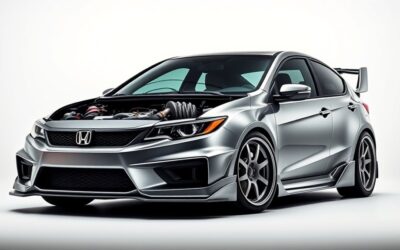
The Honda CR-X was a lightweight, Civic-based coupe built from 1983 to 1991, and its specifications vary sharply by generation and trim. Powertrains ranged from efficient 1.5-liter economy engines to the 1.6-liter DOHC VTEC unit rated at up to 150 hp. With curb weights near 760 to 860 kg, the car delivered strong acceleration, high fuel economy, and compact dimensions that shaped its handling. The details become more revealing from there.
Key Takeaways
- The Honda CR-X is a lightweight two-door Civic-based coupe built from 1983 to 1991, known for sharp handling and strong fuel economy.
- Engine choices included 1.3L, 1.5L, 1.6L DOHC, and later 1.6L DOHC VTEC B16A units, ranging from economy-focused to 160 PS.
- Performance improved to about 7.5 seconds 0-60 mph and nearly 130 mph top speed, depending on trim and engine.
- Dimensions were compact: 3,675 mm long, 1,625 mm wide, 1,290 mm high, with a 2,200 mm wheelbase and 760–860 kg curb weight.
- Key trims included DX, HF, and Si, with manual or automatic transmissions, plus model-year updates like revised lights and four-wheel disc brakes.
What Is the Honda CR-X?
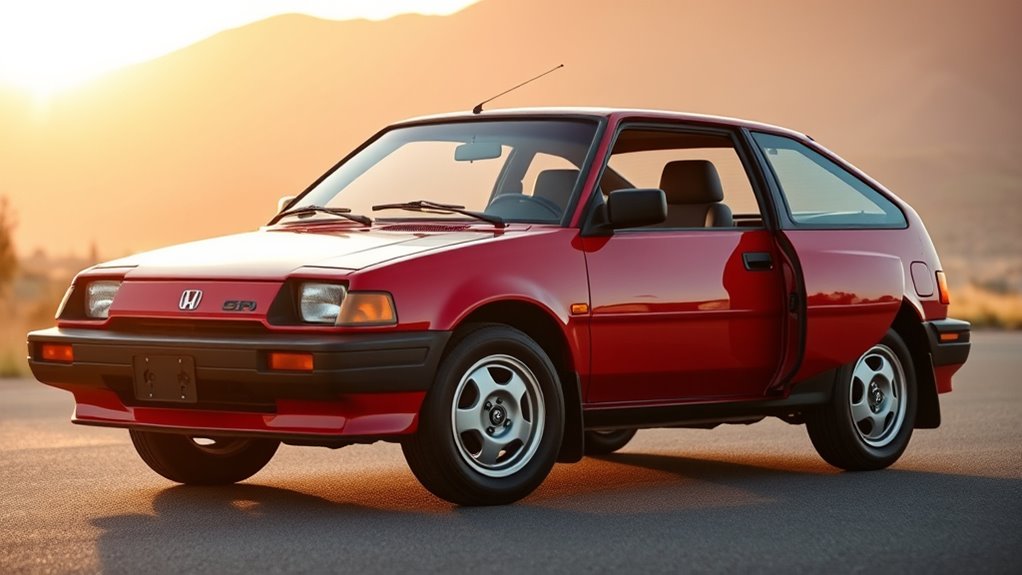
The Honda CR-X was a lightweight two-door coupe derived from the Civic platform and produced from 1983 to 1991, valued for its sharp handling and strong fuel economy, with the 1.3-liter version capable of up to 52 mpg on the highway.
The Honda CRX combined compact dimensions, low mass, and a short 2,200 mm wheelbase to deliver agile handling that rewarded precise inputs and minimized wasted motion. Curb weight typically ranged from 760 to 860 kg, helping the chassis respond quickly and maintain composure in cornering.
Compact, lightweight, and short-wheelbase, the CRX delivered agile handling with quick, precise responses.
Engine choices included 1.3 L, 1.5 L, and 1.6 L DOHC inline-fours, allowing different performance levels without sacrificing efficiency. The CR-X Si used a B16A engine rated at 160 PS, reaching 0-60 mph in about 7.5 seconds.
Its blend of fuel economy, engineering efficiency, and driver control made it a practical machine for those seeking mobility with reduced dependence on excess.
CRX History and Generations
Introduced in 1983 as the Honda Ballade Sports CR-X in Japan and later sold as the Honda Civic CRX in other markets, the model remained in production through 1991 and developed through two distinct generations.
The CR-X line traced a compact, lightweight path within the Honda Civic family, with each of its generations refining packaging and aerodynamics rather than abandoning the original concept.
- Mk1 ran until 1987
- Mk2 arrived in 1987
- Longer wheelbase improved stability
- Bodywork gained cleaner airflow
- Curb weight stayed near liberation-minded efficiency
Its design language drew inspiration from the Alfa Romeo GT Junior Zagato, giving the CR-X a distinct profile.
Across both generations, the car earned recognition for performance, fuel economy, and handling, including Car and Driver10Best listings in 1985 and 1988.
This history established the CR-X as a technical outlier in the Honda Civic range, valued for accessible performance and reduced mass.
CRX Engines by Generation
Across its two generations, the CR-X’s engine lineup evolved from efficient small-displacement four-cylinders to a more advanced performance focus.
The first generation, built from 1983 to 1987, used 1.3-liter and 1.5-liter In-Line 4-Cylinder engine options, with a later 1.6-liter DOHC I4 added in some trims. The 1.5-liter 12-valve unit produced 100 hp, while the 1.5-liter HF prioritized economy. In the CRX Si, the period’s more capable setup delivered balanced output within a light chassis.
The second generation, from 1988 to 1991, centered on the B16A 1.6-liter DOHC VTEC engine, which reached 150 hp and 7,600 rpm. That architecture gave the car a sharper technical character than a Turbocharged In-Line alternative would have, while preserving simplicity and control.
Across both generations, curb weight remained low, roughly 760 to 860 kg, allowing the engine packages to serve a liberated, agile driving ethos.
CRX Performance and Fuel Economy
The CR-X combined fuel-sipping efficiency with notable performance, as its original 1.3-liter engine could achieve 52 mpg on the highway and, in favorable conditions, exceed 70 mpg.
With lighter curb weights and more powerful variants such as the 1.6-liter DOHC VTEC and B16A-equipped SiR, 0–60 mph times of about 7.5 seconds became achievable.
The model range also reflected efficiency gains in higher-economy trims, including the 1.5-liter HF with 42 mpg city and 51 mpg highway ratings.
Fuel-Sipping Efficiency
Among the CRX’s most defining attributes was its fuel-sipping efficiency, with the original 1.3-liter model rated at 52 mpg on the highway and some reports placing it above 70 mpg under ideal conditions.
- 1.5-liter HF: 42 mpg city, 51 mpg highway
- Lightweight chassis reduced fuel demand
- Aerodynamic bodywork improved efficiency
- CRX Si balanced fuel and output
- Pre-hybrid economy appealed to Civic drivers
This fuel efficiency profile made the Civic-based hatchback a practical instrument of mobility for drivers seeking independence from costly refueling.
The CRX’s compact packaging and low mass helped it outperform many contemporaries in the 1980s and early 1990s.
Even the 1.6-liter DOHC Si preserved commendable economy while delivering 150 PS, showing that efficient engineering and usable performance could coexist without excess.
0-60 Performance
Building on its celebrated efficiency, the Honda CRX also delivered strong straight-line capability for a lightweight economy-based coupe. Initial models reached 60 mph in about 8.5 seconds, a credible result for a car weighing just over 800 kg.
Later versions equipped with the 1.6-liter DOHC VTEC engine reduced that figure to roughly 7.5 seconds, while the B16A unit in the second-generation Civic Si raised output to 150 hp and sharpened response.
The CRX’s low mass amplified every increase in engine output, improving launch feel and midrange urgency. Top speed approached 130 mph, placing its performance among notable sporty coupes of the era.
Even the original 1.3-liter model preserved strong economy, returning up to 52 mpg on the highway without surrendering its liberated driving character.
Hybrid Efficiency Gains
With hybridization, the CRX concept extends its original efficiency advantage into a modern performance context.
The 2026 CRX-e pairs a 1.5-liter Atkinson-cycle I4 with two electric motors, producing about 122 hp and 253 Nm, delivering hybrid efficiency gains in urban use.
- Fuel economy benefits from instant electric assist.
- Lightweight design supports lower energy demand.
- The original 1.3-liter model achieved 52 mpg highway.
- The HF variant returned 42 mpg city and 51 mpg highway.
- Modern tuning preserves responsive, liberated daily driving.
These figures show a consistent engineering pattern: reduced mass, efficient combustion, and electric augmentation.
The result is a compact chassis that promotes fuel economy without sacrificing usable torque or road confidence.
Honda CR-X Dimensions and Weight
The Honda CR-X uses a 2,200 mm wheelbase and compact exterior proportions, with an overall length of 3,675 mm, a width of 1,625 mm, and a height of 1,290 mm.
These dimensions support the model’s nimble handling and efficient packaging, including two-seat and 2+2 seating layouts in early versions.
Curb weight ranges from 760 kg to 860 kg, reinforcing the vehicle’s lightweight design and performance-oriented character.
Wheelbase and Proportions
Compact proportions define the Honda CR-X, whose 2,200 mm wheelbase supports nimble handling and agile response. As a compact car, its dimensions place emphasis on efficient packaging and freedom through reduced mass and footprint.
- Wheelbase: 2,200 mm
- Length: 3,675 mm
- Width: 1,625 mm
- Height: 1,290 mm
- Layout: two-seat or 2+2
These proportions help the chassis turn sharply and maintain stable directional behavior. The short wheelbase and low profile also contribute to aerodynamic efficiency and a responsive road feel.
Within the small body, the cabin is arranged to maximize usable space, reinforcing practicality without sacrificing agility. For enthusiasts, the CR-X’s dimensions represent a technical balance between compact size, lightweight structure, and dynamic competence.
Curb Weight Range
A curb weight range of 760 to 860 kg, or roughly 1,676 to 1,895 lbs, defines the Honda CR-X across its various trims and model years. This low curb weight supported agile responses, reduced power demand, and efficient motion with less mechanical burden.
In CRX HF specification, the lighter configuration enhanced fuel economy while preserving a spirited chassis character. The compact dimensions, including a 3,675 mm length, 1,625 mm width, and 1,290 mm height, reinforced its small-footprint packaging.
With a 2,200 mm wheelbase in first-generation form, the coupe balanced stability and quick direction changes. These dimensions and mass figures allowed the CR-X to challenge rivals such as the Toyota MR2 with disciplined handling, compact efficiency, and a sense of liberated mobility.
CRX Trim Levels and Engine Codes
CRX trim levels were organized around distinct powertrains and equipment sets, with the U.S. lineup centered on DX, HF, and Si variants. In CRX terminology, the engine codes marked clear functional differences, pairing each trim with a specific mission and output.
- DX: D15B2 1.5-liter engine
- HF: D15B6 lightweight economy engine
- Si: D16A6, rated at 108 hp
- U.S. transmissions: 5-speed manual or 4-speed automatic on DX and HF
- Japanese SiR: B16A with VTEC, 160 PS
The DX served as the baseline, the HF prioritized efficiency through reduced mass and economy tuning, and the Si delivered the most energetic road behavior in the U.S. range.
Outside the U.S., engine codes also reflected market-specific freedom in specification, with the SiR standing apart through its B16A and VTEC hardware.
Together, these CRX, Si, and engine codes illustrate a compact lineup engineered for choice, control, and mechanically distinct outcomes.
1988-1991 CRX Model Year Changes
For the 1988 through 1991 model years, the CRX underwent only incremental changes while retaining its core lightweight architecture and three-trim structure: standard DX, HF, and Si. In the Civic lineup, the CRX remained a low-mass, efficiency-focused coupe, with curb weights between 760 and 860 kg, supporting nimble performance and efficient control.
| Model year | Key change |
|---|---|
| 1989 | Door-mounted seatbelts on Si and base models |
| 1990 | Redesigned headlights, updated bumpers, taillights; Si gains four-wheel disc brakes |
| 1991 | Final-year Si receives new color options |
The 1988-1991 CRX kept its distinct trim hierarchy and engine range, but the year-to-year revisions were aimed at compliance and refinement rather than reinvention. The 1990 exterior updates and Si brake upgrade improved functionality, while 1991 marked the close of the CRX line with limited cosmetic differentiation.
CRX Styling, Cabin, and Features
Styling and cabin details helped define the Honda CRX as more than a lightweight Civic derivative, with its sporty profile drawing inspiration from the Alfa Romeo GT Junior Zagato and setting it apart visually from the rest of the lineup.
The CRX used styling to pair low drag with an efficient footprint, reinforcing its lightweight mission without sacrificing daily practicality. Inside, the cabin centered the driver, with straightforward controls and trim choices that balanced utility and freedom of movement.
- Manual seat adjustments were standard
- Cloth seating came on base models
- Si models could add digital instrumentation
- High-back bucket seats improved support
- A sunroof option enhanced open-air appeal
Higher trims added upgraded materials and power seat options, while 1989 cars gained door-mounted seatbelts for compliance.
CRX Awards and Cultural Impact
Cultural impact extended beyond press recognition. About 310 examples were converted into convertibles by R. Straman Company from 1984 to 1987, indicating aftermarket demand and owner-led personalization.
The CRX also appeared in competitive settings such as the BRSCC Honda CRX Championship, where its chassis balance and agility supported organized motorsport use.
Together, the awards and public reception show a vehicle that linked economy, performance, and accessible mobility, giving drivers a compact platform associated with autonomy and mechanical clarity.
CRX Racing, Convertibles, and Legacy
The Honda CRX established a notable racing heritage through events such as the BRSCC Honda CRX Championship, where its lightweight chassis and responsive handling supported competitive performance.
Between 1984 and 1987, R. Straman Company converted 310 CRXs into convertibles, including the Straman-built CRX Spyder that appeared on the cover of *Road & Track* in July 1984.
These examples reinforce the model’s legacy as a technically capable sports coupe with enduring enthusiast appeal.
CRX Racing Heritage
Honda CRX racing heritage is defined by its track presence, lightweight chassis, and strong aftermarket appeal, with the model competing in events such as the BRSCC Honda CRX Championship and earning a reputation for agility and balance.
The Mk2’s VTEC engine sharpened acceleration, while the lightweight design and Civic sedan underpinnings supported efficient packaging and responsive chassis behavior.
- Track-proven agility
- Competitive club-racing platform
- Straman-built CRX Spyder history
- Motor Trend 1984 recognition
- Car and Driver 10Best returns
This record helped establish a durable legacy among enthusiasts seeking mechanical freedom through modification and motorsport participation.
The result was a compact coupe with measurable performance credibility, broad parts support, and lasting influence in Honda tuning culture.
Convertible Conversions
Beyond its track-oriented reputation, the CRX also found an unusual second life through specialist convertible conversions that preserved its compact proportions while adding open-air usability.
From 1984 to 1987, the R. Straman Company transformed 310 Honda CRXs into the CRX Spyder, a rare derivative that retained the model’s lightweight design and agile chassis balance. The Straman-built example featured on the July 1984 cover of Road & Track, signaling broader enthusiast interest.
While the standard coupe was valued for nimble handling and fuel efficiency, the convertible form emphasized open-air enjoyment without abandoning the CRX’s efficient packaging.
These convertible conversions appealed to buyers seeking performance, style, and a more liberated driving experience.
Today, the Spyder’s legacy endures among collectors as a practical yet expressive chapter in CRX history.
Frequently Asked Questions
Is the CRX a Fast Car?
Yes, the CRX is fast by compact-car standards, with strong driving experience, notable racing potential, and room for performance upgrades. Its lightweight chassis and lively engine let it deliver responsive, efficient, and engaging speed.
Is the CRX a Collector Car?
Yes; the CRX is widely treated as a collector car, a tiny giant of 1980s engineering. CRX market trends, CRX restoration projects, and CRX enthusiast clubs all indicate sustained demand, rising values, and technical preservation.
What Does CRX Stand For?
CRX stands for Civic Renaissance Experiment. CRX history shows Honda’s goal of a sporty Civic derivative; CRX design prioritized efficiency and agility, while CRX features delivered affordable performance, appealing to drivers seeking liberated, practical mobility.
Is CRX a Good Engine?
Yes, the CRX engine is generally considered good, offering strong engine reliability, notable tuning potential, and broad aftermarket support. Its lightweight chassis amplifies responsiveness, while efficient, rev-happy designs appeal to drivers seeking technical freedom and performance.
Conclusion
To summarize, the Honda CR-X combined compact dimensions, a curb weight as low as 760 kg, and efficient powertrains to create an unusually capable small car. Its strongest image is perhaps the 1.6-liter DOHC VTEC version, which delivered up to 150 hp in a body just 3,675 mm long. That ratio of performance to size helped define the model’s appeal. Even today, the CR-X remains a benchmark for lightweight engineering, economy, and responsive handling.