Chuckwalla Valley Raceway opened in 2010 on land once used as a WWII training ground, bringing a modern motorsport facility to California’s desert. Designed by Ed Bargy, the 2.68-mile circuit combines 17 turns, a 40-foot elevation change, and both clockwise and counterclockwise layouts. Its technical profile, driver-focused programs, and practical amenities shaped its rise, but the track’s broader impact is easier to understand when its history and operations are considered together.
Key Takeaways
- Chuckwalla Valley Raceway opened in 2010 in Desert Center, California, on a former World War II training ground used by General Patton.
- The road course is 2.68 miles long, with 17 turns, a 40-foot elevation change, and both clockwise and counterclockwise configurations.
- Its 40-foot-wide asphalt surface provides consistent grip and supports year-round track days, racing, and driver education.
- The venue hosts lapping days, motorcycle racing, NASA-sanctioned events, and instructional programs for drivers and riders.
- Facilities include a large paddock, classrooms, medical support, RV sites, and camping, with guest entry and waiver requirements.
Chuckwalla Valley Raceway Overview
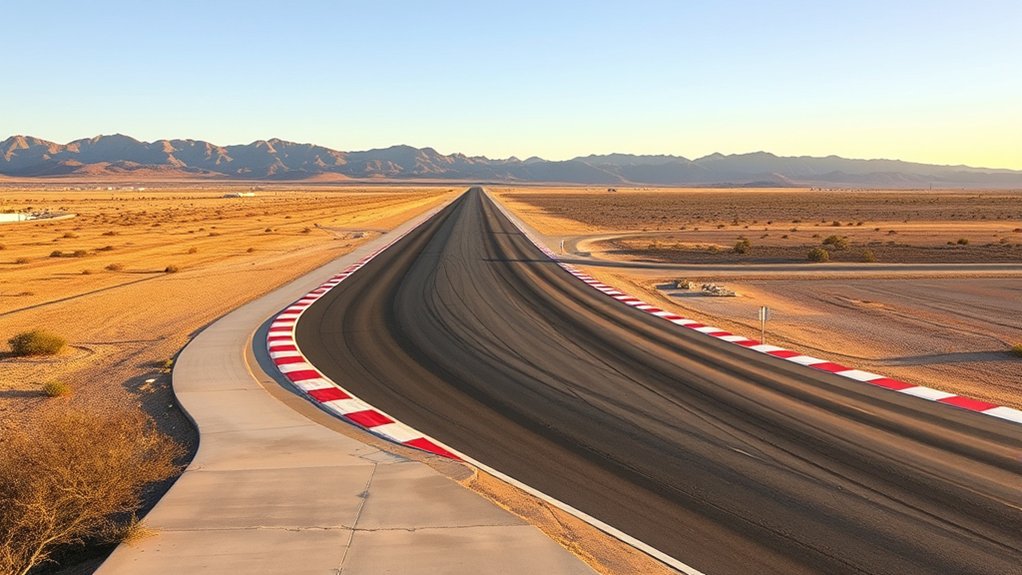
Chuckwalla Valley Raceway, a distinctive desert motorsport venue, opened in 2010 in Desert Center, California, on the site of a former World War II training ground.
The Chuckwalla road course spans 2.68 miles and includes 17 turns, arranged for both clockwise and counterclockwise use, a configuration that supports technical variety and driver development. Built in Southern California, the circuit presents roughly 40 feet of elevation change, adding measurable complexity to braking, cornering, and vehicle setup.
From its opening, the facility has supported lapping days, motorcycle racing, and instructional programs for drivers and students, extending access to skill-building opportunities. A large paddock accommodates RVs and transporters, while a timing tower and classrooms provide modern operational support.
From its opening, the facility has supported lapping days, motorcycle racing, and instructional programs, with modern amenities for drivers and students.
Accessible year-round and situated between Los Angeles and Phoenix, Chuckwalla serves as a practical motorsport hub for participants seeking open track conditions, disciplined learning, and a freer relationship with speed, terrain, and mechanical control.
History of Chuckwalla Valley Raceway
Chuckwalla Valley Raceway was established in 2010 on land that had previously served as a World War II training ground for General George Patton’s soldiers and an air supply depot.
Before its conversion to motorsport use, the site was considered for a waterskiing facility, but that plan was abandoned during the Great Recession.
Designed by architect Ed Bargy, the resulting 2.68-mile, 17-turn circuit opened as a technical racing venue with a smooth asphalt surface and multiple directional configurations.
Origins And Site History
Long before it became a motorsport venue, the site of Chuckwalla Valley Raceway had already passed through several distinct uses in California’s desert history. Its origins lie in a former World War II training ground for General George Patton’s soldiers, a landscape shaped by military preparation and disciplined movement.
Earlier, the tract functioned as a main air supply depot, then later shifted to farmland as regional needs changed. In the years before the raceway emerged, developers even proposed a waterskiing facility, but that plan collapsed during the Great Recession.
Opening And Early Development
Built in 2010, Chuckwalla Valley Raceway emerged from a site that had earlier served General George Patton’s World War II training operations in the California desert. Its early development shifted from a motocross concept to a purpose-built road course, reflecting a broader infrastructure investment in modern motorsport access.
Ed Bargy designed the 2.68-mile Raceway layout with 17 turns, balancing technical corners and straightaways. The course’s approximately 40 feet of elevation change added difficulty while preserving strong grip conditions.
As construction advanced, the Valley venue became adaptable to multiple racing disciplines rather than a single use. Soon after opening, it hosted NASA and other series, establishing a regional center for drivers seeking disciplined competition and expanded freedom of motion on a demanding, well-engineered circuit.
Chuckwalla Track Layout and Specs
Chuckwalla Race Track measures 2.68 miles and includes 17 turns, combining technical corners with straightaways in a compact circuit profile.
It is configured for both counterclockwise and clockwise running, with each direction supporting a distinct driving rhythm.
Elevation changes of about 40 feet, a 40-foot-wide racing surface, and smooth asphalt with generous runoff areas shape the track’s safety and grip characteristics.
Track Length and Turns
Measuring 2.68 miles (4.313 km) in each direction, the Chuckwalla Valley Raceway road course presents 17 turns across both its counterclockwise and clockwise configurations.
Its track length frames a sequence of turns that progress from open approaches into technical corners demanding precision and restraint. The 40-foot-wide racing surface supports safe passing and measured maneuvering, allowing drivers to assert control without unnecessary confinement.
Throughout the course, elevation changes of roughly 40 feet add a gradual vertical dimension, increasing the challenge while preserving readability. Designed for year-round access, the circuit maintains strong grip and consistent conditions, though summer heat can intensify physical demands.
In practice, the layout rewards disciplined rhythm, clean entry, and liberated speed within a structured environment.
Directional Configurations
The circuit’s twin directional configurations, counterclockwise (CCW) and clockwise (CW), each span 4.313 km (2.68 miles) and preserve the same 17-turn structure, allowing the layout to be studied from either direction without altering its core scale. In practice, this symmetry has shaped how organizers schedule track days and driver education, since both directional configurations support comparable session planning.
| Mode | Length | Primary Use |
|---|---|---|
| CCW | 4.313 km | Racing events |
| CW | 4.313 km | Track days |
| Both | 17 turns | Driver education |
Chronologically, a driver first learns the route, then refines braking, entry, and exit in clockwise and CCW runs. The result is a liberated testing ground where line choice, not direction, defines the challenge.
Elevation and Surface Features
With a 2.68-mile, 17-turn layout, the circuit combines modest elevation variation with a deliberately forgiving surface profile that supports controlled experimentation.
Initially, the asphalt track surface presents 40 feet of width, generous runoff, and high-grip conditions, establishing a safe baseline for evaluation.
As the course unfolds, elevation changes rise to roughly 40 feet, introducing measured shifts rather than abrupt demands. This progression enables a technical experience grounded in predictability, while minimal negative camber preserves stability through both clockwise and counterclockwise configurations, each measured at 4.313 km.
Over time, the combination of width, grip, and restrained topography allows drivers to refine pace, lines, and braking with uncommon freedom, turning the circuit into a practical laboratory for skill development and disciplined speed.
Facilities, Camping, and Amenities
Beyond the track surface, Chuckwalla Race Track is supported by a substantial paddock that can accommodate transporters, RVs, and vehicle parking, along with 22 reservable powered RV sites offering 50-amp electrical service.
These facilities, camping options, and amenities establish a practical base for extended stays and organized operations. Early in a visit, drivers can use the 30′ x 50′ classroom for briefings or training, while the air-conditioned meeting room and 30′ x 75′ permanent event tent support planning, meals, and storage.
The classroom, meeting room, and event tent create a practical hub for briefings, meals, and storage.
Overnight guests may camp in the paddocks for $25 per camper or RV, with dry camping available and a nearby dumping station for grey water.
- Wide paddocks frame the desert horizon.
- Power pedestals line orderly RV spaces.
- Fuel, kitchen, and medical services stand ready.
A fuel station supplies high-octane race fuel, a kitchen serves event food, and on-site medical facilities add essential support.
Events, Schools, and Membership
As the facility’s programming expands beyond daily track use, Chuckwalla Valley Raceway presents a structured calendar of lapping days, motorcycle races, and series competition, including NASA-sanctioned events that attract a wide range of drivers and riders.
In sequence, these events create a practical ladder from entry-level sessions to more demanding race formats, allowing participants to develop pace, judgment, and control.
The track also supports schools in driving and motorcycle instruction, with classroom-based briefings and training sessions that can serve up to 72 guests.
For younger enthusiasts, a go-kart program introduces motorsport fundamentals to students aged 14 and up, extending access to early skill building.
The facility’s membership model resembles a private club, with active recruitment for new members who seek recurring track access and community participation.
Custom programs further broaden opportunity, giving groups tailored instruction for novice and experienced drivers alike.
How to Visit Chuckwalla Valley Raceway
To visit Chuckwalla Valley Raceway, guests first sign a property waiver upon entry, and minors must have a legal guardian’s signature on file.
From there, Chuckwalla Raceway sits in Desert Center, CA, about 50 minutes east of Palm Springs, reached easily by Interstate 10. The approach reveals open desert, then the gate, where adults pay a $20 fee and children enter free with a guardian waiver, expanding access to road racing for families seeking motion and autonomy.
East of Palm Springs, Chuckwalla Raceway emerges from open desert, where the gate welcomes families into road racing.
- A wide Paddock area for transporters and RVs
- 22 powered RV spaces reserved by phone at (760) 227-3100
- Desert Center Airport arrivals requiring ETA, tail number, and pilot information
After arrival, visitors may join Lapping Days for on-track experiences.
Those traveling by air via Desert Center Airport (CN64) should provide flight details in advance. The facility’s layout supports practical entry, brief setup, and immediate immersion in the disciplined freedom of the circuit.
Frequently Asked Questions
What Is the Fastest Lap Time at Chuckwalla Valley Raceway?
The fastest lap time at Chuckwalla Valley Raceway is approximately 1 minute 39 seconds. Under ideal track conditions, lap records reflect advanced racing techniques, with professional drivers exploiting the circuit’s technical layout and elevation changes.
What Is the Oldest Dirt Track in America?
The oldest dirt track in America is Langhorne Speedway, founded in 1903 in Pennsylvania. Its dirt track history shaped racing legends, with a demanding track surface, steep banking, and a legacy ending in 1971.
Is Chuckwalla Raceway for Sale?
Yes—Chuckwalla Raceway is reportedly for sale, listed at $26 million in February 2026. Analysts view this through real estate trends, motorsport investments, and track maintenance needs, suggesting possible liberation for expanded operations and revenue.
Who Owns Chuckwalla Valley Raceway?
Chuckwalla Valley Raceway is owned by a private entity, operating as a member club. Chuckwalla ownership trends show stable control, while Raceway management strategies and Track event planning support events and future development opportunities.
Conclusion
In conclusion, Chuckwalla Valley Raceway has evolved from a former WWII training ground into a modern motorsport venue, blending historical significance with practical design. Its 2.68-mile layout, 17 turns, and adaptable clockwise or counterclockwise configurations make it a versatile circuit, while its schools, membership programs, and event schedule support a strong driver-development culture. Like a well-engineered instrument, the track balances performance, education, and community, securing its place as a distinctive racing destination.